Magic Eden: from Solana’s NFT marketplace to the multi-chain everything store
I watched Magic Eden go from "that Solana NFT site" to the marketplace that handles more Bitcoin NFT volume than anyone else on the planet. The pivot happened in late 2023 when Ordinals exploded and Magic Eden was one of the first major platforms to support Bitcoin inscriptions. OpenSea hesitated. Blur focused on Ethereum. Magic Eden moved fast and captured a market that nobody else was serving.
That pattern defined the Magic Eden story until February 2026, when Jack Lu reversed course entirely. In a single announcement, he shut down the Bitcoin Ordinals marketplace, killed all EVM support (Ethereum, Polygon, Base), and refocused the entire company on two things: Solana NFTs and a crypto casino called Dicey. The multi-chain empire that took three years to build was dismantled in three weeks.
The reasoning was brutal math. Eighty percent of Magic Eden's costs went to products that generated twenty percent of revenue. Solana consistently drove 85%+ of platform volume. Everything else was a money pit. So Jack cut it.
This article covers the full arc: what Magic Eden built, how it works on Solana, the Bitcoin Ordinals bet and why it was abandoned, the ME token crash, Diamond rewards, Dicey, and where the marketplace stands in April 2026 after the hardest pivot in NFT marketplace history.
What Magic Eden is and how it got here
Magic Eden is an NFT marketplace that lets you buy, sell, and mint non-fungible tokens across multiple blockchains. You connect your wallet, browse collections, bid on items, list your own NFTs, and participate in new collection launches through the Launchpad feature.
The founding team includes Jack Lu (CEO), Sidney Zhang, Zhuoxun Yin, and Zhuojie Zhou. They launched on Solana in September 2021 and hit market dominance within months. Solana NFTs were cheaper and faster than Ethereum NFTs, and Magic Eden was the place to trade them. DeGods, Okay Bears, y00ts, and dozens of other Solana collections built their communities through Magic Eden.
The funding rounds happened at the worst possible timing and the best possible timing simultaneously. $27 million Series A in March 2022. $130 million Series B in June 2022 from Sequoia, Paradigm, and Electric Capital. Valuation: $1.6 billion. Six months later, the NFT market fell off a cliff. Every headline said NFTs were dead. Collections lost 90% of their value. Most competitors cut staff and prayed for a recovery.
Magic Eden did the opposite. They hired. They expanded. They burned through that $130 million runway building infrastructure for chains that did not even have NFTs yet. When Ordinals brought NFTs to Bitcoin in early 2023, Magic Eden already had a team working on it. When other marketplaces were still debating whether Bitcoin NFTs were "real NFTs," Magic Eden was already processing millions in Bitcoin inscription trades. By early 2024, they were the undisputed number one Bitcoin NFT marketplace. That bet alone justified the Series B.
| Magic Eden timeline | Event |
|---|---|
| September 2021 | Launched on Solana |
| Early 2022 | 97% of Solana NFT daily volume |
| March 2022 | $27M Series A |
| June 2022 | $130M Series B ($1.6B valuation) |
| 2023 | Expanded to Ethereum, Polygon, Bitcoin |
| April 2024 | Runes support on day one |
| December 2024 | ME token launch + airdrop |
| 2025-2026 | Multi-chain expansion continues |
How to use Magic Eden: buying, selling, and minting NFTs
I walked a friend through his first Magic Eden purchase last month. Took 4 minutes from landing on the site to owning an NFT. The process is genuinely simple.
Go to magiceden.io. Connect your wallet. For Solana NFTs, use Phantom or the Magic Eden Wallet. For Ethereum and Polygon, use MetaMask. For Bitcoin Ordinals, use the Magic Eden Wallet or any Ordinals-compatible wallet like Xverse or Unisat.
Browse collections by chain, category, or trending volume. Each collection page shows the floor price (cheapest listed item), total volume traded, number of holders, and recent activity. Click an individual NFT to see its attributes, sale history, and current listing price.
Buying is one click. Hit "Buy Now" at the listed price, confirm in your wallet, and the NFT transfers to you. You can also place offers below the listing price. If the seller accepts, the trade executes automatically.
Selling: go to your profile, find the NFT you want to sell, click "List," set your price, and confirm. Magic Eden charges a flat 1.5% taker fee on sales (lower than OpenSea's historic 2.5%). Listing is free. Royalties are optional since Magic Eden adopted the industry-standard model where buyers choose how much royalty to pay.
Minting through the Launchpad: when a new collection launches on Magic Eden, the Launchpad page shows upcoming mints with dates, prices, and project details. Magic Eden vets Launchpad projects, which reduces (but does not eliminate) rug pull risk. Connect your wallet, approve the mint transaction, and the freshly minted NFT lands in your collection.
The Magic Eden Wallet deserves a separate mention. Released in 2024, it is a browser extension and mobile wallet that supports Solana, Ethereum, Bitcoin, and Polygon in one interface. Instead of juggling Phantom for Solana and MetaMask for Ethereum and Xverse for Bitcoin, the Magic Eden Wallet handles all three. I switched to it for about two months. The multi-chain convenience is real. The trade-off: it is newer and has a smaller plugin ecosystem than MetaMask or Phantom.
Bitcoin Ordinals and Runes: the bet that got killed
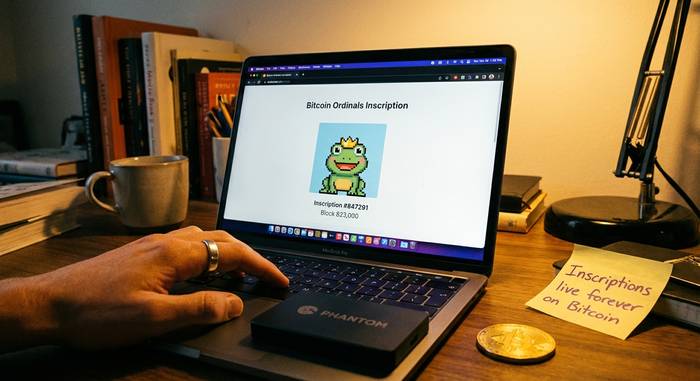
If you told someone in 2022 that NFTs would come to Bitcoin, they would have laughed. Bitcoin was supposed to be digital gold. Not a platform for profile pictures. But in January 2023, Casey Rodarmor launched the Ordinals protocol, which lets you inscribe data (images, text, code) directly onto individual Bitcoin satoshis. Bitcoin NFTs were born.
I remember the first time I inscribed an Ordinal through Magic Eden. January 2024. The interface looked clean but I was nervous because this was Bitcoin, not Solana. Ten-minute block times. Fees that spike unpredictably. And I was essentially burning a blob of image data into the Bitcoin blockchain permanently. Cost me about $15 in fees. The inscription confirmed in the next block. I looked at it on the ordinals explorer and thought "that JPEG is going to outlive me." Because it will. Bitcoin is not going anywhere.
Magic Eden built their Bitcoin marketplace to feel like their Solana marketplace. Browse collections, click buy, confirm in wallet. They abstracted away the complexity of Bitcoin UTXOs, inscription indexing, and Taproot script paths. A Solana degen who had never touched Bitcoin could trade Ordinals on Magic Eden without learning any Bitcoin-specific tooling. That accessibility is what drove the volume. At peak, Bitcoin Ordinals were generating more daily trade value than Solana NFTs.
Then Runes dropped in April 2024. Casey Rodarmor's fungible token protocol for Bitcoin. Cleaner than BRC-20, natively etched into Bitcoin transactions. Magic Eden had Runes trading live on launch day. The convergence of NFTs and fungible tokens on Bitcoin turned Magic Eden from "Solana NFT site that also does Bitcoin" into a genuine Bitcoin DeFi platform.
I traded a few Ordinals on Magic Eden and the experience was surprisingly smooth for Bitcoin. Transactions are slower than Solana (Bitcoin block times are 10 minutes). Fees are higher during busy periods. But the inscriptions themselves are permanent, stored directly on the most secure blockchain in existence.
And then, in February 2026, Jack Lu killed it. Shut down the entire Bitcoin marketplace. March 9: trading stopped. March 27: API disconnected. The Runes market, the Ordinals collections, the entire Bitcoin operation that Magic Eden had spent two years building, gone. Users had until May 1 to export their wallets before the multi-chain wallet shut down completely. $37.9 million in user assets needed to be migrated.
Why? The numbers did not lie. Bitcoin and EVM operations ate 80% of company costs while producing 20% of revenue. Solana was 85%+ of volume. The Bitcoin bet was strategically brilliant but economically unsustainable. Maintaining separate infrastructure for Bitcoin's UTXO model, Ethereum's EVM, and Solana's SVM while competing with specialists on each chain burned cash faster than the volume justified.
The ME token: Magic Eden's governance and reward token
Magic Eden launched the ME token in December 2024 with one of the largest airdrops in NFT marketplace history. Users who had traded on Magic Eden and accumulated Diamond rewards received ME tokens proportional to their activity.
The token serves multiple purposes. Governance: ME holders vote on protocol decisions through Magic Eden's DAO structure. Fee discounts: holding ME reduces trading fees on the platform. Staking: lock ME tokens to earn additional rewards and boost your Diamond accumulation rate.
I watched the token launch live on Twitter. The first hour was euphoria. People posting screenshots of five-figure airdrops. Then came the complaints. Bitcoin-focused traders who had generated serious volume on Ordinals got smaller allocations than Solana users with comparable activity. The Discord filled with "unfair distribution" posts within hours. Price dumped as early recipients cashed out immediately, which is what happens with every single airdrop in crypto history, but somehow still surprises people every time.
The numbers in April 2026 are ugly. ME trades around $0.10-0.12. Down roughly 98% from the all-time high near $5-6 at launch. Market cap sits around $47-60 million. For a company that raised $157 million and was valued at $1.6 billion, a $50 million token cap is a painful reality check.
One thing working in ME's favor: Magic Eden started a buyback program in March 2026, dedicating 30% of platform revenue to buying ME tokens off the open market. Buybacks create consistent buy pressure and reduce circulating supply over time. Whether that is enough to offset the multi-chain shutdown narrative and the broader NFT bear market depends on how much revenue Solana NFTs and Dicey actually generate.
Dicey: Magic Eden's casino pivot
This is the part nobody expected. In January 2026, Magic Eden launched Dicey, a crypto casino and sportsbook running on Solana. Yes, the NFT marketplace is now also a gambling platform.
Dicey offers casino games, sports betting, and prediction markets. Users deposit SOL or other Solana tokens and play. The platform processed roughly $15 million in bets during its first two months of beta with about 200 active users. Small numbers, but growing.
I have mixed feelings about this pivot. On one hand, crypto gambling is a massive market. Rollbit, Stake, and Polymarket proved that crypto-native users will gamble billions. On the other hand, an NFT marketplace pivoting to a casino feels desperate to some people in the community. Jack Lu framed it as "expanding into crypto entertainment." The community response was split between "smart move, follow the money" and "what happened to building the NFT future?"
The strategic logic makes sense if you do not care about optics. NFT trading volume is in decline. Casino volume is growing. Both involve the same core competency: building a platform where users connect wallets and transact. The infrastructure overlaps. The user base overlaps. If Dicey generates meaningful revenue, the ME token buyback program gets funded and token holders benefit regardless of how they feel about gambling.
Diamond rewards: Magic Eden's loyalty program
Diamonds are Magic Eden's points system. You earn them by trading, listing, and participating in platform activities. The accumulation rate depends on your activity volume and whether you stake ME tokens (stakers earn faster).
When Magic Eden launched ME, Diamonds converted into token allocation at a rate that rewarded heavy users. The program continues in 2026 as an ongoing loyalty mechanism. More diamonds means more future rewards, whether those come as additional ME tokens, fee discounts, or early access to new features.
My take on Diamond rewards: it is the same playbook Blur ran with BLUR points. Incentivize activity to generate volume numbers that attract more users. Works? Absolutely. Volume went up. But the wash trading concern is real and I have seen it firsthand. A friend of mine set up two wallets and traded a 0.1 SOL NFT back and forth between them 200 times in one afternoon to farm Diamonds. Cost him maybe $2 in fees. Whether those Diamonds convert to meaningful value later is the gamble.
Magic Eden has cracked down on the most obvious farming patterns. But the cat-and-mouse game is older than DeFi itself and no marketplace has solved it completely. Blur could not. LooksRare could not. Magic Eden cannot. The incentive to game point systems will exist as long as the rewards are worth the effort.
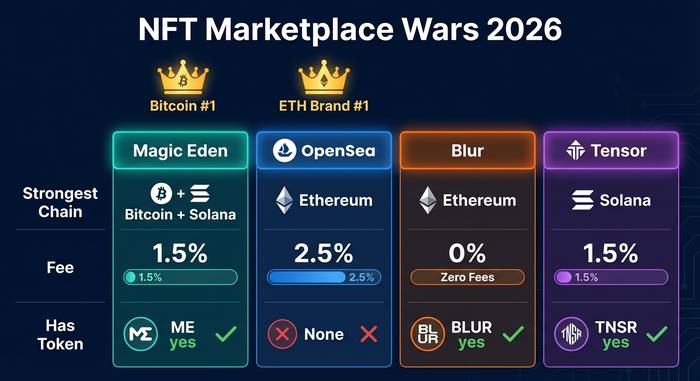
Magic Eden vs OpenSea vs Blur vs Tensor
The NFT marketplace war has four serious players in 2026. Each owns a different piece of the market.
| Marketplace | Focus (Apr 2026) | Fee | Token | Status |
|---|---|---|---|---|
| Magic Eden | Solana only + Dicey casino | 1.5% taker | ME ($0.10) | Pivoted, killed multi-chain |
| OpenSea | Ethereum | 2.5% (varies) | None | Declining volume |
| Blur | Ethereum | 0% (incentivized) | BLUR | Ethereum trading leader |
| Tensor | Solana | 1.5% | TNSR | Magic Eden's main Solana rival |
After the February 2026 pivot, the competitive landscape simplified dramatically. Magic Eden is no longer a multi-chain platform. It is a Solana NFT marketplace that also runs a casino. The "fastest to new chains" advantage is gone because they left every chain except Solana.
On Solana specifically, Magic Eden still leads by daily volume (roughly 45,000 SOL per day versus Tensor's 16,000 SOL). But Tensor has more daily active addresses (298,000 versus Magic Eden's 267,000). The volume is concentrated among fewer, larger traders on Magic Eden. The user count favors Tensor. Both metrics matter depending on what you care about.
OpenSea continues declining. Blur owns Ethereum power trading. Neither competes with Magic Eden on Solana. The real fight is Magic Eden versus Tensor for Solana dominance, and that fight got more intense after Magic Eden abandoned every other chain to focus all resources on one.
NFT trading volumes across all chains remain a fraction of the 2021-2022 peak. Total NFT market volume dropped 37% year-over-year in 2025 to about $5.5 billion. Average sale price: $96. Bored Apes dropped from 150 ETH to under 10 ETH. The marketplace war is being fought over a smaller, cheaper pie. Whether Dicey's gambling revenue can compensate for the NFT market shrinkage is the bet Magic Eden is making now.
The NFT market in 2026: context for Magic Eden's position
I am going to be honest about where NFTs stand because it matters for understanding Magic Eden's business.
The speculation-driven NFT market of 2021-2022 is not coming back in the same form. Profile picture projects, most of which had no utility beyond social status, have lost 90%+ of their value. The floor price of Bored Ape Yacht Club dropped from 150 ETH to under 10 ETH. Worse performance for smaller collections.
What is growing: utility NFTs. Gaming items that you actually use in games. Event tickets. Membership passes. Digital identity credentials. Music royalty shares. Real estate fractionalization. These use cases do not generate the same headline-grabbing trading volumes as PFP flipping, but they represent genuine product-market fit.
Magic Eden's Launchpad and multi-chain infrastructure position it well for utility NFTs. A gaming studio that wants to launch items on Solana, Bitcoin, and Ethereum can use one marketplace. A music artist who wants to sell royalty-bearing NFTs can mint through the Launchpad. The infrastructure is there. The question is whether enough builders choose Magic Eden over chain-specific alternatives.
For anyone buying NFTs on Magic Eden today, the advice is simple: treat it like collecting art or supporting projects you believe in, not like investing. The days of buying a $200 JPEG and flipping it for $20,000 a week later are gone for most collections. What remains is a legitimate technology for digital ownership, traded on marketplaces like Magic Eden that have survived the worst bear market in NFT history.