Rarible: the NFT marketplace that bet on creators and built a protocol for everyone
I minted my first NFT on Rarible in early 2021. Not because I was an artist. Because Rarible was the only platform at the time that let anyone create and sell an NFT without getting approved first. OpenSea had a creation tool too, but Rarible made it feel welcoming in a way that mattered to people who were not already in the crypto inner circle. Upload your file, set a price, click mint. No application. No gatekeeping. No "curated gallery" barrier. Just create and sell.
That open-door philosophy defined Rarible's identity from day one. While OpenSea grew into the default marketplace for NFT trading and Blur later optimized for professional flippers, Rarible positioned itself as the platform for creators who wanted control. Control over royalties. Control over how their work was sold. Control over whether they wanted to build on Rarible's marketplace or fork the entire protocol and build their own.
The result in 2026: Rarible is not the biggest NFT marketplace by volume. Not even close. OpenSea and Blur and Magic Eden all process more trades. But Rarible survived the NFT bear market, shipped RARI Chain (their own L3), and built an open source protocol that powers custom NFT marketplaces for projects that do not want to depend on OpenSea or anyone else. That combination of survival, technical ambition, and creator-first values makes it worth understanding even if you never trade a single NFT on the platform.
What Rarible is and how it works
Rarible is two things at once, and most people only know about one of them.
The first thing: an NFT marketplace at rarible.com. You connect your wallet, browse collections on Ethereum, Polygon, Solana, Immutable X, Base, and other chains, buy NFTs, sell NFTs, and create your own. The interface is clean. The experience is straightforward. Fees run about 1% on each side (buyer and seller), which is competitive with most marketplaces.
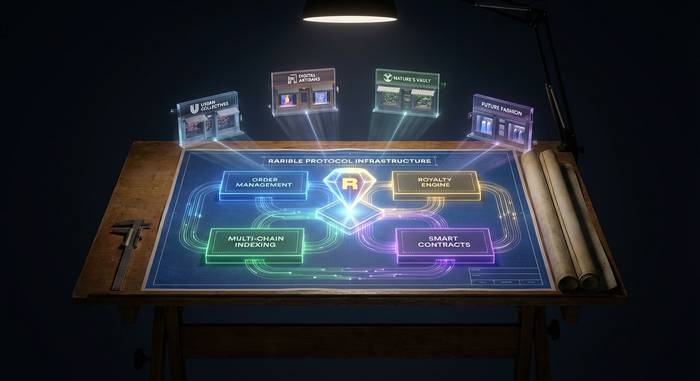
The second thing: the Rarible Protocol. This is the part that differentiates Rarible from every other marketplace. The Rarible Protocol is an open source SDK that lets anyone build their own NFT marketplace. Not a fork of Rarible's frontend. A full protocol with indexing, order management, royalty handling, and multi-chain support. Projects that want their own branded marketplace, with their own rules and their own user experience, can build on the Rarible Protocol without starting from scratch.
I think the Protocol is actually the more interesting product. The marketplace competes with OpenSea and Blur for individual traders. The Protocol competes for ecosystem infrastructure. Every community that builds a custom marketplace on the Rarible Protocol generates volume that feeds back into the Rarible ecosystem.
Alexander Salnikov and Alexei Falin cofounded Rarible in 2020. Both are from Russia, though the company relocated to the US (Los Angeles) as the project grew. Funding includes a $14.2 million Series A led by Venrock, CoinFund, and 01 Advisors. Not the $130 million that Magic Eden raised, but enough to keep building through the bear market.
How to buy, sell, and mint NFTs on Rarible
I walked a colleague through minting on Rarible last month. The process has gotten smoother since 2021 but the core idea has not changed.
Minting (creating an NFT): Click "Create" on rarible.com. Choose whether you want a single edition (one of one) or multiple editions. Upload your file: images, video, audio, 3D models all supported. Write a title and description. Set your royalty percentage (Rarible supports up to 50%, though 5-10% is standard). Choose your blockchain. Ethereum costs more in gas but has the deepest collector base. Polygon is nearly free. Solana is fast and cheap. Hit "Create Item" and confirm the transaction in your wallet.
Rarible also supports lazy minting. Your NFT exists on the platform but is not actually written to the blockchain until someone buys it. The buyer pays the gas for the on-chain transaction. This means creators can list unlimited items at zero upfront cost. I have seen artists list 100 pieces on Rarible via lazy minting and only pay gas on the ones that sell.
Buying: Browse collections or search for specific pieces. Click the NFT you want. Hit "Buy now" at the listed price or place an offer. Confirm in your wallet. The NFT transfers to you. Rarible shows you the full provenance: who created it, who owned it previously, and every sale price in the history. That transparency matters for collectors who care about an NFT's story.
Selling: Go to your profile, find the NFT, click "Sell." Choose between a fixed price, a timed auction, or an open-for-bids model where collectors offer what they think it is worth. Set your price, choose the currency (ETH, WETH, or chain-specific tokens), and list. Rarible takes 1% from the seller. The buyer also pays 1%. Your creator royalty (if you set one) gets collected automatically on every resale.
| Rarible fee structure | Details |
|---|---|
| Buyer fee | 1% |
| Seller fee | 1% |
| Listing fee | Free |
| Creator royalties | Up to 50% (customizable) |
| Lazy minting | Free (buyer pays gas on purchase) |
| Supported chains | Ethereum, Polygon, Solana, Immutable X, Base, RARI Chain |
The RARI token and RARI Chain
RARI launched as a governance token in 2020 with a total supply of 25 million tokens. The initial distribution rewarded platform users: 60% went to buyers and sellers through a "marketplace mining" program where weekly trading activity earned RARI. 10% was airdropped to existing NFT holders. 30% went to investors and the team.
The token hit an all-time high around $40 in March 2021 during the NFT frenzy. Like everything else in the NFT space, it crashed hard after that. RARI trades at a fraction of that peak in 2026. The governance utility remains: RARI holders vote on protocol changes, fee structures, and ecosystem grants.
The bigger development is RARI Chain. Rarible built its own Layer 3 blockchain using Arbitrum Orbit technology. RARI Chain is designed specifically for NFT transactions: low gas fees, fast confirmations, and NFT royalty enforcement embedded at the chain level. That last part is important.
The royalty wars of 2023-2024 gutted creator earnings. Blur made royalties optional. OpenSea followed. Magic Eden followed. Creators who had built their business on 10% royalties suddenly earned 0% on most sales. RARI Chain enforces royalties at the protocol level. If a creator sets 5% royalties, every sale on RARI Chain pays 5%. No marketplace can bypass it. No buyer can skip it. The chain itself ensures creators get paid.
Whether RARI Chain attracts enough volume to matter is the question. Royalty enforcement is a strong pitch for creators. But creators go where the collectors are, and collectors go where the liquidity is. RARI Chain needs both sides to show up. As of 2026, adoption is early but growing.
Rarible Protocol: the infrastructure play
I mentioned this above but it deserves its own section because the Protocol might be Rarible's most valuable asset in the long run.
The Rarible Protocol is an open source toolkit for building NFT marketplaces. It handles the hard parts: order matching, royalty distribution, multi-chain indexing, metadata management, and smart contract interaction. A developer can build a custom marketplace for a gaming studio, a music label, a sports league, or any community that wants to own their NFT trading experience instead of sending users to OpenSea.
The SDK supports multiple chains. A project can launch their marketplace on Ethereum and Polygon simultaneously. The Protocol handles the cross-chain complexity. The project focuses on their brand, their community, and their user experience.
Several notable projects use the Rarible Protocol infrastructure. The revenue model feeds the ecosystem: transactions on Protocol-powered marketplaces generate fees that flow back to RARI holders through governance-directed spending.
I think of the Rarible Protocol the way I think about Shopify versus Amazon. OpenSea is Amazon: massive traffic, default destination, you list on their terms. The Rarible Protocol is Shopify: build your own store with your own brand, powered by infrastructure you do not have to build yourself. Some sellers prefer Amazon's traffic. Some prefer owning their store. Both models work.
A friend of mine runs an indie game studio. They wanted to sell in-game items as NFTs but did not want their players navigating to OpenSea to trade. "Our game, our marketplace," was how he put it. He built the whole thing on the Rarible Protocol in about three weeks. Custom branding. Custom fee structure. Royalties enforced by smart contract. Players trade items without ever leaving the game's ecosystem. That use case, the white-label marketplace, is where I think Rarible's real future lives. Not competing with Blur for degens flipping JPEGs. Powering the next generation of branded NFT experiences for gaming studios, music labels, fashion houses, and sports leagues that want to own their distribution.
The Protocol SDK supports JavaScript/TypeScript and handles the gnarly parts that no game studio wants to build themselves: order management across multiple chains, signature validation, fee splitting, metadata indexing. I looked through the GitHub repo and the documentation is better than most DeFi protocols I have used. That matters because developer experience determines adoption for infrastructure products.
Rarible vs OpenSea vs Blur: honest comparison
The NFT marketplace landscape in 2026 looks nothing like 2021. Three years of bear market compressed the field.
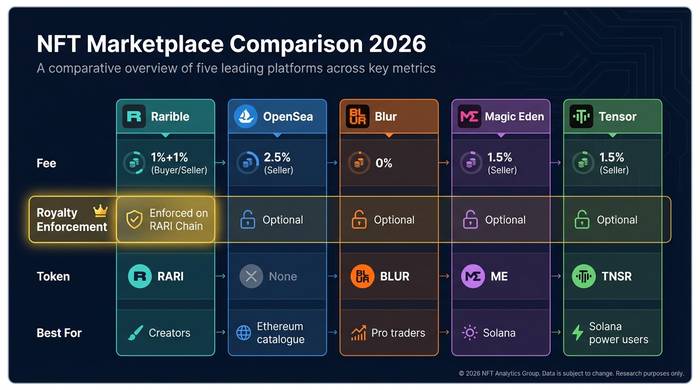
| Marketplace | Volume rank | Fee | Royalty enforcement | Best for | Token |
|---|---|---|---|---|---|
| OpenSea | Top 3 (Ethereum) | ~2.5% | Optional | Largest Ethereum catalogue | None |
| Blur | Top 2 (Ethereum) | 0% | Optional | Professional traders, flippers | BLUR |
| Magic Eden | Top 1 (Solana) | 1.5% | Optional | Solana NFTs + Dicey casino | ME |
| Rarible | Smaller | 1% + 1% | Enforced (RARI Chain) | Creators, custom marketplaces | RARI |
| Tensor | Top 2 (Solana) | 1.5% | Optional | Solana power users | TNSR |
Rarible is not winning the volume war. Let me be clear about that. OpenSea and Blur process significantly more Ethereum volume. Magic Eden and Tensor dominate Solana. In raw trade numbers, Rarible is a niche player.
But volume is not the only metric that matters. Rarible's Protocol powers marketplaces that do not show up in Rarible's own volume stats. RARI Chain offers something nobody else does: chain-level royalty enforcement. And the platform has survived a 90%+ drop in NFT trading volume while larger competitors laid off staff and scrambled to find new revenue.
For individual traders, OpenSea or Blur is probably where you start on Ethereum. Magic Eden or Tensor for Solana. Rarible makes sense if you are a creator who cares about royalties, if you want to support a creator-first platform, or if you need Protocol infrastructure for a custom marketplace build.
The NFT market in 2026 and what it means for Rarible
Total NFT trading volume dropped roughly 37% year-over-year in 2025, landing around $5.5 billion for the year. Average sale price fell to $96. The PFP (profile picture) speculation era is over. The 10,000-item generative art collection model that defined 2021-2022 has largely run its course.
What is replacing it: utility NFTs, tokenized assets, gaming items, membership passes, and digital identity. These categories do not generate the same speculative trading frenzy, but they represent sustainable demand. A concert ticket as an NFT gets used once and resold once. A gaming sword gets traded when a player quits or upgrades. These are real transactions, not speculation loops.
Rarible's infrastructure play positions it well for this shift. A gaming studio does not want to list items on OpenSea where they compete with monkey JPEGs. They want their own branded marketplace with their own rules. The Rarible Protocol gives them that. RARI Chain gives them royalty enforcement. The tooling exists. The question is how many studios actually build.
I check Rarible once a week. The volume is modest. The community is active but small compared to OpenSea or Blur. The Protocol development continues. New chains get added. RARI Chain grows slowly but it grows.
Here is my honest read on where Rarible stands: it is not going to overtake OpenSea or Blur on volume. That ship sailed in 2022. What Rarible can become is the Stripe of NFTs. Infrastructure that other businesses build on. You do not see Stripe when you buy something online. You see the store. But Stripe processes the payment. Rarible Protocol can play that role for NFT marketplaces. You do not see Rarible when you trade a gaming item on a custom marketplace. You see the game's brand. But Rarible Protocol handles the trade.
That is a smaller story than "the next OpenSea." It is also a more sustainable one. Infrastructure companies survive market cycles because their revenue comes from other businesses' transactions, not from speculative trading volume that can drop 90% in a quarter.
In an industry where most 2021-era NFT projects are dead, Rarible is still shipping code, launching chains, and signing up Protocol users. The NFT winter killed hundreds of projects that were flashier, richer, and louder. Rarible made it through by being useful rather than hype-driven. Whether that strategy produces outsized returns for RARI holders is uncertain. Whether it produces a lasting company is looking increasingly likely.