IIRC Meaning: What It Stands For and How to Use It
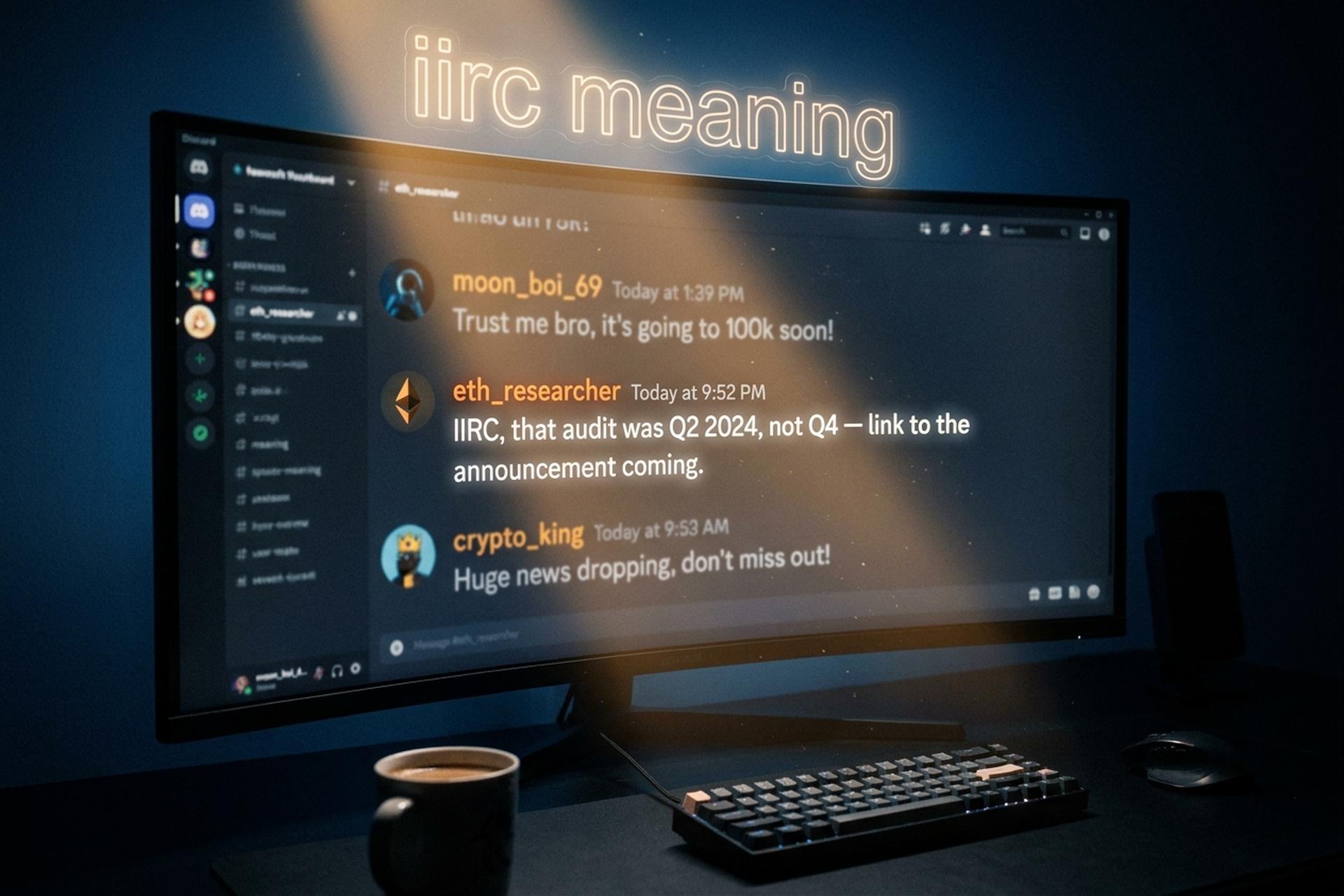
A trader posts in a Discord channel. "Project X had a $50M raise last year." Three minutes later somebody replies. "IIRC, that was a $5M raise, not $50M — check the announcement." The cascade of misinformation stops. Two letters of humility, four short ones in caps, stopped a six-figure typo from becoming a server-wide rumour. That is the actual job of IIRC, and it is why a small slang acronym has stuck around for thirty-six years and counting.
What IIRC Means and Where It Came From
IIRC stands for "If I Recall Correctly," or, equivalently, "If I Remember Correctly." Both expansions sit comfortably in the wild, and the difference between "recall" and "remember" carries no meaningful weight here. The abbreviation flags one specific thing: that the speaker is working from memory and might be wrong.
The earliest documented Usenet use traces to a post in the comp.virus newsgroup on 18 January 1990. Its cousin AFAIK ("As Far As I Know") had already appeared in comp.sys.sun on 9 December 1988, which places the entire hedging-acronym family in the late-1980s/early-1990s text-only internet — long before Discord or Telegram existed.
Authoritative dictionaries caught up later. The Oxford English Dictionary added an entry for IIRC, adv. in 2016. Merriam-Webster lists the abbreviation in its rolling roundup of common texting initialisms, with the article last updated on 18 March 2026. Dictionary.com, drawing on the Random House Unabridged Dictionary 2023, gives the definition as "if I remember correctly; if I recall correctly … from its use in digital communications" and offers the pronunciation /ahy-ahy-ahr-see/ — letter by letter, not as a word.
How to Use IIRC: Three Sentence Positions
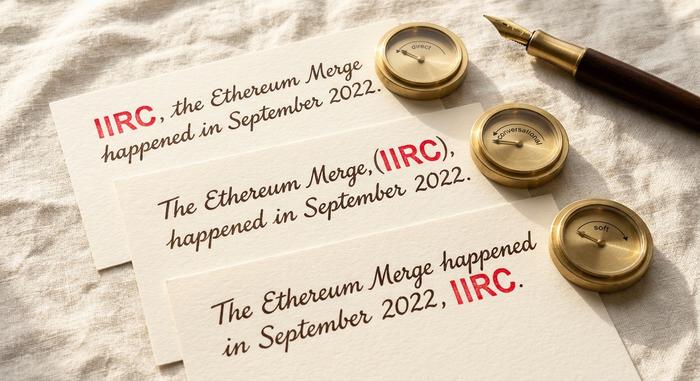
The mechanics matter more than people think. IIRC can sit at the front of a sentence, in the middle as a parenthetical, or at the end as a retroactive softener — and the tone shifts each time.
Front-loaded usage is the most direct. "IIRC, the Ethereum Merge happened in September 2022, not 2021." The hedge arrives first, telling the reader to weigh what follows accordingly. This is the variant most common in Reddit and Discord, where you are answering a question and want to flag the uncertainty up front.
The parenthetical position is more conversational. "The Merge, IIRC, happened in September 2022." It tucks the hedge into the middle of an otherwise confident sentence and feels less like a disclaimer and more like a verbal aside. Slack discussions and crypto Twitter replies use this construction often.
Trailing IIRC is the softest of the three. "The Merge happened in September 2022, IIRC." The fact comes first; the hedge arrives only at the end, almost like an afterthought. This works when you are 95% sure and want the statement to land first, but you do not want to be quoted as definitive.
Capitalisation is a separate choice. In professional contexts and email, uppercase IIRC reads as standard, emphatic, dictionary-style. In casual chat, especially among Gen Z users (who, per UCLA Applied Linguistics research, often drop capitalisation and punctuation entirely), lowercase "iirc" is more common and reads as part of the natural flow of typing. Neither is wrong. Pick the register that matches the conversation and stick with it.
A short caveat. IIRC is a hedge, not an excuse. Overusing it — three IIRCs in a single Slack message — starts to read as if the writer is constantly unsure and looking for an escape hatch. Use it where the uncertainty is genuine.
IIRC vs AFAIK, IMO, TBH, FWIW: The Hedge Family
The acronym IIRC has cousins. They look similar, they fill similar slots in a sentence, and they get confused for one another. The differences are small but real.
| Acronym | Stands for | What it hedges | Typical use |
|---|---|---|---|
| IIRC | If I recall correctly | Memory of a fact | "IIRC, that token unlock is in May." |
| AFAIK | As far as I know | Knowledge or information | "AFAIK, no audit has been published." |
| IMO / IMHO | In my opinion / In my humble opinion | Subjective view | "IMO, the tokenomics are weak." |
| TBH | To be honest | Candor on a sensitive point | "TBH, the roadmap is vague." |
| FWIW | For what it's worth | Self-deprecating contribution | "FWIW, I voted against it." |
| IDK | I don't know | Complete absence of information | "IDK if that deadline still holds." |
The rule of thumb is simple. If you are reaching back into memory for a fact that you might have wrong, reach for IIRC. If you are flagging that you might not be in the loop, AFAIK is the right tool. Mixing them up is harmless in chat but reads as careless in writing meant to be cited.
When NOT to Use IIRC (Formal Context Rules)
Client emails, legal correspondence, regulatory filings, and technical documentation are not the place. The AdaptlyPost glossary puts it bluntly: "Use only in informal work chats with familiar colleagues. For professional correspondence, spell out 'if I remember correctly' or use 'I believe' instead."
In practice, anything that might be forwarded externally should drop the acronym. Slack and Teams are fine. Internal Notion docs are fine. Discord and Telegram are fine. Email to a regulator is not.
IIRC in Crypto Chats: Discord, Telegram, Twitter/X
This is where most generic explainers stop and where the topic actually gets interesting. Discord now carries roughly 1.1 billion messages per day across all of its servers, according to Whop's 2026 platform statistics. Crypto Discord servers are among the densest acronym environments anywhere online. Telegram crossed one billion monthly active users on 19 March 2025, when Pavel Durov posted the milestone on X, and the average Telegram user opens the app twenty-one times a day and spends roughly forty-one minutes inside it. Crypto channels make up a meaningful share of that traffic.
Three concrete crypto uses for IIRC are worth tracking. Each one shows the acronym doing real social work, not decorative typing.
The trader hedge. "IIRC, that audit was published in Q2 2024, not Q4." A market that moves on rumour rewards anyone who flags the doubt rather than committing to a confident error. The two letters lower the cost of being wrong, which is exactly the point.
The governance citation. DAO debates on Snapshot, Discourse forums, and Discord governance channels often cite past proposals from memory. "IIRC, that parameter was changed in proposal 47, but check the link." A linked source closes the loop; the IIRC opens the door for someone else to provide it.
The anti-impersonation cue. Scammers and phishing-bot operators rarely hedge. They sell certainty, because uncertainty is bad for converting victims. Real researchers and longtime community members hedge constantly. When you see "IIRC, …" in a thread, you are very probably reading a real person — a subtle but useful tell in a space where impersonation is industrial.
The lesson generalises. IIRC is community infrastructure in trustless environments. In a Discord server with twenty thousand pseudonymous members, the small social contract that says "I might be wrong" keeps the conversation honest. Skip the hedge, and the same server becomes a feed of confident bad takes that nobody can correct without a fight. The acronym sounds trivial. The norm it carries is anything but.
Crypto Slang Cheat-Sheet: HODL, DYOR, NGMI, WAGMI, GM, FUD
IIRC travels with company in crypto chats. Most of its companions have specific origin stories worth knowing, because the company you keep tells the reader how new (or how old) you are to the space.
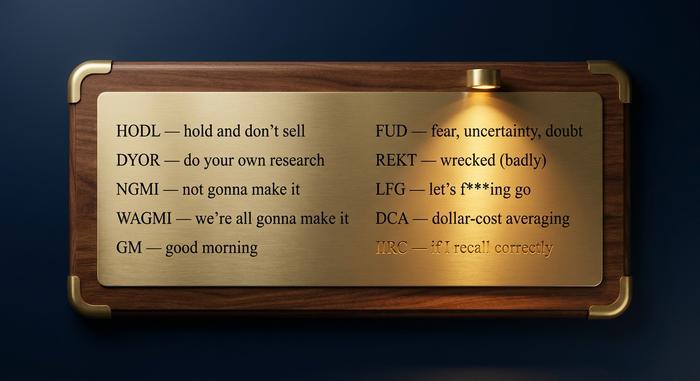
| Acronym | Means | Origin |
|---|---|---|
| HODL | Hold (and don't sell) | GameKyuubi's drunken Bitcointalk post "I AM HODLING" on 18 December 2013, with BTC mid-crash near $550 after the PBOC ban |
| DYOR | Do Your Own Research | Bitcointalk-era disclaimer, in continuous use since at least 2014 |
| NGMI | Not Gonna Make It | Fitness and 4chan /biz/ forums circa 2010; entered crypto chat during the 2021 bull run |
| WAGMI | We're All Gonna Make It | Bodybuilding community (Zyzz, d. 2011) → 4chan /biz/ → Crypto Twitter 2020-2021 |
| GM / GN | Good morning / Good night | Urban Dictionary entry 2 September 2003; ritualised in crypto Twitter and NFT communities 2021-2022 |
| FUD | Fear, Uncertainty, Doubt | 1970s tech sales jargon; popularised by Gene Amdahl in the 1980s describing IBM tactics |
| REKT | Wrecked (catastrophically) | Gaming spelling, imported into crypto for liquidations and losses |
| LFG | Let's F*ing Go | Gaming chat (also "Looking For Group" in MMOs), reused by crypto and meme-stock traders in the 2020-21 retail wave |
| DCA | Dollar-Cost Averaging | Traditional Benjamin-Graham-era finance term, rebranded as HODL-adjacent strategy |
Read those left-to-right and the crypto-chat dialect becomes legible. Reading them in a Telegram channel with no idea what they mean, on the other hand, is a fast way to feel lost.
Why Hedging Matters in Trustless Communities
Hedging lowers the cost of being wrong. That is the whole social function of IIRC, AFAIK, IMO, and TBH. In communities where a confident wrong statement can become a market-moving meme inside an hour, the small social contract of "I might be misremembering, please correct me" works as a circuit-breaker on misinformation.
It also flips the social calculus around being corrected. If you wrote "IIRC, the audit was Q2 2024" and somebody replies with the correct quarter, the correction reads as collaborative. If you wrote "the audit was Q2 2024" with no hedge and the same person corrects you, you look careless. Same fact, same correction, completely different signal. Acronym etiquette is community infrastructure, and pretending it is not just makes you bad at participating.
IIRC Examples Across Platforms
A few side-by-side snippets to illustrate the register shifts. Notice the capitalisation and tone change with the platform.
Slack message to a teammate: "IIRC, the deadline got pushed to next Thursday — let me double-check."
Internal email reply: "IIRC, the Q3 numbers were in last week's deck; happy to dig out the link."
Reddit comment in r/CryptoCurrency: "iirc this proposal was discussed in the last AMA, link?"
Discord crypto-mod note: "iirc rule 4 covers shilling — taking this to DMs."
Twitter/X reply: "iirc the unlock cliff is in May, but verify on the tokenomics page."
DAO governance forum comment: "IIRC, proposal 47 changed this parameter — citation incoming."
IIRC Across Languages and Generations
IIRC is one of the few English internet acronyms that gets borrowed verbatim into other languages inside crypto chats. Russian-speaking communities have their own native equivalent (ЕМНИП, "если мне не изменяет память"), but in English-language crypto channels Russian, Spanish, and German speakers tend to type "iirc" without translation. French chats sometimes carry "ssi" for "si je m'en souviens bien," yet IIRC still wins on global threads. The acronym has effectively become global infrastructure for one specific kind of hedge.
The generational angle adds another layer. Pew Research's December 2024 Teens, Social Media and Technology report found that 46% of US teens describe themselves as being online "almost constantly." Inside that always-on environment, lowercase "iirc" reads as natural to Gen Z users, while Millennials more often capitalise. Both are correct. The choice itself signals which generation typed it.
Quick Reference Card for IIRC Use Online
Stands for "If I Recall Correctly" (or "If I Remember Correctly"). Pronounced letter by letter. Use it when working from memory and the fact might be wrong. Front, middle, or trailing position — pick the tone you want. Lowercase in casual chat, uppercase in more formal writing. Avoid in client emails, legal writing, and regulatory filings, and just spell it out instead. In crypto chats, IIRC pairs with HODL, DYOR, NGMI, WAGMI, GM, FUD, REKT, LFG, and DCA as part of the standard dialect.