Goth AI Review: Is This Math Problem Solver Legit?

The most common thing people search about Goth AI is why it got banned. Here is the twist: it never was. The ban people half-remember hit a different app, Gauth, which was pulled from US app stores in early 2025 as part of the TikTok crackdown. Goth AI, made by a completely separate company, stayed right where it was. The two names rhyme, both solve homework, and the internet did the rest.
So with that cleared up, the real questions are worth asking plainly. Is Goth AI free? Is it safe to point at your kid's math homework? And does a photo-to-answer app actually teach anyone anything, or just make copying faster? I have opinions on all three, and I will not dangle them out of reach.
What Is Goth AI, the Math Problem Solver App?
Goth AI is a phone app that solves homework from a photo, marketed as an AI homework solver and study companion. You point your camera at a math problem, and it sends back an answer with the working laid out step by step. It is built by TUME INFINITIES (HONG KONG) LIMITED, a small studio, and it launched on the App Store in April 2024, right around the time the biggest name in the category was about to vanish from US stores.
On paper it looks healthy. The iOS listing carries a rating near 4.56 out of 5 from somewhere between 1,500 and 1,800 reviews, and third-party trackers estimate north of 250,000 downloads. Those are respectable numbers for an app most people have never heard of.
But "who made it" matters more than usual when the product eats your homework and your data at the same time. A small Hong Kong developer riding the gap left by a banned competitor is not automatically a problem. It is just a reason to read the rest of this review before you hand over a card number.
The timing is the interesting part. Goth AI launched almost exactly when the category's giant was heading for the exit, and a flood of students suddenly needed a replacement. That is good luck or good planning, depending on how generous you feel. Either way, it explains how an app from a studio nobody can name picked up a quarter of a million downloads without a marketing budget anyone has seen.
How Goth AI Solves Homework Step-by-Step
The workflow is genuinely slick. That is the easy part to praise and the easy part to overrate, because a fast answer and real understanding are not the same thing, and this app is much better at the first one.
Snap a photo, get an answer
The core loop is simple: you simply take a photo of the problem, the app reads it with text recognition, an AI model works it out, and you get a solution back in seconds. No typing equations, no fighting with a math keyboard. For a stuck student at 11pm, that speed is the entire appeal.
Step-by-step solutions and the AI tutor
Goth AI does more than spit out a final number. It shows the steps, and it bolts on an AI chat so you can ask follow-up questions in the way you might lean on a human tutor, except this one is available at midnight and does not charge by the hour. It reaches past pure math into word problems and other subjects too, though math is clearly where it is most confident.
How accurate is it?
Here is where I get cautious. I could not find a single independent accuracy test with a disclosed method for Goth AI specifically, and that absence matters. Underneath the branding it leans on the same kind of AI models that power chatbots, and those are famous for being confidently wrong. On routine algebra and arithmetic it will usually deliver accurate answers. On complex problems that run multiple steps or hide a trick in the wording, treat its answer as a draft to check, not a verdict to copy.
The failure mode worth knowing is the worst one for a student: the app does not say "I am not sure." It hands you a clean, formatted, wrong answer with the same confidence it shows a correct one. A photo of a poorly lit problem, a misread exponent, a word problem with a trick in the phrasing, and it will still produce tidy steps that lead somewhere false. If you cannot already tell a right answer from a plausible one, that is exactly the situation where a solver hurts you most.
Is Goth AI Free? Pricing and the Paywall
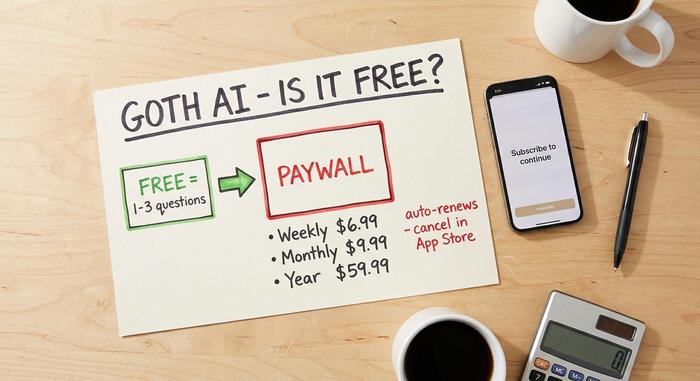
"Free to download" is doing a lot of heavy lifting in how this app is marketed. You can install it for nothing. You cannot do much with it before the paywall lands.
Free versus the paywall
Multiple App Store reviews describe the same wall: you get one to three questions, sometimes a single photo, and then you are asked to subscribe. So in practice the free version is a demo, not a usable tier. That is not unusual for the category, but it is worth knowing before "free" pulls you in.
Subscription tiers
The paid plans, as listed on the App Store, look like this:
| Plan | Price |
|---|---|
| Weekly | $6.99 |
| Monthly | $9.99 |
| Half-year | $29.99 |
| Annual | $59.99 |
A weekly tier at $6.99 is the tell of an app built to convert a panicked student fast. Do the math the app would do for you: at $6.99 a week, a year costs more than three times the annual plan.
Auto-renewal and cancelling
The angriest reviews are not about wrong answers. They are about being charged again. Subscriptions auto-renew, and the cancellation path runs through your phone's App Store subscription settings, not a button inside the app. If you only need it for one assignment crunch, set a reminder and cancel the moment you are done, or that weekly charge quietly becomes a yearly one.
Why Did Goth AI Get Banned? The Real Story
Let me put the myth fully to rest, because it is the reason most people land here. Goth AI was not banned. The app caught in the net was Gauth, a hugely popular homework app that, as Apple's own removal list shows, disappeared from US app stores on January 19, 2025.
Why Gauth AI? Because Gauth is owned by ByteDance, the same company that owns TikTok, and it got swept up in the same federal law that forced the TikTok showdown. The law in question targeted apps controlled by the parent company, and Gauth, with its hundreds of millions of self-reported student users, was collateral in a fight that was never really about homework.
When the most famous homework app in the country vanishes overnight, students go searching, the names blur, and a similar-sounding app inherits the rumor. There is a small irony here worth sitting with. The thing that made Gauth risky in regulators' eyes, where its data ultimately flowed, is a question you could just as reasonably ask of a different app run from Hong Kong. Goth AI is the beneficiary of the confusion, not a victim of the ban, but the worry that sank its rival has not actually been answered for the replacement.
Is Goth AI Safe? Privacy and Student Data
This is the section the "best homework apps" listicles skip, and it is the one a parent should read twice. The app works. Whether it is safe to put on a child's phone is a separate question with an uncomfortable answer.
The age-rating contradiction
Start with a flat contradiction in the app's own paperwork.
| Signal | What it says |
|---|---|
| App Store age rating | 4+ (suitable for all ages) |
| Terms of Service | Users must be 18 or older |
| Data collected | device identifiers (IMEI, MAC, Android ID) |
| Data sharing | shared with a third-party "ChatGPT platform" |
| Developer location | Hong Kong |
An app rated for four-year-olds whose own terms ban anyone under eighteen is not a rounding error. It means the marketing and the legal fine print are pointed in opposite directions, and the gap is exactly where a careless install happens.
What data it collects
Beyond the homework images you upload, the app's disclosures point to granular device identifiers and sharing with an outside AI service. For an adult that is an annoyance. For a minor's device, it is the kind of data trail that privacy regulators have spent the last two years writing rules about. Device identifiers are sticky in a way an email address is not: you can change an email, but a hardware ID follows the phone, which is what makes its collection from a children's app a sharper concern than it first sounds.
Minors and the parent's call
In the US, rules around collecting data from children tightened sharply through 2025. A student-facing app that collects device IDs while claiming to be both for everyone and for adults only sits in an awkward spot. None of this means Goth AI is malicious. It means a parent, not an app store badge, should be the one deciding whether it goes on a kid's phone.
Does Goth AI Help You Learn or Just Cheat?
Here is the tension at the heart of these AI tools, and it is not hypothetical. The numbers say students are leaning on these tools hard, and that they are uneasy about it themselves.
A 2025 Pew Research Center survey found that 54% of US teens use AI for schoolwork. A separate RAND study tracked the habit climbing fast, and tellingly, most students said the tools harm their own critical thinking. That is the rare case where the users are warning you about the product.
The honest read is that Goth AI is a fine tool used one way and a quiet problem used another. Photograph a problem you already attempted, compare its steps to yours, and figure out where you went wrong, and you are learning. Photograph the problem, copy the answer, and move on, and you have outsourced the one part of homework that was supposed to build the skill. The app cannot tell which student you are. Only you can.
Teachers have noticed, which is why a growing number of classrooms now grade the working, not just the final answer, and push the hard thinking into supervised class time where a phone cannot help. That is probably the healthiest response. A solver is a calculator for reasoning, and calculators did not ruin math, but the students who learned nothing were always the ones who reached for the shortcut before they understood the long way. The tool did not change that rule. It just made the shortcut faster to find.
Goth AI vs Gauth and Photomath
Goth AI is a competent stand-in, not the category leader, and the alternatives matter more now that the old leader is gone from US stores.
| Goth AI | Gauth | Photomath | |
|---|---|---|---|
| Owner | TUME INFINITIES (HK) | ByteDance | |
| Entry price | Free download, paywall fast | Free, generous | Free + Plus tier |
| US availability | Yes | Restricted since Jan 2025 | Yes |
| Strength | Broad, quick | Scale, breadth | Mature, math-focused |
| Main worry | Privacy, paywall | US ban, ByteDance data | Narrower scope |
Gauth was the giant, but its US restriction takes it off the table for most American students. Photomath, now owned by Google, is the mature, math-specialised option with a more transparent data story and a free tier that is actually usable rather than a three-question tease. Goth AI sits between them: available, broad, cheap to start, and carrying the privacy caveats above. The case for it is convenience and a low entry price; the case against it is everything in the safety section. If you want the safest default, Photomath is the easier app to recommend, and for a younger student it is not a close call.
The Verdict: Should You Use Goth AI?
Goth AI is a real, working math solver that does what it promises, and the "banned" story attached to it is a case of mistaken identity. Used as a tutor — to check your steps and learn where you slipped — it earns its place. Used as an answer key, it does the opposite of what homework is for. The aggressive paywall and the contradictory privacy terms are the real reasons to hesitate, especially for younger students, where Photomath is the safer call. So the question is not really whether Goth AI works. It is whether you will use it to think more, or to think less.