Outlier AI Review: Can You Earn Money and Is It Legit?

Here is the contradiction at the center of Outlier AI. The platform says it has paid experts more than $500 million, it is run by a company recently valued at $29 billion, and it claims over 100,000 contributors in 50 countries. The same platform carries an F rating from the Better Business Bureau and has been hit with four separate lawsuits in the span of five months. Both of those things are true at once.
So which is it? Is Outlier AI a real way to earn money from home, or a trap dressed up as flexible work? This review walks through what the platform actually is, what you realistically earn, how to verify it before you hand over your ID, and who it is genuinely worth it for. No hype, no hand-waving.
What Is Outlier AI and Who Runs Outlier.ai?
The first thing to understand about Outlier is that it is not an independent startup. Outlier.ai is a brand operated by Scale AI, and legally it sits inside an entity called Smart Ecosystem Inc. (a Delaware company that has been around since 2019, well before the Outlier name existed). That ownership is the single most useful fact for judging the whole thing, because it tells you who pays you, who sets the rules, and who is being sued.
Scale AI built Outlier in 2023 to gather human feedback for generative AI training. When a chatbot gives a better answer, it is often because a person somewhere graded an earlier version of that answer. That person might be an Outlier contributor. The company says more than 100,000 people work on the platform across roughly 50 countries, and that it has paid out over $500 million to them.
Scale itself is not a small operation. It reported around $870 million in revenue for 2024 and reached a $29 billion valuation after Meta invested $14.3 billion in June 2025. So when you work for Outlier, you are feeding one of the best-funded AI data companies in the world. Keep that in mind when we get to how the pay actually works, because the gap between a $29 billion valuation and an effective wage near the legal minimum is exactly what makes this platform worth a careful look rather than a quick yes or no.
One more thing the ownership tells you: your account, your rate, and your access to work all live inside Scale's system, not yours. There is no separate Outlier company you can appeal to. When people describe being deactivated overnight, that is the practical edge of being a contractor on someone else's infrastructure.
How Tasks Work: From the Playground to the AI Model
The work on Outlier is not data entry, and going in with that expectation is the first mistake. You are acting as an expert grader and reviewer in a process called RLHF — reinforcement learning from human feedback — which is the core technique that teaches AI models what a good answer looks like. The catch is that the task mix shifts without warning, which is the loudest complaint you will find from people who have actually done it.
Writing prompts and grading responses
Three activities make up most of the work. You write a hard prompt meant to trip up a model. You build a grading rubric, the answer key that says what a correct response must contain. Then you evaluate, rate, and rank what the AI spits back. Outlier gives you a playground to probe the model directly, poke at its weak spots, and write down exactly where it breaks. Think exam writer, not test taker. That reframe matters, because the pay scales with how good your judgment is, not how fast you can click.
Coding, math, and domain tasks
Beyond the generalist work, there are specialist tracks: coding, advanced math, law, medicine, and other domains that need real credentials. This is not a casual crowd. Outlier says 84% of its contributors hold advanced degrees or professional qualifications, and the higher-paid projects are gated behind exactly that kind of expertise.
Why your tasks keep disappearing
Now the frustrating part. Task availability swings hard. A project that filled your week can dry up overnight when the client's data needs change or the project simply ends, and the strict quality bar means weak work can quietly cut your access too. Contributors describe logging in to find the queue empty for days, then suddenly busy again. There are also community reports of broad deactivation waves where large groups lost access at once, though those have not been confirmed by mainstream reporting. Either way, your income depends on work being available, and that availability is not something you control. The people who cope best keep several skills qualified at once and never count on a given project lasting. Plan around the gaps, because they will come.
How Much Outlier Experts Earn: Real Pay vs the Hype
This is the question everyone actually came for, so let me be direct. The advertised rates are real, but they describe the best case, not the typical one. The gap between the rate on the screen and the money in your account is the whole story here, and it is the same gap the lawsuits are built on.
Advertised rates by domain
Pay is set by skill and domain. Generalists sit at the bottom, specialists with degrees sit at the top, and the spread is wide.
| Role / domain | Advertised rate (per hour) |
|---|---|
| Generalist contributor | $10–$18 |
| Domain specialist | $18–$35 |
| Coding expert | $25–$50 |
| PhD / legal / medical | $50–$100 |
| US generalist average | ~$31 |
These figures come from contributor reports collected by review sites and Glassdoor through 2025 and 2026. They are believable for time you are paid for. The problem is the time you are not.
The unpaid-time problem
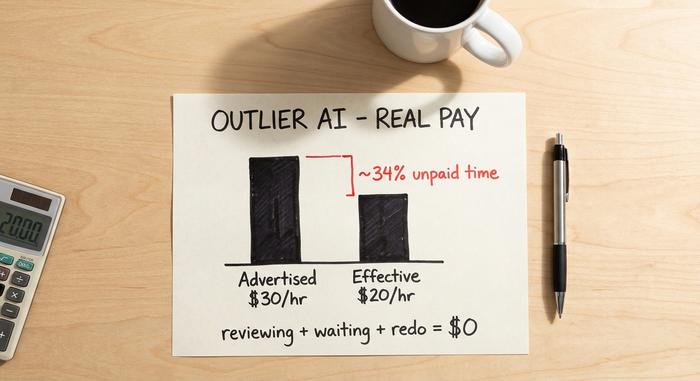
Here is the part the marketing leaves out. Reviewing tasks, reading instructions, waiting in the queue, and redoing flagged work often go unpaid. A 2025 study by AlgorithmWatch found that about a third of the time AI gig workers spend is unpaid, with some Outlier workers in the UK ending up near the effective minimum wage once you count it all. So a $30 rate can quietly become a $20 reality. That is not a rounding error. That is the difference between worth-it and not.
How and when you get paid
Payday is weekly, usually a Tuesday. The money lands through PayPal, ACH, or Airtm, depending on where you live. Most weeks it just works. But delays and disputes come up often enough in contributor forums that I would treat your first payout, not the sign-up page, as the real legitimacy test. Get paid once, on time, and then trust it.
How to Apply, Verify, and Submit Your First Task
Onboarding is a genuine filter, not a formality, and the unpaid part of it is worth knowing before you start. You will not breeze in just because you have a degree.
Here is the path. Create an Outlier account. Add a resume and a LinkedIn, then verify your identity with a government ID, which is the step that makes some people nervous, and fairly so. Next you pick up to ten skill areas and sit a General Reasoning Screening. Score 80% or higher or you are out. Pass that, grind through project-specific training, and finally the dashboard with paid work opens up. It is more hoops than most gig sites, and they are not optional.
No prior AI experience is required, which is true and refreshing. What is less advertised: parts of the assessment and onboarding are unpaid, and some contributors report that their promised rate was lowered after they finished the very tasks meant to qualify them for the higher one. Treat onboarding as an investment of unpaid hours with no guaranteed return. If that framing bothers you, it should, and it is better to know now. Once you clear it, you verify each project's instructions, do the work, and submit your response for review.

Is Outlier AI Legit? Lawsuits, the BBB, and Scams
Yes, Outlier is a legitimate platform, in the narrow sense that it exists and it pays. But "legit" and "treats its workers well" are two different questions, and a lot of online confusion comes from mashing them together with a third issue: outright scams that just borrow the name.
The lawsuits and the labor probe
The legal record is not subtle. Between October 2024 and January 2025, Scale AI and Outlier faced four separate actions.
| Date | Legal action |
|---|---|
| Oct 2024 | WARN Act class suit over mass layoffs of 500+ workers |
| Dec 2024 | Wage-theft / misclassification class action |
| Jan 2025 | PAGA wage suit (California) |
| Jan 2025 | Class action over psychological harm from disturbing content |
On top of that, the US Department of Labor has been investigating Scale AI over federal wage-law compliance since at least 2024. That is the most concentrated regulatory pressure any AI gig platform has drawn so far. It does not mean the platform is fake. It means the worker-conditions question is live and contested, in court, right now.
BBB rating and worker sentiment
The Better Business Bureau gives the Outlier entity an F rating, with 17 complaints filed and none answered (zero responses is its own kind of answer). Sentiment elsewhere is genuinely split: some contributors report steady, well-paying months, while others describe sudden account deactivations with little explanation and lost access to work they had already done. Both camps are telling the truth about their own experience. That inconsistency is the platform's real signature.
The "is it a fraud" confusion
A big chunk of the "Outlier AI scam" panic online is not about the platform at all. It is about impersonation. Scammers copy the Outlier name, message people through fake recruiter accounts, and abuse the identity-verification step to harvest ID documents or push fake "registration fees." The real platform never charges you to join and lives only at outlier.ai. If someone asks for money up front, contacts you through a random messaging app, or sends a link that is not the official domain, that is the fraud, and it is separate from anything Scale AI is being sued over.
Pros, Cons, and Who Outlier AI Is Worth It For
Strip away the noise and Outlier is a decent flexible side income for credentialed people who treat it as unstable gig work. Anyone expecting a steady paycheck will be disappointed and probably bitter.
The upside is real: genuine pay for genuine expertise, flexible hours with no minimums, the backing of a serious company, intellectually engaging work, and weekly payouts available in many countries. The downside is just as real: volatile task supply, unpaid training and review time, the risk of deactivation, and limited transparency about how rates are set.
So who should bother? If you have a specialist degree, a flexible schedule, and you want extra income without quitting anything, Outlier can pay well in good weeks. A law or medicine background, in particular, unlocks the top of the rate range that generalists never see. If you need reliable monthly income to cover rent, look elsewhere; the instability is a feature of the model, not a bug you can work around. And if you are brand new to remote work with no in-demand specialty, expect the lowest rates and the thinnest task supply, which is a discouraging place to start. I keep coming back to the same line for friends who ask: try it as a paid experiment, track your real hourly rate for two weeks, and let that number decide for you.
Getting Paid: Payout Options for Outlier Contributors
One detail that quietly decides how much of your Outlier AI earnings you keep: the payout method. For US contributors, ACH and PayPal are simple. For international contributors, PayPal and Airtm fees plus currency conversion can shave a real percentage off every payment, and on a $20 effective rate that adds up fast.
So cross-border earners look elsewhere. Many turn to stablecoin and crypto rails, which can move money across borders with a thinner spread than a PayPal-to-local-currency hop. Outlier does not pay in crypto directly. But plenty of contributors cash out, then convert, just to dodge the FX bite. The lesson is small but real: if your income crosses a border, the rail you pick can matter as much as the rate you were quoted.
The Verdict: Is Outlier AI Worth Your Time?
Outlier AI is legit, it really pays, and the work can be genuinely interesting if you have the credentials for it. It is also volatile gig work under active legal scrutiny, with an unpaid-time problem that turns advertised rates into softer real ones. Go in with eyes open: track every unpaid hour, treat your first payout as the true test, only ever use outlier.ai, and pick the cheapest way to actually get your money out. The honest question is not "is Outlier a scam." It is "is the real rate, after the unpaid parts, worth your time?" Only your own numbers can answer that.