Hedra AI: The Talking-Avatar AI Video Generator
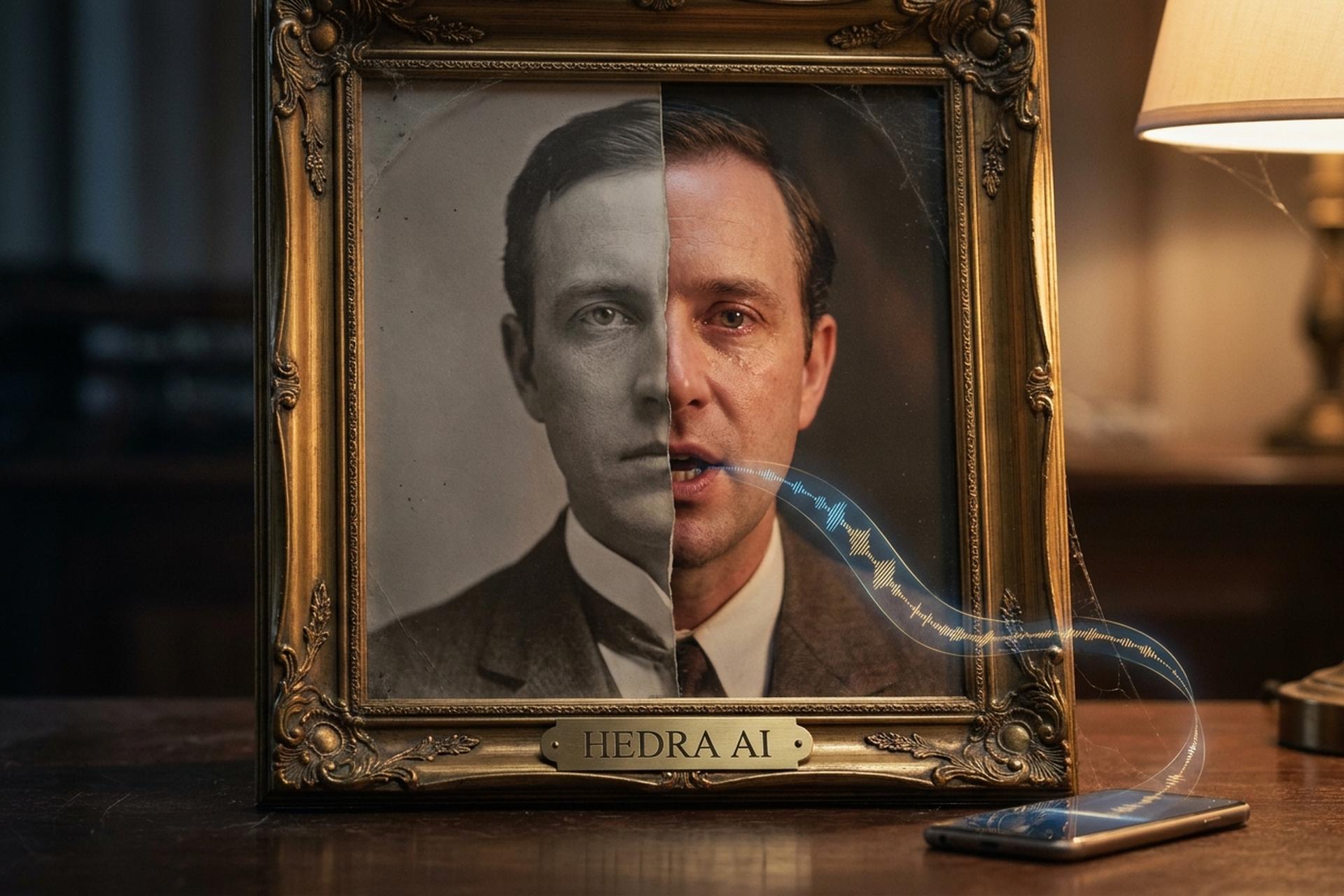
For years, making a digital character speak meant a studio, a motion-capture rig, and an overnight render. Hedra AI compresses that whole pipeline into one photo and one voice clip. You upload a face, hand it some audio, and a few seconds later the picture is talking back at you with matched lips, blinking eyes, small shifts of the brow. It is the kind of trick that looks like a gimmick until you try to do it any other way. Behind the AI video generator sits a San Francisco startup, a model called Character-3, and a $32 million check from one of the best-known names in venture capital.
This guide covers what Hedra is, how Character-3 works, how to make a talking avatar, what it costs, the use cases, the company behind it, and how it stacks up against HeyGen, Synthesia, and Runway.
What Hedra AI Is and How It Works
Hedra AI is not a text-to-video tool in the usual sense. It is a performance engine. You bring the face and the voice; the model supplies the acting. Feed it a portrait and an audio track, and it animates that exact image to speak, rather than inventing a new scene from a written prompt.
The company is Hedra Labs, based in San Francisco. It was founded in 2023 by Michael Lingelbach, a Stanford PhD who walked away from his program to build it. The core of the product is a model called Character-3. The basic loop is the same whether you are a hobbyist or a marketing team. Drop in an image, add a voice, generate, and you have a talking clip. There are no rigs to set up and almost nothing to learn. That low floor is a big part of why Hedra spread the way it did. It went viral on "talking baby" podcasts. Yes, really: absurd clips of AI infants hosting fake interviews flooded social feeds in 2025, and the tool rode that wave before it ever raised serious money. The product went viral first and got funded second. That is the reverse of how most AI startups work.
Inside Character-3, Hedra's Core AI Model
The trick behind Hedra is one model that reads several kinds of input at once. Most older systems handled this in stages: transcribe the audio, then guess mouth shapes, then paste them on. Character-3 looks at the image, the audio, and any text together. All at once. That sounds like a small distinction. It is the whole ballgame.
Phoneme-accurate lip sync and micro-expressions
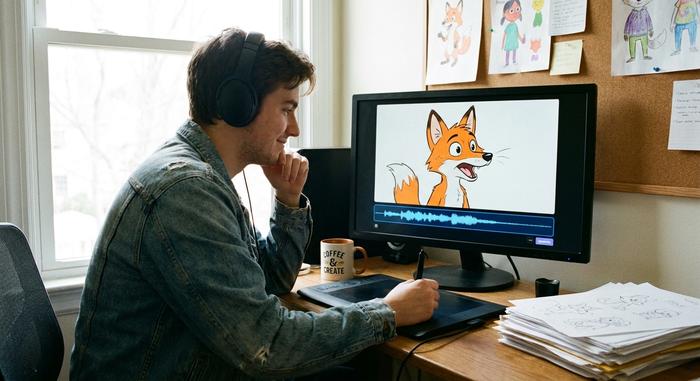
Character-3 launched on March 6, 2025, and Hedra calls it an omnimodal model, meaning it reasons over image, audio, and text jointly rather than in a pipeline. In plain terms, it listens to the sound and drives phoneme-accurate mouth shapes from it, then layers on natural facial expressions, the small involuntary things real faces do: blinks, gaze shifts, an eyebrow raised on a stressed word. The animation is generated from the audio itself rather than keyframed by hand. It works on photorealistic portraits, but also on illustrations, cartoons, and non-human faces, which is why a talking dog or a hand-drawn mascot looks just as convincing as a person. The joint approach is the whole point. Because the model never separates the voice from the face, the timing feels connected rather than pasted on. That is the difference most viewers notice without being able to name it.
One studio, 28 models
Hedra AI is no longer just a lip-sync tool. It has grown into a multi-model creative studio that bundles roughly 28 models under one subscription, including image and video engines like Kling, Veo, Sora, and Flux. An AI agent can take a plain-language brief and pick the right model for you, so a non-expert never has to know which engine is best at what. In February 2026 the company added Omnia, which brings camera control and moving environments, plus a full platform API for developers who want to build on top. There is even a Live Avatar API that streams a talking character in real time at roughly five cents a minute with sub-100-millisecond latency, aimed at interactive agents and virtual hosts rather than pre-rendered clips.
What it still gets wrong
It is not flawless. The default output is 720p, and pushing to higher resolution costs extra credits. Full-body motion still looks stiff next to a dedicated cinematic generator, and language coverage is thin, around 15 languages where some rivals reach well over a hundred. Hedra is excellent at faces. It is merely okay at everything around them, and the gap shows the moment a character has to stand up and walk.
How to Make a Talking Avatar With Hedra
The Hedra AI workflow is genuinely three steps. The craft is in the inputs: a clean, well-lit image and clear audio do more for the result than any setting.
Upload an image and add audio
Open Hedra, start a new project, and upload your character image, a JPEG or PNG of a portrait, a mascot, or a generated face. Then add the voice. You can record yourself, upload an existing audio file, type a script for text-to-speech, or clone a voice from a sample. Set the aspect ratio and length to match where the clip will run, vertical for TikTok, square for a feed.
Generate, refine, and export
Pick a model, click generate, and wait. A short clip usually renders in a minute or two. Preview it, and if the resolution is too soft, spend a few credits to upscale before you export. On paid plans the output is watermark-free with commercial rights, so the file is ready to drop straight into an ad or a video. The loop is fast enough that you iterate on the script and voice rather than fight the software. One practical tip: get the audio right before you spend credits on a long render, because the model only sounds as good as the recording you feed it, and a noisy clip will produce mushy lip movement no setting can fix.
Hedra AI Pricing and Free Credits
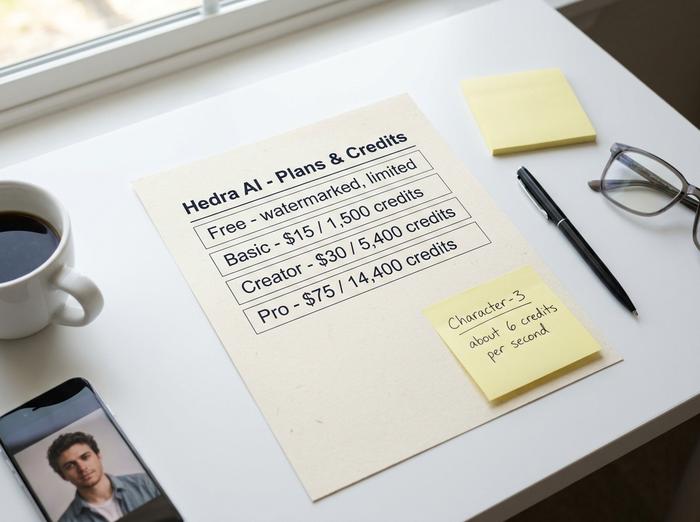
Hedra runs on credits, and the pricing rewards knowing how many you actually burn. There is a free tier, effectively an open-ended free trial, so you can test it, but the output is watermarked and the credits are limited, which nudges you to upgrade once you are hooked. The real catch is that monthly credits expire and do not roll over, and Hedra's billing has drawn a steady stream of complaints, reflected in a Trustpilot score near 2.1 out of 5.
| Plan | Price (2026) | Monthly credits | Best for |
|---|---|---|---|
| Free | $0 | Limited, watermarked | Testing the tool |
| Basic | $15/mo | 1,500 | Hobbyists, no watermark |
| Creator | $30/mo | 5,400 | Regular creators |
| Professional | $75/mo | 14,400 | Teams, fastest renders |
The numbers matter because each model burns credits at a different rate, and a single expensive generation can eat a chunk of your month. Character-3 at 720p costs about six credits per second; a high-end cinematic engine like Veo runs far higher.
| Model | Credits per second | One-minute clip |
|---|---|---|
| Character-3 (720p) | ~6 | ~360 credits |
| Veo (cinematic) | ~40 | ~2,400 credits |
That makes the $30 Creator plan worth around fifteen one-minute Character-3 clips a month before you buy more — but only two or three if you lean on the premium video models. Pricing is published on Hedra's pricing page, and it lands close to HeyGen's comparable tier, so cost is rarely the thing that decides between them.
Create Videos: Hedra AI Use Cases and Ideas
The sweet spot is one talking face, produced at volume. That covers more ground than it sounds. Marketers use Hedra for talking-head ads and user-generated-content spots without booking a creator. Content creators and faceless channels build a recurring AI avatar who never needs to be on camera. Educators and trainers turn a slide deck and a script into a presenter.
It is also a favorite for less corporate work: animating a band's album art into a music video, giving a brand mascot a voice, turning a book into an audiobook host, or making the talking-animal clips that made the tool go viral in the first place. Small businesses lean on it for spokesperson clips and localized versions of a single ad, swapping the audio track to ship the same message in another voice. The common thread is a single character delivering a script. Where Hedra struggles is anything needing full-body action or a complex multi-character scene, which is still the territory of cinematic generators. Pick the job to fit the tool and the results hold up; push it past faces and the seams show.
Hedra AI vs HeyGen, Synthesia and Runway
So which talking-video tool should you actually use? It depends on whether you value raw lip-sync quality or the scaffolding around it. Hedra wins the first; the bigger platforms win the second.
Where Hedra wins
Hedra's lip-sync is widely rated the best available, and it will animate any image you give it, a cartoon, a mascot, a non-human face, not just a library actor. The 28-model studio means you are not juggling five subscriptions. And it is cheap to start. For a creator who wants their own characters talking, nothing else is quite as direct.
Where the rivals win
The incumbents win on scale and polish. That is not nothing. HeyGen ships 500-plus stock avatars, 4K output, and translation across 175-plus languages. Synthesia targets the enterprise with SOC 2 and GDPR compliance, 140-plus languages, and 230-plus avatars, and it now carries a $4 billion valuation. Runway leans cinematic, and its Act-One feature drives a character from a single performance video. D-ID focuses on real-time agents. None of them match Hedra on portrait expressiveness, but each beats it somewhere that matters at scale.
| Tool | Best at | Stock avatars | Languages | Entry price |
|---|---|---|---|---|
| Hedra | Portrait lip-sync, any image | None (bring your own) | ~15 | $15/mo |
| HeyGen | Stock avatars, 4K, dubbing | 500+ | 175+ | ~$29/mo |
| Synthesia | Enterprise, compliance | 230+ | 140+ | Enterprise |
| Runway | Cinematic video | n/a | n/a | $15/mo+ |
Hedra: Company, Funding, and AI Studio Vision
Hedra's rise has been fast even by AI standards. Founded in 2023 by two Stanford PhDs, it grew to roughly three million users in under a year. By its Series A it had powered more than ten million videos. Almost none of that came from ad spend; it was product-led growth, the kind investors dream about. Then the money came. In May 2025 it raised a $32 million Series A led by Andreessen Horowitz, bringing total funding to about $44 million, at a valuation reported around $200 million.
Founder Michael Lingelbach has said the company crossed roughly ten million dollars in annual recurring revenue inside its first year, which is unusually fast for a consumer creative tool and helps explain the investor interest.
The bet a16z is making is not just on a lip-sync model. It is on the idea that the company which owns both the model and the studio around it captures the workflow. By consolidating dozens of image and video engines into one subscription with one bill, Hedra is trying to be the place creators start — not just a feature they pass through on the way to somewhere else. Whether that holds as the underlying models commoditize is the open question, but it explains why a foundation-model investor wrote the check rather than a pure consumer fund.
Risks and Limits of Using Hedra AI
The honest caveats, in one place. Animating any face from a photo raises an obvious likeness problem: it is easy to make someone appear to say something they never did, so consent matters. Hedra's terms also allow it to use de-identified user content to improve its models, which not everyone will love. On the practical side, the monthly credits expire, the default resolution is only 720p, language support is limited, and the billing reputation, that 2.1-star Trustpilot average, is a real reason to read the plan terms before you subscribe.
Hedra AI is the best tool in the world at exactly one thing: making a still face talk convincingly, in almost any art style. Around that core it has bolted a capable, if less remarkable, all-in-one studio. The trade is expressiveness now against the polish, the languages, and the enterprise trust the bigger players offer. If a talking character is what you need, spend the free credits on a single test clip first. Watch how it handles your specific image and voice, then decide whether Hedra earns a place in your workflow.