Cryptocurrency slang: the complete guide to crypto language and where it came from
On December 18, 2013, a Bitcoin holder named GameKyuubi posted on the Bitcointalk forum while drunk. The title: "I AM HODLING." Bitcoin had just crashed from $1,242 to $480 in a month. He knew he was a bad trader. He knew his girlfriend was at a lesbian bar. He knew the word was "holding." He typed HODL anyway. That typo became the most recognized term in all of crypto. Over a decade later, it is still the first word most people learn when they enter the market.
Crypto slang is not random noise. It is a living record of what this community went through. Every term carries a story: a market crash, a collective mania, a rug pull that took someone's rent money, a win that bought someone a house. The language evolved on Bitcointalk forums in the early 2010s, migrated to Reddit during the ICO boom, moved to Crypto Twitter during DeFi Summer, and now lives in Telegram groups and Discord servers where memecoin traders talk in a dialect outsiders cannot parse.
This guide covers the most important cryptocurrency slang terms, where they actually came from, and what they tell you about the culture behind the money.

The OG terms: Bitcointalk and early Reddit era (2011-2017)
These terms came from the earliest days of crypto, when the community was small enough that a single forum post could mint permanent vocabulary.
HODL is the cornerstone. GameKyuubi's drunk post on Bitcointalk in December 2013 became a manifesto for long-term holders. The community retroactively turned it into an acronym: Hold On for Dear Life. The real origin is funnier and more honest. A guy who had been drinking knew he should not sell, could not spell, and created the defining word of an entire asset class. HODL means refusing to sell regardless of what the market does.
Whale showed up early. Somebody holding enough crypto to move price with one order. In 2011, that was a few thousand BTC. Now it means wallets with millions. When a whale sends 10,000 BTC to Coinbase, people panic. Arkham Intelligence exists largely because everyone wants to know what whales are doing.
FUD is borrowed goods. Gene Amdahl used it in the 1980s to describe IBM's scare tactics against competitors. Crypto grabbed it and ran. Any negative news is "FUD" whether it deserves the label or not. Someone posts a genuine security concern about a bridge? "FUD." The SEC files a lawsuit? "FUD." Sometimes it is. Sometimes the FUD is just the truth arriving early.
FOMO did not start in crypto but it might as well have. Fear of missing out has caused more money to evaporate than any hack. BTC runs from $30K to $60K and suddenly your neighbor is talking about "generational wealth." You buy at $59,000. It drops to $40,000. That is FOMO doing its job.
Altcoin is anything that is not Bitcoin. Simple as that. Ethereum, Solana, DOGE: altcoins. The word itself is a power move by Bitcoin maximalists who see the rest of crypto as "alternatives." Some people take the label as a compliment. Others find it dismissive. Both reactions are correct.
Rekt is gamer speak. Wrecked. Destroyed. Obliterated. Went long on LUNA the day before the death spiral. Aped into a memecoin that did a 99% rug. "Completely rekt" is said with no sympathy because the community treats losses as tuition. You paid. You learned. Move on.
| Term | Origin | Era | What it means |
|---|---|---|---|
| HODL | GameKyuubi, Bitcointalk | 2013 | Holding and refusing to sell |
| Whale | Early Bitcoin forums | 2011-2012 | Large holder who can move markets |
| FUD | Gene Amdahl / IBM culture | Borrowed ~2014 | Fear, uncertainty, doubt |
| FOMO | General culture, adopted by crypto | 2017 ICO boom | Fear of missing out on gains |
| Altcoin | Bitcoin maximalists | 2013-2014 | Any cryptocurrency that is not Bitcoin |
| Rekt | Gaming culture | 2014-2015 | Losing money badly |
| Bagholder | Stock market slang | Borrowed early | Holding a worthless asset and unable to sell |
| ATH | Trading terminology | Always | All-time high price |
The ICO and DeFi Summer era (2017-2021)
The 2017 ICO boom and the 2020-2021 DeFi Summer generated a whole new layer of vocabulary.
To the moon was 2017 in three words. Every ICO was going to the moon. Every white paper was the future. People said it with straight faces while throwing savings at tokens with no product. The follow-up was always "when Lambo?" Because in 2017, the measure of crypto success was not financial freedom. It was a specific Italian sports car. That obsession never fully went away.
Diamond hands and paper hands hopped the fence from WallStreetBets during the GameStop mania in January 2021. Diamond hands: you hold through 80% drawdowns without flinching. Paper hands: you sell the second your screen turns red. The genius of these terms is that they made a financial decision into a moral judgment. Selling is weakness. Holding is character. That framing is extremely powerful and not always helpful.
Rug pull is DeFi Summer vocabulary that went mainstream. Dev creates a token. Hype it. Get people to add liquidity. Pull the liquidity out. Vanish. The "rug" under the investors is gone. $2.8 billion in rug pull losses in 2025 according to CoinLaw. 62% of meme coins flagged as potential rugs within 30 days. The term is so common now that my non-crypto friends use it.
Degen started as an insult. Short for degenerate. The kind of person who buys random tokens at 4 AM with no research. DeFi Summer 2020 flipped it. Being a degen became a flex. It meant you were in the game, taking shots, learning by doing instead of reading Medium posts. If someone calls you a degen in 2026, say thank you.
WAGMI / NGMI: we are all gonna make it, or not gonna make it. WAGMI is collective hopium. NGMI is reserved for anyone who sold BTC below $10K, stayed in fiat during a bull run, or fell for an obvious scam. The terms split the world into winners and losers with no middle ground.
GM is the simplest and weirdest one. Good morning. That is it. Crypto Twitter posts "gm" every day like a roll call. 24 time zones, no business hours, and the first thing thousands of people type is "gm." It is a handshake, a presence check, a tribe signal.
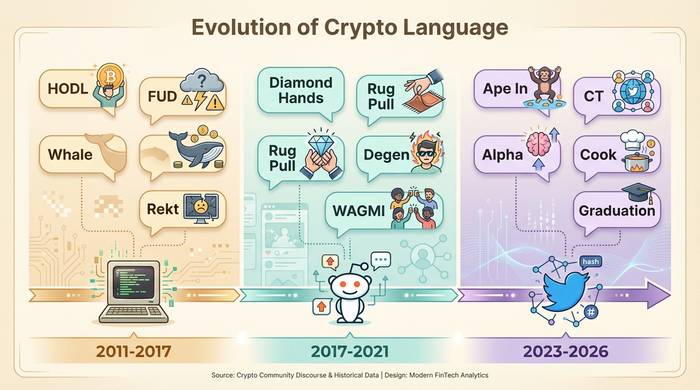
The memecoin and CT era (2023-2026)
The latest wave of slang comes from memecoin culture, Pump.fun, and Crypto Twitter (CT).
Ape in means buying a token without doing any research. Just throwing money at it because the chart looks good or someone you follow mentioned it. "I aped into this new dog coin at 3 AM." It is a conscious decision to skip due diligence. Sometimes it works spectacularly. Mostly it does not.
CT is Crypto Twitter, now the primary platform where crypto culture happens. CT is where news breaks, where alpha gets shared, where influencers shill, and where memes are born. If you are not on CT, you are getting information late.
Alpha means valuable information that most people do not have yet. In traditional finance, alpha is risk-adjusted excess return. In crypto, it just means "inside info that could make you money." "Found some alpha on this new Solana project" means someone found an opportunity before the crowd.
Cook means something is being prepared or developed. "The devs are cooking" means the team is building something the market does not know about yet. It implies upcoming good news.
Nuke means a sharp price crash. "ETH just nuked 15%." Fast, violent, and often unexpected.
Bonding curve graduation is Pump.fun vocabulary. On Pump.fun, a new token starts on a bonding curve where early buyers get in cheap. When the token hits a market cap threshold, it "graduates" to a real DEX like Raydium. Graduation is the moment a memecoin stops being a bonding curve experiment and becomes a tradeable asset.
Ser and fren are CT spellings of "sir" and "friend." Used ironically, affectionately, or both. "Ser, this is a Wendy's" is a way of telling someone they are being too serious about something stupid. "Gm frens" is a greeting to your timeline.
Touch grass means go outside. Stop staring at charts. The term is used when someone is obviously too deep into the market and needs to remember that the real world exists.
Cope and seethe come from internet culture broadly but found a home on CT. "Cope" means deluding yourself about a bad position. "Seethe" means being angry about missing a trade. "He sold at the bottom and is coping hard" or "ETH maxis are seething at Solana's volume."
| Term | Era | What it means | Example |
|---|---|---|---|
| Ape in | 2021+ | Buy without research | "I aped into the new memecoin at launch" |
| CT | 2020+ | Crypto Twitter | "CT is bullish today" |
| Alpha | 2021+ | Valuable early information | "This thread is pure alpha" |
| Degen | 2020+ | High-risk trader (reclaimed) | "Full degen mode on Solana memes" |
| Cook | 2023+ | Something good being prepared | "The team is cooking" |
| Nuke | 2022+ | Sharp price crash | "BTC nuked 10K in an hour" |
| Ser / fren | 2021+ | Sir / friend (ironic CT speak) | "Gm ser, ngmi fren" |
| Touch grass | 2021+ | Go outside, take a break | "You need to touch grass" |
| Graduation | 2024+ | Token moves from bonding curve to DEX | "Only 0.89% of Pump.fun tokens graduate" |
What crypto slang tells you about the culture
If you read crypto slang as just internet humor, you are missing the point. This language does real psychological work.
HODL and diamond hands exist because watching your portfolio lose 90% of its value is one of the hardest things a person can do with money. The words give you a role to play. You are not losing money. You are HODLing. You are not panicking. You have diamond hands. The language reframes financial pain as identity. That is powerful. It keeps people in the market when cold logic says sell.
The tribal layer is harder to defend. NGMI draws a circle and puts anyone outside it in the loser category. Paper hands is not a description. It is a judgment. The crypto community talks about fiat currency like a contagious disease. That us-vs-them framing builds conviction in bull markets and blinds people to risk in bear markets.
The speed of turnover says something too. "When Lambo" is a punchline now, not a goal. "Moonshot" sounds dated. Every market cycle generates its own vocabulary and kills the last one. In 2020, the word was "yield." In 2024, it was "memecoin." In 2026, half the slang that dominates CT today will already sound stale.
And none of it was designed. No company wrote a style guide. HODL was a typo by a drunk Bitcoiner. Degen was an insult that got flipped. Rug pull was descriptive, not coined on purpose. This dialect built itself from the ground up, one forum post and one blown trade at a time.