PLAUD AI Review: Is This AI Voice Recorder Worth It?
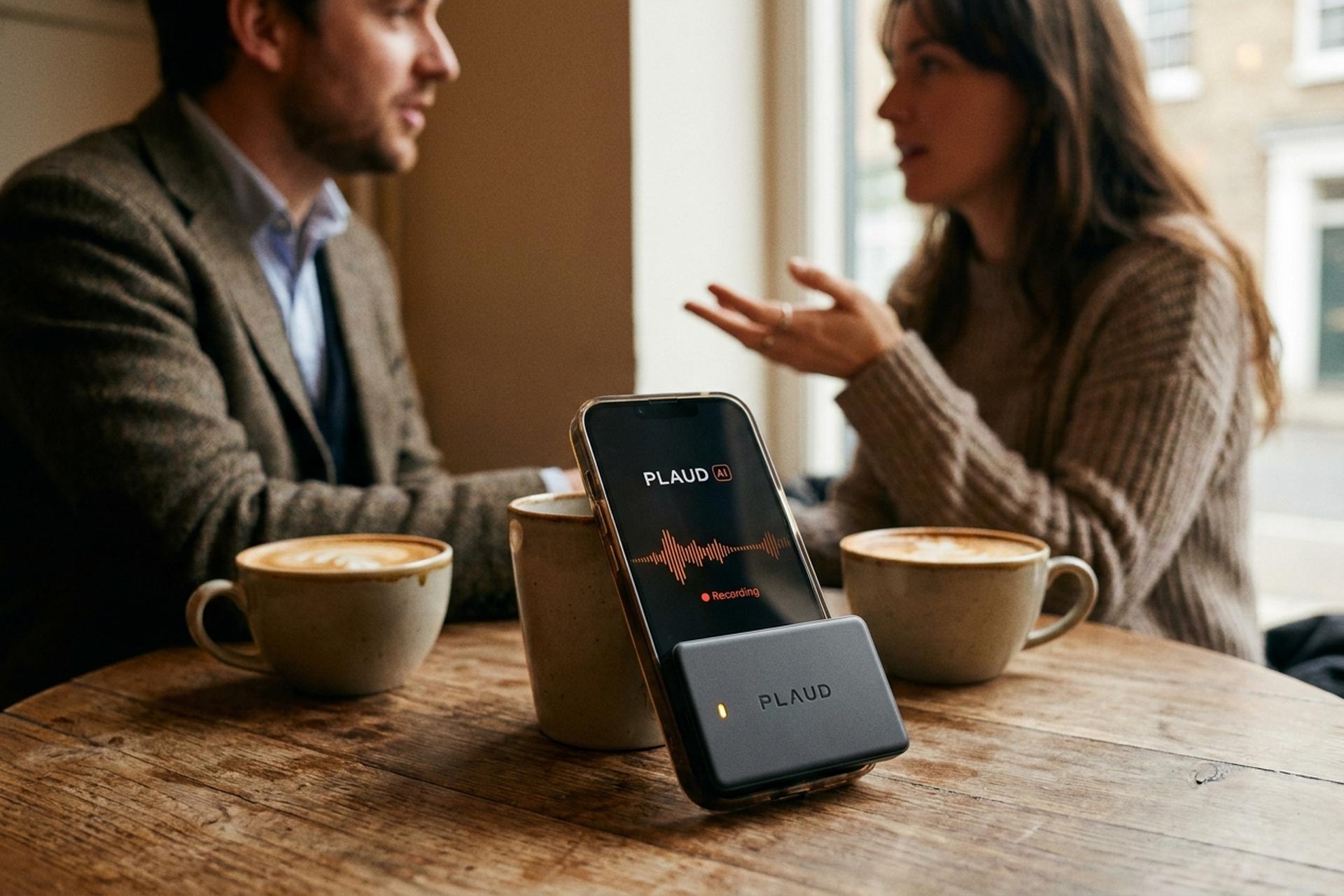
A company that sells credit-card-sized voice recorders has quietly shipped more than 1.5 million of them across 170 countries and is reportedly pulling close to $250 million a year, all on barely $5 million of venture funding. In the same stretch, its two biggest wearable rivals were bought and shut down. So as a business, PLAUD AI clearly works. That part is not in question.
The question that matters to you is narrower and more practical. Is the device, plus the subscription it nudges you toward, actually worth the money? Is the transcription as accurate as the marketing says? And — the part almost every gadget review skips — is it even legal to point at the people you are recording? I will weigh all three honestly, because the answers are not the same for everyone.
What Is PLAUD AI? The Note Taker Lineup
PLAUD AI is not one gadget. It is a small family of AI-powered note-taking devices, and which one you buy changes the value math more than the marketing lets on.
There are four main devices. The PLAUD NOTE ($159) is a thin card that snaps to the back of your phone with magnets and records meetings and phone calls. The NotePin ($159) and NotePin S ($179) are wearable AI devices you clip on or wear like a pendant for hands-free capture. The Note Pro ($189) is the higher-end model aimed at larger rooms and teams. There is also a PLAUD Desktop app for capturing online meetings without sending a bot into the call.
The choice between them is really a choice about how you work. If most of your recording is phone calls and desk meetings, the NOTE on the back of your phone is the natural pick. If you spend your day walking between conversations, a NotePin you never have to fish out wins. The thirty-dollar gap between the cheapest and priciest device is small enough that the form factor, not the price, should decide it.
Behind it all is a company called PLAUD, led by founder Xu Gao. It says more than two million professionals use its tools, and independent trackers put devices sold north of 1.5 million. One question comes up constantly, so let me answer it plainly: yes, PLAUD was founded by a team with Chinese roots and operates globally. On its own that tells you little. What actually matters is where your audio goes and who can read it, which I will come back to in the privacy section, because that is the part worth your attention.
How PLAUD Records, Transcribes, and Summarizes
The core loop in PLAUD AI is genuinely good, and it is worth being precise about where the value sits: it is in the summary, not the recording. Anything can record audio. The reason people pay for this AI tool is that it turns an hour of talking into something you can actually use in thirty seconds.
Capture: NOTE, NotePin, and phone calls
Capture is a single tap. The NOTE sits on your phone and handles audio recording of both sides of a phone call as well as in-person conversation; the NotePin rides on your collar for meetings where pulling out a phone would be rude or obvious. The desktop app handles video calls. The hardware is deliberately boring in the best way, with no screen to distract you and long enough battery to forget it is running. That last point is the quiet selling point. A phone app makes you choose between being present in the room and taking notes; a dedicated recorder you can ignore lets you do both, which is the whole pitch in one sentence.
Transcribe in 112 languages
Once a recording stops, it uploads and auto-transcribes, with the AI transcription supporting 112 languages and labeling who said what. The transcription and the summaries lean on frontier AI models, and on the Note Pro you can pick between current-generation engines from OpenAI, Google, and Anthropic. This is the part that has improved most over the product's life, and it is why older reviews undersell it.
Summarize and Ask Plaud
The summary is where the product earns its keep. PLAUD produces structured, multidimensional summaries, pulls out action items, and offers more than ten thousand templates tuned to specific situations, from a sales call to a doctor's visit to a lecture. You can also query a recording directly with Ask Plaud, asking what a meeting decided without rereading the transcript, the way you would ask a colleague who took good notes. Export and sharing are straightforward. Used well, it genuinely removes the after-meeting busywork that eats the hour after every call. The flip side, which I will get to, is that all of this only happens because your conversation has been shipped off to be processed somewhere else.
Is PLAUD AI Free? Device Cost and the Pro Plan
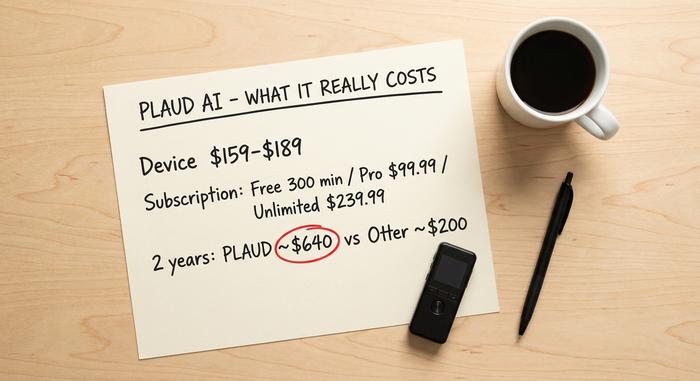
No, PLAUD AI is not free, and the honest cost is two numbers, not one: the hardware up front and the subscription after. This is exactly where the "is it worth it" question lives.
You buy the hardware first
There is no free device. You pay for the recorder, then the PLAUD app gives you a free tier of about 300 transcription minutes a month. For light use that free tier is genuinely usable. For anyone recording daily, it runs out fast, and that is by design.
Device prices and plans
| Device | Price |
|---|---|
| PLAUD NOTE | $159 |
| PLAUD NotePin | $159 |
| PLAUD NotePin S | $179 |
| PLAUD Note Pro | $189 |
| Plan | Cost | Transcription |
|---|---|---|
| Free (Starter) | $0 | ~300 min/month |
| Pro | $99.99/year | ~1,200 min/month |
| Unlimited | $239.99/year | no monthly cap |
The real total cost versus Otter
Stack it up and a serious PLAUD setup is around $159 to $189 for the device plus up to $239.99 a year for the Unlimited plan. Compare that with Otter.ai, which runs about $100 a year with no hardware to buy at all. So PLAUD only makes financial sense if you specifically want a dedicated device, want clean phone-call capture, or dislike running a bot in your meetings. If you mostly need software transcription of video calls, Otter quietly undercuts it. Run the numbers over two years and the gap widens: a PLAUD setup on the Unlimited plan lands near $640, while Otter sits closer to $200, and that difference only buys you something if the hardware is doing work an app cannot.
How Accurate Is PLAUD AI Transcription?
PLAUD AI's headline accuracy figure sits in the 90 to 95 percent range, but treat that as a ceiling, not a floor. It is a vendor number, and there is no published word-error-rate benchmark behind it.
In practice, independent reviewers land in the same place: very good in clean conditions, noticeably worse with background noise, heavy accents, or several people talking over each other. A crowded cafe meeting will not transcribe like a quiet one-on-one, and no amount of marketing changes the physics of a small microphone in a loud room.
The transcription is the easy part. The summary is where errors get dangerous, because an AI summary can quietly invent a decision or misattribute a commitment, and unlike a garbled word, a wrong summary reads perfectly fluently. Picture a summary that confidently records that "the team agreed to ship Friday" when the team agreed to no such thing. The practical rule is simple. For your own notes, it is a huge time saver. For anything that carries legal or financial weight, read the source transcript before you trust the summary.
Is PLAUD AI Safe? Privacy and Recording Law
This is the section the gadget reviews gloss over, and it is the one that can actually cost you money. The hardware is the easy decision. The legal and privacy questions are the hard ones.
Where your audio goes
Your recordings do not stay on the device. They upload to the cloud and pass through third-party AI models to be transcribed and summarized. PLAUD lists a reassuring stack of credentials, including ISO 27001, ISO 27701, SOC 2, and GDPR alignment, and states that customer data is not used to train AI models. That is better than nothing, and better than several rivals. But the honest framing is the one from the founder question above: your conversations leave your control the moment they sync, so the trust you are extending is to PLAUD and its model providers, not just to a gadget in your pocket.
Recording-consent law
Here is the part that surprises people. In the United States, whether you can legally record a conversation depends on your state.
| Consent rule | What it means |
|---|---|
| One-party consent | only you need to agree to record (federal default, many states) |
| All-party consent | everyone in the conversation must agree (13 states) |
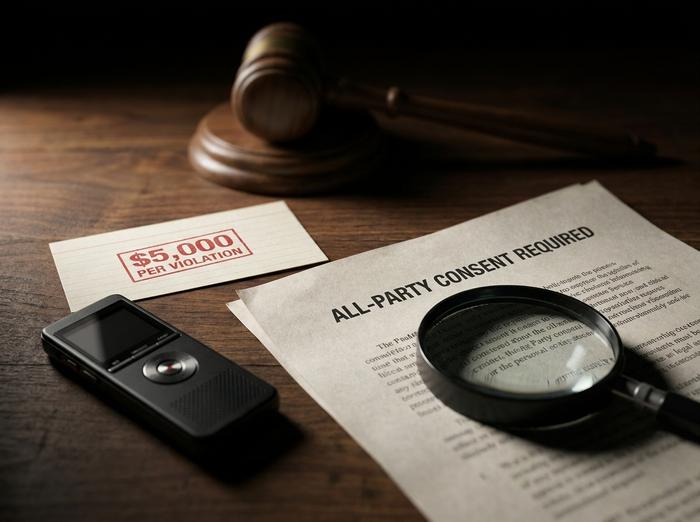
| California (Penal Code 632) | all-party; civil penalty up to $5,000 per violation |
| Ambriz v. Google (2025) | a "capability test" that can create CIPA liability for AI recording tools |
Thirteen states require all-party consent before you record, and a 2025 California case, Ambriz v. Google, pushed the exposure further by focusing on a tool's capability to intercept communications, not just what it ultimately does with the data. In plain terms, that legal theory can attach liability to the recording itself, before anyone even reads the transcript. PLAUD, like every tool in this category, puts that liability squarely on you, the user, in its terms. None of this makes the device illegal to own. It makes quietly recording other people a risk you are carrying personally. The fix is unglamorous but real: tell people they are being recorded, and get a yes. In a one-on-one in a one-party state that is trivial; in a group call spanning several states it is genuinely worth thinking about before you hit record.
The HIPAA gap
PLAUD lists HIPAA among its certifications, which sounds perfect for a doctor or therapist. Look closer. Healthcare compliance hinges on a signed Business Associate Agreement, and there is no public BAA on offer. Without one, recording patients on PLAUD is very likely non-compliant no matter what badge appears on the marketing page. If you work in healthcare, do not put it near a patient without your compliance team signing off first.
PLAUD AI vs Otter.ai and the Empty Field
PLAUD's strongest advantage in 2026 is not a feature. It is that most of the competition vanished.
| Tool | Cost | Notes |
|---|---|---|
| PLAUD | $159+ device + up to $240/yr | dedicated hardware, phone-call capture |
| Otter.ai | ~$100/year | software only, no device |
| Limitless Pendant | discontinued | acquired by Meta, wound down |
| Bee | discontinued | acquired by Amazon, wound down |
The wearable-AI field thinned out fast. Limitless was absorbed by Meta and Bee by Amazon, and both consumer products were wound down, leaving PLAUD as the last standalone hardware note taker really standing. That is good and bad news at once. Good, because PLAUD now has the dedicated-device niche largely to itself and the revenue to keep improving. Bad, because the same wave that took out its rivals is a reminder that hardware startups get bought and shut down, and a recorder is only as useful as the cloud service behind it stays alive. PLAUD's scale makes that risk lower than most, but it is not zero, and it is worth pricing in when you buy a device that depends on a subscription. Otter remains the obvious software alternative and the cheaper one. So the choice is less "which gadget" and more "do I want a gadget at all," because if the answer is no, Otter does the software job for less.
The Verdict: Is PLAUD AI Worth It?
PLAUD AI is worth it for a specific person: someone who records a lot, wants a dedicated device rather than another app, values clean phone-call and in-person capture, and is in a position to control consent. For that user, the summaries alone pay back the cost in saved time. For everyone else, the case is weaker. Casual users will find Otter cheaper, and anyone tempted to quietly record people in an all-party-consent state is buying a legal problem, not a productivity tool. The summaries are the real product here. The legal exposure is the real catch. So the honest question is not whether PLAUD works. It is whether your recordings are yours to make.