Securing a Lithuanian Crypto License in 2026 : MiCA CASP
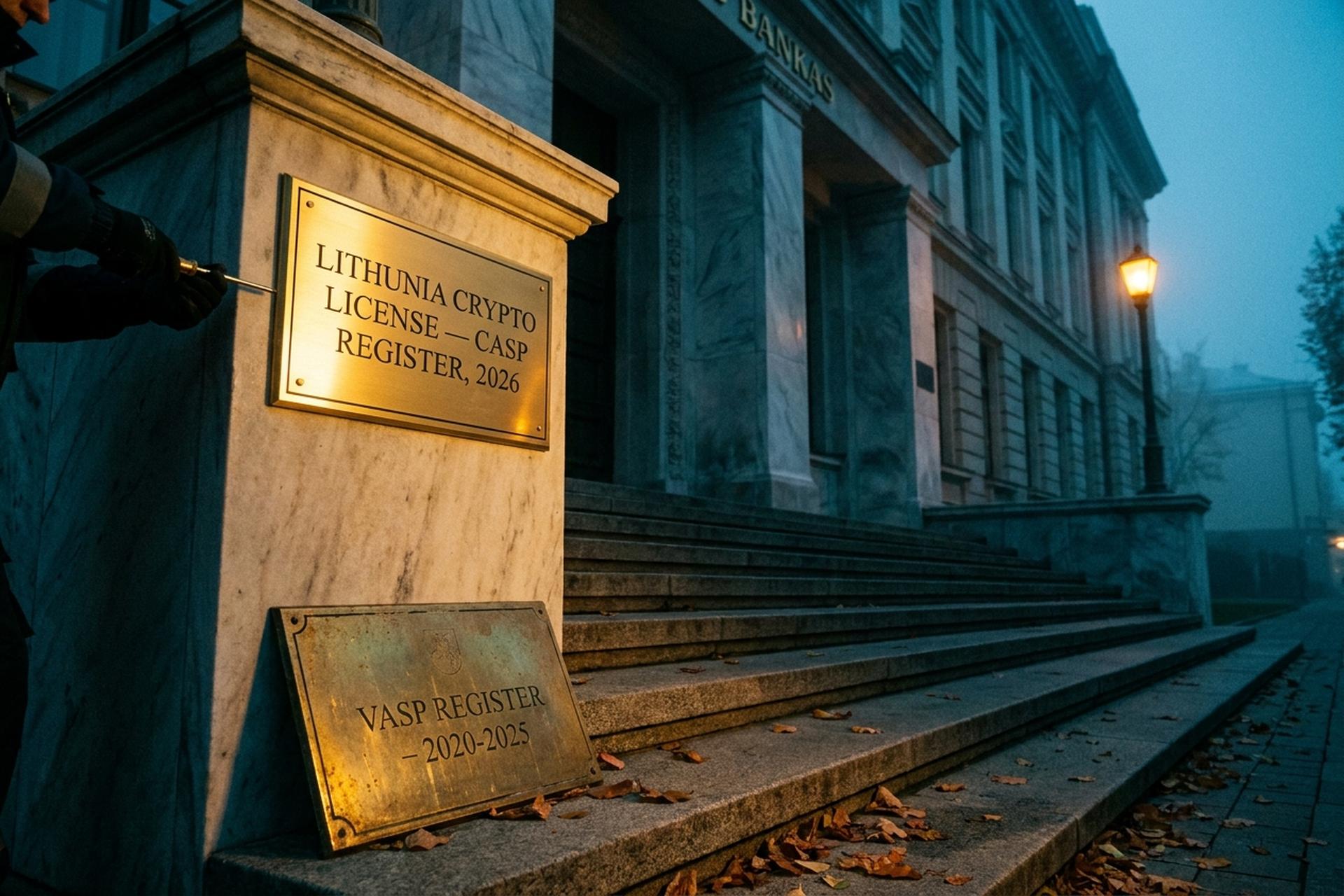
At its 2022 peak, Lithuania had more than 800 registered crypto firms. By late 2024 the number was 307. By the close of 2025, only three companies held a MiCA-era CASP authorisation issued by the Bank of Lithuania: Robinhood Europe, CoinGate, and Nuvei. The Lithuania crypto license, and crypto licenses in Lithuania more broadly, have not disappeared — the cryptocurrency license regime has been re-engineered, and the cost of entry has changed accordingly. Obtaining a crypto license in Lithuania is now a documentation-led project rather than a paperwork shortcut.
Why Lithuania Still Leads on Crypto Licenses
Lithuania did not fade when MiCA took effect. Title V of MiCA creates the new CASP license. It applied across the EU from 30 December 2024. Lithuania moved fast at home. Its Law on Markets in Crypto-Assets passed on 11 July 2024. The law named the Bank of Lithuania (Lietuvos bankas) as the lead regulator. The Financial Crime Investigation Service (FCIS) lost its old VASP-licensor role at the same time.
Robinhood Europe UAB became Lithuania's first MiCA-era CASP holder earlier in 2025. On 17 December 2025 the Bank of Lithuania authorised two more — CoinGate (UAB Decentralized) and Nuvei Liquidity. Three approvals out of more than three hundred legacy VASPs sounds harsh. It is harsh. It also signals how the regime works now. The bar is high. The process is paper-heavy. The regulator picks firms that arrive ready, not firms that arrive cheap.
The reasons startups picked Lithuania still hold. The Bank of Lithuania still moves faster than several larger EU peers. EU passporting still hands a Lithuanian CASP a market of roughly €17 trillion in household financial assets. One Lithuanian crypto exchange license lets the holder serve clients in every other EU state without re-applying. The license allows that cross-border work by default. The fintech ecosystem around Vilnius — Revolut, Wise, Paysera — built deep local talent that you cannot copy in a smaller country overnight. What changed is that "fast and cheap" is now "fast and serious." For firms that can clear the bar, the cryptocurrency licence in Lithuania remains one of the more credible routes onto the EU market.

From VASP to CASP: The MiCA Transition
Two clean-up rounds set the stage. In November 2022, Lithuania pushed the minimum share capital for a domestic VASP from €2,500 to €125,000. Half the registry deregistered. Then MiCA arrived in late 2024, and the EU offered member states up to eighteen months of grandfathering for legacy operators. Lithuania declined the full window. The Lithuanian cutoff landed at 1 January 2026 (briefly cited as 31 December 2025 mid-transition). Any legacy VASP that had not filed a CASP application by then lost the right to operate without re-applying from scratch.
MiCA restructured what sat underneath. The Lithuanian CASP regime now sorts three license classes by service scope, not firm size — covered next. Authority over crypto firms is split. The Bank of Lithuania runs prudential and market-conduct supervision and the MiCA-AML overlay. The FCIS (also called FNTT) keeps AML and CFT enforcement, receives suspicious-activity reports, and supervises national-level financial-crime rules. A Lithuanian-resident AML officer, full-time and exclusive to one CASP, became mandatory. Physical office in Lithuania. At least one Lithuanian or EU-resident board member. From 1 January 2025, a Lithuanian or EU-branch bank account from day one. Not after the fact.
None of this came out of nowhere. The architecture mirrors MiCA Annex II almost line by line, with a national overlay that codifies practice. Calling the VASP-to-CASP transition a revolution overstates it. Re-platforming is closer.
The Three CASP License Classes Explained
A common beginner mistake is to ask for "the" crypto license. There is not one. MiCA defines three CASP classes by the activities you intend to perform, and the capital requirement scales with the riskiest activity in scope. The classes replaced the old binary "exchange licence vs wallet licence" split that the pre-MiCA virtual asset service provider regime used.
| Class | In-scope services | Minimum capital |
|---|---|---|
| Class 1 | Advice, order placement, reception and transmission | €50,000 |
| Class 2 | Custody and administration, exchange (crypto/fiat or crypto/crypto), execution, transfer services | €125,000 |
| Class 3 | Operation of a trading platform | €150,000 |
Pick the wrong class and the Bank of Lithuania will either request a re-classification or reject the application. Plan for the highest-risk service you actually intend to offer in the first eighteen months, and design your governance to match it.
Share Capital, Fees, and Year-One Compliance Cost
Lithuania remains among the cheaper Phase-1 setups in the EU. "Cheap" is now a relative word, though. Consultancy estimates put the Bank of Lithuania application fee in the €5,000 to €25,000 range, depending on class and complexity. First-year supervisory costs typically add €20,000 to €40,000 on top. The Czech Republic is lower on paper — the CNB charges CZK 20,000, roughly €800 — but it does not yet match Lithuania's depth of fintech advisory talent.
| Cost line | Lithuania | Notes |
|---|---|---|
| BoL application fee | €5,000–€25,000 | Class-dependent |
| First-year supervisory fees | €20,000–€40,000 | Includes ICT/DORA filings |
| Legal + corporate setup | €20,000–€60,000 | Named providers: Sorainen, Adamsmith, Hacken, Manimama, Gofaizen & Sherle |
| Total year-one (incl. capital + ops) | €150,000–€250,000 | Versus €400,000–€700,000 in Germany or the Netherlands |
The right way to read the table is not as a discount versus the EU average. Treat it as the floor below which your operation cannot survive the BoL's documentation requirements. Underbidding the line items invites a rejection, which costs more in the end than budgeting them in from day one.
How to Obtain a CASP License in Lithuania
The application process has both a statutory side and a practical side, and they diverge by several months. Walk through it in this order.
First, register a Lithuanian limited-liability company (UAB) with Registrų centras. This is the legal entity that will hold the CASP authorisation, and company formation in Lithuania for non-resident founders typically completes in 5-10 working days. The same step works for both crypto exchange services and custody or storage services; remote incorporation is possible, but you will still need apostilled corporate documents for non-EU shareholders. Legal entities incorporated outside the EU cannot directly hold a Lithuanian CASP licence — they must use a Lithuanian subsidiary or branch. Second, appoint a Lithuanian-resident AML officer (full-time, single-employer), at least one Lithuanian or EU-resident board member, and arrange a physical office in Lithuania.
Third, open a corporate bank account at a Lithuanian bank or an EU bank with a Lithuanian branch. From 1 January 2025 this has been mandatory and cannot be opened after the application has been filed.
Fourth, prepare the documentation pack. The Bank of Lithuania expects a full business plan, an AML and counter-terrorist-financing policy, an internal risk-management framework, an ICT and operational-resilience programme that satisfies the Digital Operational Resilience Act (DORA), fit-and-proper documentation for senior managers and any beneficial owner above the 10% threshold, and a white paper if the firm intends to issue or offer crypto-assets.
Fifth, submit to the Bank of Lithuania.
Sixth comes the completeness check, capped at 25 working days under MiCA Article 63. The Bank either accepts the file for substantive review or asks for additional material, which restarts that clock.
Seventh, the substantive assessment runs for up to 40 working days. End-to-end statutory ceiling: 65 working days. The practical reality, confirmed by both Hacken and Buckingham Capital Consulting, is three to six months for a clean file, with several firms approved in four to five.

AML, KYC, Travel Rule, and DORA Compliance
Compliance is the part that actually decides whether a CASP application survives review. Two EU regimes sit on top of MiCA. The Transfer of Funds Regulation (EU Reg. 2023/1113), in force from 30 December 2024, requires CASPs to collect and transmit originator and beneficiary data on transfers above €1,000. The same threshold applies to transfers involving self-hosted wallets — the "Travel Rule" leg that most legacy VASPs had been ignoring.
The Digital Operational Resilience Act (EU Reg. 2022/2554), applicable from 17 January 2025, demands a documented ICT risk-management framework, incident reporting on a defined clock, and a maintained register of third-party ICT providers. CASPs fall in scope because MiCA classifies them as financial entities.
Domestically, Lithuanian-resident AML officers cannot be shared across firms, and the FCIS retains the supervisory hammer for money laundering and terrorist financing prevention and suspicious-activity reporting. Practically, that means your AML officer has to be an actual person in Lithuania, on payroll, accessible to the FCIS. The same officer signs off on customer due-diligence procedures for crypto assets, digital asset transfers, and any virtual asset service provider activity offered to Lithuanian or EU residents.
Lithuanian Crypto License vs Estonia, Malta, Czech
Four jurisdictions get compared all the time. Honest summary in 2026: Lithuania sits in the middle.
| Jurisdiction | Capital | App fee | Substance | 2026 status |
|---|---|---|---|---|
| Lithuania | €50k–€150k | €5k–€25k | LT AML officer + LT board + LT bank | 3 MiCA CASPs by end-2025 |
| Estonia | €100k–€250k | Higher | Estonian-resident director, on-site office, local AML | FIU revoked ~389 of ~490 VASPs by 2023; grandfathering to 1 July 2026 |
| Malta | €50k–€150k | ~€35k+ | MFSA approval, local presence | ~10 active CASPs; VFA grandfathering to 1 July 2026 |
| Czech Republic | €50k–€150k | CZK 20,000 (~€800) | Czech entity, CNB oversight | CNB became NCA 15 Feb 2025; first 6 CASPs end-2025 |
Estonia bled out its VASP roll in 2022–2023 and now imposes the toughest substance. Malta is selective and slow. The Czech Republic is the cheapest paper-fee route, but its CNB authorisation pipeline is younger than Lithuania's and its advisory market is thinner. Lithuania trades a higher fee for a more mature regulator-and-consultant ecosystem.
Common Compliance Mistakes Crypto Companies Make
Four patterns show up in early Bank of Lithuania rejections. The first is class mismatch: applying for Class 2 while the business plan describes Class 3 trading-platform activity. The second is a non-resident AML officer dressed up as a Lithuanian one. The third is a thin business plan that ignores concentration risk on a single counterparty or chain. The fourth is a DORA register that lists third parties without any substantive risk assessment. Each of these is fixable. The cost of fixing them mid-application is far higher than getting them right before the file is submitted.
Tax Treatment for a Crypto Business in Lithuania
The standard corporate tax rate in Lithuania sits at 15%. Small companies — under ten employees, annual turnover below €300,000 — get a reduced 5% rate. Cryptocurrency exchange between a digital asset and fiat is VAT-exempt, following the CJEU's Hedqvist judgment (Case C-264/14), which the Lithuanian tax authority applies domestically. Personal capital gains on crypto land at a flat 15%. None of this is the cheapest in Europe. Combined with the regulatory ecosystem, the overall tax picture for a cryptocurrency license in Lithuania still looks competitive against Germany or the Netherlands.
Where a Plisio Payment Gateway Fits Crypto Companies
Not every crypto business needs a CASP license. A merchant accepting Bitcoin or USDT through a payment gateway like Plisio is operating as a customer of an already-authorised service provider, not as a licensee. The same logic applies to many small platforms that route the cryptocurrency licence-bearing activity to a partner. That distinction matters for early-stage e-commerce projects, because the cost of accepting crypto can be the cost of an integration rather than the cost of a year-long license application.