SWIFT and XRP: Can Ripple Replace SWIFT’s Rails?
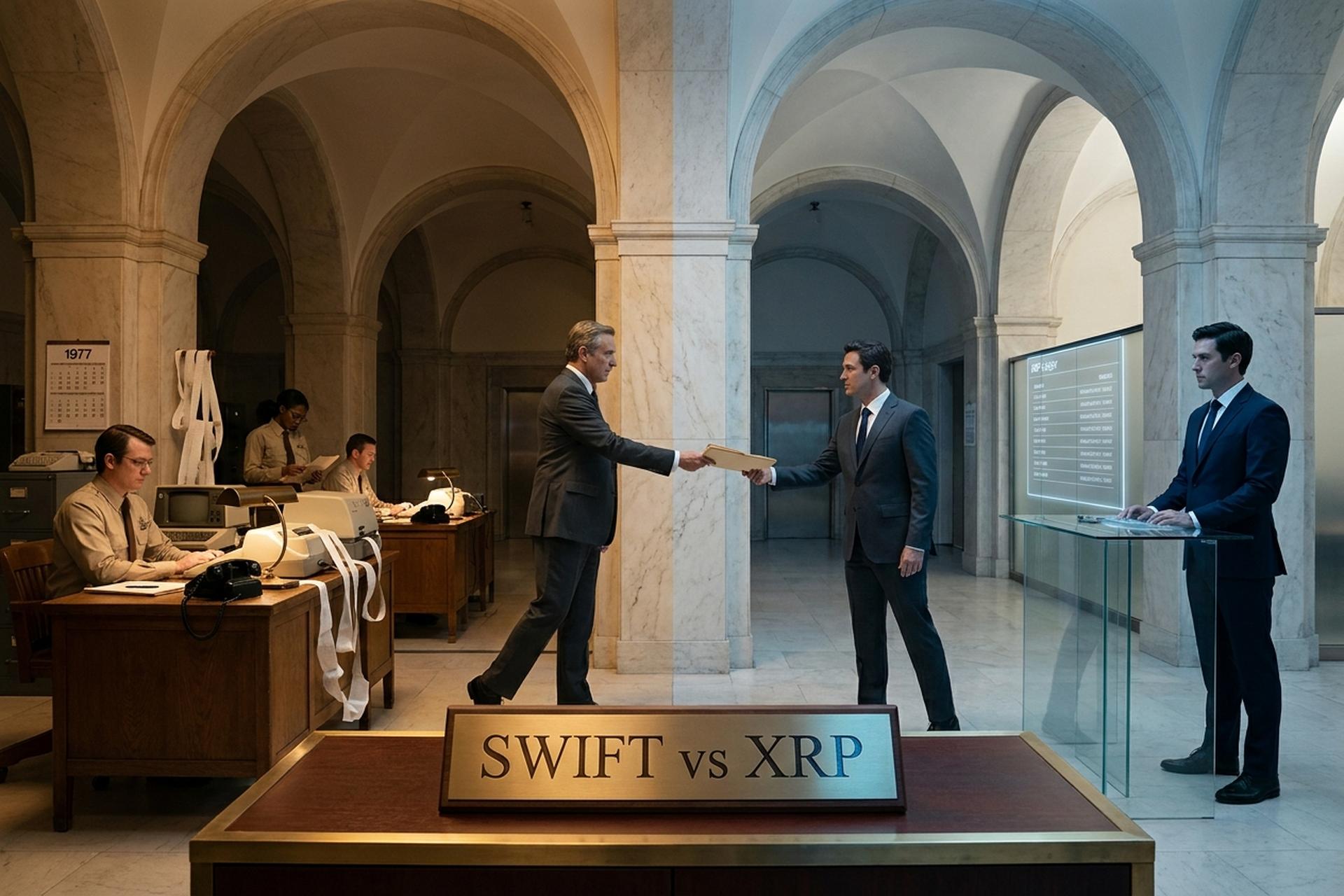
The most awkward fact about the SWIFT vs XRP debate in 2026 is that both sides are right and both sides are wrong at the same time. SWIFT named more than thirty banks for a new instant-payments framework going live in mid-2026, and at least half of those banks already have working relationships with Ripple. The two networks supposedly fighting a winner-takes-all war share most of their important customers. That alone breaks the binary.
For years, "XRP replaces SWIFT" was the punchiest line in crypto. It assumed a head-on collision between an old, slow messaging network and a fast blockchain-based settlement rail. The reality has turned out messier. SWIFT did not stand still; it modernized, partnered with Chainlink, hired ConsenSys to build its own ledger, and rolled out gpi and Swift Go. Ripple, in turn, shifted the heart of its commercial story away from XRP-as-a-bridge toward a stablecoin called RLUSD and a prime brokerage acquired for 1.25 billion dollars. The competing visions are still there, but the rails on the ground in 2026 look more like coexistence than displacement.
This article walks through what each side actually does, what changed across 2025, and where the real money is moving in cross-border payment infrastructure today.
What SWIFT actually is and why XRP got compared to it
SWIFT is not a payment system. That is the single most useful sentence to start with. The Society for Worldwide Interbank Financial Telecommunication is a messaging network. When a bank in Spain wires money to a bank in Singapore, SWIFT is the secure pipe that carries the instruction; the actual move money operation happens through correspondent banks holding pre-funded nostro accounts on either side. The funds never leave the banking system; the message tells everyone what to debit and credit.
The scale is enormous. According to SWIFT's 2024 Annual Review, more than 11,500 financial institutions across more than 200 countries use the network, and FIN traffic reached 13.4 billion messages in 2024 — roughly 53.3 million a day, with a peak of 59.5 million on December 20, 2024. That is twelve percent year-on-year growth, the fastest pace in fifteen years. SWIFT's gpi service moves around 530 billion dollars in daily value, and SWIFT data show that about sixty percent of gpi payments credit the beneficiary inside thirty minutes and roughly ninety percent within an hour, already ahead of the G20's 2027 target. The five-day SWIFT transaction is mostly a story about exotic corridors and outdated correspondent chains, not the median experience.
XRP is a different animal. The XRP Ledger is a public blockchain that settles in three to five seconds at a base fee of 0.00001 XRP, around two-hundredths of a cent. Throughput is roughly 1,500 transactions per second. Where SWIFT moves messages between banks, the XRP Ledger moves value directly. Ripple, the payments company that uses XRPL most aggressively, sells the idea of using XRP as a bridge currency: a sending institution converts local fiat to XRP, the digital asset travels across borders in seconds, and the receiving institution converts to its own fiat. The use of XRP as a bridge means there is no need for pre-funded nostro accounts on either side, because the digital asset itself sources liquidity in real time.
So the comparison is not quite a category error, but it is close. SWIFT and XRP can be substitutes only at the layer where they overlap: cross-border value transfer between financial institutions. SWIFT's messaging dominates the wholesale layer; XRP, through Ripple's product, competes mainly at the on-demand liquidity layer beneath it. That nuance matters when the question is whether one can replace the other at all.

Ripple, XRP, and on-demand liquidity explained
On-Demand Liquidity, or ODL, is Ripple's flagship product and the reason XRP has any payments use case at all. A bank in Mexico that wants to send remittances to the Philippines used to need pesos parked in Manila and pesos coming back the other way. With ODL, the bank converts pesos into XRP on a Mexican exchange, ships the XRP across the XRP Ledger, and the receiving partner sells the XRP for Philippine pesos on a local exchange. The bridge uses XRP for under a minute. No pre-funded accounts, no idle capital.
This is where Ripple's marketing and Ripple's revenue diverge. RippleNet has more than 300 financial institutions across 55 countries on its books, but only about forty percent — roughly 120 firms — actually use XRP through ODL. Most of the rest sit on the messaging layer, which integrates xrp not at all. SBI Remit in Japan (Japan to Philippines, since 2021), Tranglo across South-East Asia, Travelex Bank in Brazil (the first Latin American bank fully on ODL), Pyypl, Modulr, and Zand Bank in the United Arab Emirates show up as confirmed ODL users. Santander, MUFG, and Standard Chartered show up on every "Ripple partner" list but route through messaging, not the token; Santander's One Pay FX has explicitly said it uses RippleNet messaging only, not XRP for liquidity.
| Institution | Region | Layer | Notes |
|---|---|---|---|
| SBI Remit | Japan | ODL (XRP-using) | Japan to Philippines corridor since 2021 |
| Tranglo | South-East Asia | ODL | Joint venture; key XRP corridor hub |
| Travelex Bank | Brazil | ODL | First Latin American bank fully on ODL |
| Zand Bank | UAE | ODL | Live UAE corridors from 2025 |
| Pyypl, Modulr, Onafriq | EMEA / Africa | ODL | Remittance specialists |
| Santander (One Pay FX) | Spain / UK | RippleNet messaging | Uses messaging, not XRP, for liquidity |
| MUFG, Standard Chartered | Japan / UK | RippleNet messaging | No XRP for settlement |
| Bank of America | US | RippleNet member since 2016 | Marketing claim of "100% internal tx on XRP" never confirmed by BoA |
Of the 300-plus institutions on RippleNet, roughly 120 actually use XRP through ODL. The rest, including most Tier 1 banks, sit on the messaging layer alongside their existing SWIFT connections. Calling RippleNet a SWIFT replacement is a stretch when most of its members still rely on traditional correspondent banking for the bulk of their international transfers.
SWIFT vs XRP: speed, cost, and the data table
Side by side, the operational gap is real but narrower than the headline numbers suggest. SWIFT gpi handles many transfers in minutes; XRPL clears in seconds. The fee gap is wider than the speed gap. Each SWIFT cross-border payment carries roughly 25 to 50 dollars in combined messaging, intermediary, and FX costs (an industry estimate, not a SWIFT-published number), while XRPL fees are essentially zero. The bigger savings, though, come from the elimination of pre-funded nostro accounts, which can lock up billions of dollars per major bank.
| Dimension | SWIFT | XRP / XRPL |
|---|---|---|
| Settlement time | ~60% via gpi in <30 min; ~90% in <1 h | 3 to 5 seconds |
| Transaction fee | $26-$50 typical (industry estimate) | ~$0.0002 base fee |
| Throughput | 13.4 B FIN messages in 2024; 53.3 M per day | ~1,500 transactions per second |
| Coverage | 11,500+ institutions, 200+ countries | 55+ live corridors via Ripple |
| Governance | G10 central banks, ~2,400 member shareholders | Open protocol; Ripple is largest holder |
| Liquidity model | Pre-funded nostro accounts | On-demand via XRP bridge |
The data still favours XRP on a per-transaction basis. What it does not capture is the cost of switching: the deep regulatory relationships SWIFT has with central banks, sanctions regimes, and audit trails that Tier 1 banks need before they can move a single dollar at scale. That is not a technology problem.
The 2026 SWIFT framework: 30 banks, 25 corridors, no XRP
In late 2025, SWIFT announced its biggest payments move in a decade. The framework is a coordinated push to deliver near-instant retail and SMB cross-border payments across 25-plus corridors. The first wave is a live scheme by mid-2026. SWIFT named more than 30 of the 50-plus participating banks; the headliners include Bank of America, JPMorgan Chase, Citigroup, Toronto-Dominion, HSBC, Santander, and Deutsche Bank. The corridors cover India, Pakistan, Bangladesh, China, Thailand, the United Kingdom, the United States, Australia, Canada, Germany, and Spain — five of the world's top ten remittance markets among them.
XRP is not a counterparty to that framework. It plays no role in the messaging, settlement, or liquidity provision. That is the part the crypto press tends to skip. The more interesting irony is that at least 30 of the 50-plus banks SWIFT named already have ties to Ripple, and a meaningful share use ODL on at least some corridors. So the same Tier 1 banks that signed up for SWIFT's instant-payments scheme are also part of Ripple's distribution.
Separately, and easy to confuse with the consumer-payments framework, SWIFT is building a blockchain-based shared ledger as a parallel track. This is the SWIFT blockchain workstream that crypto media tend to label a potential SWIFT replacement, though the project is much narrower than the headline. The development partner is ConsenSys, the Ethereum-focused firm behind Linea and MetaMask. Bank of America, JPMorgan, Citigroup, and Toronto-Dominion are among the named participants in the prototype. SWIFT's MVP design uses tokenized commercial bank deposits as the settlement instrument; XRP is explicitly not part of the architecture. The ledger is also not yet live; the Motley Fool described it in late 2025 as an early-stage conceptual prototype.
There is a separate fact often misread as a partnership: XRPL has been a member of the ISO 20022 Registration Management Group since 2020, the same status as Stellar, Hedera, and Algorand. SWIFT's cross-border MT-to-MX coexistence period ended on November 22, 2025; every cross-border instruction now moves in MX format. Technical interoperability is real. A commercial Ripple-SWIFT integration is not.
The takeaway is uncomfortable for the maximalist version of the XRP thesis. SWIFT is not waiting to be disrupted. It is hiring blockchain engineers, naming banks worldwide for new schemes, running a CBDC sandbox that processed more than 750 transactions across 38 central banks and market infrastructures, and absorbing the modernization narrative through its existing global network.
Stablecoins and the quiet pivot inside Ripple
The most overlooked story of 2025 was that Ripple itself became less of an XRP-only company. On December 17, 2024, Ripple launched RLUSD, a US-dollar-pegged stablecoin issued under New York Department of Financial Services oversight. By July 2025 RLUSD had crossed 500 million dollars in market cap, and by early December 2025 it sat at 1.26 billion, the third-largest US-regulated stablecoin. In April 2025 Ripple agreed to acquire prime broker Hidden Road for 1.25 billion dollars, closing the deal in October 2025; Hidden Road clears roughly 3 trillion dollars a year for over 300 institutional clients. Add Metaco (250 million in 2023) and Standard Custody (closed mid-2024), and Ripple has spent close to four billion dollars reshaping itself from a payments company into an institutional infrastructure stack.
Stablecoins solve the volatility problem that has dogged the XRP-as-bridge thesis from day one. A treasurer routing 100 million dollars through a five-second corridor cannot afford to be exposed to a four-percent intraday move in a token's price. Stablecoins also fit the 2026 regulatory mood music, with the European Union's MiCA framework, Singapore's MAS guidelines, and the US GENIUS Act all leaning toward dollar-backed digital assets. SWIFT itself has shown no appetite for issuing or settling stablecoins. That leaves an open lane for Ripple Payments and competitors like Circle. The fight over the future of cross-border payments is shifting from "blockchain vs messaging" to "which dollar token wins."
Will XRP replace SWIFT? The math that doesn't work
Brad Garlinghouse, Ripple's CEO, said at XRPL Apex in Singapore in June 2025 that the goal is to capture roughly fourteen percent of SWIFT's volume within five years — about twenty-one trillion dollars a year. That is the company's own stated ceiling, and a ceiling, not a replacement. SWIFT moves around 190 trillion dollars in cross-border flows annually, and McKinsey's Global Payments Report 2025 puts total global payment flows close to two quadrillion. Even capturing the upper bound Ripple has described would still leave more than eighty percent of the wholesale messaging market with SWIFT.
There is also a pure-math problem with full replacement. Ripple's own ODL volume, as best as can be reconstructed, was roughly 15 billion dollars in 2024 and about 1.3 billion in Q2 2025; both figures are Ripple-sourced and have not been independently audited. Reaching twenty-one trillion would mean a thousand-fold scaling. For XRP to handle one hundred percent of SWIFT's flow as a bridge currency, the working stock of XRP needed to source liquidity in real time would imply a market cap larger than most national stock markets. Replacement, in other words, is internally inconsistent with the price predictions XRP holders tend to attach to it. The serious version of the bull case is share-of-flow, not displacement.

XRP ETFs and the price vs payment solutions split
Spot XRP ETFs are a separate story that often gets glued to the SWIFT debate, with the result that XRP price moves are routinely read as a verdict on payment solutions and on the potential for XRP to take share from existing SWIFT rails. After the SEC withdrew its appeal on March 19, 2025 and SEC v Ripple closed on August 7, 2025 with a fifty million dollar penalty (down from 125 million originally sought), seven spot XRP ETFs went live by year-end: REX-Osprey XRPR in September, Bitwise's product at a 0.34 percent expense ratio in November, plus Canary, Franklin Templeton, Grayscale, 21Shares, and Amplify. Cumulative inflows passed 1.37 billion dollars by mid-January 2026 with ETP AUM around 2.6 billion by the end of Q1 2026. BlackRock has not filed. ETF inflows move price, not payments throughput; a treasurer at HSBC does not care what XRP closes at on a Friday.
What this means for cross-border payment users
The honest answer for a corporate treasurer in 2026 is "both." Use SWIFT for the deep regulatory perimeter, large institutional moves, and any flow tied to sanctioned-country compliance. Use Ripple Payments or a stablecoin rail for high-frequency corridors where liquidity sourcing and settlement speed dominate. Replacement is a slogan; portfolio-of-rails is the practical model the banks themselves are quietly running.
The takeaway: rails, not winners
SWIFT and XRP have spent five years cast as opposites. The 2026 picture is more mundane and more interesting at once. SWIFT modernized faster than its critics expected, named banks worldwide for instant payments, and started building its own ledger with ConsenSys. Ripple shifted weight from XRP-as-bridge toward stablecoins, custody, and a prime brokerage, accepting that the easier road into bank treasuries runs through dollar-denominated rails. The remaining question for the next decade is not which one wins. It is which slices of the global payment system each captures, and how quickly the banks holding the wallet decide they no longer need to choose.