Best Web3 Wallets: Crypto Wallet, Ledger, DeFi, NFTs, dApps

Web3 wallets sit alone at the top of a crypto user's toolkit in 2026. They own the private keys. Those keys prove you, and only you, control every token, NFT, and on-chain identity tied to your address. Every transaction that moves money, mints art, joins a DAO, or pays a merchant runs through them. Right now, roughly 820 million active crypto wallets are live worldwide. About 6.8% of the planet. One sloppy click inside any of them can flip a portfolio into someone else's profit before lunch.
So this guide walks through the things that actually matter. What Web3 wallets really are. How they work under the hood. The types you will run into. Security choices that will save or cost you money. Best Web3 wallets for 2026. And how wallets plug into real-world jobs: DeFi, NFTs, dApps, crypto payments. Written for Plisio readers, so there is a full section on payments plus the usual custody and security material.
What Is a Web3 Wallet? Blockchain Keys and dApps
Software, or a tiny piece of hardware. That is the whole surface area of a Web3 wallet. It stores the cryptographic keys tied to a blockchain address, and those keys are what let the owner sign transactions the chain treats as authoritative. No signature, nothing moves.
The mental model is two keys and one phrase. A public key, turned into a wallet address, is the thing you share to receive funds. Think of it like an email. A private key is the secret that proves you own whatever sits at that address. You never share it. Lose it and the blockchain shrugs, because there is no password reset. The assets are simply gone.
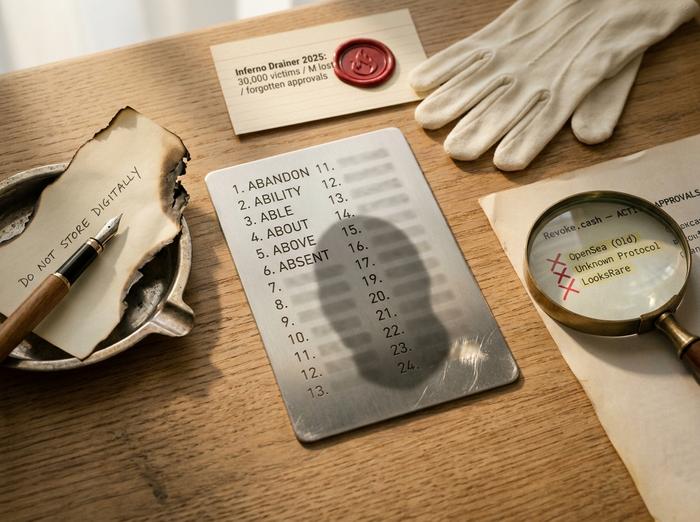
Most wallets add a recovery phrase (12 to 24 words) that can regenerate the private key if the wallet software breaks or your phone dies. That phrase is the root of everything. Acceptable homes for it: paper, engraved metal, a hardware wallet. Unacceptable homes: screenshots, cloud drives, and the notes app.
Beyond key storage, Web3 wallets are the gateway into decentralized applications. A DeFi protocol, an NFT marketplace, a Web3 game, a Plisio merchant checkout: all of them pass signature requests to the wallet. The wallet shows the request, you approve or reject it, and the signed message goes to the chain. Token ownership, permissions, payments: every one of those outcomes rides on a signature you authorised.
How Web3 Wallets Work: Keys, Signing, and Blockchain
Every on-chain action runs the same five steps.
Open the wallet. Private keys sit locally on the device. A dApp pings it for a signature. Wallet builds a structured message that spells out what is about to happen. "Send 0.2 ETH to this address." "Approve the Uniswap router for 1,000 USDC." "Mint one NFT from this contract."
Sign. Private key produces a signature cryptographically tied to both the key and the exact bytes of the message. Flip one character, signature breaks. Wallet then broadcasts the signed transaction. Validators grab it, they check signature, balance, fee, and include it in a block if the numbers line up.
Chain records the outcome. Wallet polls, new balance shows up. Nobody sits between the user and the state.
One detail makes the whole thing secure: private keys never leave the device. Modern wallets encrypt the key on disk and only decrypt it in memory when the user types a password or PIN. Hardware wallets go further by keeping keys inside a secure element chip the host computer cannot even read. These security features give Web3 wallets the advanced security posture a custodial exchange account simply cannot match. Same reason most DeFi dApps treat a hardware-backed signature as the safest approval you can issue.
Types of Web3 Wallets: Software Wallet to Smart Wallets
There are four families of Web3 wallets in common use, and most people eventually end up with two or three of them for different purposes.
A software wallet is the default starting point. Browser extensions like MetaMask, mobile apps like Trust Wallet or Phantom, and desktop wallets like Exodus all fall into this bucket. These hot wallets store your private keys on the device and use them to sign. Wallets like MetaMask are free, fast to install, and good enough for day-to-day activity. They are also permanently connected to the internet, which makes them vulnerable to malware, phishing attacks, and approval scams.
A hardware wallet is a small physical device that stores the private keys offline. Hardware wallets like Ledger, Trezor, Keystone, and Blockstream Jade are the well-known manufacturers. The device signs transactions internally, so the private keys never touch an internet-connected computer, which gives enhanced security compared with software-only setups. Cold wallets of this kind are the gold standard for crypto users and crypto holders with serious balances. Ledger has sold more than 8 million signers to date and says the line has secured over 20% of the world's crypto with zero confirmed device-level hacks. The trade-off is cost, a physical object to lose, and a slightly slower signing workflow.
A custodial wallet is hosted by a centralized company that holds the keys on the user's behalf. Coinbase, Binance, Kraken, and OKX all operate custodial wallets where wallets store private keys on enterprise infrastructure rather than on your device. The big advantage is recovery. Forget the password, and customer support can reset it. The big disadvantage is that "not your keys, not your coins" applies literally: the company can freeze the account, lose the funds to a hack, or be compelled by regulators.
Smart wallets are the newer category. They replace a single private key with a smart contract account governed by programmable rules. Safe multisig, Argent, Zerion, Coinbase Smart Wallet, and Trust's SWIFT product all implement variations on the idea. Under the EIP-4337 account abstraction standard, a smart wallet can offer multi-signature validation, social recovery through trusted contacts, spending limits, gasless transactions, and passkey logins. Dune Analytics data shows smart account creation peaked above 1 million deployments in a single week in July 2024, with sustained activity around 120,000 new smart accounts per week through 2025. For users who never want to handle a seed phrase, smart wallets are the reason the industry is optimistic about the next hundred million users.
Custodial vs Non-Custodial Wallets: Exchange or You
Custodial or non-custodial. That is the first real choice every crypto user makes, usually without realising it.
Custodial wallets park private keys on a third-party server. Log into Coinbase, stare at a balance, and what you see is a database row tracking your slice of a pool the exchange holds. The exchange decides withdrawals, KYC, and which chains you can even reach. When one collapses the way FTX did in 2022, the number on your screen stops mapping to anything you can recover.
A non-custodial wallet hands the keys to you, and that is all. The Web3 default. MetaMask, Phantom, Trust Wallet, every hardware wallet. The wallet offers complete control to the user, with one catch: misplace the seed phrase and recovery math will not save you. That is the full trade.
| Dimension | Custodial wallets | Non-custodial wallets |
|---|---|---|
| Who holds keys | Exchange or service | User |
| Password reset | Yes, by support | No |
| KYC required | Almost always | Rarely |
| Self-sovereign | No | Yes |
| dApp / DeFi access | Limited to in-app | Full web3 ecosystem |
| Suited for | Buying crypto, active trading | On-chain life, long-term custody |
If you plan to buy and hold through a centralised service, custodial does the job. For anyone using DeFi, NFTs, dApps, Web3 games, or crypto payments, non-custodial wallets are the only door into the real ecosystem. A common pattern: keep a small balance in a custodial exchange for fiat on-ramps, move the rest into a non-custodial setup.
Hot vs Cold Storage: Ledger, Trezor, and Software Security
Hot vs cold is the second big choice, and it runs parallel to custodial vs non-custodial, not inside it. A hot wallet stays connected to the internet: browser tab, mobile app, desktop program, whatever. Most software wallets live here. A cold wallet keeps the private keys offline until a transaction actually needs signing.
Ledger and Trezor own the cold-wallet hardware category in 2026, and hardware wallets like Ledger keep setting the bar for secure self-custody. Ledger ships the Stax (3.7-inch E Ink touchscreen), the Flex (2.8-inch Gorilla Glass), and the Nano line at lower price points. Ledger Live supports over 15,000 cryptocurrencies across 90 chains with 50 integrated providers. Trezor's Safe 3 and Safe 5 compete hard on price and open-source firmware. Keystone and Blockstream Jade serve Bitcoin-focused holders.
The recipe experienced users settle on is short. Bulk of digital assets lives in a cold hardware wallet. Smaller working balance lives in a hot software wallet, on a fresh address with minimal permissions and no history. Hardware wallet connects to MetaMask or Rabby for occasional signing of major DeFi transactions, which lets you interact with dApps securely without exposing your storage keys. Any dApp approval gets treated like a wire transfer.
Recent history explains why the split matters. On February 21, 2025, Lazarus Group drained about USD 1.46 billion in ETH, stETH, and mETH from Bybit during what was meant to be a routine cold-to-warm wallet transfer. The hardware was fine. The signing infrastructure around the transfer was not. Takeaway for individuals: cold for storage, hot for spending, never let the hot wallet touch anything irreversible.
Web3 Wallet Security: Seed Phrase, MFA, Hardware Advice
Every serious Web3 wallet security practice boils down to the same short list.
Write the seed phrase on paper. Better, engrave it into metal. Never photograph it. Never paste it into a cloud drive. Never type it anywhere except the wallet itself. A seed phrase in a Google Doc is a seed phrase heading for an attacker. Phishing kits target exactly that file.
Use a hardware wallet for any balance you would miss. Ledger and Trezor devices keep private keys offline, so even a malware-infected laptop cannot sign without the user pressing a button on the physical device. For long-term holders, this step is non-negotiable.
Turn on two-factor authentication everywhere. Prefer an authenticator app over SMS codes. SIM-swap attacks still drain wallets whose only second factor was a phone number.
Keep dApp approvals tight. Every "approve" signature hands a smart contract permission to move specific tokens from your wallet. Use tools like Revoke.cash or Rabby's built-in revocation panel to cancel old approvals on a schedule. A lot of wallet drains, including the ones running on kits like Inferno Drainer that returned in 2025 and hit over 30,000 victims for more than USD 9 million in six months, exploit forgotten approvals rather than steal keys directly.
Double-check every transaction on the hardware wallet screen, not the computer screen. Malware can show a clean address in the browser while silently substituting the recipient in the signed payload. The hardware wallet's independent display is the last honest surface you have.
Separate operational wallets from storage wallets. Practiced users keep a "burner" hot wallet for risky dApp experiments, a "main" hot wallet for regular activity, and a cold wallet for savings. Some add a smart-contract multisig for shared or high-value accounts. Done well, a single compromise costs a slice, not the whole stack.
Store private keys offline for the long-haul portion of your holdings. Use software only for active operations. That single discipline closes most realistic attack paths.
Best Web3 Wallets 2026: MetaMask, Phantom, Trust, Coinbase
No single wallet wins for every user. There are strong defaults for each ecosystem plus a handful of specialised picks worth knowing.
| Wallet | Type | Best for | Users (2025-26) | Supported chains |
|---|---|---|---|---|
| MetaMask | Non-custodial hot / browser + mobile | EVM DeFi, Ethereum L2s, dApps | ~30M MAU | Ethereum + 30+ EVM chains |
| Phantom | Non-custodial hot / browser + mobile | Solana, SVM, multi-chain | ~17M MAU | Solana, Ethereum, Bitcoin, Base, Polygon |
| Trust Wallet | Non-custodial hot / mobile-first | BNB Chain, multi-chain mobile | 200M+ installs, 10M+ MAU | 100+ blockchains |
| Coinbase Wallet | Non-custodial hot / smart wallet option | Fiat on-ramp integration, US users | Tens of millions | EVM, Solana, Bitcoin, more |
| Rainbow | Non-custodial hot / mobile-first | EVM, NFTs, beginner UX | Several million | Ethereum + major L2s |
| Ledger (Nano / Flex / Stax) | Non-custodial cold / hardware | Long-term storage, serious balances | 8M+ signers sold | 15,000+ tokens, 90+ chains |
| Trezor (Safe 3 / Safe 5) | Non-custodial cold / hardware | Bitcoin + multi-asset, open-source | Millions sold | Bitcoin + 1,000+ tokens |
| Argent | Smart contract / mobile | Social recovery, daily limits | Millions | Ethereum L2s (Starknet, zkSync) |
| Safe (multisig) | Smart contract / browser | DAOs, teams, institutional | 10,000+ active safes | Ethereum + L2s |
| Zerion | Non-custodial hot / smart wallet | DeFi portfolio + multi-chain | Millions | 10+ networks |
Default picks per ecosystem look like this. MetaMask for Ethereum and every EVM chain. Phantom for Solana, now a serious multi-chain contender in 2026 too. Trust Wallet for mobile-first usage, especially in emerging markets. Coinbase Wallet for US users already on the Coinbase exchange. Rainbow for beginners who care about design. Ledger and Trezor for hardware. Safe for DAO or corporate multisig.
The combination experienced users recommend: MetaMask (or Rabby) paired with a Ledger for daily on-chain life, a Safe multisig for shared or corporate funds, a mobile Trust or Phantom for travel.
Smart Wallets and Account Abstraction: Advanced Security
Smart wallets are the category that is changing the wallet landscape the fastest in 2026. Under EIP-4337 on Ethereum and equivalents on other chains, the wallet becomes a smart contract rather than a simple key pair. That single shift unlocks features that a traditional wallet cannot provide without compromising the security model.
Social recovery replaces the seed phrase. Instead of one magic 12-word string, the wallet designates two or three trusted guardians who can together restore access if the user loses their device. Argent pioneered this pattern. Coinbase Smart Wallet, Safe, and Zerion have implemented variations.
Passkey logins use the same WebAuthn standard as Apple and Google account security. The user signs transactions with Face ID or Touch ID. The private key stays in the secure enclave of the phone, and a lost phone can be replaced without losing the wallet.
Session keys let a user authorise a dApp to perform bounded actions for a fixed duration. A game can execute in-game trades without prompting for every signature, but only within strict limits set by the user.
Gasless transactions let an application sponsor the gas cost, which removes the "buy native token before doing anything" hurdle for new users.
Multi-signature policies are first-class. A Safe can require two out of three signers for any transaction over a threshold, which is how most DAO treasuries operate in 2026.
None of this is free. Smart wallets pay higher gas for every transaction because a smart contract is more expensive to execute than a simple signature. Deployment typically costs a small one-time fee. And the wallet ecosystem is fragmented across chains, so a user on Base, Arbitrum, and Starknet may need different smart wallets on each. For the right use case (a mainstream user who will never touch a seed phrase, a team treasury, or a power user running bots) the trade-off is well worth it.
Web3 Wallets for DeFi, dApps, and Crypto Payments
The practical value of a Web3 wallet shows up in what it lets the user do on-chain.
DeFi wins on dollar volume. Decentralized finance runs on wallets. Every Uniswap trade, every liquidity position on Aave or Compound, every Curve yield farm, every stablecoin loan on a money market begins with users interacting with decentralized applications through a wallet. Wallet signs the approval. Wallet signs the specific action. Trackers like Zerion and DeBank just read the address.
Then NFTs and on-chain identity. Wallet holds the token, surfaces it inside OpenSea, Magic Eden, or the wallet's own gallery. Same address doubles as a pseudonymous identity for Web3 communities, Discord verifications, token-gated apps.
Web3 games and social apps tap the wallet for ownership and progression. Items travel between compatible games. Token gating lets creators drop exclusive content to holders of a given NFT or token. Most of these flows now open inside a web3 browser view embedded in the wallet app.
Crypto payments are where the Plisio audience actually lives. A merchant installs a checkout. A customer signs a transaction from their Web3 wallet. Funds reach the chain in minutes. Low fees. No chargebacks. Stablecoin payments in USDT, USDC, or DAI do most of the work. Cross-border commerce, merchant payouts, freelance invoicing, subscriptions: a non-custodial Web3 wallet paired with a Plisio-style gateway is often the cheapest and fastest option running in 2026.
DAO governance closes out the list. Token holders connect their wallet to Snapshot or Tally, read proposals, sign a vote. Signature is cryptographic proof, so nobody gets to dispute the tally.
The market is not a niche, either. Web3 wallet segment: around USD 7 billion in 2025, heading to roughly USD 23.8 billion by 2030 at a 27.8% CAGR. Underneath that: more than 820 million active crypto wallets and approximately 560 million crypto owners, about 6.8% of the global population.

Your Crypto Journey in the Decentralized Web
The decentralized web started tiny in 2009. By 2026 it serves hundreds of millions. Web3 wallets are the part users actually touch.
Starting a crypto journey, three moves get you most of the way there. First, grab a non-custodial hot wallet for the chain you will actually use: MetaMask on Ethereum, Phantom on Solana, Trust for mobile multi-chain. Second, once holdings pass a number you cannot afford to lose, add a Ledger or Trezor and move the long-term stack there. Third, drill seed phrase discipline until it is automatic. That single habit stops most realistic losses.
Experienced users layer on smart wallets, multisig for shared funds, per-activity address segmentation. Institutional holders run Fireblocks, BitGo, or Copper with MPC. Plisio-style merchant flows give you a non-custodial way to accept crypto, with no long-lived private key exposed to the checkout surface.
Broader trend matters too. The global crypto wallet market is projected near USD 98.6 billion by 2034. Smart account adoption under EIP-4337 is reshaping the user experience across Ethereum L2s, Starknet, and newer chains. Drainer kits, phishing toolkits, and social engineering keep pace. Web3 wallets are where each user strikes their own balance between convenience and custody, which is the central design question of the next few years. Pick deliberately, guard the keys, treat every signature like it matters. On-chain, every signature does.