
XeggeX Exchange Review 2026 : Anatomy of an $80M Collapse
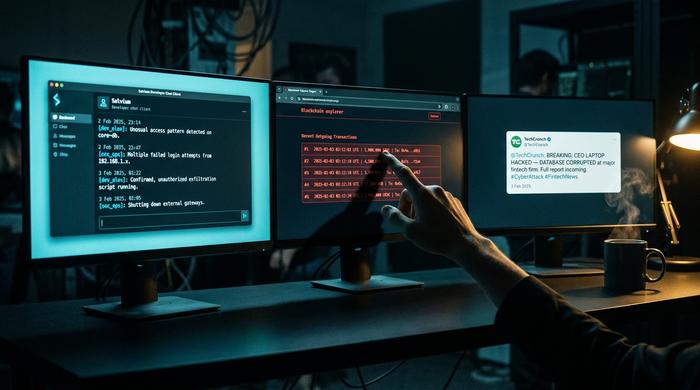
The morning of February 3, 2025 was the last normal trading day on XeggeX. Withdrawals stopped without warning that afternoon. The site went offline. The operator known publicly only as "Karl" posted that the CEO's laptop had been compromised and the database was corrupted. By the next morning, on-chain analysts at Salvium and Nerva had already published wallet screenshots showing clean, sequential outflows of USDC, USDT, ETH, and BNB from XeggeX hot wallets dated 2 and 3 February. The story did not match the chain.
What followed was not a recovery. It was a slow, public unwinding that turned XeggeX from a 314,000-user mining-coin exchange into the most-cited cautionary tale in 2025 crypto. This article is the autopsy.
What was XeggeX? A short profile
The exchange was founded in 2021 as a centralized cryptocurrency platform. Its claimed jurisdiction was Seychelles per CoinMarketCap, Germany per BitDegree's review, and unverifiable in either case. The operator was anonymous; the only public name attached to the platform was "Karl." At its peak the exchange listed 587 cryptocurrencies across more than 900 trading pairs, with roughly 314,000 registered users. KYC was tiered: a no-KYC tier capped withdrawals at USD 5,000 per day; verified accounts could withdraw up to USD 1,000,000 per day. Trading fees ran from 0.20% down to 0.06% by 30-day volume, with a further 25% discount for holders of the platform's XPE token. Pre-collapse 24-hour volume hovered around USD 3 million.
The hack: how XeggeX went dark on February 3, 2025
The first signs were on-chain, not in any announcement.
On February 2 and 3, 2025, blockchain analysts watching XeggeX hot wallets noticed clean sequential outflows of USDC, USDT, ETH, and BNB. The Salvium team posted screenshots. Nerva's developers cross-referenced. The pattern looked nothing like the chaotic, scattered withdrawals of an external compromise. It looked like an inside job, executed by someone with full keys, working in order.
By the afternoon of February 3, the site was offline. Karl's first message went up shortly after, posted on the platform's Telegram channel. The CEO's laptop had been "hacked," he wrote; the platform's database had been "corrupted." Users on Discord and Telegram were told to stand by while the team assessed the damage. There was no incident response timeline, no third-party security firm engaged, no postmortem promised. Trading liquidity for the platform's hundreds of altcoin pairs evaporated within hours.
The official narrative had three problems. First, hot-wallet keys are not normally on a CEO's laptop — they are on hardware modules, signing services, or multi-sig schemes. Second, a database "corruption" does not move funds out of cold storage; it stops the front end from rendering balances. Third, the on-chain pattern showed someone signing transactions in clean order, not a panic-driven smash-and-grab. The community read it the only way it could: this was not external compromise. This was the inside of XeggeX leaving.
Coverage from rekt.news ran under the title "Plant a Red Flag." The Quadriga Initiative, a victim-advocacy group named after Canada's most infamous exit-scam exchange, opened a case file on XeggeX within days. Mining-coin teams that had relied on the platform as a primary listing venue began publicly counting losses.
Whatever actually happened on February 3, the on-chain record makes one thing clear: by the time the first platform users heard about a "hack," the funds were already gone, moved out in a sequence that lasted less than 36 hours and ended in wallets that immediately split flows across at least three mixers.
Promissory tokens: how XeggeX issued IOUs after the hack
The site partially returned in mid-February. Real withdrawals were impossible. Holders of Bitcoin, Ethereum, and USDT instead found that their balances had been quietly reissued as platform-native tokens labelled BTCXX, ETHXX, and USDTXX. These IOU tokens carried what XeggeX described as 0.5% monthly interest — a phrase chosen, presumably, to dress the maneuver up as a structured restructuring rather than a stalling tactic.
The community was not fooled. An exchange that holds your Bitcoin owes you Bitcoin. An exchange that hands you a custom token labelled BTCXX owes you a promise. The two are not interchangeable, and 0.5% per month does not fix that asymmetry. By late February, XeggeX subreddits and Discord servers were pricing the IOU tokens at deep, double-digit discounts. By March, holders who tried to sell them in the few markets that still listed them were taking losses of more than 80%.
The IOU model also bought XeggeX something legally useful. As long as the platform technically had "balances" in user accounts — denominated in tokens it controlled — it could plausibly argue that no funds had been stolen, only converted. The same trick has appeared in nearly every mid-sized exchange collapse since Mt. Gox: an internal token, a promised interest rate, a vague timeline, and a steady erosion of public attention. By the time most users gave up trying to redeem their BTCXX or USDTXX holdings, the secondary market for those tokens had thinned to near zero.
Bankruptcy on June 27, 2025: what platform users lost
The platform formally announced bankruptcy via its own site on June 27, 2025, citing the February incident as the root cause. Press coverage cited roughly 12,000 users affected and around USD 80 million in assets. Neither figure was independently audited; both originated from XeggeX's own announcement and were reproduced through coverage at AInvest, CoinRank, and Cryptonews. No bankruptcy administrator was named. No court process was made public. There was no creditors' committee.
Salvium's team was one of the few project communities to mark the moment publicly. The Salvium developers posted on X on June 27, 2025 that XeggeX had been the primary venue for SAL holders, and that any user who had left funds on the venue should now treat those funds as lost. Verus, Avian, Pirate Chain, Conceal, and several other small mining-coin communities posted similar statements within the following week.
For platform users, June 27 was less a legal event than a confirmation of what February 3 had already told them: the money was not coming back. The bankruptcy filing carried no enforceable creditor protections in any of the jurisdictions the platform had loosely claimed. There was no insolvency court involved. There was no liquidator appointed to sell remaining assets and distribute proceeds. The bankruptcy was an announcement, not a process.
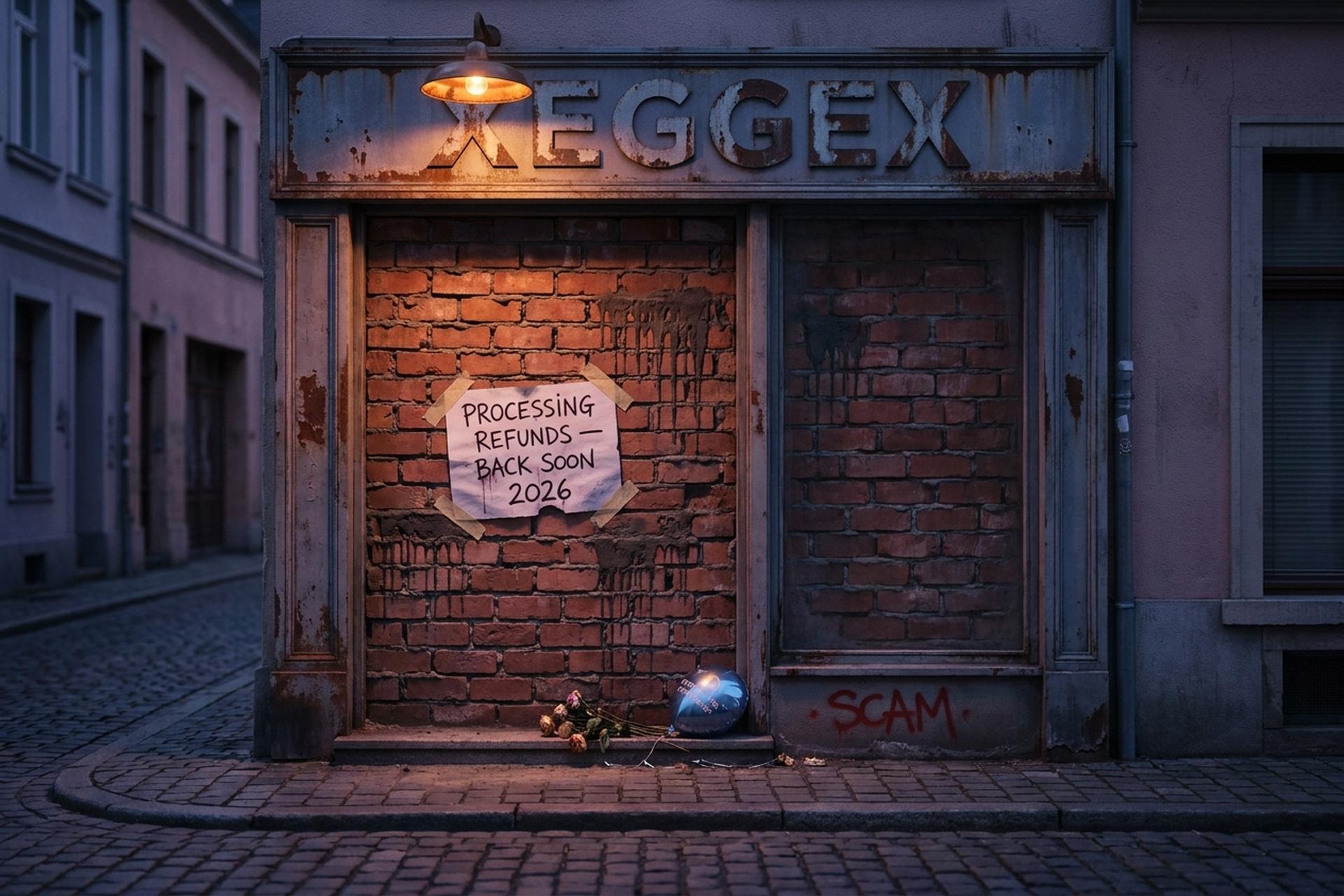
The XeggeX 2026 "revival": refund theater or scam continuation?
In January 2026, the xeggex.com domain quietly reactivated. On February 15, 2026, the @xeggex account on X posted that the platform was "back" and was "processing refunds." The community response was immediate, and skeptical.
The signs that the 2026 entity was a continuation rather than a comeback were structural. The same operator was behind both. The IOU tokens — BTCXX, ETHXX, USDTXX — remained in user accounts. No audit of platform reserves was published. No third-party administrator validated the refund process. There was no court oversight, no regulatory acknowledgement, and no ledger of who had been paid out.
Community trackers were direct. nerva.one published an analysis under the headline "XeggeX crypto exchange scam." The Quadriga Initiative updated its case study to flag the 2026 reboot as a likely continuation. Both organizations advised users not to deposit and not to engage with refund offers that required additional fees or "verification deposits" — a pattern that had already started to appear in user reports.
A near-identical clone called AnonEx had already launched in 2025 on the same codebase. Mining-coin Discords flagged it as a likely re-rug within weeks of its launch. The same operational handwriting was visible in both.
| Date | Event |
|---|---|
| 2 Feb 2025 | On-chain analysts flag suspicious USDC/USDT/ETH/BNB outflows from XeggeX hot wallets |
| 3 Feb 2025 | Site goes dark; Karl posts "CEO laptop hacked / database corrupted" |
| Feb-Mar 2025 | Site returns partially; BTCXX/ETHXX/USDTXX IOU tokens replace user balances |
| 27 Jun 2025 | XeggeX formally announces bankruptcy; ~12,000 users, ~$80M cited |
| Late 2025 | AnonEx clone launches on the XeggeX codebase |
| Jan 2026 | xeggex.com domain reactivates |
| 15 Feb 2026 | @xeggex on X claims "back / processing refunds" |
Karl, Paul Vernon, and the XeggeX operator question
The only public name attached to XeggeX is "Karl." Community researchers at the Quadriga Initiative and rekt.news have alleged a link to Paul Vernon, the operator of the Cryptsy exchange who was indicted in 2016 on related charges. The link is a community allegation. It has not been court-proven, no regulator has filed against Karl as Vernon, and the article should phrase the connection as alleged rather than established.
The pattern matters more than the name. The same configuration is visible in case after case: anonymous operator, custodial venue, no proof of reserves, no audit trail, no bankruptcy administrator when the time comes. That configuration took TradeOgre down in September 2025 by enforcement and took XeggeX down in February 2025 by apparent insider theft. The mechanism varies. The exposure does not.
XeggeX vs TradeOgre: parallel deaths in the same graveyard
XeggeX and TradeOgre lived in the same neighborhood of crypto. Both were custodial. Both ran without meaningful KYC for most or all users. Both became refuges for mining coins and privacy assets that larger venues had delisted. Both were operated anonymously. Both ended in 2025, seven months apart, by very different mechanisms.
XeggeX collapsed first, on February 3, 2025, in what looked from the chain like an inside job dressed up as a hack. TradeOgre was seized by the Royal Canadian Mounted Police on September 18, 2025 — the largest cryptocurrency seizure in Canadian history at CAD$56 million, and the first time Canadian law enforcement had dismantled an exchange. Different endings; the same underlying configuration.
| Dimension | TradeOgre (pre-Sep 2025) | XeggeX (pre-Feb 2025) | XeggeX 2026 reboot |
|---|---|---|---|
| KYC | None | Optional (no-KYC up to USD 5K/day) | Unclear; refund claims only |
| Trading fees | 0.2% flat | 0.20%-0.06% tiered + XPE discount | n/a |
| Custody model | Custodial | Custodial | Custodial (claimed) |
| Stated jurisdiction | Offshore / unregistered | Seychelles (claimed) | Same domain, opaque |
| Operator | Anonymous | "Karl" (alleged Paul Vernon link) | Same operator |
| Outcome | RCMP seizure CAD 56M | Hack/exit-scam, bankruptcy 27 Jun 2025 | Refund theater |
Two exchanges. Same category. Same year. Different mechanisms of failure. The category is what is dying.
Where XeggeX traders moved their digital assets
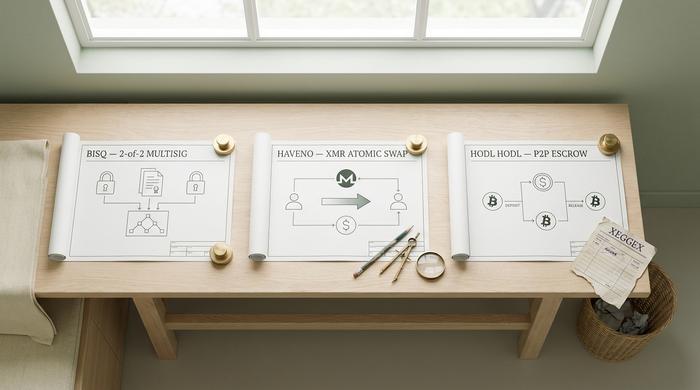
Where do mining-coin holders go after a venue like XeggeX disappears? Three structurally different alternatives survive because they do not share XeggeX's failure mode. Bisq is a non-custodial peer-to-peer network with 2-of-2 multisig escrow and arbitrators; the operator never holds user funds. Haveno is a Bisq fork built specifically for Monero, which most centralized venues have now delisted in any case. Hodl Hodl is a non-custodial Bitcoin-only P2P platform that has reportedly served more than 500,000 users without taking custody of any of them. For merchants who need to accept crypto without onboarding KYC infrastructure on the customer side, payment gateways such as Plisio fill the adjacent gap, separating the trading question from the settlement question. Decentralized exchanges such as Uniswap and Curve handle most ERC-20 currency liquidity directly from self-custodied wallets. None of these are perfect substitutes for a fast custodial venue, but each one removes the single point of failure that took XeggeX and TradeOgre down.
Lessons from the XeggeX collapse
Anonymous operator plus custodial venue plus no proof of reserves plus no audit equals a configuration that 2026 cannot afford. IOU tokens issued after a sudden freeze are not restructuring. They are a stalling tactic that buys the operator legal cover and gives the user nothing. A domain that goes dark in June and comes back in January under the same operator with the same IOU tokens is not a comeback. It is a brand cleanup. The lesson, written in two parallel collapses in 2025, is structural: the venue that holds your funds without verifying who you are will eventually choose between a regulator and an exit, and you will be the cost of either choice.



