De-Dollarization in 2026 : BRICS, Gold, Stablecoins, and the Slow Slide

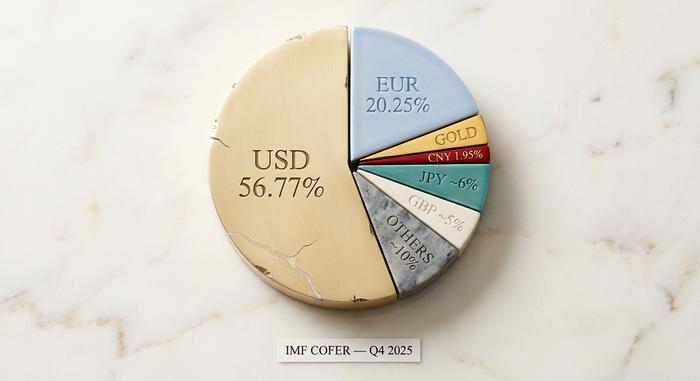
According to IMF COFER data released in March 2026, the dollar's share of allocated foreign exchange reserves stood at 56.77% in Q4 2025. That is down from roughly 71% at the start of the millennium. A fourteen-percentage-point slide spread across twenty-five years.
Every decade since Nixon's "temporary" suspension of gold convertibility in August 1971 has had its own death-of-the-dollar cycle. The 2026 version, though, has new ingredients. The 2022 freeze of roughly $300 billion in Russian central bank reserves changed how every reserve manager thinks about dollar holdings. BRICS expanded from five to ten full members, Indonesia joining most recently in January 2025. President Trump signed an executive order establishing a Strategic Bitcoin Reserve on March 6, 2025, and signed the GENIUS Act stablecoin law on July 18, 2025. Central banks have bought more than 1,000 tonnes of gold for three consecutive years. None of these moves individually displaces the dollar. Together they describe a slow, multi-axis shift that is finally hard to dismiss.
This article walks through what de-dollarization actually means. It looks at where the dollar still dominates, the 2022 sanctions inflection, the gold flows, the BRICS+ reality, and the crypto angle that cuts both ways.
What de-dollarization actually means
The trend of de-dollarization is happening at three different layers, each on its own clock. The basic definition is the same across all three. Countries reducing reliance on the dollar as primary reserve currency. Reducing it as the dominant medium for international trade and global trade. And reducing it as the default store of value. Central bank reserve managers shift the asset mix away from the dollar in their portfolios. Trade counterparties switch invoicing currency in bilateral commerce, often using local currencies for trade with China and other partners. Households and firms in emerging markets move savings into and out of the US dollar depending on local conditions. They reduce reliance on the US dollar where the global financial system permits.
A short history clarifies the inheritance. The Bretton Woods Conference of July 1944, held at the Mount Washington Hotel in New Hampshire and attended by 44 nations, fixed dollar-to-gold convertibility at $35 per troy ounce. It built the post-Second World War international monetary system around the dollar and made the dollar the world's primary reserve currency. President Nixon ended that arrangement on August 15, 1971, with what economists still call the Nixon Shock. A 1974 informal arrangement with Saudi Arabia tied oil pricing to the dollar. It recycled Saudi surpluses into US Treasuries. The pattern is sometimes called petrodollar recycling. The euro launched in cashless form on January 1, 1999, the first plausible challenger.
Each of those events redrew the boundary of dollar dominance without replacing it. The current cycle is doing the same thing, more visibly, at a faster cadence. What might it mean for the global financial system if the trend of de-dollarization could finally cross from the margin into the mainstream? That is the question banks around the world are now starting to model.
The numbers in 2026: where the dollar still dominates
The honest summary of where the dollar stands in 2026 fits in one table.
| Metric | Dollar share | Source |
|---|---|---|
| Allocated FX reserves (Q4 2025) | 56.77% | IMF COFER |
| SWIFT international payments (Jan 2025) | 50.2% | SWIFT RMB Tracker |
| Foreign-exchange trading (one side, 2022) | 88% | BIS Triennial Survey |
| Foreign-currency debt issuance | ~70% | Federal Reserve, July 2025 |
| Cross-border bank claims | ~55% | Federal Reserve, July 2025 |
| Foreign-currency deposits | ~60% | Federal Reserve, July 2025 |
The reserve series is the cleanest way to see the slide. From roughly 71% in 2000, the dollar share of central bank reserves moved to about 66% by 2014, 57.79% in Q4 2024, and 56.77% in Q4 2025. The dollar in global trade and the dollar in recent years has shown a similar slow erosion, with the US dollar losing ground in both reserves and trade invoicing. Foreign currency holdings have shifted, and foreign currency debt issuance still runs near 70% USD. Total allocated foreign exchange reserves stand at $13.14 trillion. The euro is essentially flat at 20.25%. China's renminbi, despite Beijing's persistent push, sits at only 1.95% of central bank reserves. The dominance of the dollar is fading, but the end of dollar dominance is not what the data shows that the US dollar still does. Most of the displaced share has scattered into "non-traditional" reserve currencies (Australian, Canadian, and Singaporean dollars, the Korean won, the Nordic currencies) and into gold. The dollar is still hugely dominant, but the share of reserves it commands has moved.
The Bank for International Settlements' Triennial Central Bank Survey was conducted in April 2022. It found the dollar on one side of 88% of all foreign-exchange trades. Daily FX turnover stood at $7.5 trillion. The 2025 update has not been released as of writing. SWIFT's RMB Tracker put the dollar at roughly half of international payment value as of early 2025. The euro held near a quarter. The yuan reached around 3.5% at its April 2025 peak. By September it had settled closer to 3.17%. The dollar's dominance in FX trade and de-dollarization happening in parallel is the picture the data actually shows. The IMF emphasizes a point worth keeping in mind. Quarter-to-quarter moves in the reserve mix often reflect valuation effects rather than active reallocation. A stronger dollar mathematically raises the dollar share even if no central bank lifted a finger.
The 2022 sanctions inflection and what changed
In late February 2022, the United States and its G7 partners froze approximately $300 billion of Russian central bank reserves in response to the war in Ukraine. Economic sanctions on this scale, applied to a G20 economy, were unprecedented; the move ranks among the most consequential US sanctions decisions of the post-2001 period. About €200 billion of those assets sit at Euroclear in Belgium, and on December 12, 2025, the European Union agreed to an indefinite freeze. Major Russian banks were removed from SWIFT in March 2022. None of this is unprecedented in form, but the scale and the political context made the action visible to every reserve manager outside the Western alliance.
The framing that has stuck is "weaponization of the dollar." It captured something real. Dollar holdings are politically conditional. Gold bars in a domestic vault are not. The Russia and China alignment accelerated quickly after the freeze. Russian foreign trade adjusted quickly too. By 2024, roughly 90% of Russia's BRICS-aligned trade was settling in local currencies. The yuan share of Russian exports rose from about 1% pre-war to roughly 15%. Most of the new flow is priced in chinese yuan instead of US dollars. The chinese yuan instead of US is now the routine framing in trade settlement reporting. China itself trimmed its US Treasury holdings. They fell from a peak of about $1.32 trillion in November 2013 to $759 billion at the end of December 2024. By October 2025 the number was $688.7 billion. That is the lowest level since November 2008. The United Kingdom overtook China as the second-largest official Treasury holder in March 2025, behind Japan.
JP Morgan, Brookings, and Carnegie analysts have all argued the same point. The most important effect of the freeze was not the immediate Russian response. It was the demonstration of dependency on the US dollar. Sanctions against Russia changed the calculus for everyone. Reserve managers in Beijing, Riyadh, Brasília, and Ankara saw the same thing at the same time. They have been quietly reducing reliance on the U.S. dollar since — and the world's reliance on the dollar with them. Movement away from the US dollar is now visible in the share of global reserves, in trade settlement with China, and in countries like India that have started treating the US dollar as an intermediary less often. The displacement of the dollar at the heart of cross-border settlement has been incremental but steady.
Gold: where reserve managers are voting with their feet
The clearest expression of that diversification is in central bank gold purchases. Across 2022, 2023, and 2024, central banks bought more than 1,000 tonnes of gold each year, three consecutive years above that threshold for the first time on record. They added another 863 tonnes in 2025, still roughly double the pre-2022 pace. The central bank share of total gold demand jumped from about 12% in the 2015–2019 average to roughly 25% in 2024.
The largest 2025 buyer was Poland, which added 102 tonnes. China, India, Turkey, Kazakhstan, and Brazil all participated heavily. Total global gold demand crossed 5,000 tonnes in 2025 and the price set 53 all-time highs through the year, according to the World Gold Council. Reserve managers do not give interviews about why they are buying gold. Their balance sheets do.
BRICS+ in 2026: bigger but no closer to a common currency
BRICS membership has expanded, slowly. Within BRICS, the original five (Brazil, Russia, India, China, South Africa) added Egypt, Ethiopia, Iran, and the United Arab Emirates as full BRICS countries on January 1, 2024. Argentina, invited at the same time, declined under the new Milei government on November 30, 2023. Indonesia joined the BRICS plus framework as the tenth full member on January 6, 2025. A second tier of partner countries (Belarus, Bolivia, Cuba, Kazakhstan, Malaysia, Nigeria, Thailand, Uganda, Uzbekistan, Vietnam) adds another ten. The group covers around 35% of global economic output.
The bloc has not, however, produced a common currency. The Kazan Summit on October 22–24, 2024, hosted by Russia, issued a declaration that talked about "BRICS Pay" as a payment messaging alternative and emphasized settlement in local currencies. It did not announce a unit of account. The talk about de-dollarization in the Kazan declaration was real, but the BRICS nations stopped well short of currency commitment. President Trump posted a 100% tariff threat on Truth Social on November 30, 2024, against any BRICS country backing a non-dollar currency. The threat landed politically. South Africa publicly disavowed any BRICS currency days later.
What BRICS does have are payment rails. Project mBridge, a multi-CBDC bridge involving the central banks of China, Hong Kong, Thailand, and the UAE (with Saudi Arabia as observer), has settled approximately $55.5 billion across roughly 4,000 transactions. The Bank for International Settlements stepped away from mBridge on October 31, 2024, partly over concerns about its use by sanctioned actors, but the project continues under the participating central banks. China's CIPS messaging system reaches 1,467 financial institutions across 111 countries. Russia's SPFS, India's SFMS, and Brazil's Pix complete the alternative payment systems landscape. Bilateral trade and cross-border bilateral trade between China and Russia, China and India, and China and Brazil routinely settles outside the dollar now. Countries like China and India are leading the use of the dollar as an intermediary down. They prefer the trade with china to be priced in their own units.
The crypto angle: stablecoins, Bitcoin reserves, and CBDCs
The crypto layer is where the de-dollarization story gets paradoxical. President Trump signed an executive order on March 6, 2025 establishing a Strategic Bitcoin Reserve, capitalized initially with roughly 207,000 forfeited bitcoins worth about $17 billion at the time. The order mandates "budget-neutral" acquisition going forward. No other major central bank has Bitcoin on its declared FX reserve sheet at scale. The signaling matters more than the volume.
The bigger structural story is stablecoins. On July 18, 2025, Trump signed the GENIUS Act, the first US federal stablecoin law. The Senate voted 68–30 on June 17. The House voted 308–122 on July 17. Treasury Secretary Scott Bessent has projected that the dollar-stablecoin market could grow to $2–3 trillion by the end of the decade. He has framed the law as "the next era of dollarization." USDT and USDC together account for around 93% of stablecoin market capitalization. USDT alone is above $150 billion. Stablecoin transaction volume between January and July 2025 exceeded $4 trillion, an 83% year-over-year increase.
Adoption in emerging markets is striking. According to TRM Labs, more than 60% of crypto users in Argentina convert pesos into stablecoins. Sub-Saharan Africa shows the highest residential stablecoin adoption rate globally at 9.3%. In Nigeria alone, an estimated 11.9% of the population (about 25.9 million people) uses stablecoins. China's e-CNY is the world's most-developed CBDC. By November 2025 it had recorded 3.4 billion cumulative transactions and RMB 16.7 trillion (about $2.3 trillion) in throughput. The system covers 230 million personal wallets and 18.8 million corporate wallets.
Here is the paradox. Stablecoins are dollar-denominated; they extend dollar reach into corners of the global economy that conventional banking has missed. By volume, they are a dollarization vector. But they also route around the dollar's correspondent banking infrastructure. That makes them one of the more curious alternatives to the dollar. When value moves over public chains, no SWIFT message is sent and no New York intermediary bank touches the transaction. Crypto payment gateways like Plisio illustrate the same effect at the merchant level. A buyer in one BRICS-aligned country can settle with a merchant in another using a USD-denominated stablecoin without either party ever touching a US-controlled dollar payment rail. The asset is the dollar; the plumbing is not, which is felt in the U.S. policy debate. For sanctioned counterparties and BRICS+ corridors, that distinction is the entire point.

The honest verdict: slow slide, not collapse
The dollar's structural advantages remain extraordinary. The depth and liquidity of US capital markets matter. So does the predictability of US contract law. The United States sits at the center of every cross-border financial network. And the simple network effects of a currency that everyone already accepts produce a moat no rival comes close to crossing. The yuan's reserve share remains stuck near 2% precisely because exchange controls, capital controls, and limited convertibility make holding china's renminbi unattractive for global savers. Most emerging-market governments would prefer a multipolar reserve world to a yuan-dominated one. The dollar remains the global yardstick by demand for the dollar metrics that matter for cross-border bond markets.
The honest direction of travel is not "the yuan replaces the dollar." It is "the US dollar is still hugely dominant, but no longer monolithic." Every decade since 1971 has produced its own end of dollar dominance narrative. The 2026 cycle is plausibly different. Three independent forces — the sanctions catalyst, the move away from the US dollar by reserve managers, and digital-currency technology — are working together for the first time. Economic and political reforms in the BRICS+ bloc could accelerate, or stall; either way the pace of moving away from the US is measured in decades, not quarters.
What it means for global businesses and households
Reserve managers will continue to diversify slowly. SWIFT and the major FX markets will stay overwhelmingly dollar-denominated for the foreseeable horizon. Stablecoins and CBDCs will keep growing as alternative settlement rails, sometimes denominated in dollars, sometimes not. Gold will keep its bid as the reserve asset that no government can sanction.
So if the question is whether de-dollarization is happening in 2026, the answer is yes; but on multiple time horizons that look very different depending on which one you watch.