QS Stock 2026: PowerCo Deal, Dilution, and the 12× Spread
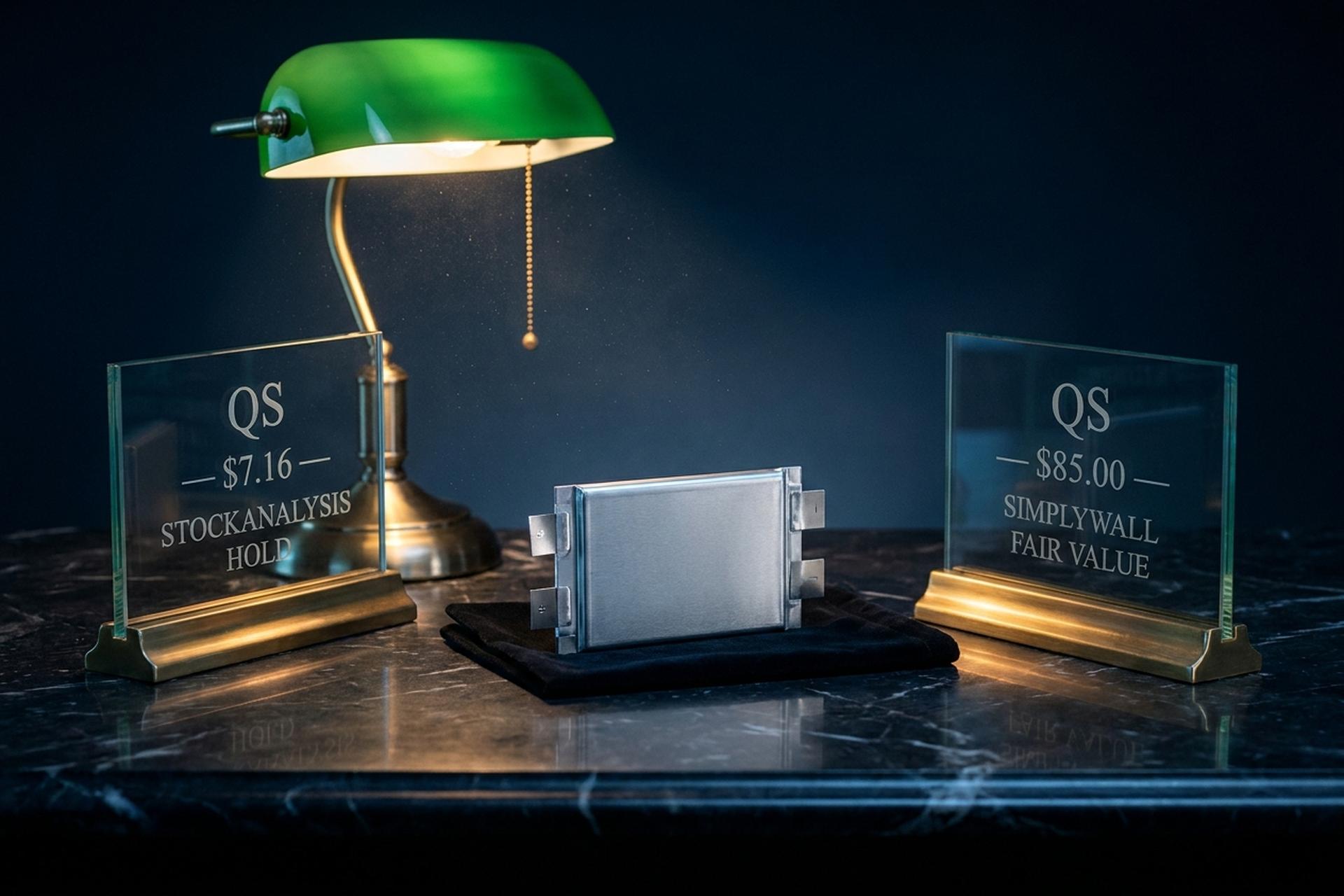
QS stock is the rare ticker on the NASDAQ where one analyst sees 90% upside and another sees 21% downside in the same week. The spread itself is the article. QS trades around $9, the market cap sits between $5.0 and $5.6 billion depending on intraday print, the product revenue line on the income statement is still essentially zero, and Wall Street can not agree whether that combination is a coiled spring or a slow drain. This guide walks through what QuantumScape Corporation actually is, how the July 2024 Volkswagen PowerCo deal locks in the next six years of the business, why the dilution clock matters more than the technology data, and where QS sits in the broader solid-state battery race.
What QuantumScape is and how QS reached NASDAQ
QuantumScape Corporation was founded in 2010 in San Jose, California by Jagdeep Singh and Tim Holme, with early backing from Bill Gates's Breakthrough Energy Ventures, Kleiner Perkins, Khosla Ventures, and Volkswagen Group. The company develops next-generation solid-state lithium-metal batteries aimed at electric vehicles, replacing the liquid electrolyte in conventional cells with a proprietary ceramic separator. The QSE-5 cell is its flagship platform. QuantumScape went public on November 25, 2020 through a merger with Kensington Capital Acquisition Corp II, the SPAC vehicle at the centre of the late-2020 EV-SPAC wave. The combined company began trading on the NASDAQ under the ticker QS, classified by sector as Consumer Cyclical and by industry as Auto Parts. Headquarters and core engineering remain in San Jose; pilot production sits in Germany alongside Volkswagen.
QS stock price 2020–2026: from $131 to single digits
The QS stock price chart reads as two separate eras. SPAC closing on November 25, 2020 priced shares around $10. Pure post-merger mania ran the stock to an intraday all-time high of $131.67 on December 22, 2020, a 13-fold move in four weeks that had almost nothing to do with cell shipments and almost everything to do with what retail desks were doing that month. The unwind that followed was equally brutal. The QS stock price today, in late May 2026, sits in the $8.71 to $9.11 range, a roughly 93% decline from peak. The 52-week range runs $3.88 to $19.07. Market capitalisation is between $5.0 billion and $5.6 billion depending on intraday print. Shares outstanding stand at 615.15 million, up from 364 million at the SPAC closing, a 69% increase over five-and-a-half years of secondary offerings and equity-based compensation. Realized volatility remains high, with a five-year beta of 2.58, which is among the most extreme readings for any auto-sector listing.
The PowerCo deal: capital-light royalties and a 6-year leash
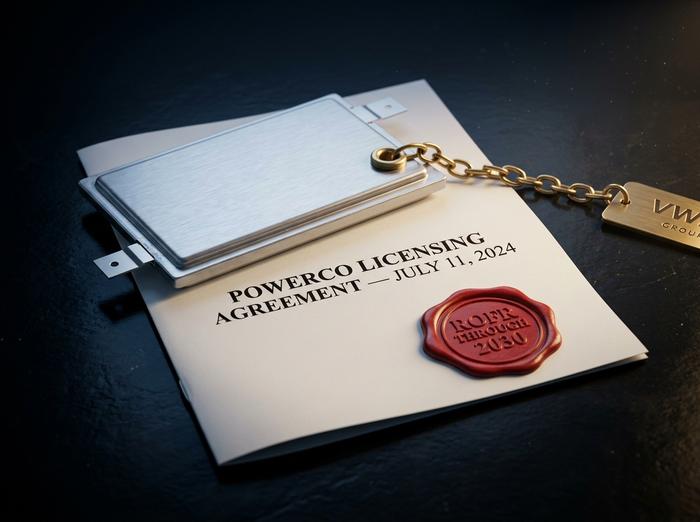
Most secondary coverage treats the July 11, 2024 Volkswagen PowerCo licensing agreement as a binary "QS is saved" event. The mechanics are more interesting than that, and the timeline is the part most retail buyers skip.
The structure: PowerCo paid QuantumScape a $130 million advance royalty at signing, with up to $131 million in additional milestone payments tied to industrialization stages. The license covers up to 40 gigawatt-hours of annual production. The royalty rate per kilowatt-hour is redacted in the SEC filing; sell-side estimates cluster around $10 to $15 per kWh. If PowerCo hits the full 40 GWh ramp at the high end of the rate band, the steady-state royalty stream is roughly $400 to $600 million annually, which would re-rate QS materially.
The catch is in the right-of-first-refusal clause. PowerCo holds a six-year ROFR on QSE-5 cells, meaning it has first call on QuantumScape's output for VW-group customers before the company can sell to any other OEM at meaningful scale. The practical effect is that QS revenue is locked to Volkswagen group industrialization until roughly 2030. PowerCo's own gigafactory track record (Salzgitter, St. Thomas in Canada, Sagunto in Spain) has been mixed on timeline, with the Sagunto site delayed and St. Thomas pushed to 2027.
Q1 2026 reported $11 million in first-ever customer billings. That headline is widely repeated and widely misunderstood. The 10-Q footnotes make clear the figure represents development-program work plus PowerCo prepayments, not product revenue from manufactured cells delivered into a finished vehicle. The distinction matters because the bullish framing implies a revenue ramp has started. It has not. What has started is a contractual receipts ramp tied to engineering deliverables.
QuantumScape also disclosed that four top-10 global OEMs are actively engaged, with two active joint development agreements and one new JDA signed in Q1 2026, signalling that the addressable market extends beyond electric vehicles into energy storage and grid applications. Only Volkswagen has been named publicly. The other three remain undisclosed pending production capacity that does not yet exist under the PowerCo ROFR.
Why analyst ratings spread $7 to $85 is the QS thesis
The cleanest way to understand what QS is in 2026 is to read the analyst desks side by side. They are not disagreeing at the margin. They are pricing different companies entirely.
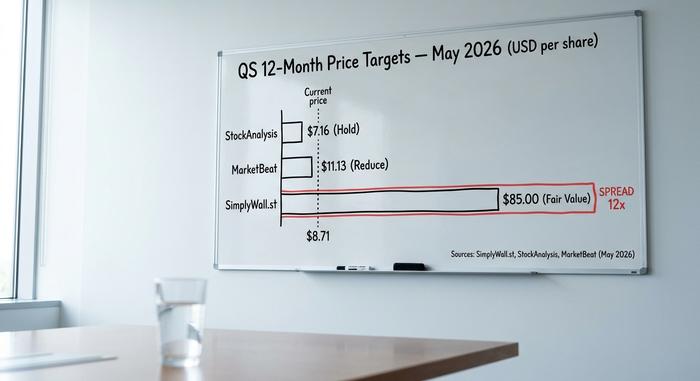
The bull desk is SimplyWall.st aggregate fair value at $85 per share, implying 89.8% upside from $8.71. That model prices QSE-5 cells reaching the full 40 GWh PowerCo ramp by 2030, royalty rate at the high end of the estimated range, and non-VW OEM customers unlocking after the six-year ROFR expires. It treats the technology and the licensing structure as the thesis.
The Hold desk is StockAnalysis at $7.16 twelve-month target, implying 21% downside. That model prices manufacturing-execution risk explicitly, dilution from the company's own FY2026 EBITDA loss guidance of $250 to $275 million, and PowerCo timeline slippage similar to other PowerCo gigafactory projects. It treats the cash runway as the thesis.
The Reduce desk is MarketBeat at $11.13 consensus, seven analysts covering, six Hold and one Sell, zero Buy ratings. That panel treats QS as a structural underperformer absent a commercial cell-shipment catalyst, which is not expected before 2028 at the earliest.
A 12-fold spread between bull and bear price targets on a $9 stock is not analyst noise. It is the market saying that QS is two completely different companies depending on which footnote in the 10-K you weight more heavily.
| Desk | 12-month price target | Rating | Implied scenario |
|---|---|---|---|
| SimplyWall.st fair value | $85 (+90% upside) | Bull | Full 40 GWh PowerCo ramp by 2030; $15/kWh royalty; OEM unlock post-ROFR |
| StockAnalysis consensus | $7.16 (−21% downside) | Hold | PowerCo timeline slips; FY2026 EBITDA loss as guided; one more secondary |
| MarketBeat consensus | $11.13 (+22% upside) | Reduce | No commercial-cell catalyst before 2028; structural drift |
The technology data, for what it is worth, looks real. The QSE-5 specification published in December 2025 reports 844 watt-hours per litre of volumetric energy density, compared to roughly 600 Wh/L for the best current lithium-ion battery cells. The same data sheet shows faster charging from 10 to 80% in 12 to 15 minutes, more than 95% capacity retention after 1,000 cycles, and enhanced safety from the elimination of flammable liquid electrolyte. B1 samples shipped to OEMs in October 2025 and the Eagle Line pilot production facility was officially launched on February 4, 2026 with OEM customers present at the ribbon-cutting. None of that is a guarantee of commercial-scale manufacturability, but it is also not nothing.
Dilution, cash runway, and the EBITDA gap
The piece nobody puts in the bull case sits on page twelve of every recent 10-K financial review. Accumulated deficit since founding is $3.9 billion. Shares outstanding have grown from 364 million at the November 2020 SPAC closing to 615 million by Q1 2026, a 69% dilution in five-and-a-half years. Insiders are net sellers of roughly $83.4 million over the trailing three months as of January 2026. One director liquidated approximately $36 million in December 2025. Co-founder Tim Holme sold $1.2 million in May 2026 after exercising options.
Liquidity at the end of Q1 2026 was $904.7 million in cash and short-term investments, against an operating cash burn of $59.5 million per quarter. Simple math gives 15 quarters of runway, putting the cash exhaustion date in late 2029.
The simple math is misleading. FY2026 EBITDA loss guidance is $250 to $275 million, materially above the annualized $238 million implied by the quarterly cash burn. The gap means either a step-up in operating spending in the back half of 2026, a non-cash impairment writedown, or both. Either way, the practical cash exhaustion date is closer to 2029 than 2030, and the company will almost certainly need to tap the equity market at least once more before commercial royalty revenue materializes. I am not convinced most retail buyers of QS have priced that next secondary offering into the dilution scenario.
Peer comparison: Solid Power, Microvast, Enovix, ProLogium
The cleanest peer benchmark to sense whether QS is correctly priced is Solid Power, the closest direct comparable in the solid-state field.
| Company | Ticker | Market cap (May 2026) | Revenue (TTM) | Stage |
|---|---|---|---|---|
| QuantumScape | QS | $5.0–5.6B | $11M (development, not product) | B1 sample, Eagle Line pilot |
| Solid Power | SLDP | $662M | $21.7M | EV cell sampling, BMW JDA |
| Microvast | MVST | ~$900M | $360M | Commercial lithium-ion, energy storage |
| Enovix | ENVX | ~$1.5B | $30M | Silicon anode, mobile/wearable |
| ProLogium | private | $5.8B (2024 round) | undisclosed | Mass-production line live in Taoyuan |
Solid Power generates roughly twice as much actual revenue at one-eighth of QuantumScape's market cap. ProLogium, the private Taiwanese solid-state developer, has the only mass-production line currently operating in the field and trades at a private-market valuation broadly comparable to QS without any of the public-equity dilution dynamics. The cleanest single bear sentence is that QS is priced as though it has already won a race that has not yet been run.
The Bill Gates and Jim Cramer questions
Two questions appear in nearly every retail QS search query. They deserve direct answers.
Bill Gates does not personally own QuantumScape stock above any current disclosure threshold. His historical exposure ran through Breakthrough Energy Ventures and Khosla Ventures, both of which were among the earliest backers in the 2012 to 2018 funding rounds. The exposure today is through fund vehicles rather than individual holdings, and the Bill Gates association persists in retail folklore far more than it does on the current 13G filings.
Jim Cramer has been publicly bearish on QS for most of 2024 and 2025, repeatedly flagging it as one of the SPAC-era casualties he expected to underperform. His March 2026 segment described QuantumScape as "a science experiment looking for paying customers." A reversal in his coverage would itself be a short-term sentiment catalyst for QS, but as of May 2026 it has not arrived.
How to buy QS stock and the option mechanics
Any investor looking up the QS stock price today will find it listed on the NASDAQ and available through every major US broker, including Fidelity, Charles Schwab, Robinhood, Interactive Brokers, and Webull. Fractional shares are supported on most platforms. The beta of 2.58 keeps realised volatility elevated, which makes covered-call premiums attractive for active traders who want yield enhancement on a long position. QS is not in the S&P 500; it appears in the Russell 2000 and several clean-energy thematic ETFs, which provides modest passive demand.
What QS at $9 is actually pricing
QuantumScape at $9 is not pricing a battery. It is pricing a probability-weighted royalty stream that begins between 2028 and 2031, anchored by a PowerCo industrialization timeline outside QS's direct control. The bull case prices the high end of the royalty band — roughly $15 per kWh on a full 40 GWh ramp — plus an OEM unlock after the six-year ROFR expires in 2030. The bear case prices a second secondary offering, another year of dilution running through 2027, and a product-revenue line that stays empty into 2028. Neither camp is irrational; they are just weighting the same Q1 2026 10-Q footnotes differently.
The honest question for any retail buyer is which year they personally think the first commercial gigawatt-hour ships under the QSE-5 license. Wall Street is treating that year as 2030 in the bull camp and "not in this model" in the bear camp. The middle path — first commercial cells flowing in 2029, partial royalty ramp through 2031, OEM diversification after 2032 — sits closer to where the QS stock price chart has actually drifted over the last twelve months, and it implies QS is roughly fairly valued today rather than dramatically mispriced either way.