ChatGot or Chat Got: AI Chatbot Assistant + ChatGPT Review

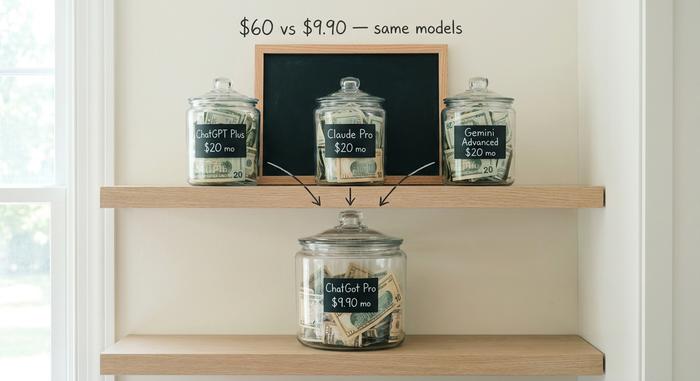
A fair amount of the AI tooling market in 2026 sits in a curious shape. ChatGPT Plus is twenty dollars a month. Claude Pro is twenty dollars a month. Gemini Advanced is twenty dollars a month. Subscribe to all three and you are spending sixty dollars before you have written a single prompt. ChatGot, the New York startup at chatgot.io, is the answer some people pick instead. One chat box. Multiple frontier AI models behind a single sign-in. Pro tier nine dollars and ninety cents per month. The product targets exactly the gap that opens between paying for one model and paying for all of them.
This guide covers what ChatGot actually is, the AI models it currently aggregates, what the pricing looks like across free, Pro, and Max, where crypto payments fit (and where they do not), how it compares to Poe, OpenRouter, and Anakin AI, and where multi-AI tools land in real crypto and Web3 workflows. We pulled from chatgot.io directly, third-party reviews, vendor changelogs from OpenAI, Anthropic, Google, and Meta, and on-record industry reporting from TechCrunch and the major AI vendor blogs. Where ChatGot itself does not publish something, we say so.
What ChatGot is: an AI assistant for many models
ChatGot, sometimes written as Chat Got, is a multi-model AI assistant operated from chatgot.io. The company was founded in 2023, is based in New York City, and per Tracxn remains bootstrapped without disclosed institutional funding. Vendor messaging claims more than 350,000 users. Independent measurement from Ahrefs put traffic at around 930,000 visits for March 2025. Founders are not publicly disclosed in any of the reviewed sources.
The product's core mechanic is the at-symbol syntax. Type @gpt-5, @claude, or @gemini inside a single conversation and the platform routes that turn to the named model while keeping the prior context intact. You can paste a piece of code, ask GPT-5 to debug it, then write @claude review the answer above to get a second opinion in the same thread. Cross-model context retention is what differentiates ChatGot from simply switching browser tabs between three subscriptions.
The model roster shifts. As of the May 2026 fetch, the homepage emphasizes GPT-4o Mini, DeepSeek R1, Gemini 3 Pro, and Sora 2. Earlier reviews from Fritz.ai and MobileAppDaily documented Claude 3.5 Sonnet, Claude 3 Opus, Gemini Pro, Llama 3.1 70B, Mistral Large 2, and DALL-E 3 in the lineup, and ChatGot's own marketing copy claims access to "100+ AI models" through tiered upgrades. I am not convinced that hundred-model number reflects what most users actually reach in a typical session, but the spread of frontier models on offer is real and unusually broad for a single nine-dollar subscription.
How ChatGot works: chatbot interface for users
Loading chatgot.io drops you into a single chat input that behaves like ChatGPT or Claude on the surface. Underneath, every message can be routed to a different model. The platform's pitch is gathering many models like GPT-5, Claude Opus 4.5, and Gemini 3 Pro in one place, on one platform, so users do not have to switch between different vendor sites mid-task. The key features extend that base interaction in concrete ways. ChatPDF lets you upload a document and run grammar checks, summary requests, or specific prompts against it through the model of your choice, including parse-and-extract Q&A on long files. AI slides generation produces draft PowerPoint or Google Slides decks from a prompt — useful for content creation in creative projects or quick presentations. Multilingual translation supports multiple languages across most of the major frontier models, since each one already supports it natively. The platform also offers personalized AI assistant configurations: you can define a system prompt and tool set once, save it as a custom bot, and call that bot in future conversations whenever the same task profile comes up.
The interface is browser-based. There is no native macOS or Windows install. Chrome and Edge extensions exist for users who want a sidebar shortcut. Real-time web search is available for queries that need fresh information, with results sourced through Google or Bing depending on the active model. Image generation works through the integrated DALL-E 3 path or through ChatGot's own self-branded "Imagen" model.
Two parts of the workflow drew positive attention in third-party reviews. The first is what Fritz.ai calls "tag multiple AI bots in a single conversation to compare results", useful when you do not actually know which model will give the better answer to a specific question. The second is the cross-model evaluation pattern, where you ask one AI to critique another's response, which is harder to do cleanly with separate subscriptions.
ChatGot pricing: free, Pro, and the crypto question
The published tiers documented in third-party reviews and the vendor's own pricing-related pages settle into three rungs. Free gives 10 queries per day with no sign-up required. Pro at $9.90 per month unlocks 6,000 standard queries plus 400 advanced queries plus 300 image credits. Max at $15.90 per month bumps that to 8,000 standard, 500 advanced, and 500 image credits. Annual billing brings a small discount; an Enterprise plan exists with custom pricing. Standard queries cost one credit each. Advanced queries to GPT-5-class or Claude Opus models consume two to three credits. Image generation costs five to ten credits per image depending on the source model.
The pricing comparison sets the context. A standalone ChatGPT Plus subscription is $20 per month. Claude Pro is $20. Gemini Advanced is $20. Each one of those gives access to one model's full feature set; ChatGot's $9.90 Pro tier sits below any of them and gives passable access to all three plus several others. What I keep coming back to is that the math only works for users who do not need the deepest version of any single model. For those users, the direct subscription wins. For everyone else, the aggregator math is favorable.
The crypto payment question is the part Plisio readers actually care about, and the honest answer is short. ChatGot does not publicly list cryptocurrency among its accepted payment methods. Reviewed third-party pages do not document a BTC, ETH, or USDT checkout. Site behavior during research suggested standard card processing through a Stripe-like provider. If you want to pay for an AI aggregator with crypto in 2026, OpenRouter is the only major aggregator with a documented native USDC checkout. Other aggregators including Poe and Anakin AI run card-only billing. The remaining option for ChatGot specifically is a third-party crypto card such as Moon, Cwallet, or iPeakoin, which converts crypto to a virtual card that the platform's card processor will accept. That works but introduces an extra processor fee.
Comparison: ChatGot vs Poe, OpenRouter, Anakin AI
Five aggregators dominate the category in 2026. Their strengths divide cleanly.
| Platform | Founded | Models supported | Free tier | Paid tier (entry) | Crypto payment | Notable feature |
|---|---|---|---|---|---|---|
| ChatGot | 2023 | ~100 incl. GPT-5, Claude 4.5, Gemini 3 | 10 queries/day | $9.90/mo Pro | Not publicly supported | "@"-tag multiple models in one prompt |
| Poe (Quora) | 2022 | GPT-5, Claude 4.x, Gemini 3, Llama 4, FLUX, Veo 2 | Limited daily points | $4.99/mo | No | Largest model + media catalog; dev API since Jul 2025 |
| OpenRouter | 2023 | 300+ from 60+ providers | 25–33 free models | Pay-as-you-go (+5.5% fee) | Yes (USDC) | Unified API, model routing, regional failover |
| Anakin AI | 2023 | GPT-4/5, Claude, Gemini, Llama | 30 credits/day Gemini-only | $9.90/mo | No | Workflow builder, batch processing |
| Perplexity Pro | 2022 | GPT-5.x, Claude Opus 4.x, Gemini 3 Pro | Free search | $20/mo | No | Search-grounded answers, Sonar API |
Poe undercuts everyone on price at the entry point. The $4.99 plan TechCrunch covered in March 2025 hands you 10,000 daily points, which is enough for most casual use. Poe's API for developers shipped July 31, 2025, opening a path to scripted multi-model access that ChatGot does not match. OpenRouter is the right pick for any user who cares about crypto payments, broadest possible model coverage, or programmatic access — its 300-plus model library across 60-plus providers, and its 5.5 percent platform fee on credit purchases, make it the developer-grade aggregator. Anakin AI matches ChatGot at $9.90 but pivots toward workflow automation rather than open-ended chat. Perplexity Pro is in a different category, search-grounded answers, and overlaps with ChatGot only when a user wants to ask the same question to multiple LLMs while doing research.
The choice on a clean first read is roughly this. Cheapest entry: Poe. Crypto payments: OpenRouter. Multi-model tagging in one prompt: ChatGot. Workflow automation: Anakin AI. Search-grounded answers: Perplexity. ChatGot's claim is the second middle of those. Affordable, simple, multi-model. And it holds up against direct competitors at the same price point.
Use cases for crypto and Web3: where multi-AI helps
The practical case for an aggregator gets stronger inside a crypto or Web3 workflow because no single model is best at everything. GPT-5, released August 7, 2025, leads on code reasoning and stepwise debugging. Claude Opus 4.5, released November 24, 2025, leads on long-form synthesis and document analysis. Gemini 3 Pro, released November 18, 2025 with a 1,501 LMArena Elo, leads on retrieval-grounded factual queries. DeepSeek R1 holds its own on math-heavy reasoning at a lower cost per token. A trader synthesizing a market thesis, a developer reviewing a smart contract, and a researcher pulling on-chain data each face a different task and each benefit from a different model. The leadership shuffles month by month, and aggregators absorb that for you.
Concrete workflows are now visible. ChatGPT Agent, launched July 17, 2025, runs autonomous browsing, charting, and sentiment work for crypto traders, per Cointelegraph's coverage of its trading-desk applications. Dune Analytics shipped MCP, CLI, and Skills tooling in early 2025 to make 130-plus blockchains queryable by AI agents directly, turning what used to be SQL work into prompt work. CertiK's AI Auditor flagged 88.6 percent of vulnerabilities across 35 real-world 2026 Web3 hacks during its public testing in April 2026. Coinbase's "Frosty" auditor, also surfaced in April 2026, completes a full smart-contract audit in one to two hours at roughly one-hundredth the cost of the equivalent manual engagement, with an F1 score 1.5 times the next-best automated tool, per Decoding Crypto's coverage.
AI now handles roughly 65 percent of crypto trading volume by 2026. ChatGot is not the differentiator inside any of those workflows — it is one of several reasonable user-facing entry points. The case for using an aggregator inside a trading or development pipeline is the case for not committing to a single model when the leadership board changes every quarter.

Privacy, support, and how to resolve ChatGot issues
ChatGot's vendor language claims it applies "strict measures" to protect user privacy and that prompts are not used to train any of the underlying models. Independent verification of those claims is hard because the third-party model providers (OpenAI, Anthropic, Google) each have their own data policies that govern what happens to the prompt once ChatGot relays it. There is no clearly published data protection officer or GDPR contact in third-party listings. Users in the EU should treat the aggregator pattern as adding one more party between the prompt and the model, with whatever privacy implications follow from that.
Support is ticket-based and asynchronous, with response times reported in single-digit business days across reviews. The most common user-side issue is regional or bot-detection blocks, sometimes surfaced as a generic "Why have I been blocked" Cloudflare page. Resolving that typically requires switching networks or contacting support; there is no in-app workaround. Frontier-model feature delays are the other recurring complaint. When OpenAI ships a new GPT capability, it lands on chatgpt.com first and on aggregators a few weeks later. That lag is structural rather than fixable.
Should you use ChatGot? When it's the right tool
Use ChatGot if your monthly AI budget sits under $20, you actively benefit from comparing frontier models in one thread, and you do not need crypto checkout. Skip it if you need cryptocurrency payment (OpenRouter), the broadest plan ladder and a developer API (Poe), workflow automation across batches (Anakin AI), or you have already standardized inside a single model and use its full feature surface. The category exists because tracking GPT-5.2 against Claude Opus 4.5 against Gemini 3 Pro is hard work most users do not want to do. ChatGot abstracts the model question. The trade-off is depth on any single model. Whether that is the right deal depends on which side of that line your work actually sits.