What Is Mopoga? Hottest Mobile Games Online to Download

A quick search for "Mopoga" returns dozens of articles describing a single mobile gaming platform with HTML5 puzzles, racing titles, and quizzes. The reality on the live web is messier than that. The most-trafficked domain, mopoga.com, is classified by Similarweb as Adult and serves browser-based adult games. Sister domains — mopoga.net, mopogaa.com, themopoga.net, and mopoga.online — host conventional casual mobile-style games like Moto X3M, Bloons TD 6, and Papa's Burgeria. Same brand. Different products. Most "what is Mopoga" articles flatten the two categories into one paragraph and confuse readers who arrive looking for either.
This guide separates what is verifiable about the Mopoga properties, walks through how the actual sites behave, then puts the broader category in context. We compare to the cloud-gaming tier (GeForce Now, Boosteroid, Xbox Cloud Gaming) and the legitimate free-portal tier (CrazyGames, Poki, Y8), and we close on the surprisingly thin crypto-payment angle in the gaming market. Sources: live fetches of mopoga.com and mopoga.net, Similarweb and Semrush traffic measurement, Scamadviser registration data, NVIDIA and Boosteroid official pricing pages, Xbox Wire and Game Informer for Game Pass pricing history, and the public Steam record on Bitcoin.
What Mopoga actually is and what it isn't
Mopoga is a brand spread across at least five domains operated under similar branding but different content models. The site at mopoga.com presents itself with the tagline "Sex & Porn Games ready to play on any device" and an 18-plus age-gate splash page; Similarweb places it in the Adult category at a US category rank of 599, with Semrush counting roughly 12.78 million monthly visits in November 2025. The companion domain mopoga.net runs under "Play Free Mobile Games — No Downloads!" and lists conventional categories like action, puzzle, racing, strategy, simulation, and adventure across titles you would recognize from any casual game site. Two more mirror domains — mopogaa.com and themopoga.net — serve content very close to mopoga.net and reuse the same templates and copy.
The mopoga.com domain was registered on June 8, 2019, through NameCheap, hosted by Reflected Networks in the United States. Scamadviser's automated trust score rates it "very likely safe" but flags both the adult-content classification and the registrar's history of hosting scam properties. The mopoga.net "About Us" page lists an 11th Avenue address in Manhattan's Hudson Yards area, an [email protected] contact, and a US phone number. No founder is named. No corporate filings have surfaced in mainstream tech press, and TechCrunch, Polygon, IGN, and PC Gamer have not run features on Mopoga as of the May 2026 search.
What I keep coming back to is that searching "Mopoga" surfaces both products as if they were the same thing. They are not. If you came looking for casual browser games, mopoga.net is the right page; mopoga.com is something else.
How Mopoga works: free mobile games to enjoy anytime
The technical model is identical across both branches of the brand. Every game is browser-based and built in HTML5. There is nothing to download. There is no required account. Optional sign-up exists for save-progress functionality, but you can pick a game and start playing in under five seconds without one. The interface is mobile-responsive, and the same site loads cleanly on a smartphone, a tablet, or a desktop browser. There is no native iOS or Android app on the App Store or Play Store, which has both the upside of zero install friction and the downside of no app-store policy gating between users and the homepage.
Casual catalog on mopoga.net covers the standard browser-game set: action titles, racing, puzzles, strategy, simulation, fighting, adventure, and arcade. Categories surface through a tile grid, with sort options for latest updates and popular this week. Engagement metrics on Similarweb for mopoga.com run at about 4.45 pages per visit and a 24.24 percent bounce rate with average session length around three minutes forty-three seconds — numbers that suggest people who land on the site are actually using it rather than bouncing immediately.
The site's marketing copy leans hard on the SEO vocabulary that defines this category. Read the .net site long enough and you will see promises about playing the hottest mobile games online, mobile games online for free, a wide range of games available without needing to download anything, new games added regularly, popular mobile games to enjoy your favorite games and start playing right away with no installation or storage space required. The site copy claims seamless gameplay across mobile devices, free to play with there's always something for everyone, a range of exciting games directly accessible without effort, games on Mopoga that run directly in your browser without software or plugins, optimized for mobile devices in a mobile-friendly interface, a wide variety of games that run directly in your browser, requires no downloads, and an overall gaming experience that promises endless fun with games anytime. The marketing also touts features like instant access on a smartphone or tablet, the ability to choose a game and have the game will load directly in your browser, a large game library with graphic-rich titles to play online, plus there's something for everyone across iOS and Android, with vendor support claims describing gaming effortless. None of this is unique to Mopoga; it is the standard SEO copy that every browser-game portal in the long tail produces. The point is to recognize the genre when you see it.
The advertising experience is the part of the product that draws complaints. Pop-ups and pop-under redirects are the default monetization across the Mopoga properties. Independent reviewers cite this as the main practical risk vector. Malwarebytes reported that malvertising surged roughly 10 percent year over year in 2024, with low-bid ad networks and free-portal traffic the largest contributor. None of this is unique to Mopoga; it is the common pattern across the entire long tail of free game and free media portals. Running uBlock Origin or a comparable ad-blocker is the practical baseline for any time spent on this category of site.
Is Mopoga safe? Privacy and ad-network risks
Mopoga's safety profile is the standard free-portal package. The site loads over HTTPS. Scamadviser's automated checks return "very likely safe" and the registrar is a major commercial provider (NameCheap), not a fly-by-night nameserver. There is no published privacy policy from a verifiable corporate entity, no data protection officer contact, and no GDPR controls visible. The standard mitigation stack handles most practical exposure: ad-blocker active, browser sandboxed, no logins or payment information shared with the site, no acceptance of any "verify your account" or "browser update required" redirect.
Critically, Mopoga is not a piracy site. It does not distribute Switch ROMs, PlayStation ISOs, or pirated AAA executables. The 2024-2025 anti-piracy actions against Yuzu, Nintendo's 8,535-repo GitHub DMCA purge in May 2024, the FBI and Dutch FIOD takedown of NSw2u in September 2025, and the $2 million Modded Hardware settlement do not apply to a site that hosts syndicated HTML5 games in a browser. The legal risk to Mopoga is closer to the standard ad-network risk that any free portal carries, not the criminal-copyright exposure that defines the ROM-distribution side of the gaming web.
Mopoga's gaming tips vs cloud gaming: GeForce Now and Xbox
A meaningful portion of users who land on a "what is Mopoga" search are actually looking for cloud gaming, where AAA titles stream from a remote GPU rather than running in a browser tab. This is a different product category and the 2025-2026 pricing landscape is worth getting right.
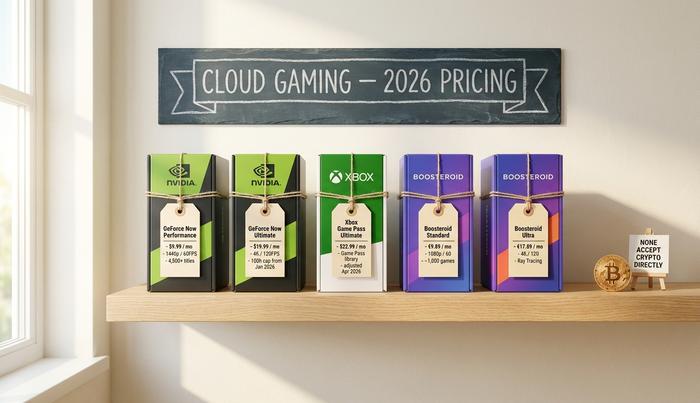
NVIDIA's GeForce Now charges $9.99 per month for the Performance tier (1440p at 60 frames per second, six-hour sessions) and $19.99 per month for Ultimate (RTX 5080 servers, 4K at 120fps or 1080p at 240fps, eight-hour sessions). The library covers 4,500-plus supported titles across Steam, Epic, and other PC stores. The major change effective January 1, 2026 is a 100-hour monthly playtime cap; once you exhaust it, additional 15-hour blocks cost $2.99 on Performance or $5.99 on Ultimate. That is a quiet effective price increase for power users.
Boosteroid is the European-headquartered competitor, priced at €9.89 per month for Standard (1080p/60) or €17.89 for Ultra (4K/120, ray tracing, frame generation), with €7.49 per month available on annual billing. The catalog runs about 1,000 games via the bring-your-own-game model where you connect Steam or Epic accounts. Twenty-nine data centers cover the US, Canada, Mexico, the UK, mainland Europe, and Brazil.
Xbox Cloud Gaming through Game Pass Ultimate had the most volatile year. Microsoft pushed the subscription from $19.99 to $29.99 per month in October 2025, a 50 percent increase that bundled in 1440p streaming, Ubisoft+ Classics, Fortnite Crew, and 75-plus day-one titles annually. Backlash followed; on April 21, 2026, the company walked the price back to $22.99 per month per its own Xbox Wire announcement. None of these platforms accept cryptocurrency directly.
| Platform | Type | Pricing (2026) | Library | Crypto |
|---|---|---|---|---|
| Mopoga (.net) | Free browser HTML5 | Free, ad-supported | Hundreds of casual titles | No |
| GeForce Now Performance | Cloud streaming (BYOG) | $9.99 / mo | 4,500+ PC titles | No |
| GeForce Now Ultimate | Cloud streaming (BYOG) | $19.99 / mo + 100h cap | 4,500+ PC titles | No |
| Boosteroid Standard | Cloud streaming (BYOG) | €9.89 / mo | ~1,000 PC titles | No |
| Boosteroid Ultra | Cloud streaming (BYOG) | €17.89 / mo | ~1,000 PC titles | No |
| Xbox Cloud (GP Ultimate) | Cloud streaming (subscription) | $22.99 / mo | Game Pass library + day-one | No |
| CrazyGames | Free browser HTML5 | Free, ad-supported | Thousands, curated | No |
Statista projects the cloud-gaming market at $10.46 billion in 2025 growing to $25.30 billion by 2029, a 24.71 percent compound annual growth rate. Mordor Intelligence puts the 2026 figure at $6.23 billion projected to $21.62 billion by 2031, slightly different methodology but similar trajectory.
Mopoga trend alternatives: CrazyGames, Poki, Y8
The legitimate free-portal tier has three dominant players. CrazyGames runs about 30 million monthly active users with around 300 million plays per month, all under in-house curation that filters games before they go live on the site. Poki operates at a similar order of magnitude with hundreds of millions of plays per month. Y8 reaches roughly 50 million unique gamers annually across a long-tail catalog that historically exceeded 70,000 titles.
For most users searching "Mopoga," one of these three is the better-curated alternative for the same use case. The structural difference between a top-tier portal and a long-tail aggregator is the QA layer: bigger portals run editorial review and ad-network whitelisting before games appear; smaller aggregators syndicate from third-party feeds with much lighter quality control. CrazyGames' catalog overlaps significantly with what the .net property hosts, and the experience tends to be cleaner. None of these platforms accept cryptocurrency either, but their direct monetization is also pure advertising rather than subscription.

Mopoga, crypto, and cloud gaming: where the gap sits
Cryptocurrency has not landed in mainstream cloud gaming. NVIDIA, Microsoft, Sony, and Boosteroid all process payments through standard card networks and PayPal. Steam famously dropped Bitcoin in December 2017, citing on-chain transaction fees that had spiked from about twenty cents to twenty dollars per transaction during the bull-run congestion, alongside Bitcoin's price volatility and what Valve's blog described as roughly 50 percent of Bitcoin transactions being fraudulent. That experience colored the broader gaming industry's view of crypto checkout for the rest of the decade.
Web3-native gaming had a punishing 2025. Funding into the category fell roughly 70 percent year on year. The PIXEL token, one of the higher-profile play-to-earn assets, lost about 95 percent of its value. Axie Infinity's daily active users halved to around 60,000 after October 2025 reward-system changes. The early thesis of "play-to-earn tokens replace gaming subscriptions" is no longer the active narrative. What replaced it is more boring and more useful: stablecoin checkout for indie cloud-gaming and browser-game operators that want global pay-in without card-processor friction. I am not convinced the major cloud-gaming platforms will adopt crypto in 2026, but the gap is real for the long tail that sits below them. A processor like Plisio, with a 0.5 percent flat fee and support for BTC, ETH, LTC, USDT, XMR, DOGE, ZEC, BCH, DASH, and dozens more assets, fills exactly that long-tail gap.
Should you use Mopoga? When legitimate options win
Use mopoga.net if you specifically want the catalog it hosts, with an ad-blocker active and no logins. Use CrazyGames or Poki for the same casual no-install browser-game use case at higher curation quality. Use GeForce Now or Boosteroid if you want AAA streaming for ten to twenty dollars per month. Use Xbox Cloud Gaming if a Game Pass subscription is already in budget and you want the day-one library. Avoid mopoga.com unless you are specifically looking for adult browser games, since the .com domain serves different content from the rest of the brand. None of the legitimate tiers accept cryptocurrency directly, which is the structural payments gap an indie cloud-gaming or browser-game operator can fill with a processor like Plisio.