Who Is Nischal Shetty? The WazirX Founder Story
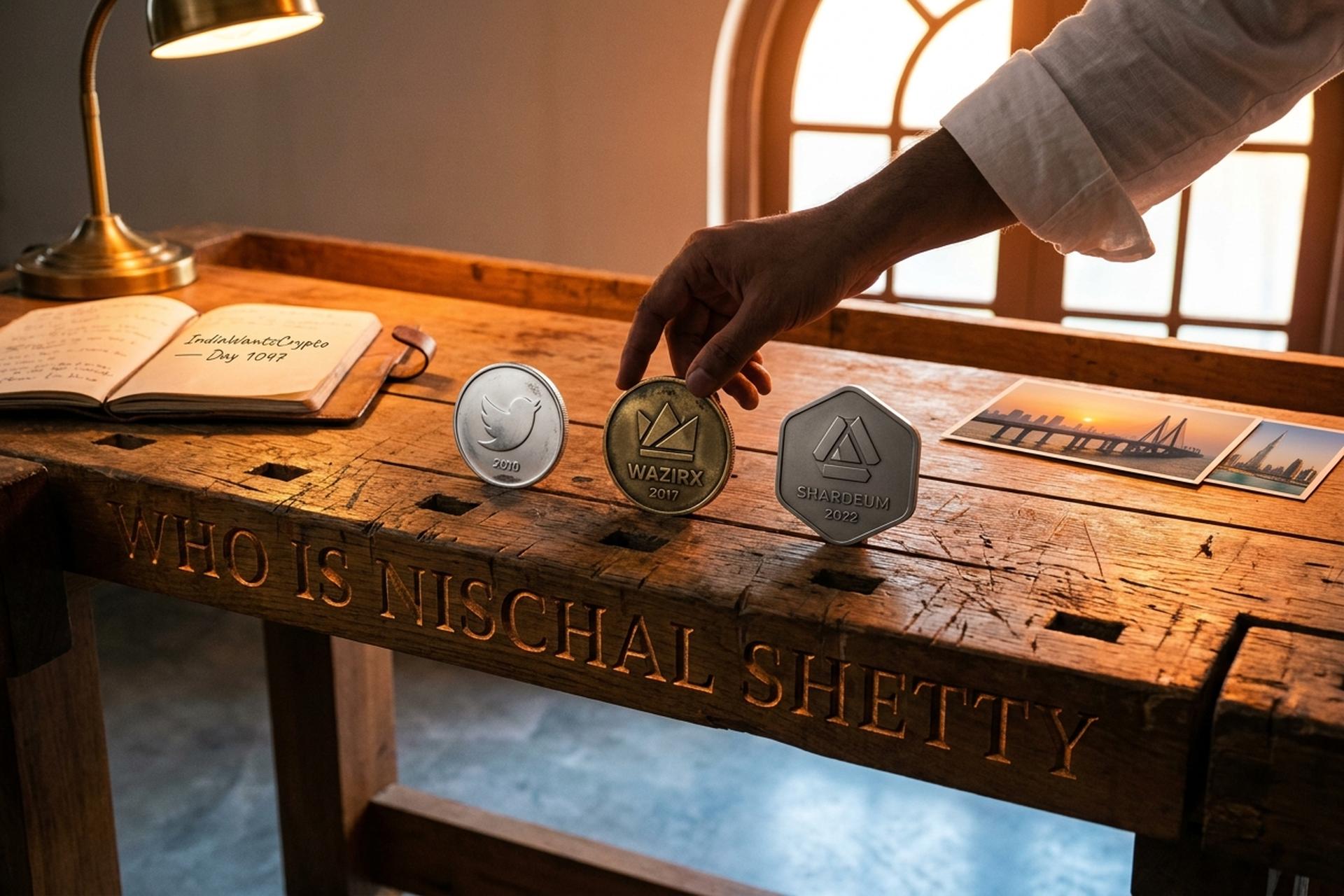
Read enough Indian crypto news from the last five years and his name keeps surfacing. Nischal Shetty runs WazirX as founder and CEO, and WazirX is the country's largest cryptocurrency exchange. For most Indian retail traders, it was where they bought their first bitcoin in INR. Outside the exchange, his other big play was the #IndiaWantsCrypto Twitter campaign. He kept it going daily for over 1,000 days. That is an unusually long lobbying push for any policy fight, let alone one over crypto. Since 2022 he has worn a third hat as well: co-founder and President of Shardeum, an autoscaling EVM Layer 1 blockchain whose mainnet went live in April 2025.
Three companies. Three career arcs. One through-line. The role he kept playing across all of them was translator: the entrepreneur Indian retail trusted to make crypto legible for them. The trust took its first real punch in July 2024, when WazirX lost roughly $234.9 million to North Korea's Lazarus Group. It took a second punch through the Singapore High Court restructuring that did not clear until October 2025. Nischal Shetty came out the other end still in his seats, still tweeting, still shipping product, but carrying a far harder story than he had a year earlier.
What follows is the rest of it. Who he is, how he got here, what really went down with Binance, why Shardeum exists at all, and where his career sits as of 2026.
Who Is Nischal Shetty: The Quick Answer
Mumbai-born founder, three companies on the ledger, none small. JustUnfollow turned into Crowdfire after a 2015 Kalaari Series A. WazirX came next and grew into the country's biggest crypto exchange. Shardeum is the blockchain he is still building. He keeps two seats today, WazirX CEO and Shardeum President, and his ninety-second pitch has barely shifted across all three: get crypto into Indian retail hands, lift broader awareness about cryptocurrency, do not lecture.
The fame outside business circles came from a hashtag. #IndiaWantsCrypto, daily, over a thousand consecutive days, asking Indian regulators for clarity. Forbes India put him on a 30 Under 30 list in 2014, before any of the crypto-Twitter version of him existed.
Early Life, Education and the Coder Years
Nischal Shetty grew up in Mumbai. His father ran a restaurant. He studied Computer Science at Visvesvaraya Technological University, graduating in 2007. By any conventional reading, that is a pretty standard Indian middle-class engineering background.
What he did with the degree was less standard. His first job was at Burrp!, an early Mumbai foodtech startup, where he worked as a software engineer. Friends from that period describe him less as a coder than as a software developer who liked shipping things end to end. He was not patient with theoretical computer science. He wanted to build products people used.
That impatience is the through-line. By 2010, three years after graduation, he had quit Burrp! and started his first company.

Crowdfire: Nischal Shetty's First Pivot
JustUnfollow launched in 2010. The original product was simple: a tool that let Twitter users see who had unfollowed them. Within a few years it had 6 million users and over $1 million in annual recurring revenue. Three of the four founders, Anirudh Khusape, Sameer Mhatre, and Siddharth Menon, would later resurface as Shetty's WazirX co-founders.
In 2015 the founders raised a $2.5 million Series A from Kalaari Capital, hitting a meaningful early-stage valuation, and rebranded JustUnfollow as Crowdfire. The new positioning was a broader social media management platform: scheduling, analytics, content discovery, the usual SaaS features. Crowdfire grew to over 20 million users at its peak, with about 6.5 million in its first scaling phase. By that point Shetty had nearly a decade of years of experience as both a coder and a marketer of his own product, which is unusual for an Indian engineering founder. It was a respectable consumer SaaS exit-track story.
It did not exit. Crowdfire wound down on 15 May 2025 in a quiet farewell post on its company blog. By then Shetty had been gone for years, focused on WazirX and Shardeum. The Crowdfire brand had stopped competing with newer social-media tools years before the formal shutdown. No acquisition, no fanfare. Just a closed chapter.
Founding WazirX and the IndiaWantsCrypto Campaign
Year was 2017. Nischal Shetty co-founded WazirX with Sameer Mhatre and Siddharth Menon, the same two engineers who had been with him since the JustUnfollow years. The product went live on 8 March 2018. Almost exactly a month later, the Reserve Bank of India dropped a banking ban on crypto businesses. Talk about timing.
The ban turned Shetty from founder into part-time activist. WazirX's first technical answer was a peer-to-peer auto-match platform: Indian users could swap INR for crypto via direct bank transfers, with WazirX escrowing the crypto leg and never touching the rupee leg. The second answer was political. On 1 November 2018, Shetty started tweeting once a day with the hashtag #IndiaWantsCrypto, asking for clear and positive crypto regulation in India. He did not stop for over 1,000 consecutive days. The campaign overlapped with the March 2020 Indian Supreme Court ruling that struck down the RBI banking ban as unconstitutional. By the time he finally paused the daily posting, the hashtag had become the loudest single crypto-policy signal coming out of India.
WazirX itself became the country's largest cryptocurrency exchange by INR volume. It is a platform that allows users to buy more than 150 cryptocurrencies in INR. CoinGecko clocked it at above 11% market share at the peak, ahead of CoinDCX and ZebPay. The platform's meteoric rise from 2020 through 2021 made Shetty one of the recognizable founder names in the Indian crypto industry, and the broader crypto ecosystem began treating him as a sort of cultural translator between Indian regulators and global crypto players. He spoke at industry events. He gave the Forbes India interview where he predicted that significant crypto regulation in India would take "two to three years" to crystallize. (It is now 2026, and India still has only a tax framework, not a comprehensive crypto law, so the prediction was directionally right.)
WazirX was also where Shetty's brand and the brand of the exchange merged. When you read about cryptocurrency in India between 2019 and 2024, his face was on the explainer.
Nischal Shetty vs Binance: The Acquisition Dispute
In November 2019, Binance announced it had acquired WazirX. CZ wrote a blog post. Indian press reported it as a done deal. The Binance Launchpad listed WazirX's WRX token in February 2020.
Then in August 2022, things got strange. India's Enforcement Directorate had begun investigating WazirX over alleged links to predatory fintech-loan-app laundering. CZ posted on X that Binance "does not own any equity in Zanmai Labs," the Indian operator of WazirX, and was "only" a wallet-services provider. Shetty rebutted publicly, arguing that Zettai Pte Ltd, the Singapore parent, had sold the WazirX tech, brand, and domain to Binance years earlier. He referenced an internal acquisition agreement. CZ did not back down.
The dispute never landed in a courtroom in 2022 or 2023, but it never resolved either. Binance terminated wallet services to WazirX in February 2023. WRX was eventually delisted from Binance on 25 December 2024, dropping about 60% within the hour and roughly 98% from its 2021 peak.
Shetty has continued to maintain that the acquisition happened. Binance has continued to deny it. As of 2026, the litigation is technically still open and the question of who owns what remains the central business controversy of his career.
Dubai, Regulation and India's 30% Crypto Tax
In April 2022 Nischal Shetty and Siddharth Menon shifted their personal base from Mumbai to Dubai. The trigger was India's new crypto tax regime: a flat 30% tax on gains and a 1% TDS on every transfer, both of which kicked in earlier that year. Indian Twitter read the move as a vote of no-confidence in domestic policy. Shetty himself framed it as a move closer to where global crypto entrepreneurs were already operating.
The same year, India's regulatory pressure on WazirX intensified. The ED had already issued a FEMA notice for roughly ₹2,790.74 crore in June 2021. In August 2022, the agency froze about ₹646.7 million ($8.16 million) of WazirX assets under PMLA. Bank accounts were unfrozen the following month after WazirX cooperated, but the message was clear: India's crypto entrepreneurs were operating in an unfriendly enforcement environment, and even the most public-facing among them, Shetty included, were not insulated.
Add GST on platform service fees from July 2025, plus mandatory VDA reporting in the ITR from FY 2025-26, and the picture is of an Indian fintech sector that runs through some of the world's heaviest crypto-tax friction. Shetty's Dubai relocation now reads less like a vote against India and more like a recognition that the regulatory backdrop was not going to ease soon.
The 2024 WazirX Hack and Singapore Restructuring
On 18 July 2024, WazirX lost approximately $234.9 million in crypto from a multi-signature wallet operated under Liminal Custody. The wallet had six signers: five from WazirX and one from Liminal. Authorizing a transaction needed three WazirX signatures plus the Liminal signature. The attackers presented WazirX's signers with a spoofed Liminal user interface that displayed a benign transaction while signing a malicious smart-contract call. Once the threshold was met, the attackers rewrote the contract governing the cold wallet and drained it. Elliptic linked the funds to North Korea's Lazarus Group within 24 hours. A January 2025 joint statement from the United States, Japan, and South Korea formally attributed the breach to DPRK.
Nischal Shetty became the public face of the response. He appeared in interviews, communicated with users via the WazirX blog and X, and led the company's pivot from the original "socialized loss" repayment plan (which would have locked 45% of every user's wallet) to a court-supervised Scheme of Arrangement under Section 210 of the Singapore Companies Act. The Singapore High Court sanctioned that scheme on 13 October 2025, with about 95.7% of creditors voting in favor by count and 94.6% by claim value.
WazirX restarted trading on 24 October 2025, fifteen months after the hack, with around 85% of user funds returned, BitGo as the new institutional custodian, and a "WazirX Zero" zero-fee trading model for the relaunch period. In a November 2025 interview with Business Standard, Shetty described the phased restart approach and made one of his most-cited post-hack quotes: "I don't believe in regretting. I believe in learning and moving forward." He remained CEO through the entire process and as of late 2025.
Shardeum: Building an Indian Layer 1 Blockchain
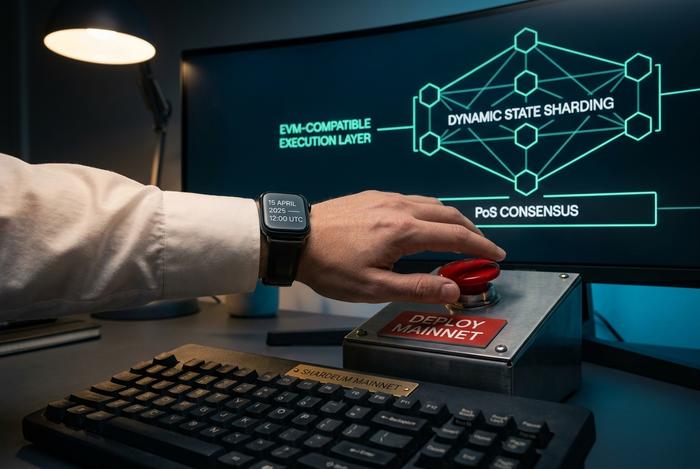
Even as WazirX was in the middle of its crisis, Nischal Shetty was busy building something else. Shardeum is the something else. He co-founded it in February 2022 with Omar Syed, a US-based blockchain architect. The technical pitch is narrow and ambitious. Build an autoscaling EVM-compatible Layer 1 that uses dynamic state sharding to keep gas low and throughput high as the network grows. Proof-of-stake at consensus. EVM at execution. Indian-led, globally pitched.
The capital piled up early. October 2022 saw a $18.2 million seed from more than 50 investors. Jane Street, Struck Crypto, and Spartan all wrote checks. The cap table read like a who-is-who of crypto liquidity providers, traders, and DeFi specialists. A $5.4 million strategic round followed and stretched the investor portfolio further. Then mainnet shipped on 15 April 2025. The SHM Token Generation Event concluded on 8 May 2025, with the public sale priced between $0.66 and $0.90 per token. EVM mainnet support and a 1:240 redenomination (supply expanded from 249 million to 59.7 billion tokens) followed on 30 October 2025.
The token, to put it bluntly, has underperformed. CoinMarketCap's tracking of the legacy ticker shows distressed market-cap data, and the post-redenomination metrics have not yet stabilized into a clear ranking by early 2026. Nischal Shetty's framing has stayed steady: Shardeum is meant to be a decentralize-first network for cutting-edge crypto products and NFTs that pulls blockchain technology to a wider Indian and global audience. The pitch leans on scaling innovation, not token speculation. That emphasis on decentralization is also a deliberate jab at the centralized custody model that hurt WazirX in 2024. He is still co-founder and President.
| Shardeum milestone | Date | Detail |
|---|---|---|
| Project unveiled | February 2022 | Co-founded with Omar Syed |
| Seed round | October 2022 | $18.2M from 50+ investors |
| Strategic round | 2024 | $5.4M |
| Mainnet | 15 April 2025 | Autoscaling Layer 1 |
| SHM TGE concludes | 8 May 2025 | $0.66–$0.90 public sale |
| EVM mainnet + 1:240 redenomination | 30 October 2025 | Supply 249M → 59.7B |
Nischal Shetty Net Worth, Profile and Current Role
So how rich is the man? Honestly, nobody actually knows. Aggregator sites throw out numbers from $60 million up to north of $330 million (something like ₹2,790 crore). Methodologies are missing across the board. Take any single figure with caution. The basket implied is some mix of WazirX equity, WRX token holdings, a Shardeum founder allocation, residual stakes in Crowdfire, and a long tail of undisclosed angel positions. Honest summary in three sentences: he is wealthy. The wealth concentrates in early-stage and post-hack assets whose mark-to-market is contested. Public disclosures are minimal.
His public footprint mostly lives on X. The @NischalShetty handle had around 483,800 followers in 2024, with no clean 2026 scrape circulating yet. He runs no high-frequency podcast. There is no weekly YouTube drop. What he does is sit for occasional interviews, usually with Indian business publications like Business Standard, Forbes India, Inc42, and YourStory, plus the odd crypto desk such as CoinDesk, TheStreet, or CoinGape. His name also turns up on the cap tables of EPNS, Wint Wealth, InVideo, Hypersign, and Remtir, sometimes as an investor and sometimes as an advisor.
That is the present-tense state. Founder and CEO at WazirX. Co-founder and President at Shardeum. Both companies are mid-build, or mid-rebuild, depending on which one you mean. Crowdfire is the chapter that has fully closed.