
Bitcoin Transaction Accelerator: BTC and Bitcoin Accelerators in 2026

On April 24, 2024, Bitcoin miners earned $25.8 million in fees in a single day — the highest daily total in network history, per The Block. That was the day the Runes protocol launched in the same window as the halving, and every block came out crammed with inscription traffic at four-digit sat/vB rates. A user staring at a stuck $200 BTC payment that afternoon could pay any BTC accelerator service $59, $80, or $120, and it would not have mattered. Every pool's next block was already full of higher-fee transactions.
A Bitcoin transaction accelerator is not a magic button. It is a request, with a market price, sent to one specific mining pool, asking that pool to bend its priority list for one specific TXID. Whether it works depends on whether that pool finds a block soon, and whether your fee bid beats the rest of the mempool when it does. Once you see it that way, most of what marketing pages claim falls apart, and the cases where an accelerator actually helps shrink to a narrow band.
What a Bitcoin transaction accelerator actually is
A Bitcoin transaction accelerator, sometimes marketed as a BTC accelerator or a transaction acceleration service, is a service that asks a mining pool to prioritize one unconfirmed transaction over others sitting in the mempool. The mempool is the global buffer of transactions waiting to be included in a block, and miners pick from it greedily, by fee per virtual byte. If your transaction is paying 5 sat/vB and the next-block tier is at 25 sat/vB, you wait, sometimes for hours, sometimes longer. An accelerator is a side-channel pitch to a specific pool: please look at this transaction ID and put it in the next block you find. It is not a protocol feature, it is not magic, and it has no effect on pools that did not agree to listen.
Why Bitcoin transactions get stuck in the mempool
Stuck does not mean broken. It means you underpaid for the current fee market. The mempool is not a queue; it is a real-time auction for block space, and every miner runs the same arithmetic: include the highest fee-per-byte transactions first. Your transaction fee is denominated in satoshis per virtual byte (sat/vB), not in dollars or in the amount you are sending. A 250-byte payment of 50 BTC at 1 sat/vB pays the same fee rate as a 250-byte payment of $5 at 1 sat/vB, and both clear at the same time.
When traffic is light, that auction clears at the floor. BTC.network's block-space report for April 9-16, 2026 puts the median next-block fee at 1 sat/vB. When traffic spikes, the floor rises sharply. The May 2023 Ordinals surge pushed the mempool past 465,000 unconfirmed transactions and high-priority fees above $40, per BeInCrypto. December 2023 saw average fees of $37, the highest since April 2021, per CoinDesk. The April 20, 2024 halving block (block 840,000) carried 37.6 BTC in fees, about $2.4 million, with median rates briefly hitting 1,805 sat/vB.
The good news, often left out of accelerator marketing, is that a stuck transaction does not vanish. Bitcoin Core's default mempool expiry is 14 days, set by PR #9312 back in 2017 and still the default in 2026. After 14 days, the inputs return to your wallet and you can rebroadcast at a higher fee.
How BTC accelerators work — three different mechanisms
The word "accelerator" hides three completely different mechanics, and conflating them is how the marketing wins.
The first kind is free node-rebroadcast. Services like BitAccelerate take your TXID and push the raw transaction to roughly 20 well-connected Bitcoin nodes on the blockchain network. This only helps in one narrow case: your wallet failed to propagate the transaction widely, and some miner with a different mempool view had not seen it. If your transaction is already visible on mempool.space, rebroadcasting changes nothing. The fee tier still decides inclusion.
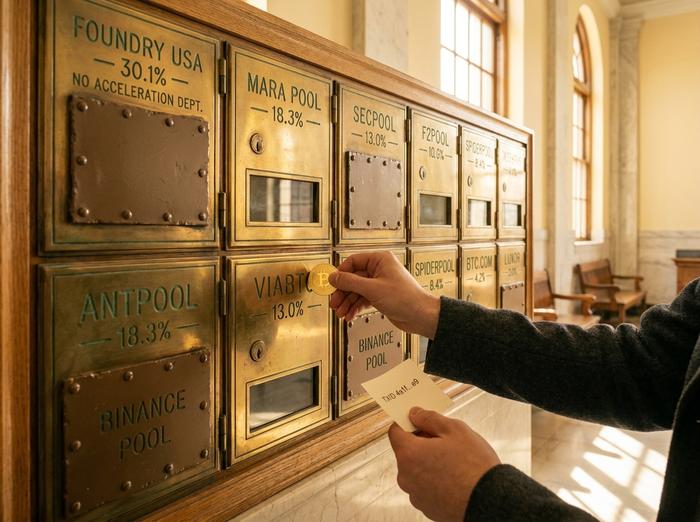
The second kind is mining-pool priority partnership. ViaBTC and F2Pool both run accelerators tied to their own pool operations. When you pay them, your TXID goes to the top of their internal priority list. The catch is mathematical. According to HashrateIndex's December 2025 ranking, ViaBTC mines 13.0% of all Bitcoin blocks and F2Pool 10.0%. Foundry USA, the largest pool at 30.1%, runs no public paid accelerator. AntPool sits at 18.3% and accelerates mostly internally. So even after paying ViaBTC, you are buying roughly a one-in-eight shot at the next block being yours.
The third kind is out-of-band fee payment, the mechanism behind mempool.space's Mempool Accelerator. There is no new on-chain transaction. Instead, the service collects fiat or Lightning, then signals partner pools off-chain that this TXID has effectively been topped up. The payment never touches the Bitcoin network as a fee, which is why the mechanism works without invalidating your original transaction. It is the most transparent of the paid options because every acceleration is published on a public dashboard.
None of these mechanisms can override the fundamental fact: the pool that mines the next block has full discretion over what goes in it.
Top BTC accelerator services in 2026, compared
The table below collapses the list to what matters: who operates the service, how much hashrate they actually control, and what they cost. Marketing pages bury the hashrate column.
| Service | Operating pool | Pool hashrate share | Free tier | Paid price (sample) | Mechanism |
|---|---|---|---|---|---|
| ViaBTC | ViaBTC | 13.0% | 0/hour as of May 2026 | >0.002 BTC (~$120) | Pool priority |
| F2Pool | F2Pool | 10.0% | None | ~0.001128 BTC (~$69) | Pool priority |
| Mempool Accelerator | Multiple (undisclosed) | Sum unknown | None | Variable, fee + service | Out-of-band |
| BTC.com | Linked to Antpool | 18.3% (Antpool) | None | Variable, ~$25-$60 | Pool priority |
| BitAccelerate | None disclosed | n/a | Free rebroadcast | ~$59 paid tier | Rebroadcast |
| Bitcoin Afterburner | None (wallet feature) | n/a | n/a | $5.99 + CPFP cost | CPFP wallet |
| ConfirmTX | None disclosed | n/a | <250 byte tx | ~$5 floor, 12 hr | Mixed |
| Antpool | Antpool | 18.3% | None | Internal | Pool priority |
A few things stand out. First, the price column does not correlate with the hashrate column. BitAccelerate charges $59 with no disclosed pool affiliation; ConfirmTX charges $5 with the same. Second, Bitcoin Afterburner is not actually an accelerator; it is a Samourai wallet feature that builds a child-pays-for-parent transaction for you, which any wallet with CPFP support can do for free. Third, Foundry USA controls roughly 30% of the network and operates no public accelerator, so 30% of all blocks are unreachable through any paid service no matter how much you spend.
ViaBTC's free counter showing 0 per hour as of the May 4, 2026 fetch is itself a data point. The historical quota was 100/hr, dropped to 20/hr, now zero. The free tier exists primarily as marketing for the paid one.
Free Bitcoin transaction accelerators — what the "free" actually buys
A free Bitcoin transaction accelerator is a queue with no guarantee. That is the honest framing. ViaBTC's free service used to allow 100 free accelerations per hour on BTC transactions under 0.5 KB with a low transaction fee; that quota dropped to 20, then to 0 as of the live page check on May 4, 2026. BitAccelerate's free tier rebroadcasts to roughly 20 nodes, useful only if your transaction failed to propagate, useless if it just has a low fee.
The pattern across every free Bitcoin transaction accelerator I have looked at is the same. The free tier costs the operator essentially nothing because most "free" requests are queued indefinitely and quietly fail. The paid tier is where the operator makes money, and the free tier exists to drive traffic to it. None of this is dishonest; the services rarely promise more than "we will try." But a user who reads "free Bitcoin accelerator" and assumes confirmation within an hour is reading something the operator never wrote.
The Mempool Accelerator and what out-of-band fees mean
Mempool.space's Mempool Accelerator is the most technically transparent paid option, and worth understanding even if you never use it. Unlike RBF or CPFP, the service does not create a new on-chain transaction. Instead, you pay a service fee plus a fee delta that brings your effective rate up to a chosen target, with payment via Lightning, Cash App Pay, Apple Pay, Google Pay, or prepaid credit. The service then signals its partner pools off-chain that this TXID should be treated as if it carried the higher fee.
The partner pools are intentionally undisclosed; mempool.space says only "our mining pool partners." Every acceleration is logged on a public dashboard, with success and failure visible in real time. Service fees are non-refundable to discourage transaction pinning attacks. The mechanism is clean, and the dashboard transparency is real, but the same hashrate-share question applies. If Foundry mines the next block and is not a partner, the acceleration does nothing for that block.

Why most don't need an accelerator — RBF and CPFP win
The single most important change for anyone thinking about accelerators happened on October 10, 2024, when Bitcoin Core v28.0 was released and full Replace-by-Fee became the default mempool policy via `mempoolfullrbf=1`, per the Core release notes. Peter Todd's measurements showed at least 31% of hashrate already mining full-RBF in August 2023, climbing to roughly 70% by January 2024, per Bitcoin Optech. After the Core 0.28 default flip, the network now treats RBF as standard.
That matters because Replace-by-Fee lets you broadcast a new version of your stuck transaction with a higher fee, signed from the same inputs. Miners pick the higher-fee version, the original is replaced, and inclusion is essentially deterministic at the new fee tier. Child-Pays-For-Parent (CPFP) is the alternative when you cannot RBF: for example, if you do not control the inputs but you do control one of the outputs. You spend that output in a new child transaction with a high fee; miners must include the parent to include the child, so they get bundled.
The economics are not subtle. A 250-byte transaction bumped from 5 sat/vB to 30 sat/vB via RBF costs roughly 6,250 satoshis in additional fee, about $1.50 at $24,000 per BTC. The same outcome through ViaBTC's paid accelerator costs $120 with a 13% chance of next-block inclusion. I keep coming back to this number because it is the point. Paying for a paid accelerator instead of using RBF is paying 80x the price for worse determinism.
The table below makes the comparison concrete.
| Method | Cost (typical) | Determinism | When to use |
|---|---|---|---|
| RBF | Fee delta (~$1-5) | High — every miner picks higher fee | Wallet signaled RBF; you control inputs |
| CPFP | Child fee (~$2-10) | High — miners must bundle | You don't control inputs but control an output |
| Paid accelerator | $25-$120 | Pool-share dependent (10-30%) | Non-RBF tx with no spendable output |
For most wallets in 2026 (Sparrow, BlueWallet, Electrum, Bitcoin Core itself), RBF signaling is on by default. If your wallet supports it, paying an accelerator is the equivalent of overnighting a letter you could have emailed.
Bitcoin accelerator scams and the red flags to learn
The other thing that has changed since 2023 is the scam surface. Chainalysis's 2026 Crypto Crime Report logged roughly $14 billion in on-chain scam inflows for 2025, up from $9.9 billion in 2024. Proofpoint flagged a January 2025 phishing campaign that used fake "automated mining accelerator" lures specifically. The page asks for an upfront BTC payment to a fresh address, no acceleration ever happens, and the address drains within minutes.
The red flags are consistent. A real accelerator either belongs to a known mining pool with a verifiable hashrate, or publishes a dashboard of past accelerations. Phishing fronts ask for upfront BTC to a fresh address, have no pool affiliation page, no historical record, and a domain younger than twelve months. If you cannot find the operator on HashrateIndex or Bitcoin Optech, treat the site as a phishing front by default.
When an accelerator actually makes sense
Three narrow conditions justify paying for an acceleration service to speed up unconfirmed BTC transfers. First, your transaction was sent without RBF signaling (common in older wallets or some exchange withdrawals), and you do not control any output to do CPFP. Second, you must have confirmation within the hour during a real congestion event, not a steady-state market. Third, the accelerator you are about to pay operates a pool with at least 10% network hashrate, so the math is at least defensible.
Outside those conditions, the answer is usually wait. Bitcoin Core's 14-day mempool expiry means the worst case is a two-week delay followed by a free rebroadcast at a current fee. That is the cheapest accelerator there is.



