Stablecoin Regulation 2026 : GENIUS Act, MiCA, and Global Rules

For roughly half a decade after the 2019 Libra controversy, stablecoin regulation in the United States was the thing Congress could not get done. Two presidential administrations, four Treasury Secretaries, and a dozen committee hearings produced reports, executive orders, and proposed bills, but nothing with statutory force. That changed with one signature on 18 July 2025, when President Trump signed the GENIUS Act into law and gave the United States its first federal cryptocurrency framework. The European Union's MiCA Title III and Title IV had already been applying since 30 June 2024, the United Kingdom's FCA had finalised the framework that goes live on 25 October 2027, and Hong Kong's Stablecoins Ordinance had taken effect on 1 August 2025. By April 2026 the total stablecoin market cap had crossed $320 billion, with USDT at $188 billion, USDC at roughly $78 billion, and Treasury Secretary Scott Bessent forecasting the segment toward $3.7 trillion by 2030 if the new frameworks hold. The shift from regulatory inaction to coordinated regimes is the real story of 2025; the individual rules, important as they are, follow from that one political fact.
The TerraUSD shadow that wrote these laws
Every framework discussed here is reactive to a single event. TerraUSD's collapse in May 2022 wiped roughly $45 billion of UST and LUNA market cap inside a week, after a run on the Anchor Protocol exposed the fragility of the algorithmic peg. Treasury Secretary Janet Yellen cited the collapse in May 2022 testimony as evidence that stablecoins required federal regulation. The argument took three years to produce a statute. Then it produced one in every major jurisdiction.
The GENIUS Act: what it actually requires
The Guiding and Establishing National Innovation for US Stablecoins Act, S.1582, is the most consequential US crypto statute since the Bank Secrecy Act extended to virtual asset service providers. It cleared the Senate on 17 June 2025, the House on 17 July, and was signed on 18 July. The framework it creates is more conservative than what the crypto industry asked for: no yield to stablecoin holders, full Bank Secrecy Act scope, and reserve eligibility narrowed to cash and the safest end of the Treasury market. The most important thing the Stablecoins Act did, however, was not the reserve rules. It was the explicit removal of a payment stablecoin from securities and commodities classification, ending the multi-year ambiguity that had paralysed bank-affiliated issuers.
Permitted issuance under the Act runs in three tracks for any payment stablecoin issuer. The first is a subsidiary of an insured depository institution, supervised by its parent bank's primary federal payment stablecoin regulator. The second is a federal qualified payment stablecoin issuer, a non-bank chartered by the Office of the Comptroller of the Currency. The third is a state-qualified payment stablecoin issuer; state qualified payment stablecoin issuers operate under a state payment stablecoin regulator and a state regime that the OCC certifies as substantially similar to the federal one. A nonbank payment stablecoin issuer in the federal track is reviewed by the Stablecoin Certification Review Committee created by the Act. The federal/state line for stablecoin issuance sits at $10 billion of outstanding payment stablecoins. Below that, an issuer may opt for a state regime; above it, the move to federal supervision is mandatory. Stablecoin issuers must hold reserves equal to 100% of payment stablecoins issued, in segregated accounts. Eligible assets are narrow: US dollars at insured banks, Treasury bills with maturity at or under 93 days, reverse repos on Treasuries, and government money-market funds. Monthly reserve disclosure is mandatory, and issuers above $50 billion submit annual audited financial statements. Payment stablecoin holders rank ahead of all other creditors in bankruptcy. The Act also requires that issuers be able to seize, freeze, or burn tokens on lawful order.
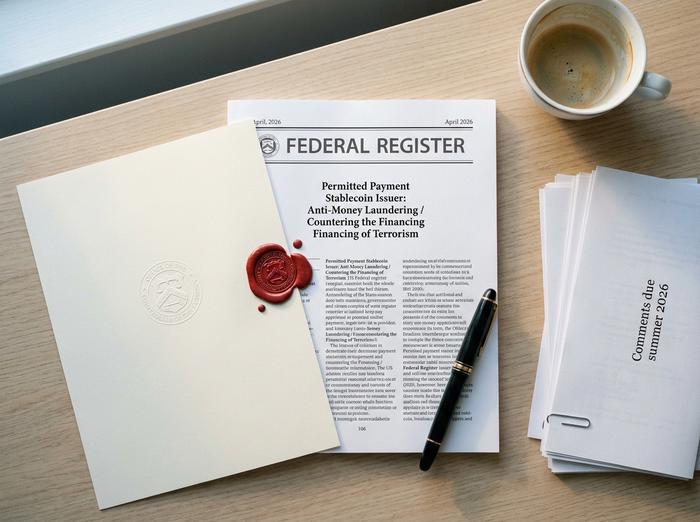
Treasury proposes rules to implement the GENIUS Act
Federal banking agencies have 18 months from enactment to write the rules that operationalise the statute, and the implementation of the GENIUS Act is now the most active piece of US financial rulemaking in 2026. The Office of the Comptroller of the Currency published a proposed rule in March 2026 covering chartering, capital, liquidity, and supervision standards for any permitted payment stablecoin issuer that opts into the federal track. The proposed rule would implement the GENIUS Act's federal-track requirements. Bank-style capital floors. Reserve segregation. Strict requirements for permitted payment stablecoin reserves. OCC examination on the same cycle as a national bank. The Act requires the OCC to act within fixed deadlines. Final rules within 18 months. That is the GENIUS Act's calendar, and it is why 2026 is such an active rulemaking year. The GENIUS Act provides the only federal pathway for banks to issue payment stablecoins. The GENIUS Act permits state-track issuers to operate in parallel below $10 billion. Payment stablecoins must, under provisions of the GENIUS Act, maintain a stable value relative to the US dollar. Reserves backing the stablecoin sit in the narrow asset list above. The Act requires that any holder of any payment stablecoin be able to redeem a payment stablecoin at par on demand, and the rules around redemption of payment stablecoins and redeeming payment stablecoins under stress conditions are central to the proposed framework. Issuers of stablecoins must plan for both routine and crisis-mode redemption flows. Anyone who wants to issue a payment stablecoin or otherwise issue stablecoins in the US has to model both. A run on the stablecoin is the scenario the framework is designed against. For any payment stablecoin issued at scale, that means stress testing the operational risk of stablecoin issuers in advance — not after the fact. The GENIUS Act also bars paying interest to stablecoin holders, which closes the loophole that earlier yield-bearing stablecoin designs had relied on. Treasury's Financial Crimes Enforcement Network published a companion notice of proposed rulemaking in the Federal Register in April 2026. The heading: "Permitted Payment Stablecoin Issuer: Anti-Money Laundering / Countering the Financing of Terrorism". It brings every permitted payment stablecoin issuer under the Bank Secrecy Act for transaction monitoring, sanctions screening, suspicious-activity reporting, and customer identification.
Treasury proposes a tiered regulatory framework for payment stablecoins. State-qualified payment stablecoin issuers below $10 billion file with their state regulator and report aggregated metrics up to the OCC. Federally qualified issuers above $10 billion file directly with the OCC and the Federal Reserve, with capital floors keyed to the issuer's reserve composition and operational risk profile. The Department of the Treasury and the Secretary of the Treasury also retain authority over foreign payment stablecoin issuers seeking access to US users, through the comparable-jurisdiction determination explained later in this guide. Comments on both notices of proposed rulemaking close in summer 2026, with final rules expected in early 2027. The companion CLARITY Act, which passed the House the same week as GENIUS, allocates spot-market jurisdiction over digital commodities to the CFTC, leaving GENIUS as the first pillar (stablecoins) and CLARITY as the second (market structure). State preemption remains the most actively litigated open question because state regulators retain primary authority below $10 billion while the federal framework for payment stablecoins applies uniform disclosure and reserve floors above it. The implementing the GENIUS Act work stream, in short, will dominate US crypto policy through 2027, and the rules for stablecoins it produces will set the global baseline for issuance of payment stablecoins.
MiCA Title III and IV and the EUR 200M cap
The single most consequential MiCA provision for stablecoin economics is the cap on non-EUR significant stablecoins used as a means of exchange in the European Union: 200 million euros per day OR 1 million transactions per day, whichever bites first. The cap is functionally a US-dollar ban for retail flows — dressed as a prudential limit on systemic risk. It will be tested in court well before 2027. Everything else in MiCA's stablecoin regime flows from that constraint.
Regulation (EU) 2023/1114 has applied stablecoin rules from 30 June 2024. Title III governs asset-referenced tokens (ART) that reference multiple currencies, commodities, or a basket. Title IV governs e-money tokens (EMT) that reference a single fiat currency and must be issued by an authorised credit institution or an EMI-licensed e-money institution. Reserves are held with EU-authorised credit institutions under strict liquidity and bankruptcy-remoteness rules. Significance designation by the European Banking Authority is triggered by user counts, transaction volume, market cap, or cross-border activity, and it shifts supervision from national competent authorities to the EBA with enhanced capital and reporting. The transitional period for non-compliant issuers ends on 1 July 2026. After that, an unauthorised issuer cannot legally offer services in the European Union. Tether holds no EMI license in any member state as of early 2026, which is why most EU venues delisted USDT for retail in 2024 and 2025 or restricted it to professional clients. Circle's USDC is EMT-compliant through a French EMI authorisation granted in mid-2024.
United Kingdom, Singapore, Hong Kong, Japan: four different bets
The four major Asian and UK jurisdictions made structurally different choices. The United Kingdom's regime, built on FSMA 2023, the FCA's CP25/14, and HM Treasury's Phase 1 positioning, becomes effective on 25 October 2027, the latest schedule among the major jurisdictions. The Bank of England runs a parallel consultation on systemic stablecoin oversight that closed in February 2026. Singapore's Monetary Authority finalised its Single-Currency Stablecoin framework in August 2023, in force from 2024, with a base capital requirement of S$1 million plus 50% of operating expenses, restricted to SGD or G10-currency pegs. Hong Kong's Stablecoins Ordinance, passed in May 2025 and effective 1 August 2025, requires HKMA licensing for fiat-referenced stablecoin issuers with HK$25 million minimum capital, and the first sandbox cohort moved into full licensing in early 2026. Japan amended the Payment Services Act in 2023 to permit trust-bank issuance of electronic payment instruments, and JPYC issued its first regulated stablecoin on 27 October 2025 under the Progmat Coin trust-bank reference architecture.
The design diversity is itself the point. The UK is the slowest because it is the most cautious. Hong Kong is the most welcoming because it has the most to gain from positioning. Singapore is the most conservative because the MAS has reputational equity to protect. Japan is the most institutional because the trust-bank route bypasses the entire fintech licensing question. None of them clones any other.
Algorithmic stablecoins: regulated to death
The post-Terra consensus across major jurisdictions is the same: algorithmic peg mechanics do not qualify for retail authorisation. The GENIUS Act limits the payment-stablecoin definition to fiat-backed instruments. MiCA Title III explicitly excludes purely algorithmic stabilisation mechanisms. Singapore, Hong Kong, and Japan all restrict licensing to fully reserved fiat-referenced tokens. Over-collateralised crypto-backed designs such as DAI's continuing evolution are the only frontier where genuinely new mechanisms remain regulatorily viable. Even there the path to "payment stablecoin" status is closed.
Cross-border and the significance question
The geopolitical lever in the new regime is Treasury's "comparable jurisdiction" determination. A foreign-issued stablecoin can serve US users only if Treasury determines that the issuing country's framework offers comparable consumer protection. MiCA's significance designation is the European analogue: a non-euro EMT that crosses the EUR 200M / 1M-tx daily threshold gets dragged into the EBA-supervised tier and faces the cap on top of the licensing requirement. The Financial Action Task Force updated its Travel Rule guidance in June 2025 to cover stablecoin transfers across virtual asset service providers, and the BIS and IMF have continued cross-jurisdictional coordination through the Financial Stability Board's stablecoin recommendations. The structural effect is that non-compliance is no longer a regulatory-arbitrage problem. It is a geographic-availability problem — fail one regime, lose that region's retail market entirely. An issuer that fails any one of the major regimes loses access to that region's retail market entirely.

Issuer-by-issuer in 2026: who adapted, who didn't
Circle is the prepared incumbent. USDC reached $78 billion in circulation, completed its NYSE IPO in June 2025, holds the only top-tier EMT compliance in the EU through its French authorisation, and is the default candidate for any payment-platform integration that needs regulatory durability. The bet Circle is making: compliance everywhere creates a moat that latecomers cannot quickly close. Tether is the unbookable elephant. USDT remains the largest stablecoin at $188 billion. Its 2026 posture is the most fragmented of any major issuer. Non-MiCA-compliant in the EU. Hit by an OFAC freeze of $344 million linked to Iranian sanctions evasion in April 2026. Subject of an ongoing US Department of Justice probe into reserve practices. Tether's bet is that geographic fragmentation lets it survive as the offshore default — without compliance everywhere. Both bets are still live in 2026.
Ripple's RLUSD is the sleeper. The token launched on 10 December 2024 under New York Department of Financial Services authority, and Ripple itself received the OCC's conditional approval for a federal trust bank charter on 12 December 2025. The combination, an NYDFS-regulated stablecoin distributed through Ripple Payments and the XRP Ledger, plus the trust-bank charter that opens federal banking-rail access, is a legitimate threat to the USDC duopoly position over the next two years if the institutional pipeline materialises. PayPal USD, issued by Paxos, has expanded onto Solana and BNB Chain alongside Ethereum and stayed comfortably within New York DFS supervision; PYUSD is doing exactly what you would expect a payment-platform stablecoin to do.
Recent enforcement and what to watch
Headline enforcement in the GENIUS era is still scarce in mid-2026, and that will change. The April 2026 OFAC action against Tether-linked addresses related to Iranian sanctions, with $344 million frozen, is the most consequential public move so far. The DOJ probe into Tether's reserves is ongoing. EU national competent authorities, Italy's CONSOB and Germany's BaFin first, have begun MiCA enforcement against non-compliant issuers. SEC Chair Paul Atkins, who replaced Gary Gensler in early 2025, has taken a notably lighter posture on stablecoins now that GENIUS removed them from the SEC's jurisdiction. The next twelve months will tell whether the GENIUS Act requirements bite at the federal level, whether MiCA's significance designation pulls a major US-dollar issuer onto European supervisory hooks, and whether the UK regime arrives in October 2027 with rules sharper or looser than the EU baseline.