Best Bitcoin Ordinals Wallets 2026 : Top Wallets for NFT Inscriptions
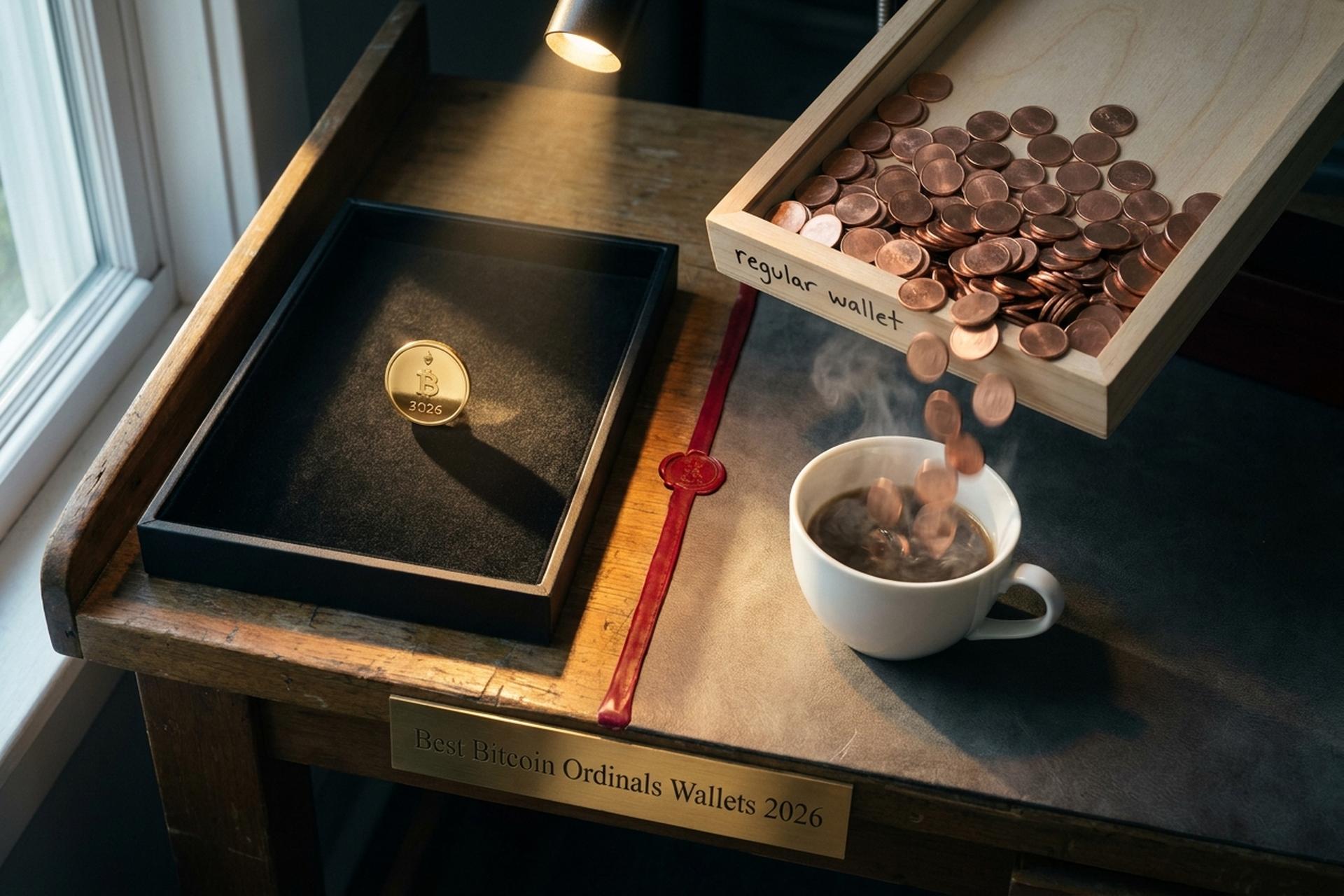
A regular Bitcoin wallet does not understand Ordinals. Receive an inscription into a generic crypto wallet, Electrum, BlueWallet, Trust Wallet, or Ledger Live's default Bitcoin app, and the wallet sees the UTXO as ordinary BTC. It may pay that UTXO out as change on your next Bitcoin transaction, destroying the inscription with no warning. The first thing any holder needs is therefore not a bigger collection but an Ordinals-aware Bitcoin wallet, a wallet that understands which satoshi a given inscription lives on and refuses to spend that UTXO during ordinary coin selection. The best Bitcoin Ordinals wallets in 2026 share one defining feature: native, non-custodial wallet handling of Ordinal NFTs as unique digital assets rather than fungible BTC, and tight integration with the wider Bitcoin ecosystem.
This guide reviews the wallets that meet that bar in 2026, compares their feature sets across desktop and mobile, walks through the inscribing flow and the BRC-20 and Runes activity around it, and covers the specific failure modes that have cost inscription holders money in the last two years.
What Bitcoin Ordinals are in 2026
Casey Rodarmor turned satoshis into NFTs. The Ordinals protocol launched in January 2023, on the back of the Bitcoin Taproot upgrade from 2021. It assigns each sat, the smallest unit of Bitcoin, a serial number based on its mining order. Arbitrary data, images, text, code, video, can then be inscribed directly on the Bitcoin blockchain and tracked as an immutable on-chain artifact. By April 2026 the Bitcoin network has crossed roughly 90 million inscriptions, and a parallel Ordinals ecosystem of marketplaces, indexers, and inscription-as-a-service providers has grown around them. BRC-20 tokens and Runes are the two fungible-token standards that share the same underlying primitive on the Bitcoin mainnet.
What an Ordinal wallet is and how it works
The functional bar for an Ordinal wallet is small but concrete. A wallet that supports Ordinals indexes inscriptions by sat number, surfaces inscription metadata in receive and send flows, and refuses to spend UTXOs that contain inscriptions during ordinary coin selection unless the user explicitly authorizes it. Wallets that meet all three criteria are called Ordinals-aware. The protocol relies on inscriptions living on specific sats inside specific UTXOs, and spending the UTXO spends the inscription; that is the whole risk model — in one sentence. Postage of 546 to 10,000 sats wraps the inscription to keep the UTXO above Bitcoin's dust limit, and the postage itself sits inside the inscription UTXO rather than as a separate output. Most Ordinal wallets covered here are non-custodial wallets, which means you hold the private keys yourself, and the private keys hold the inscriptions.
Top Bitcoin Ordinals wallets to choose in 2026
Eight popular wallets for Bitcoin Ordinals dominate the inscription market in 2026, with a clear three-way split among the top wallets. Mainstream consumer tools (Xverse, Phantom, Exodus) emphasise simple onboarding and integrated fiat ramps. Ordinals-native power-user tools (Unisat, Leather) build their UI around inscription tooling itself. Security-focused desktop tooling (Sparrow) targets cold-storage workflows. Magic Eden Wallet and OKX Wallet sit on either side of the centralised-versus-self-custodial line, and each NFT marketplace they integrate with adds a slightly different inventory. The table below summarises the headline feature set for each.
| Wallet | Type | Ordinals | BRC-20 | Runes | HW pairing | Year |
|---|---|---|---|---|---|---|
| Xverse | Mobile + Ext | Yes | Yes | Yes | Ledger | 2022 |
| Unisat | Ext + Mobile + Desktop | Yes | Yes (native) | Yes | Limited | 2022 |
| Leather | Ext + Desktop | Yes | Yes | Yes | Ledger | 2018 / 2023 rebrand |
| OKX Wallet | Ext + Mobile | Yes | Yes | Yes | Ledger, Keystone | 2018 |
| Magic Eden | Ext + Mobile | Legacy only | No | Limited | Ledger | 2024 |
| Sparrow | Desktop | Yes (UTXO control) | Indirect | Indirect | Coldcard, Trezor, Ledger, BitBox | 2021 |
| Phantom | Ext + Mobile | Yes | Deprecated | Yes | Ledger | 2021 |
| Exodus | Mobile + Desktop + Ext | Partial | Via partners | Via partners | Trezor | 2015 |
All eight are free to install. Revenue comes from swap spreads and marketplace fees rather than wallet subscriptions. Network fees in sats per virtual byte are paid by the user to Bitcoin miners; the wallet does not withhold a separate platform fee on the chain transaction itself.
Xverse wallet: the mainstream Bitcoin pick
Xverse is the most-installed self-custody Ordinals wallet in 2026 and the one most reviewers recommend as a default for collectors who do not want to think about UTXO management. Built by Secret Key Labs since 2022, it runs on iOS, Android, and as a Chrome extension, supporting raw Ordinals, BRC-20, Runes, rare sats, Stacks, and Bitcoin layer-2 networks in a single user interface. The wallet integrates a fiat on-ramp, in-wallet swaps via Satsdaq, and marketplace flows for Gamma, Liquidium, and Horizon Market.
Native Ledger integration, an audit by Least Authority, and partial open-source code make it the conservative choice for users who want exposure to inscriptions without giving up the option of moving to a hardware wallet later. Xverse is the recommended pairing for Ledger devices that want a usable Ordinals UI. Ledger Live alone does not surface inscriptions. The gap between Ledger Live's bare Bitcoin view and Xverse's inscription UI is the single most common reason collectors who started with hardware wallets migrate their workflow later.
The trade-off, as with every mainstream tool, is a lower ceiling on power-user features. Xverse will not show you unconfirmed inscriptions before the mempool settles, and its UTXO management is hidden behind helpful but opinionated defaults. Holders of high-value collections often install Xverse for daily use and pair it with a Coldcard-and-Sparrow cold-storage rig for the half of the portfolio they would not want to test their phishing resistance on.
Unisat: the Ordinals-native power user pick
The Unisat wallet launched in 2022 as the original Ordinals-native wallet and has retained that reputation through several feature waves. Unisat supports raw Ordinals, BRC-20, Runes, Alkanes, and rare sats. The built-in Ordinals marketplace and a power-user interface surface unconfirmed inscriptions before they have settled, a feature unique to Unisat. Active inscribers use it to buy Bitcoin Ordinals at mint and trade Ordinals on the secondary market within minutes of confirmation. The wallet's open-source indexer (libbrc20-indexer on GitHub) is the only first-party indexer in this comparison and underpins much of the third-party BRC-20 tooling shipped over the last two years.
Unisat runs the largest BRC-20 marketplace by volume. In March 2026 the company announced a 90-day zero-fee marketplace policy and the UniHexa unified BRC-20-and-Runes exchange, both of which pulled volume back from competitors that had crept up during 2024 and 2025. Hardware-wallet integration is limited; users who want air-gapped signing typically pair Sparrow with Coldcard rather than route the workflow through Unisat. The wallet's UI assumes a level of comfort with sat-level reasoning that beginner collectors will find off-putting, but for active inscribers the interface compresses operations that take three or four clicks elsewhere into one.
Leather (formerly Hiro Wallet) and Bitcoin DeFi
The Leather Bitcoin wallet, formerly Hiro Wallet, rebranded in August 2023 after Trust Machines acquired Hiro Systems PBC. It ships as a Chrome extension and desktop app, supporting BTC, Ordinals, BRC-20, Runes, Stamps, and Stacks (STX), so it can manage your Bitcoin Ordinals alongside Stacks balances in one interface. Stacks-native legacy makes it the strongest wallet for Bitcoin DeFi: ALEX, Bitflow, Velar, and Zest all integrate Leather as a default connector, and sBTC bridging between Bitcoin mainnet and Stacks is supported in the same flow. Leather public stats put MAU above 100,000 with more than 300,000 monthly transactions in 2026. For collectors who want one wallet for inscriptions and Stacks-side yield, Leather is the obvious pick among Ordinal wallet options.
OKX Wallet and Phantom for multi-chain holders
Two wallets are worth a brief look for users who do not want a Bitcoin-only stack. OKX Wallet is exchange-affiliated but self-custodial, with an MPC key-sharding option and 50+ chains under one interface, including full Ordinals, BRC-20, and Runes support and an integrated marketplace. It pairs with Ledger and Keystone hardware wallets and works well as a multi-chain hub. Phantom, originally a Solana wallet, added Bitcoin Native SegWit and Taproot plus Ordinals support in late 2023 and now ships built-in sat protection that warns before any transaction would spend a UTXO containing a rare sat or inscription. In-app BRC-20 was deprecated in late 2025; Runes remains first-class, and on-ramps include MoonPay, Robinhood, and PayPal.
Sparrow and Coldcard for cold-storage Ordinals
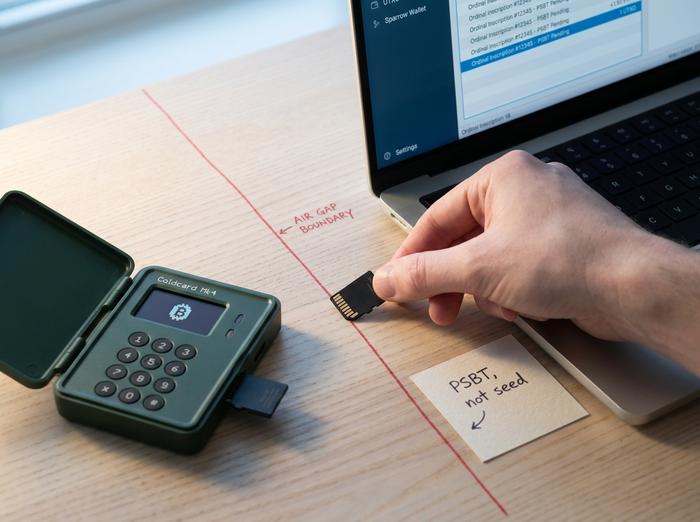
Sparrow Wallet, written by Craig Raw and released in 2021, is the canonical desktop wallet for collectors who want full UTXO control. Sparrow does not have an Ordinals-native UI, but the official Ordinal Theory Handbook recommends it as the standard receive-and-hold workflow. The user receives an inscription into a fresh Sparrow address, locates the UTXO in the wallet's UTXO tab, freezes it from the right-click menu, and the coin selector then refuses to touch it during ordinary spends. Frozen UTXOs persist across wallet restarts and survive a full re-sync, which is the property that makes the workflow safe for long-term storage rather than just careful day-to-day spending.
Sparrow pairs natively with Coldcard via microSD-PSBT for fully air-gapped signing, an arrangement widely treated as the gold standard for cold storage of high-value inscriptions. The PSBT moves between Sparrow on a hot machine and Coldcard on an offline device through a microSD card or QR code; the seed never touches an internet-connected computer. Trezor and Ledger work with Sparrow over USB for collectors who prefer those devices, but neither matches Coldcard's air-gap discipline. The combination of an open-source desktop wallet, full UTXO visibility, and air-gapped signing is what most Bitcoin-side custody guides converge on for inscription portfolios above five figures of dollar value.
Hardware wallet integration for Bitcoin Ordinals
A hardware wallet adds enhanced security by keeping the private keys on a dedicated device, but as of mid-2026 no hardware wallet has a first-class on-device inscription viewer. The pattern is consistent across vendors: the hardware device handles signing while a software wallet handles indexing and display. Trezor Suite shows BTC balance but no inscription metadata; Ledger Live shows the same; Coldcard shows raw PSBT data only. Hardware wallet integration with the Ordinals-aware software wallets below is what makes the combination usable in practice. The pairings worth knowing are summarised below.
| HW device | Ordinals signing | Recommended pairing |
|---|---|---|
| Ledger Nano S+ / X / Stax / Flex | Yes (Taproot supported) | Xverse extension or mobile |
| Trezor Safe 3 / Safe 5 | Yes (firmware 2.6+) | Sparrow Wallet |
| Coldcard Mk4 / Q | Yes (air-gapped PSBT) | Sparrow Wallet |
Coldcard plus Sparrow is the most security-paranoid setup most professional custodians settle on for the strongest security; Ledger plus Xverse is the friendliest option for everyday collectors who still want serious security on top of an Ordinals-aware UI.
How to inscribe an Ordinal NFT in 2026
A Taproot Bitcoin address, the file (typically under 400 KB to fit one transaction), and BTC for fees are the three requirements. Three routes dominate. The first is the ord reference client run locally against a synced Bitcoin node, which gives maximum control and no third-party trust but assumes a node operator's level of comfort. The second is the wallet-native one-click flow inside Unisat or Xverse, where the user uploads a file, picks a fee tier, and signs once. The third is an inscription-as-a-service provider such as OrdinalsBot or Gamma.io, which abstracts the node away entirely.
Pricing reflects the route. Gamma charges 10% of mint plus a 7,500-sat service fee plus 546 sats of postage. OrdinalsBot charges miner fees in sats per byte — plus a configurable service fee, with postage of 330 to 10,000 sats. Network fees fluctuate with mempool congestion: 5 to 20 sats per virtual byte on quiet days, 50 to 200 or more during BRC-20 or Runes mint frenzies. A typical text or PFP inscription runs $1 to $10 in fees during quiet mempool periods and $30 to $150 or more during peaks.
Security incidents and how to avoid them
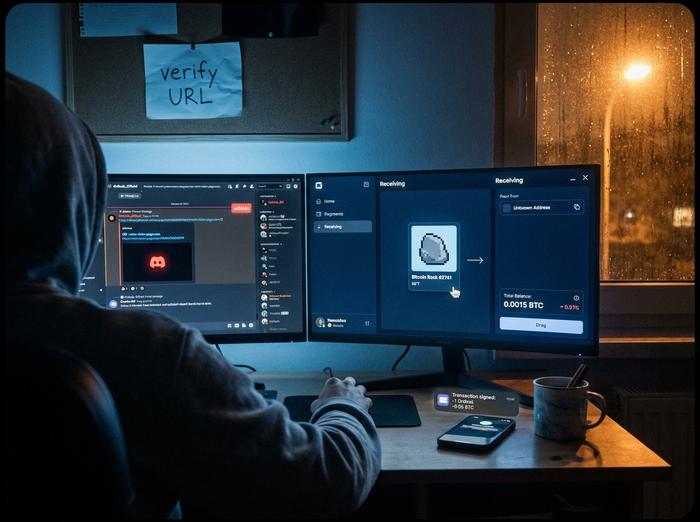
The dominant attack pattern for Ordinals holders in 2024 and 2025 was not a wallet code exploit but a wallet drainer delivered through spoofed marketplace UI, malicious Discord links, and hijacked X accounts. A few cases set the pattern. In March 2024 the Bitcoin Rock Ordinals community founder, known as Archon, lost roughly 1.47 BTC plus another 4 BTC of inscriptions, around $311,000 at the time, to a Discord drainer pinned by an admin-impersonation account inside the project's own server. In October 2023 attackers seized the ordswap.io domain and replaced the marketplace's Connect Wallet button with a drainer that emptied any wallet that approved the malicious signature.
The ordinalswallet.com X account was hijacked in 2024 and used to push a fake "claim tokens" link to followers; the UK FCA later issued an unauthorised-firm warning against the same brand. Outside of inscriptions specifically, August 2025 saw an individual lose 783 BTC, about $91 million, to a phishing-driven approval drain. Chainalysis reported $3.4 billion in stolen crypto across 2025, and the share of attacks targeting individual wallets rose materially. The defensive pattern is consistent: use an Ordinals-aware wallet with strong security features at the receive address, verify URLs manually rather than via search, never sign blind PSBTs, and prefer cold storage with Sparrow plus Coldcard for high-value Ordinals collections. When you choose a wallet for inscriptions, look for wallets that ship explicit sat protection, audited code, and robust security defaults, rather than wallets that bolt Ordinals onto a generic crypto wallet UI.
BRC-20 and Runes status in 2026
BRC-20 sector market cap sits in the $70 to $240 million range through early 2026, well below the $2 billion 2024 peak. ORDI, deployed in March 2023 with a 21 million supply, was the first BRC-20 to reach a $1 billion market cap in November 2023 and is now listed on Binance, OKX, and Bybit. SATS (1000SATS) holds the largest BRC-20 holder count. Runes, also from Rodarmor, launched at the April 20, 2024 halving block 840,000. It has absorbed most of the fungible-token volume that BRC-20 once carried. The design intent is that Runes consume UTXOs rather than create them, which keeps Bitcoin's UTXO set leaner over time.
How to choose the right Ordinals wallet today
Choosing the best Ordinals wallet comes down to matching the wallet to the use case rather than picking one suitable wallet for everything. For a beginner collector, the Xverse wallet on mobile with a Ledger paired in is enough. For an active inscriber chasing mints and BRC-20 trades, Unisat on desktop earns its UI cost. For Bitcoin DeFi exposure through Stacks, Leather is the obvious pick. For a multi-chain holder who keeps assets across several blockchains, OKX Wallet or Phantom puts every Bitcoin Ordinal in the same interface as Solana or Ethereum balances. For anyone holding Bitcoin NFTs worth more than a few thousand dollars, Sparrow plus Coldcard remains the configuration that has not been broken yet.