Per Diem Meaning: Per Diem Rate, Rules, Crypto Pay 2026

If your job sometimes pays for hotels and dinners while you are on the road, you have probably seen "per diem" on a reimbursement form. The Latin phrase means "by the day," and in modern US payroll it stands for a daily allowance covering lodging, meals, and a few small incidentals while traveling for work. The numbers behind it are set by the federal government, the rules are set by the IRS, and the way companies actually pay it is changing fast. Some employers now disburse per diem in stablecoins instead of fiat, especially for international and contractor travel.
This guide covers the per diem meaning in 2026, the GSA rate that most US trips run on, the IRS high-low method that simplifies it, the difference between accountable and non-accountable plans, what happens when you exceed the rate, the foreign per diem system, and how a growing number of finance teams are paying per diem in crypto without breaking tax rules.
What does per diem mean: the simple definition
The per diem meaning is straightforward once you cut through the jargon. Per diem is Latin for "per day." In US business and government travel, it is a fixed daily allowance, also called a per diem allowance, a fixed per diem amount per day, or a daily allowance provided to employees, that an employer gives a traveling worker to cover three categories of cost: lodging, meals and incidental expenses (the last one is usually shortened to M&IE when you see it on a form). Federal employees and federal government employees use the same standard per diem rate as private companies adopt for business travel.
The point of per diem is simple. It replaces line-by-line expense reports with a flat number. Instead of submitting twelve receipts for a three-day trip, the employee gets a single daily figure and uses it however makes sense. Coffee, dinner, hotel, hotel taxes, tips, the laundry the airline lost. All of it rolls into one daily allowance.
What per diem does not cover: airfare, mileage, rental cars, conference fees, and most ground transportation. Those are reimbursed separately, usually as actual expenses with receipts. The IRS even has a separate mileage rate for personal-vehicle use.
Per diem rate 2026: GSA standard CONUS
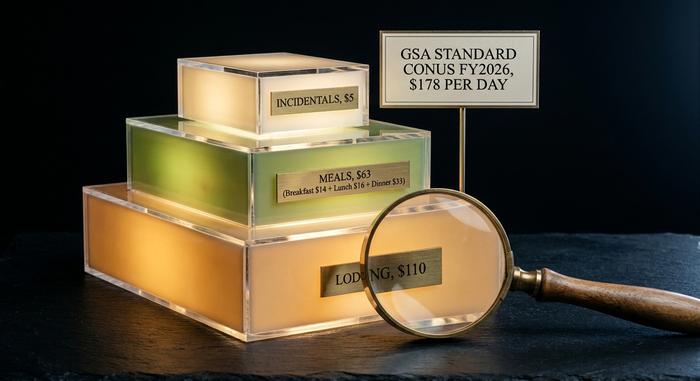
The General Services Administration publishes per diem rates for federal employees inside the continental United States, and the rest of the U.S. quietly uses these as a benchmark. These are the rates that federal agencies use to reimburse their employees on official travel, and private employers borrow the same federal per diem to keep their cost of living math defensible against the IRS. Companies that adopt the GSA schedule use it to reimburse their employees in line with what the federal government already pays. The Department of Defense applies the same numbers under its Joint Travel Regulations. For fiscal year 2026 (October 1, 2025 through September 30, 2026), GSA held the standard rate flat at $178 per day, broken into:
| Component | Standard CONUS FY2026 |
|---|---|
| Lodging | $110 per night |
| M&IE (meals + incidentals) | $68 per day |
| Total | $178 per day |
The standard rate applies to roughly 2,600 counties classified as ordinary cost-of-living areas. About 300 cities are designated as Non-Standard Areas (NSAs) and get higher rates because hotels and restaurants there cost more. NSAs include New York City, San Francisco, Boston, Washington DC, Seattle, Chicago, Los Angeles, and many resort destinations during peak season.
| Non-standard locality | FY2026 peak per diem |
|---|---|
| Manhattan, NY | ~$379 (lodging up to $342 + $92 M&IE seasonal) |
| San Francisco, CA | ~$367 |
| Boston, MA | varies seasonally; convention months highest |
| Washington, DC | seasonal range |
| Seattle, WA | seasonal range |
GSA publishes the full FY2026 master file at gsa.gov, with month-by-month lodging tables for every NSA. Lodging often varies by season; meals do not. Rates for Alaska, Hawaii, US territories and possessions sit outside the CONUS table and are set by the Department of Defense for those locations.
Per diem payment, M&IE breakdown, lodging
The M&IE portion of per diem is broken into specific meal and incidental components. GSA publishes the breakdown so travelers and finance teams can split partial-day amounts cleanly.
| Standard CONUS M&IE FY2026 | Amount |
|---|---|
| Breakfast | $14 |
| Lunch | $16 |
| Dinner | $33 |
| Incidentals (tips, fees) | $5 |
| Total | $68 |
The first and last day of any trip get 75% of M&IE only, not the full amount. That is $51 per day at the standard rate. The reasoning is that travelers eat at home or in transit on travel days, so they are not paying a full day of meals. Provided meals (a hosted conference lunch, a client dinner) get deducted at full value from the daily M&IE, not at 75%.
Lodging per diem (the per diem rate for lodging, or lodging per diem in many policies) is the maximum the federal government will reimburse for a hotel night. If your hotel costs less, you get reimbursed the actual amount. If it costs more, you eat the difference unless your employer's policy is more generous than GSA. Lodging expenses exclude taxes; the tax portion is usually reimbursed separately. Tips for hotel staff and certain fees and tips for porters are bundled into incidentals, not lodging.
How per diem work for business travelers
The mechanics are the same whether you work for a federal agency, a Fortune 500, or a Shopify-shop pulling its first off-site.
A typical per diem flow:
1. The employee logs the trip dates and destination in the travel system.
2. The system pulls the GSA rate (or the company's chosen rate) for that location.
3. The employee gets a per-day allowance for lodging and M&IE, with the 75% rule applied to first and last day.
4. The employee provides documentation as required by the company (lodging receipts at minimum, M&IE often without receipts when at or below GSA).
5. Payroll either issues an advance before the trip or reimburses after.
A few practical points. Employers can pay above the GSA rate, but the excess amount above the federal rate becomes taxable wages unless that excess is substantiated with actual receipts. Most companies match GSA exactly to keep payments to employees clean and audit-ready. Self-employed and 1099 contractors who travel for work can claim M&IE per diem at GSA rates on Schedule C, but they cannot use per diem for lodging, they need actual receipts there. The Internal Revenue Service treats per diem expenses based on the location of travel and the days of travel reported, not on a flat amount per day company-wide. Employees are reimbursed only for certain expenses tied to actual business travel; commuting and other employee expenses outside the trip do not qualify for per diem.
Days under 12 hours typically do not qualify for any per diem under the GSA test. Trips between 12 and 24 hours qualify for 75% M&IE per calendar day.
Accountable vs non-accountable per diem policies
This is the single most important distinction in per diem tax law. It decides whether the daily allowance hits the employee's W-2 or stays off it.
| Plan type | What it means | Tax effect for employee |
|---|---|---|
| Accountable plan | Business connection + substantiation within 60 days + return of excess within 120 days | Reimbursement is not wages; not on W-2; no income or FICA tax |
| Non-accountable plan | Missing one or more of the above | Treated as wages; reported on W-2; subject to income tax + FICA |
The accountable plan rules come from IRS Regulation §1.62-2 and are explained in Publication 463. There are three tests, all required:
- Business connection. The expense was paid in connection with services performed for the employer.
- Substantiation. The employee documents date, location, business purpose, and (for lodging) actual cost within a reasonable period, the IRS safe harbor is 60 days.
- Return of excess. Any per diem paid above what was actually spent must be returned to the employer within 120 days.
Reimbursements at or below the GSA rate are "deemed substantiated" if the employee provides date, location, and business purpose. That means an accountable plan does not always require a sandwich receipt. It does always require the trip to be documented.
Non-accountable plans show up most often when companies pay flat travel stipends without follow-up paperwork. Easy to administer, expensive to receive. Every dollar is taxed twice, payroll tax to the employer, income tax and FICA to the employee.
When you pay per diem and when you reimburse
Pay per diem when the trip is short, predictable, and within standard travel parameters. Reimburse actual travel expenses when the trip is unusual, expensive, or sensitive enough that you want full receipts on file. Per diems cover the routine cost-of-living-while-traveling slice (cover meals, cover living expenses, cover expenses incurred on the road); transportation expenses and additional expenses outside that slice are reimbursed separately.
Per diem fits these cases best:
- Domestic trips of 1 to 7 days where lodging is in the GSA range.
- Multi-traveler trips where the same flat rate keeps things even.
- Recurring travel (sales territories, regional audits) where setup matters more than one-off accuracy.
- Conference travel where a known city has a known GSA rate.
Actual-expense reimbursement fits these cases:
- Long international trips where the State Department rate may not match real costs.
- Executive travel with non-standard lodging.
- Trips with major variable costs (laboratory equipment shipping, on-site materials).
- Government-contractor work where the FAR may require actual costs.
A blended approach is also common: per diem covers M&IE, while lodging is reimbursed at actual cost up to the GSA cap. That removes the lodging-overage headache and keeps paperwork minimal on meals.
Benefits of per diem for finance teams
Finance teams adopt per diem because the alternative, line-item expense reports for every business trip, eats hours per traveler per trip. The benefits of per diem are operational more than financial. The per diem method also gives clean numbers for rolling forecasts: a known daily rate × known travel days = known business expenses for the quarter.
- Predictable budgeting. A 50-person sales team's quarterly travel cost is calculable in a spreadsheet, not a guessing game.
- Less audit work. GSA rates are presumed reasonable, so IRS audits focus on substantiation rather than rate level.
- Faster reimbursement. Travelers get reimbursed (or pre-paid) on a schedule, not a 6-week lag for receipt processing.
- Lower fraud surface. Flat per diem removes incentive for inflated meal receipts; the worst case is a traveler eats at McDonald's and pockets the difference, which is small money.
- Simpler policy. One rate per location replaces a 30-page travel manual.
For globally distributed teams, the operational case is even stronger. International contractors and per diem workers (sometimes also called per diem employees in healthcare or per diem employees in construction) prefer a known number in their currency over a back-and-forth on receipts. That is also where the crypto angle starts to matter. Unused per diem is also less of a headache: at GSA-rate accountable plans, an excess amount under daily caps does not need to be returned, since the GSA rate is deemed substantiated.
How to use per diem in different countries
Foreign per diem is set by the US Department of State, not GSA. Rates live at allowances.state.gov and are updated monthly to reflect currency moves and price changes. The range is wide, about $150 a day in low-cost destinations up to $700 or more in cities like Tokyo, London, Geneva, and Zurich.
A few practical rules for international travel:
- Use the State Department rate for the city, not the country. The same country can have a $200 difference between its capital and a secondary city.
- Lock the rate the day you book. Foreign rates can move month to month with currency.
- Account for VAT and lodging tax separately. Most foreign rates exclude these.
- Document everything. International audits scrutinize per diem more closely than domestic.
- Watch the FX cost. Wires often hide a 1-3% spread on top of the headline FX rate.
Finance teams sending many travelers abroad often hit a wall at the FX-and-banking-delay layer. SWIFT wires take 3-5 business days. A traveler landing in São Paulo on Monday night with a Tuesday meeting cannot wait until Friday for cash. That is the practical reason crypto rails have grown so fast in 2025-2026 for traveler payments.
Crypto per diem: paying staff in stablecoins
The newest twist on the per diem meaning: some employers do not pay it in fiat at all.
Some companies now pay per diem in stablecoins instead of bank wires. The mechanics are simple: the employer holds USDC or USDT, calculates the per diem amount in dollars, and sends the equivalent in stablecoin to the traveler's wallet. The traveler converts to local currency through an exchange or a card-linked custodial wallet at destination.
Why companies do this:
- Speed. Stablecoin transfers settle in minutes, not 3-5 business days. A contractor flying out tomorrow can receive Monday's per diem on Sunday night.
- Lower FX cost. The traveler can choose when to off-ramp, often beating the bank's spread on cross-border wires.
- No banking-day delay. Weekend and holiday transfers work the same as weekday transfers.
- Borderless reach. Same flow for a contractor in Manila or in Madrid.
Real adoption numbers from 2026 confirm this is no longer experimental. Toku announced $1 billion in annual stablecoin payroll volume on Polygon in January 2026. Deel rolled out stablecoin payroll across the UK and EU in February 2026 via MoonPay Iron. Rise covers 190+ countries with stablecoin payouts in USDC and USDT.
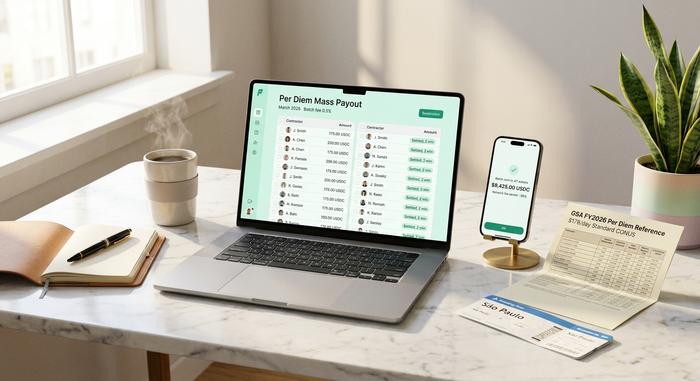
For mass-payout workflows, crypto payment gateways like Plisio support batched disbursement: bundle up to 1,000 individual per diem payments into one transaction batch, cutting network fees by roughly 80%. Plisio's mass-payout fee is 0.5% flat with no monthly or setup charges, supports BTC, ETH, LTC, USDT, USDC and more, and lets a finance team cut a single check that lands in a hundred wallets.
Tax rules for crypto per diem payment
Paying per diem in crypto does not change the tax framework, only the payment rail. The IRS still treats the underlying transaction the same way it would treat a USD wire.
The relevant rules:
- IRS Notice 2014-21 treats crypto as property, not currency. A per diem paid in stablecoins is valued in USD at the fair market value on the date of payment.
- Accountable plan rules still apply. A substantiated stablecoin reimbursement at or below the GSA rate is not wages and not reported on W-2.
- Non-accountable stablecoin per diem is W-2 wages. Subject to federal income tax withholding, FICA, and employer payroll tax, valued at FMV on the payment date.
- Employer disposition. Sending crypto out of the company treasury is technically a disposition. With stablecoins, gain or loss is functionally zero. With BTC or ETH, the company recognizes a capital gain or loss on the difference between purchase price and payout-day price.
The last point is why almost every company using crypto per diem uses stablecoins. Paying $200 of BTC and recognizing $40 of capital gain on the company books is operationally messy. Paying 200 USDC and recognizing zero is clean.
A best practice: lock the USD value at the moment of payment, store the on-chain transaction hash, and document the conversion rate used. That gives the company a clean substantiation record for IRS purposes.
Common mistakes that void per diems
A clean per diem meaning translates into a clean policy only when finance teams avoid the standard pitfalls.
A short list of errors that turn a tax-free per diem into taxable wages.
- Missing 60-day substantiation. The window is firm. Documentation submitted on day 61 voids the accountable plan.
- Failing to return excess. If a traveler's actual costs come in under per diem, the difference must be returned within 120 days for fixed-amount stipends. For GSA-rate per diem, the excess is automatically deemed substantiated and does not need to be returned.
- Paying lodging by per diem to a 1099 contractor. The IRS allows M&IE per diem for self-employed but not lodging, actual receipts only.
- Using a flat all-locations rate. Some companies pay $100 per day everywhere. That is below GSA in NYC ($379) and above it in rural Alabama. The IRS only deems substantiation at GSA-published rates for the actual location.
- Combining the high-low method with city-specific rates in the same year. The IRS requires consistent use of one method per year per employee.
- Paying per diem on personal-time days. A traveler who extends a Friday business trip into a Saturday-Sunday personal stay only gets per diem for business days.
- Forgetting the first/last day 75% rule. Common audit flag.
Most of these errors come from policy gaps, not from individual employees. A clean per diem policy spells out the rate, the substantiation window, the personal-time rule, and the documentation form, and trains travelers once when they join.