Liora Nuclear Beam Price, Crypto Tokenomics, Risks
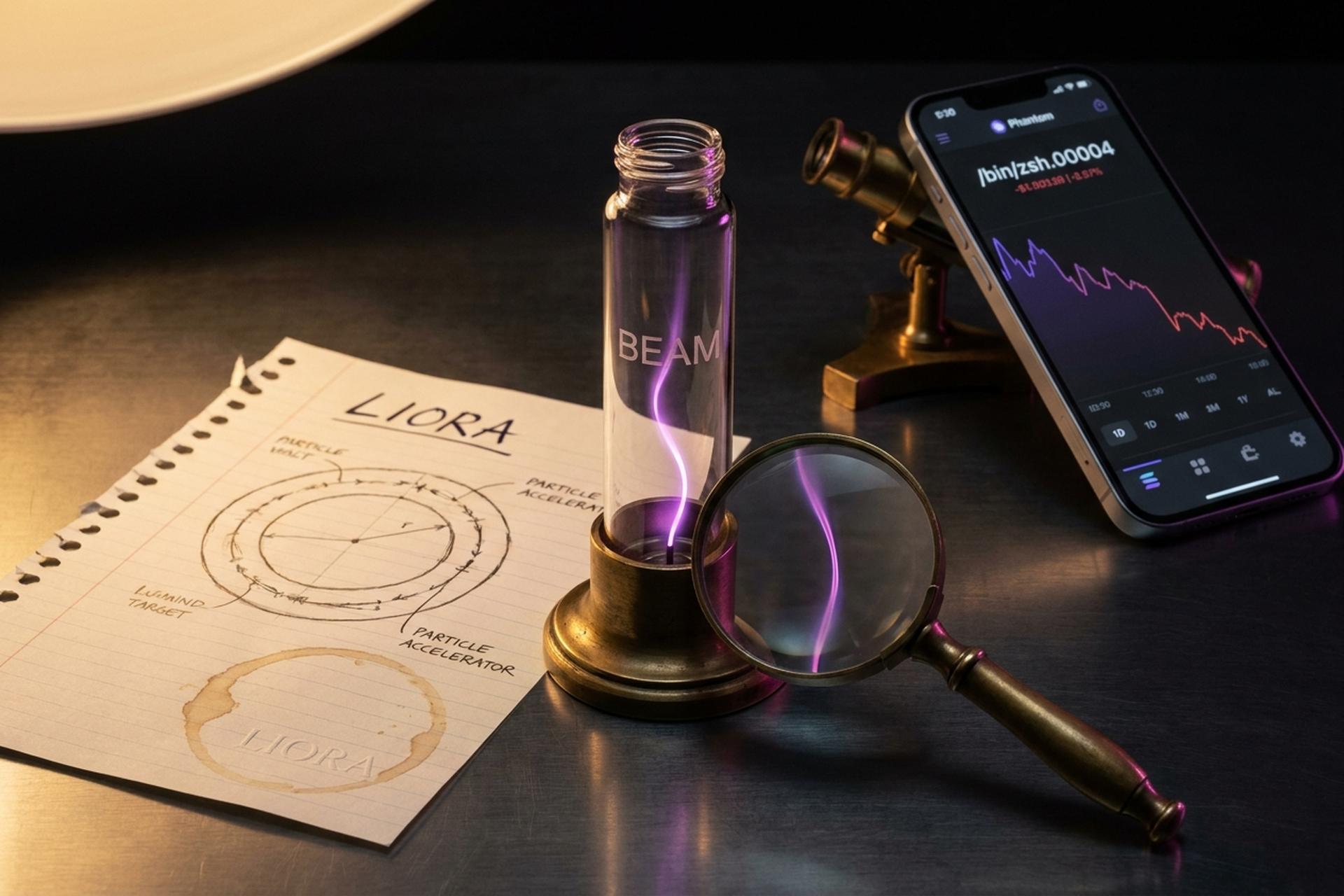
Liora Nuclear Beam (BEAM) is one of the more eye-catching pitches to land in the decentralized science (DeSci) corner of crypto in 2026. The project claims to anchor data from particle accelerators, proton therapy machines and fusion reactors on the Solana blockchain. The reality on-chain is harder to love. As of April 30, 2026, BEAM trades around $0.00004, the entire project is worth roughly $40,000, and the token is down 99.5% from a February 2026 high.
This guide explains what Liora Nuclear Beam claims to be, how the BEAM token works on Solana, what the price has done, where to buy it, the major red flags any buyer should know before clicking swap, and how it compares with real DeSci projects like VitaDAO, Bio Protocol and OriginTrail. Read this before you put any SOL into BEAM.
What is Liora Nuclear Beam (BEAM)?
Liora Nuclear Beam is a Solana-based token (SPL standard) with the contract address `CV38eqqRKfhvqZ5yyuwuNFGTfof1wYvNguJXt2mZDRMj`. The project describes itself as "the research layer for nuclear tokenization." On its website and social channels, the team frames BEAM as a specialized oracle network that ingests "beam data" (energy output, particle trajectory, radiation density) and writes that telemetry to Solana so it cannot be tampered with after the fact. Liora Nuclear Beam aims to give scientific data the same kind of immutable trail that price feeds already have on chain.
The pitch sounds serious. The implementation, by every checkable measure, does not match the pitch. There is no whitepaper, no GitHub repository, no public dev team, no audit, and no named research institution that has confirmed any integration. Phantom, the most popular Solana wallet, flags BEAM as an unverified token.
Before we go any further, this is worth saying clearly: the project's ambition (recording high-energy physics data on-chain) is interesting on paper. The token sold under that ambition has none of the verification a serious investor would expect.
How Liora Nuclear Beam works on Solana
According to its own materials, BEAM works in three steps. Sensors at a participating facility (in theory: a particle accelerator, a proton therapy unit, a fusion diagnostic rig) push readings to a Liora node. The node validates the reading against consensus benchmarks and submits a signed record to Solana. The on-chain record then becomes a permanent, queryable proof that the reading existed at that moment.
The BEAM token, in this model, plays two roles:
- Pay for data ingestion. Facilities or users that need to publish telemetry pay in BEAM.
- Reward node operators. Validators that confirm the readings earn BEAM.
The architecture mirrors how real oracle networks like Chainlink or Pyth work for price feeds, just applied to a different data type. The big missing piece is evidence that any such facility actually streams data through Liora today. As of late April 2026, no university, lab, hospital chain, or fusion startup is publicly named as a Liora data source.
There are also no published specifications: no node software, no smart contract addresses for staking or rewards beyond the token itself, no API documentation. A retail user buying BEAM today is buying the narrative, not a working scientific data layer.
Liora Nuclear Beam tokenomics and supply
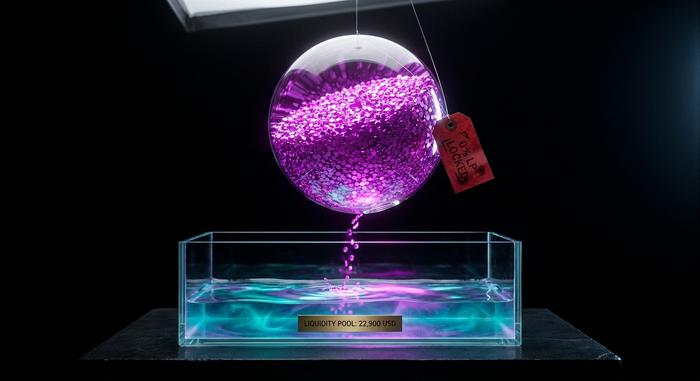
BEAM has a maximum supply of 1,000,000,000 tokens. About 999,925,569 are already circulating. That is essentially 100% of supply on the market, with nothing held back for vesting or treasury releases that the public can verify.
| Tokenomics field | Disclosure |
|---|---|
| Max supply | 1,000,000,000 BEAM |
| Circulating supply | 999,925,569 BEAM (~100%) |
| Decimals | 6 |
| Team allocation | Not disclosed |
| Investor / advisor allocation | Not disclosed |
| Treasury or DAO | Not disclosed |
| Vesting schedule | None published |
| Lock-ups | None published |
| Liquidity pool | Single Meteora DAMM V2 pool, ~$22.9K |
| LP locked | 0% per Rugcheck |
| Mint authority | Creator retains control over metadata, fees, sells, minting and transfers |
A round 1B supply with no public split, no vesting, and no treasury is the standard pattern for opportunistic Solana micro-cap launches. It is not the pattern of a serious infrastructure project. Real DeSci tokens like VitaDAO publish a multi-page tokenomics breakdown showing team, treasury, public-sale and DAO buckets with multi-year vesting.
Liora Nuclear Beam price today and history
| Metric | Value | As of |
|---|---|---|
| Price | ~$0.00004 | Apr 30, 2026 |
| Market cap | ~$39,963 | Apr 30, 2026 |
| Market cap rank | #7385 (CoinGecko) | Apr 30, 2026 |
| Fully diluted valuation | ~$39,963 | Apr 30, 2026 |
| 24h trading volume | $14.97 (CoinGecko) | Apr 30, 2026 |
| 24h price range | $0.00003927 - $0.0000404 | Apr 30, 2026 |
| All-time high | $0.008724 | Feb 4, 2026 |
| % from ATH | -99.5% | Apr 30, 2026 |
| All-time low | $0.00003636 | Apr 26, 2026 |
| Holders | 13,118 | Phantom token page |
The Liora Nuclear Beam price chart tells a familiar story. The token launched in late January 2026, ran to an all-time high of $0.008724 on February 4, then bled out for 12 weeks until it printed an all-time low of $0.00003636 on April 26. That is a drawdown of more than 99% in roughly three months, which is the typical post-launch unwind for a Solana micro-cap with no organic demand once the launch buyers exit.
The earlier Coinbase snapshot from a few weeks prior in April showed the token at rank #5425 with a market cap near $137K and daily volume around $812. Inside a single month the rank slid by roughly 2,000 places and the daily turnover collapsed to under $20. That is not a typical "cooling off." That is liquidity walking out the door.
What drives Liora Nuclear Beam price moves
Three forces move the Liora Nuclear Beam price right now, and none of them are scientific adoption.
Pool depth. With about $22.9K of liquidity in a single Meteora pool, every trade larger than a few hundred dollars moves the price visibly. A $5,000 sell order would slip 30% to 50% on its own. That makes the chart hyper-sensitive to one or two real-money decisions.
Solana memecoin and DeSci narrative flow. When DeSci tokens like Bio Protocol (BIO) rally, money sometimes leaks into smaller "DeSci-themed" tokens including BEAM. When the broader narrative cools, micro-caps fall first and hardest. Bio Protocol rallied roughly 96% in a recent stretch, and watch-list traders sometimes use that momentum to bid micro-caps for short bounces.
Holder distribution. With roughly 13,118 holders and 100% of supply circulating, any single large wallet can move the price simply by deciding to exit. Top-wallet concentration could not be retrieved at the time of writing because Solana's public RPC, Solscan, and Helius all blocked or rate-limited our requests. That itself is a flag worth checking via Bubblemaps or the Solscan UI before any trade.
The chart pattern of a token that ran to an ATH inside its first two weeks and then bled 99.5% for the next two and a half months is a textbook unwind, not a fundamentals-driven curve. If you are reading the price chart looking for a signal of demand, the signal is the absence of it.
Where to buy Liora Nuclear Beam on Solana
Realistic access to BEAM is narrow. There are no centralized exchange listings on Binance, Coinbase, Kraken, MEXC, Gate, KuCoin or LBank. Coinbase shows the token on its informational price page only; it is not tradable on the Coinbase exchange itself.
The only practical buy path is on Solana, through a self-custodial wallet like Phantom, Solflare or Backpack, swapping SOL for BEAM via the Jupiter aggregator. Jupiter routes the trade into the single Meteora DAMM V2 pool that holds all of BEAM's liquidity.
Steps for a determined buyer:
1. Hold SOL in a Solana wallet (Phantom or Solflare both work).
2. Open Jupiter, paste the BEAM contract address `CV38eqqRKfhvqZ5yyuwuNFGTfof1wYvNguJXt2mZDRMj` to make sure you are routing to the correct token (there are scam tokens with similar names).
3. Set slippage appropriately. With a $22.9K pool, slippage at any meaningful trade size will be high. Anything above 5% is a warning sign about position size, not just settings.
4. Acknowledge Phantom's "unverified token" pop-up if you proceed.
5. Sign the swap.
The thinness of this path is the point. You cannot use a brokerage. You cannot use a regulated CEX. You can only swap directly on a small DEX into a tiny pool. That structure is itself a signal.
Liora Nuclear Beam vs other DeSci crypto tokens
Putting BEAM next to actual DeSci tokens makes the gap obvious. Below are the larger DeSci projects ranked on CoinGecko on April 30, 2026.
| Project | Ticker | Market cap | Core function |
|---|---|---|---|
| OriginTrail | TRAC | $143.2M | Decentralized knowledge graph for science, supply chain, AI |
| Bio Protocol | BIO | $89.6M | BioDAO launchpad and capital coordination |
| The Innovation Game | TIG | $28.6M | Open algorithm marketplace for scientific compute |
| ResearchCoin | RSC | $23.6M | Rewards for publishing and peer review on ResearchHub |
| NOVA (Bittensor SN68) | SN68 | $18.9M | Bittensor subnet for scientific research |
| VitaDAO | VITA | $13.4M | Longevity research funding DAO |
| Liora Nuclear Beam | BEAM | ~$40K | Claims nuclear and fusion telemetry oracle |
The total DeSci sector market cap is about $365.8M with $241.3M of 24-hour volume in 2026. BEAM is roughly 330 times smaller than VitaDAO, the smallest established DeSci project on the list, and 3,500 times smaller than OriginTrail. It is also outside every DeSci index, every BioDAO ecosystem, and every list a sector ETF or research desk would actually use.
This does not mean micro-caps cannot grow into something. Most do not. The few that do tend to publish working code, attract independent researchers, and graduate from a single liquidity pool to multiple venues. BEAM has none of those signals as of late April 2026.
Major risks and red flags before buying BEAM
This is the section that should decide most of your decision. The risk inventory for Liora Nuclear Beam is not subtle.
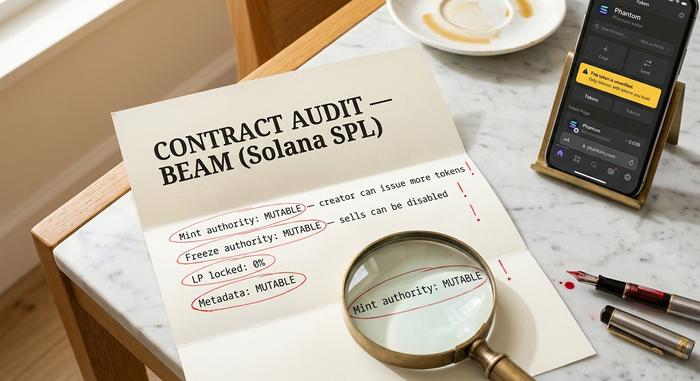
- Mutable token contract. Per Rugcheck, the creator can change metadata, disable sells, change fees, mint more tokens, and move user tokens. Any of those, used once, would damage holders directly.
- 0% LP locked. The single Meteora liquidity pool is not locked. The deployer can pull liquidity at any moment, leaving the token unsellable.
- Anonymous team. No founders, advisors, or named institutional partners. No LinkedIn, no ENS, no Twitter handle tied to a real human profile.
- No whitepaper. Nothing on the website, nothing on CoinGecko, nothing in any third-party archive.
- No GitHub. CoinGecko's `repos.github` is an empty array. No code to audit or read.
- No audit. No third-party security review. The contract permissions alone make an audit moot until those are revoked.
- Single venue, thin liquidity. One Meteora pool, ~$22.9K depth, $15-$812 daily volume. Even a small sell crashes price.
- Young contract. The pool was deployed in late January 2026. The all-time high was set 10 days later. The chart since has been a slow drain.
- Down 99.5% from ATH already. Most projects do not recover from a 99% drawdown without entirely new fundamentals.
- Phantom unverified warning. "Only interact with tokens you trust." That language is not decoration. It is the wallet telling you it has no positive signal on this token.
- No CEX listings. Centralized exchanges have listing teams that do basic due diligence. The absence of any listing is information.
If even three of these were present, a serious investor would walk. All of them together is the description of a mechanically risky launch dressed in a science narrative.
How the BEAM contract was checked for safety
A simple safety check on Solana goes through a few public tools. None of them came back with comforting answers for BEAM.
- Rugcheck flagged mutable mint, freeze and metadata authorities, plus 0% LP locked. The summary text is: "the contract creator can make changes to the token contract such as contract metadata, disabling sells, changing fees, unrestrictive minting of more tokens, transferring tokens etc."
- Phantom marks the token as unverified. That status comes from Phantom's own automated review, not from the project.
- Solscan is the canonical Solana explorer for inspecting holder distribution and recent flows. At the time of research, public access was rate-limited, which means a real diligence step here is to open Solscan in a browser and read the top-50 holder list manually.
- Bubblemaps is the standard tool for checking if a handful of wallets effectively control supply. For BEAM, this check is recommended before any trade.
A clean micro-cap, by contrast, would show locked LP, revoked mint authority, a verified contract status in major wallets, and a clear holder distribution where no single non-pool wallet holds more than a small percentage of supply. BEAM does not present any of those.
DeSci sector context for Liora Nuclear Beam
DeSci as a category in 2026 is still small but real. Total market cap sits around $365.8M with $241.3M of 24h sector volume. Real money is flowing into projects with measurable scientific output, like Bio Protocol, which has channeled roughly $65 million into BioDAOs through Q1 2026, or VitaDAO, which funds longevity research. Researchers, venture investors and AI-aligned crypto funds are paying attention to the space because actual peer-review economics and lab-funding mechanisms are being tested on-chain.
That tailwind is exactly what makes a token like BEAM appealing to launch and to buy. Wrap a credible-sounding "nuclear and fusion data" theme around any Solana SPL token, fund a $20K-$30K pool, and you can ride the broader DeSci narrative for a few weeks. Sometimes the launch buyers make money, sometimes they get exit-liquidified by the deployer. Either way, the underlying scientific claim does not get tested.
This is why putting Liora Nuclear Beam in context matters. The DeSci thesis is sound. BEAM, as currently visible on-chain, looks more like a narrative-shaped micro-cap than an actual contributor to that thesis.
Should you trade Liora Nuclear Beam?
Honest answer, broken into the buyer profiles you might be:
- Long-term DeSci investor. No. BEAM does not meet basic infrastructure-token criteria. There are five to ten serious DeSci tokens with real teams and code. Pick one of those.
- Short-term micro-cap trader. Maybe, but only with size you would set on fire. Mutable contract plus unlocked LP means a deployer can rug at any moment. The expected value is negative for anyone who is not in the same Telegram channel as the deployer.
- Researcher curious about the project. Read the contract, read Rugcheck, read the holder distribution on Solscan, check the website and X account. Form an opinion on the team's seriousness before any capital decision. A $50 test buy through Phantom + Jupiter is the cheapest way to see exactly what the buy and sell experience looks like.
- First-time crypto buyer. No. The Liora Nuclear Beam crypto experience is not what a beginner should learn buying. Start with SOL, ETH, BTC, or a vetted blue-chip DeSci token like VITA before going anywhere near tokens this small.
The clean version of the verdict: BEAM has an interesting story and an unhealthy structure. Trade it only if you have already decided you are speculating, not investing.