TamilYogi Explained: India’s Tamil Movie Piracy War
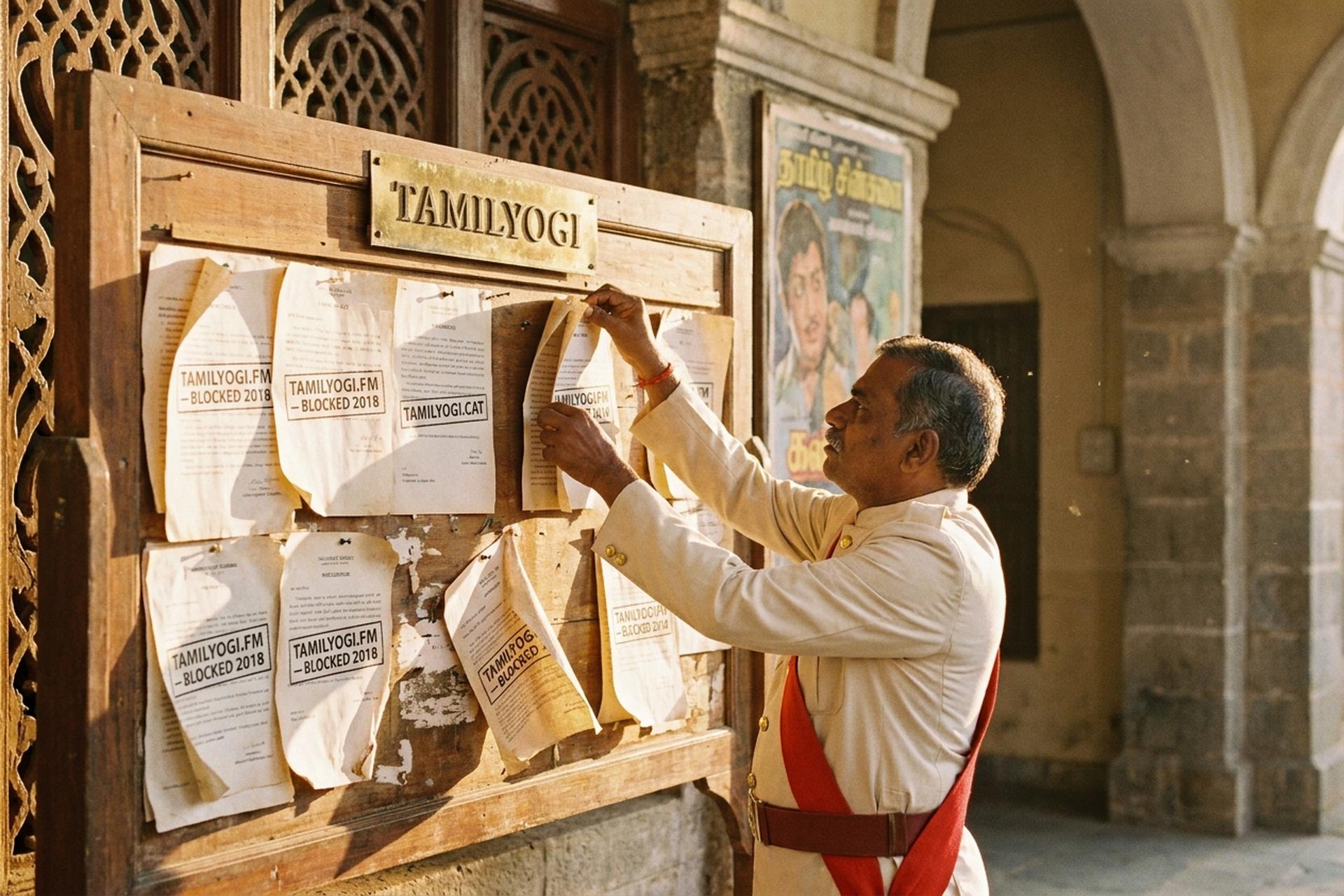
November 2018. The Madras High Court signed off on a sweeping block order ahead of Rajinikanth's "2.0", and tamilyogi.fm landed on the list. Eight years later that same site keeps showing up under different domains: .cat one month, .io the next, then .vip, .blog, .city. The math has not improved. India still bleeds an estimated INR 224 billion a year to digital piracy.
So why bother writing about TamilYogi specifically? It is not even the biggest operator in the country. The reason is that it is the clearest case study of a problem nobody has solved yet. ISP blocks, court orders, a 2023 criminal-penalty law, and India still cannot quite shut the door on Tamil movie piracy.
This piece is the long view. What TamilYogi actually is, how much damage it represents, what legal machinery India has built to push back, and where the system keeps lagging the operators. It is not a how-to. It is a look at the policy fight and the technical fight that runs behind it.
What Is TamilYogi? Origin and Mirror Domain Sprawl
Strip away the noise and TamilYogi is a streaming-first piracy site for Tamil and South Indian cinema. The catalogue runs deep: latest Kollywood releases, plus Tamil-dubbed Bollywood, Malayalam, and Hollywood. Mid-2010s is the closest anyone can date the launch. Beyond that, the trail goes cold.
Compare it to TamilRockers, which started in 2011 as a torrent indexer with a clear leadership trail. Coimbatore police nabbed three TamilRockers men in March 2018. Kerala's cyber cell hit again in 2023 and July 2024. TamilYogi? No public arrests on record. Nobody knows who runs it. Reporters have tried and come up empty.
The thing that actually defines TamilYogi is the mirror swarm. Court blocklists, threat reports, and traffic trackers have caught at least fifteen TLDs hosting the same content: tamilyogi.com, .fm, .cc, .nl, .vip, .pro, .cool, .to, .blog, .cat, .co.uk, .io, .plus, .wiki, .news. Then add the "1tamilyogi" cluster: .actor, .ceo, .app. SimilarWeb's March 2026 numbers tell the story. tamilyogi.cat: 1.4K monthly visits. tamilyogi.com: 9.1K. tamilyogi.io: 21.5K. No single dominant site, just dozens of weak signals. That is the design.
Audience tilt is steady across mirrors. About 70% of visits come from India. The rest skews toward the Tamil diaspora, with Malaysia carrying a noticeable slice. Money flows in through ads. Display banners, pop-unders, malvertising networks. You will not find a subscription page, a Stripe account, or a registered company. There is nothing to seize.
Inside the Tamil Movie Piracy Ecosystem
TamilYogi does not work alone. Half a dozen other crews fight for the same audience. Each one runs a slightly different shop.
Quick tour of the rest of the field:
- TamilRockers. The oldest. Started 2011. Prosecuted more than anyone. Torrent-first.
- TamilBlasters and 1TamilBlasters. Fast-release torrents plus streams. Multilingual.
- Movierulz. Pan-India spread. Hindi, Telugu, Tamil, Hollywood, you name it.
- IsaiMini and Moviesda. Tamil-heavy. Built for phones.
- FilmyZilla. Bollywood-leaning with regional sections nailed on.
Their release windows tell the real story. A title like "Maharaja" or "Kalki 2898 AD" lands on every one of them inside two days. Sometimes overnight. MPA's count puts roughly 90 million Indians on pirated video in 2024. They project 158 million by 2029, unless enforcement rewrites the playbook. That same May 2025 piece (jointly by Media Partners Asia and the Confederation of Indian Industry) priced 2024 online video losses at USD 1.2 billion. They expect a cumulative USD 2.4 billion gap by the end of the decade. None of these numbers is small.

The Real Cost to Tamil Cinema and Indian Cinema
Numbers tell the cleanest version of this story. The most-cited measurement is EY-IAMAI's "Rob Report" from October 2024. Top-line: INR 224 billion (about USD 2.7 billion) lost every year. The breakdown is where the number actually lands.
| Loss category | Annual cost | Source year |
|---|---|---|
| Theatrical (film) piracy | INR 137 billion | 2024 |
| OTT piracy | INR 87 billion | 2024 |
| Foregone GST tax revenue | INR 43 billion | 2024 |
| Total piracy economy | INR 224 billion | 2024 |
Worth flagging that the Indian government quoted a different figure when it pitched the 2023 Cinematograph Amendment. Their number: INR 20,000 crore a year (roughly USD 2.4 billion). Different methodology, different scope, both official, neither one perfectly reconciled with the EY-IAMAI estimate. Either way, you are talking about losses big enough to actually change how studios price films, schedule releases, and budget for theatrical windows.
MUSO's 2024 Piracy Trends and Insights, released in June 2025, ranks India as the world's number-two source of pirate-site traffic. Some 17.6 billion visits, 8.12% of the global total. Only the United States is bigger. TV pulls 45% of the world's pirate traffic; film just 11.3%. For Tamil cinema that ratio actually matters, because the heaviest pain is from opening-weekend theatrical leaks rather than slow-drip TV piracy.
What about the audience? Here EY-IAMAI's 2024 survey is interesting. 64% of pirated-content users in India said they would switch to a free, ad-supported legal service if one existed. 70% refuse to pay for OTT subscriptions. 62% want stricter enforcement. So the audience is not unreachable. It is just not willing to pay current prices.
India's Anti-Piracy Legal Framework Update
India fights piracy with three laws stitched together. The Copyright Act. The IT Act. And as of 2023, a tougher Cinematograph Act.
Take them one by one. The Copyright Act of 1957 (Sections 51 and 63) makes infringement a crime and opens the door to civil damages. The IT Act of 2000 layers on top. Sections 69A and 79 hand courts and ministries the power to order blocks, plus the power to strip safe-harbour cover from intermediaries that ignore takedown notices. Then in 2021 the Intermediary Rules pulled the response window down to 36 hours. Standard global plumbing, give or take.
What changed in 2023 was the Cinematograph (Amendment) Act. Signed by the president on 4 August 2023. Two new sections, 6AA and 6AB. Together they make it a crime to record a film in a theatre or to exhibit an unauthorised copy. Here is what the penalty actually looks like:
- Jail: three months to three years.
- Fine: starts at INR 3 lakh. Tops out at 5% of the audited gross production cost.
Industry pitched the law on the back of an INR 20,000 crore annual loss figure. The fine is steep enough to make a casual camcorder think twice. Snag is, prosecutors first have to figure out who actually shot the leak. They rarely can.
Underneath the statute sits a quieter piece of machinery. From late 2023 the I&B Ministry has appointed nodal officers who can tell platforms to pull pirated content within 48 hours. That mechanism fired loudly on 11 March 2026, when the Ministry directed Telegram to disable 3,142 piracy channels and ISPs to block 800 more websites under Section 79(3)(b). Theoretical no longer.
TamilYogi Court Blocks: How Dynamic Injunctions Work
The single most important legal tool in this fight is the dynamic injunction, introduced into Indian law by the Delhi High Court on 10 April 2019.
The case was UTV Software Communications Ltd. v. 1337x.to. Justice Manmohan, drawing on Singapore's 2018 ruling in Disney v. M1, recognised that conventional blocking orders were useless against piracy operations that simply moved to a new domain the next day. His ruling let plaintiffs extend an existing block to new mirror domains by affidavit, filed before a Joint Registrar of the court, without launching a new lawsuit each time. That single procedural change shaved months off enforcement cycles.
A short timeline of the most relevant Indian court actions:
| Date | Court | Ruling | Significance |
|---|---|---|---|
| Nov 2018 | Madras HC | Pre-"2.0" block order | 12,000+ URLs across 37 ISPs; tamilyogi.fm explicitly named |
| 10 Apr 2019 | Delhi HC | UTV v. 1337x.to | First dynamic injunction in India |
| 2024 | Delhi HC | Star/Disney "Dynamic+" | Extended blocks to clones plus registrar suspensions |
| Dec 2025 | Delhi HC | Multi-studio coalition | "Dynamic Plus Plus" injunctions; 150+ pirate sites; 72-hour registrar lock |
| 11 Mar 2026 | I&B Ministry | Telegram + 800 sites | 3,142 channels disabled under IT Act §79(3)(b) |
Madras HC's November 2018 order is the one that put TamilYogi inside the Indian blocklist for the first time. The "Dynamic Plus Plus" injunction from December 2025 is the most aggressive yet: a coalition that included Netflix, Disney, Warner Bros., Apple, and Crunchyroll obtained orders requiring domain registrars to lock targeted domains within 72 hours of notification, not just ISPs to drop them at the network layer.
In practice, courts now treat dynamic injunctions as the default mechanism for piracy enforcement. The question is no longer whether to grant them, but how broadly the perimeter should be drawn.
Why Mirror Sites Beat the Block: Technical View
Even with dynamic injunctions and registrar-level suspensions, mirror sites stay one step ahead. The technical reasons are simple. They explain why TamilYogi's catalogue keeps showing up under fresh TLDs.
Start with DNS. ISP-level DNS blocks in India are trivial to bypass. Switch your resolver to 1.1.1.1 or 8.8.8.8 and the blocked domain answers like nothing ever happened. Indian ISPs rarely deploy deep-packet inspection or HTTPS-aware blocking against piracy targets. The cost of getting around a block stays at the level of "change one setting in network preferences".
CDN obfuscation is the next layer. A piracy site that sits behind Cloudflare shows law enforcement only Cloudflare's IPs, never the real host. To pull the origin you need the CDN's cooperation, and that usually means a court order issued in the CDN's home jurisdiction. By the time that order arrives, the domain has often already migrated.
Then there is operator workflow. A new TLD costs USD 10 to USD 30. Mirroring the whole catalogue takes hours, not weeks. Google, Bing, and DuckDuckGo will reindex inside a few days. So friction is low for the people running the site, and high for everyone trying to stop them. That asymmetry is the whole game.
Telegram has become the fourth wave. Channels with names like "Tamil HD" and "Latest South Movies" host direct download links and embedded streams, surviving inside Telegram's app even when their web counterparts are blocked. The 11 March 2026 directive to Telegram disabling 3,142 channels was the largest single Telegram piracy enforcement action by India to date, and the Ministry's framing made it clear the channel count is expected to climb again.
TamilYogi and the 2023 Cinematograph Act Explained
The 2023 Cinematograph Amendment is often described in news coverage as "the law that bans piracy". The reality is narrower.
Sections 6AA and 6AB do two specific things. They criminalise the act of using any audiovisual recording device to capture a film inside a licensed cinema hall, and they criminalise the unauthorised exhibition of an infringing copy. The penalty floor is three months in jail; the ceiling is three years plus a fine starting at INR 3 lakh and rising to 5% of the audited gross production cost.
What the law does not do is shift the burden of proof onto the operators of streaming sites. A site like TamilYogi can host an infringing copy of a film, but the criminal liability under §6AA still attaches primarily to the person who recorded the original leak. Civil action under the Copyright Act remains the main lever against the site itself. That is why the 2024 arrests (Jeb Stephen Raj in Trivandrum on 28 July, then two more in Kerala in October over a Malayalam film) targeted camcorders and uploaders, not site administrators.
The 2023 Act has narrowed the supply side of leaks but has not closed the distribution channel. That gap is what TamilYogi and its peer mirrors continue to fill.
Latest TamilYogi News and 2026 Industry Response
As of May 2026, the latest TamilYogi-relevant news cluster centres on the I&B Ministry's March 2026 Telegram crackdown and the Tamil Film Producers Council's escalating dispute with multiplexes over the OTT release window.
Three threads run in parallel:
The first is enforcement. The Telegram action removed an estimated 3,142 channels distributing pirated film and OTT content, while another 800 websites were ordered blocked. Some of the blocked channels reportedly hosted more than 2,000 download links each. The Ministry signalled that further actions would follow if Telegram's compliance slowed.
The second is industry strategy. The Tamil Film Producers Council adopted a revenue-share model for big-budget releases and opposed an industry-proposed extension of the OTT theatrical window from four to eight weeks. The TFPC's position is that long theatrical windows leave releases more exposed to piracy because the early streaming option for paying viewers gets pushed too far back. A producers' strike was threatened from 10 May 2026 if the window extension was forced through.
The third is platform-side response. JioHotstar, the merged JioCinema and Disney+ Hotstar property, ended IPL 2025 with roughly 300 million subscribers, a scale that materially changes the economics of OTT distribution in India. MUSO's analysts flagged bundled OTT distribution through JioFiber and Airtel Xstream as one of the few measurable piracy reducers of the last two years.
VPNs, Court Orders, and the User's Real Risk
VPNs and proxies sit at the heart of how people access TamilYogi, and the public conversation about them is muddled. Two things need to be pulled apart.
First: a VPN is a legal tool in India. No statute bans the use of a virtual private network itself. What gets you in trouble is what you do with it. Use a VPN to watch pirated copyrighted material and you have committed the same offence as watching it directly. That is infringement under the Copyright Act, and potentially a violation of the IT Act intermediary rules if you redistribute. The VPN does not change the legality of the content. It only changes how visible you are.
Why does that visibility actually matter? Because rights holders in India have started chasing civil damages against named individuals, not just against operators. Under the IT Act and procedural orders attached to dynamic injunctions, ISPs can be compelled to disclose subscriber information. Courts have so far been careful about extending this to mass-scale identification. The legal hooks exist, though, and the direction of travel is clear.
A second risk to user privacy is rarely discussed in the consumer press. Cybersecurity firms have repeatedly documented that piracy sites, including TamilYogi mirrors, carry malware risk up to 65 times higher than legitimate streaming services. Kaspersky's Digital Footprint Intelligence team logged 7,035,236 compromised streaming-service credentials in 2024. Microsoft, in a late-2024 advisory, traced a malvertising chain that originated on illegal streaming sites and ultimately compromised nearly one million devices worldwide. The common payloads (Lumma and Redline infostealers, banking trojans, session-cookie theft) are the kind that show up months later as drained accounts and stolen identities. Any review of personal device logs after a visit to a mirror domain typically reveals more telemetry than the user expected to see.
How OTT Releases Are Reshaping Tamil Films
The most effective long-term lever against piracy is not enforcement. It is supply.
Tamil cinema has shifted toward fast OTT releases over the last three years. A typical big-budget Tamil release in 2026 enters theatres on a Friday and lands on JioHotstar, Sun NXT, or Aha within four to six weeks. That four-week window is what the TFPC is fighting to keep against multiplex pressure to extend it. The faster the legal stream is available, the smaller the piracy window during which a leaked copy is the only route to viewing for the time-impatient audience.
The OTT shift has reorganised who gets paid for a Tamil film, when, and how much. Pre-COVID, theatrical revenue was the dominant cashflow line. Post-COVID, OTT licensing fees are often the financial backstop that gets a film greenlit at all. Producers price the OTT deal first and treat the theatrical run as the marketing layer. That is a structural change in how Tamil films are financed, and it is one of the few responses to piracy that materially reduces the appetite for sites like TamilYogi.
The Best Path Forward for Tamil Movie Watchers
The honest answer to "what should viewers do?" is that the practical path forward is the legal one, and it has finally improved enough to compete.
Aha covers the bulk of new Tamil releases with a regional-cinema focus and tiered pricing under INR 600 per year. Sun NXT carries the Sun Pictures library with same-day digital availability for some titles. JioHotstar bundles Disney's Indian catalogue with cricket and pulls in international streamers. Amazon Prime Video and Netflix run smaller but premium Tamil libraries with original commissions like "Suzhal: The Vortex" and "Vadhandhi", along with select Tamil web series content. For older or niche titles, YouTube's licensed Tamil channels carry classic catalogues that simply did not exist on legal services five years ago. Picture quality on these legal services is consistent and free of the malware risk that piracy mirrors carry by design.
Across these services, the catch is fragmentation: any serious Tamil viewer subscribes to two or three of them, and that price stacking is part of what feeds the persistence of piracy in the first place. The viewer experience improves when one bundle covers most of what a household wants to explore. Discover-style recommendations and curated regional rows on Aha and Sun NXT are now closer in quality to what global services provide. EY-IAMAI's data on willingness to pay ties directly back to this point. Bundles, ad-supported tiers, and family pricing are the levers that close the gap.
For policymakers and industry leaders, the case is not academic. India loses INR 224 billion a year to piracy. The 2023 Cinematograph Act has moved part of the supply chain underground but has not stopped distribution. Dynamic injunctions and registrar-level suspensions have raised the cost of running a mirror but have not made it uneconomic. Telegram crackdowns slow the secondary channel without closing it. The infrastructure of Indian piracy will keep adapting to whatever enforcement regime is in place, because the legal alternatives have not yet eliminated the demand. TamilYogi is a symptom; the underlying market gap is the disease.