Spain Crypto Tax Guide 2026 : Crypto Tax in Spain
If you live in Spain and own crypto, the tax authority knows more about your portfolio than you probably think. The Agencia Tributaria, or AEAT, started receiving annual data feeds from Spanish exchanges in 2024 through Modelo 172 and Modelo 173. From January 1, 2026, the EU's DAC8 directive turns every European exchange into an automatic informant on Spanish residents. And the top savings tax rate on crypto gains quietly climbed from 28% to 30% with Ley 7/2024.
This Spain crypto tax guide pulls those threads together: how capital gains, mining, staking, and DeFi yield are taxed for the 2025 tax year that you declare in 2026, what the Modelo 100, 172, 173, 721, and 714 forms each do, how the Beckham Law treats expats with foreign crypto, what changes under MiCA and DAC8, and the deadlines and penalties that catch most people off guard. Every number cited has a source.
This is general information, not personal tax advice. For sums that actually matter, talk to a Spanish tax professional. Spain 2026 tax obligations on crypto change quickly, and ensuring compliance with Spanish tax laws often requires a year-by-year refresh of your tax regime.
How is cryptocurrency taxed in Spain in 2026?
Spain treats crypto as a financial asset, not as currency. That single decision shapes everything that follows. Profits from selling or swapping crypto are typically capital gains taxed in the savings base (base del ahorro). Income from working with crypto, like mining as a business or receiving a salary in tokens, is ordinary income taxed in the general base (base general).
The General Directorate of Taxes (Dirección General de Tributos) clarified the cost-basis method in Consulta Vinculante V0999-18: when you sell identical crypto units, the FIFO method applies. The earliest tokens you bought are considered sold first.
Cryptocurrency taxed in Spain therefore boils down to three questions for any transaction:
- Did a taxable event occur (sale, swap, payment, reward)?
- What category does it fall into (savings vs general)?
- What was the EUR value at the moment it happened?
Get those three right and the math is mechanical. Get them wrong and you either overpay or invite a discrepancy notice from AEAT.
Capital gains tax on crypto in Spain in 2026
Most retail investors deal with capital gains. You buy crypto, you sell it later (or swap it for another token), and the difference is a gain or a loss. That difference enters the savings base and is taxed at progressive tax rates. The Spain crypto tax treatment here is straightforward: any disposal is a taxable event in Spain, even if you never converted to fiat. Selling crypto for euros, swapping crypto for crypto, and using crypto to pay for goods are all crypto disposals subject to capital gains tax.
Spain crypto tax brackets in the savings base for the 2025 tax year, declared in 2026:
| Savings income (EUR) | Rate (FY2025) |
|---|---|
| 0 – 6,000 | 19% |
| 6,000 – 50,000 | 21% |
| 50,000 – 200,000 | 23% |
| 200,000 – 300,000 | 27% |
| Over 300,000 | 30% |
The top 30% rate is new. It replaced the previous 28% under Ley 7/2024 starting with income earned on or after January 1, 2025. Some older guides still quote 28% at the top; for the Renta 2025 campaign that closes June 30, 2026, the correct rate above €300,000 is 30%.
Crypto-to-crypto swaps and crypto trading on any platform trigger capital gains, even if no euros change hands. AEAT's view, repeated in multiple binding consultations, is that a swap is two events at once: a disposal of token A and an acquisition of token B at the same EUR price. That includes stablecoin swaps. USDC to USDT looks like nothing on the surface; on your tax return, it is a disposal that you must price in EUR.
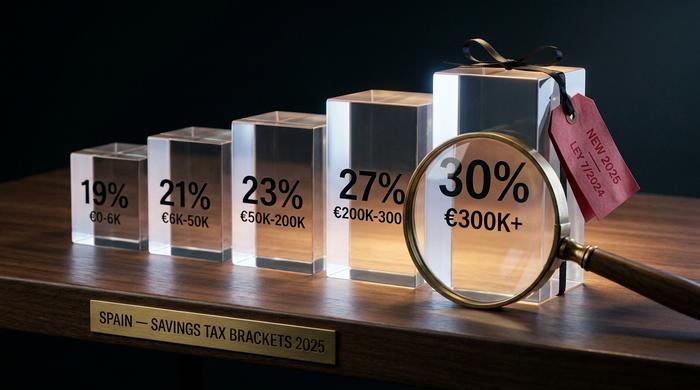
Savings income tax rates and brackets for crypto
Capital gains are not the only thing that lands in the savings base. Movable capital income (rendimientos del capital mobiliario), which includes most staking rewards, lending yield and DeFi interest from passive positions, also taxes there at the same rates. The savings base then adds capital gains and movable capital income together to determine which bracket you sit in.
A practical example. Imagine you earned €4,000 from selling Bitcoin and €3,000 from staking ETH in 2025. Your savings base for those activities is €7,000. The first €6,000 is taxed at 19%, the next €1,000 at 21%. The split happens automatically when you fill in Modelo 100; you do not pick the bracket yourself.
Losses inside the savings base offset gains. If your overall savings result is negative, you can carry the loss forward for up to four years. From 2025 onward, you can also offset up to 25% of negative capital income against positive movable capital income (and vice versa) in the same year. The wash-sale rule (Article 33.5 LIRPF) disallows a loss if you re-buy the same asset within two months for listed tokens or within a year for unlisted ones.
Income tax on crypto mining, staking, and airdrops
Not every crypto event sits cleanly in the savings base. Several common activities are taxed in the general base, where Spain's IRPF general income tax rates apply. Those rates combine a state portion and an autonomous community portion, so the top marginal rate ranges from roughly 45% (Madrid) to over 50% (Catalonia, Valencia, Asturias).
| Activity | Tax base | Indicative rate |
|---|---|---|
| Mining (occasional, individual) | Capital gain without prior acquisition → general base | Up to 47% |
| Mining (regular, professional) | Economic activity → general base + autónomo regime | Up to 47%, deductions allowed |
| Staking rewards (passive PoS) | Movable capital income → savings base | 19–30% |
| DeFi lending yield, LP fees | Movable capital income → savings base | 19–30% |
| Airdrops | Capital gain without prior acquisition → general base | Up to 47% |
| Hard forks | Treated like airdrops → general base | Up to 47% |
| Salary paid in crypto | Employment income → general base | Up to 47% |
| NFT royalties from your own creations | Economic activity → general base | Up to 47% |
The split between savings base (staking, lending, capital gains) and general base (mining, airdrops, hard forks) is one of the most-asked Spain crypto tax questions and the easiest place to make a costly mistake. Income from crypto activities in the general base follows progressive tax rules and the standard income tax rules for self-employed taxpayers when the activity is regular. In Spain crypto income from these sources stacks with salary, so your overall tax can move you into a higher general bracket. When in doubt about a borderline activity, Spain's tax authority publishes binding consultations on its website. A specific question to the General Directorate of Taxes can give you a written answer that protects you on audit.
How to report crypto taxes in Spain: Modelo forms
Reporting crypto in Spain runs across several Modelo forms. The good news is that you only file the ones that apply to you.
| Form | Who files | What it covers | Deadline |
|---|---|---|---|
| Modelo 100 | All resident taxpayers | Annual IRPF return, gains, staking, mining, airdrops | June 30, 2026 (Renta 2025 campaign) |
| Modelo 172 | Spanish exchanges and custodians | End-of-year balances per user, in EUR | March 31 annually |
| Modelo 173 | Spanish exchanges and custodians | All transactions, by user | March 31 annually |
| Modelo 721 | Spanish residents holding crypto on foreign platforms | Foreign-held crypto over €50K total at Dec 31 | March 31, 2026 (for FY2025) |
| Modelo 714 | Wealth tax filers | Net wealth on Dec 31, including crypto | June 30, 2026 |
| Modelo 718 | Solidarity tax (large fortunes) filers | Net wealth above €3M | July 2026 (if applicable) |
Modelo 100 is the headline form. Spanish residents who had any crypto disposal during 2025 generally need to file, even if their total income would otherwise be below the 22,000 euro filing threshold. AEAT cross-references Modelo 100 against the data exchanges submit on Modelo 172 and 173. If the numbers do not match, an automated notice typically follows.
To report crypto taxes in Spain correctly, gather a complete transaction history from every exchange and wallet you used during the year, value every event in EUR using the price at the moment it happened, and keep records for at least four years. Tracking crypto transactions and transactions in Spain via Spanish CASPs is now mandatory under Modelo 172 and 173, which means the tax agency already has its own copy of your activity. Tax-free in Spain are only a small set of moves: buying crypto with EUR, holding it, and sending it between your own wallets. International crypto activity and any cryptocurrency taxes you incur abroad still need to appear in your Spanish annual income tax return, because Spanish tax laws treat residents on worldwide income.
Modelo 721: foreign crypto assets in Spain
Modelo 721 was introduced by Royal Decree 249/2023. It was first filed in March 2024 for the 2023 tax year. It covers crypto assets in Spain held abroad. That means balances on Binance, Coinbase, Kraken, Bybit, OKX or any exchange not registered with the Bank of Spain or CNMV at the relevant date. Self-custodied wallets (where you hold the keys) sit outside Modelo 721 because they are not held by a third party in any country.
The reporting threshold is €50,000 in combined foreign holdings on December 31 of the tax year, valued in EUR at year-end market prices. If you cross that threshold, you file once. In subsequent years, you only have to refile if total foreign holdings increase by more than €20,000 from the prior declaration.
Penalties for Modelo 721 follow the standard Ley General Tributaria regime, not the old Modelo 720 regime that the Spanish Constitutional Court and EU Court of Justice struck down in 2022. Late voluntary filing usually means €20 per data point, with a €300 minimum and €20,000 maximum. Filing after AEAT requests it doubles to a €400 minimum. Inexact data is €150 per item.
The old €10,000 minimum fine that some industry guides still cite has been gone since 2022. If a tax adviser quotes that figure today, get a second opinion.
Wealth tax, inheritance tax and crypto in Spain
Crypto counts toward your net wealth on December 31. Whether that triggers wealth tax depends on where in Spain you live.
The state framework sets a €700,000 exempt minimum and a primary-residence exemption of €300,000. Above that, a state scale runs from 0.2% to 3.5% across eight brackets. But the wealth tax is ceded to the autonomous communities, and they can reduce or zero out the bill.
| Region | Effective wealth tax (2026) | Notes |
|---|---|---|
| Madrid | 0% via 100% rebate | Rebate reactivated in 2023 to absorb Solidarity Tax |
| Andalucía | 0% via 100% rebate | Same approach as Madrid |
| Galicia | ~50% rebate | |
| Cataluña | Up to 3.48%, exempt minimum just €500K | Highest band |
| Comunidad Valenciana | Up to 3.5%, €500K minimum | |
| Baleares | Up to 3.45% | |
| País Vasco / Navarra | Foral regimes, separate rules | Often more favorable |
A second layer, the Impuesto Temporal de Solidaridad de las Grandes Fortunas, applies nationwide above €3 million and cannot be neutralized by regional rebates. Wealth tax already paid is creditable against it, so Madrid residents pay the full Solidarity Tax while a Catalonia resident has usually paid most of the equivalent through regional wealth tax already. The tax was originally introduced as temporary in 2022 and has been extended; verify the current legal status against the latest BOE before filing. Whether your crypto portfolio is subject to wealth tax or subject to capital gains tax depends entirely on what you did and where you live, so a clean wealth tax declaration matters as much as your IRPF return. Wealth tax rates and corresponding tax bands sit alongside the general income tax rates as the second pillar of Spanish tax law.
For inheritance tax (Impuesto de Sucesiones y Donaciones), crypto received as a gift or inheritance is valued in EUR at the moment of transfer and taxed at regional rates from roughly 7.65% to over 36%. Some regions apply heavy rebates for direct family. Crypto gifts you give count as a disposal for IRPF, even if no euros are received.
Beckham Law: Spain crypto tax for expats
The Beckham Law (Régimen Especial de Impatriados, Article 93 LIRPF) is the most-asked-about regime for incoming expats. After the 2023 reform, you qualify if you become a Spanish tax resident and you have not been resident in Spain in the prior five years.
| Beckham feature | Rule |
|---|---|
| Duration | Year of move plus 5 following years (6 total) |
| Tax basis | Non-resident style (IRNR), Spain-sourced income only |
| Spanish work income | 24% flat up to €600,000, 47% above |
| Spanish-source savings (capital gains on Spanish assets) | Same 19/21/23/27/30 brackets |
| Foreign-source capital gains, dividends, interest | Generally exempt from Spanish tax |
| Wealth tax | Only on Spain-located assets |
| Modelo 720 / 721 | Not required while Beckham applies |
Crypto under Beckham is the gray zone. Tokens held on a non-Spanish exchange (Binance, Coinbase, Kraken International) are generally treated as foreign-source, so capital gains are exempt during the Beckham years. Tokens on a Spanish CNMV-registered platform like Bit2Me are likely Spanish-source and taxable. Self-custody wallets are unsettled: AEAT has not issued binding criteria, and Garrigues, Cuatrecasas, and Pérez-Llorca have all flagged the legal uncertainty in published opinions.
If your crypto position is meaningful, ask AEAT directly. A binding consulta vinculante on your specific structure is the only way to lock in tax treatment. Without it, you are exposed to whatever interpretation an inspector reaches later. Crypto profits and crypto gains for incoming expats are generally subject to general income tax only when sourced in Spain; foreign-source disposals are exempt during Beckham years, but transferring crypto from a foreign wallet to a Spanish exchange close to a sale can shift the source analysis. Tax implications for crypto gifts (and crypto disposals via gifting) are also complex under Beckham.

MiCA, DAC8 and crypto tax rules in 2026
Two EU rules reshape Spain crypto tax in 2025 and 2026. They do not change the IRPF brackets, but they change what AEAT can see.
MiCA (Markets in Crypto-Assets Regulation) became fully applicable to crypto-asset service providers (CASPs) on December 30, 2024. Spain elected the maximum 18-month transition window. From July 1, 2026, only CNMV-authorized or EU-passported CASPs can serve Spanish clients. The old Bank of Spain registry stops covering new business; existing registrations expire. If you use an exchange that does not get MiCA-authorized in time, expect service disruptions or forced offboarding.
DAC8 is the more important change for tax purposes. From January 1, 2026, EU CASPs must collect data on every customer. That includes identity, residence, balances and transaction history. The first reports are due to tax authorities by January 31, 2027. They cover the full 2026 calendar year. AEAT will get a complete picture of EU crypto activity for Spanish residents, much like banks already report under DAC2/CRS. Non-EU CASPs serving EU clients must register in one Member State to deliver the same data.
The practical effect: anonymity within the EU ends. If you hold crypto on a Coinbase Spain account, on Bit2Me, on Kraken's EU entity, or on any other licensed CASP, AEAT will see it. The Spanish tax authorities have been cross-referencing Modelo 172 and 173 against Modelo 100 since 2024; from 2027 forward, that visibility extends across the whole EU. Anyone trying to hide crypto income at this point is essentially betting against EU-wide tax reporting infrastructure, and tax evasion via undisclosed wallets is a much riskier strategy than it was even two years ago. The tax regulations apply to all cryptocurrency in Spain regardless of where the wallet sits, and the corresponding tax follows the resident.
How to calculate your crypto taxes step-by-step
A clean Spain crypto tax workflow looks like this:
1. Pull a complete transaction history. Export CSVs from every exchange you used in 2025 plus on-chain history for any wallet you control. Cover all 12 months, not just trades you remember.
2. Tag every event. Each transaction is a buy, sell, swap, transfer between own wallets, staking reward, mining reward, airdrop, hard fork, NFT trade, lost-asset event, or fee.
3. Value each event in EUR. Use the EUR exchange rate at the timestamp. Most crypto tax software does this automatically. For sparse-liquidity tokens, use the most reliable available index price.
4. Apply FIFO to compute gains and losses. When you sell BTC, the first BTC you bought is the one you sold. The crypto tax calculator software handles the math, but the cost-basis method is mandatory.
5. Split events into savings base vs general base. Gains, staking rewards, lending interest go to savings. Mining, airdrops, hard forks, salary in crypto go to general base.
6. Aggregate for Modelo 100. Plug the totals into the corresponding boxes; the form auto-applies the bracket rates.
7. Check thresholds for Modelo 721, Modelo 714, and Modelo 718. File those if you cross them.
8. Reconcile. Compare your Modelo 100 figures against the totals AEAT received via Modelo 172 and 173. Significant gaps invite a propuesta de liquidación.
Calculate your crypto taxes once, save the workings, and keep records for at least four years. AEAT's review window for personal income tax extends that long. The list of tax forms you may need to file your crypto activity is short (mostly Modelo 100 plus 721 if applicable), but completing them is where the work sits: build your numbers carefully, verify the tax liability and tax purposes line-by-line, and pay the corresponding taxes correctly the first time. The 2025 tax year you declare in 2026 will be the last full cycle before DAC8 reports begin landing in 2027.
Tax deadline and penalties for crypto investors
The crypto tax deadline calendar for 2026:
| Form / event | Deadline |
|---|---|
| Modelo 721 (foreign crypto holdings, FY2025) | March 31, 2026 |
| Modelo 172 / 173 (filed by exchanges) | March 31, 2026 |
| Renta 2025 campaign opens (Modelo 100) | Early April 2026 |
| Modelo 100 / 714 (final) | June 30, 2026 |
| Modelo 718 (Solidarity Tax) | July 2026 |
Penalties stack quickly. Late Modelo 100 without a prior request triggers a 1% surcharge plus 1% per month, growing to 15% plus interest after a year. Filing after AEAT issues a request can mean 50% to 150% of the unpaid tax. Modelo 721 inaccuracies cost €150 per item, and full non-filing can move into percentage-based sanctions on the undeclared base. Wealth tax non-filing is treated under the LGT general regime, which is similar to IRPF.
The cheapest enforcement path for AEAT in 2026 is the discrepancy notice. If your declared crypto gains do not match the totals exchanges submitted on Modelo 172 and 173, AEAT sends a propuesta de liquidación. You either accept and pay or contest within 15 days with documentation.
Crypto tax calculator and tracking your crypto
Manual spreadsheets break down quickly once you have more than a few hundred transactions. A dedicated crypto tax calculator built for Spanish rules saves time and reduces errors. The main options used by Spanish residents:
- Koinly, strong Spanish output formats and direct Modelo 100 box alignment.
- CoinTracking, long history, deep transaction support, Spanish-language interface.
- Blockpit, built around EU regulations, MiCA-aware reporting.
- TaxDown, Spanish-focused, integrates with AEAT systems.
- TokenTax, useful for high-frequency traders.
- Bit2Me Tax, bundled with the Spanish exchange.
Most of these tools accept exchange CSVs, on-chain wallet imports, and DeFi protocol data. Tracking your crypto in real time, rather than reconstructing it in May from memory, is what makes the June 30 deadline manageable.
A common pitfall: tools differ on edge cases like LP fees, liquid staking rebases, and certain airdrops. If two tools give different totals, treat the conservative number as your filing base and document why you chose it. The goal is not the lowest tax. The goal is a defensible return. You need to report your crypto, including any tax free transactions for the audit trail, and the tax law is now strict enough that "I forgot" rarely works. The same logic applies to selling crypto across multiple platforms: every disposal must be reflected, even when no euro flows. To file crypto activity properly, you also need to know what is taxable in Spain versus what falls outside scope; mistakenly applying general tax rates instead of savings rates (or vice versa) is a recurring source of overpayment. The simplest way to ensure compliance with Spanish tax authorities is to log every event the moment it happens, not five months later, and track taxes on crypto as you would any portfolio statement.