Ick Meaning: Where ’The Ick’ Came From and Why It Stuck
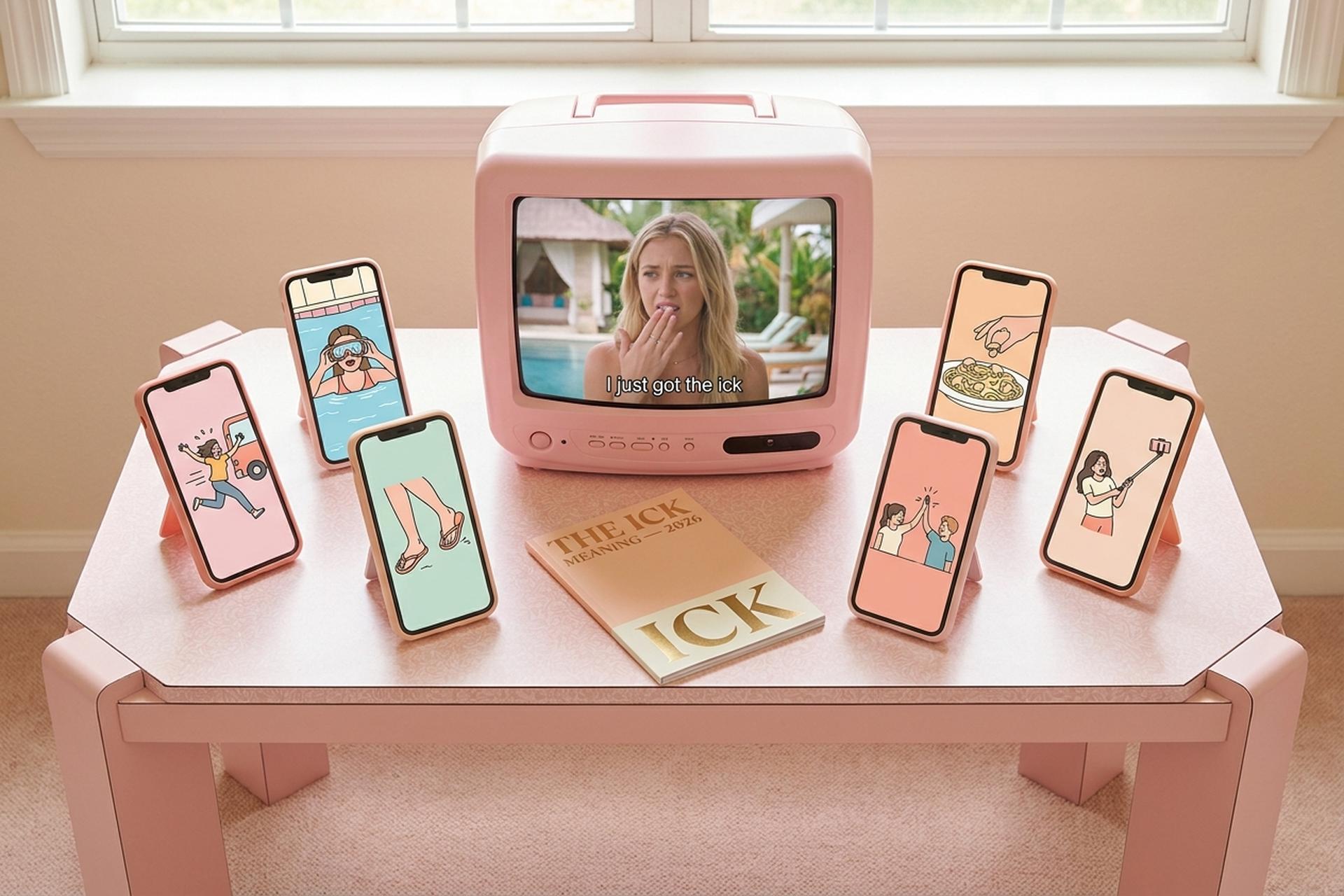
June 2017. Love Island UK. Olivia Attwood is on camera explaining why things ended with Sam Gowland. No fight. No cheating. No values clash. She just got the ick. That was it.
A tweet went up the same evening: "olivia's just described that so well the ick ruins everything forever". Three days later somebody filed an Urban Dictionary entry. Six years after that, Dictionary.com made it official. Cambridge followed in 2024.
Eight years later the word is everywhere. So what does it actually mean? Where did it come from before Love Island? And why did this one word, out of every piece of dating slang the last decade has thrown up, end up being the one that stuck? Here is the closer look — the meaning, the history, and the cultural moment that turned a passing reaction into a piece of shared vocabulary.
What 'The Ick' Actually Means: A Working Definition
Shortest working definition? The ick is a sudden, mostly involuntary wave of disgust toward someone you used to find attractive.
The thing that makes it distinctive is the trigger. Almost never something serious. Almost always something tiny. They run for the bus and their gait goes wrong. They show up to a date in flip-flops. They fumble a chopstick, laugh at the wrong volume, drop a sock weirdly while undressing. None of that is a real character problem. In another mood you might find it sweet. But the brain logs it anyway, and the entire romantic frame just collapses on itself.
Cambridge Dictionary, which added the word in 2024, keeps it broad: "a sudden feeling that you dislike someone or something". Dictionary.com goes narrower, locking it to dating: a sudden feeling of disgust toward a partner you used to be into. Merriam-Webster, which slotted "ick" into its slang dictionary on June 20, 2025 (then quietly updated the entry on March 30, 2026), splits the difference. Their phrasing: "a feeling of disgust or repulsion".
Three major dictionaries, roughly the same shape of definition, all within a span of two years. That kind of convergence is rare. It says the language needed a name for the experience. "Ick" got there first.
Where the Ick Comes From: A Slang Origin Story
The popular explanation that "the ick" was invented on Love Island is half right. The phrase did not start there. But the modern dating sense did go viral there.
Two earlier appearances on television matter to the etymology. The first is a 1998 episode of Ally McBeal, where the title character uses "the ick" to describe a sudden, unexplained loss of attraction to a coworker. The second is the Sex and the City episode "The Ick Factor" from January 11, 2004, in which Carrie Bradshaw is unable to enjoy Aleksandr Petrovsky's grand romantic gestures because they tip into something faintly nauseating. Both episodes used the word in something close to its modern meaning, but neither caused it to spread beyond the writing room.
The actual viral moment was Olivia Attwood on Love Island UK in June 2017. The reach of UK reality television in that era amplified small phrases fast, and "the ick" was suddenly the way people described an experience they had been having for years without a label. The first wave moved through Twitter and Tumblr in 2017 and 2018. The second wave, much larger, was on TikTok.

Examples of Icks That Went Viral on TikTok
TikTok picked it up in June 2020. KnowYourMeme dates the earliest viral entries to three creators in a tight three-week window: @fizzzabella on June 15, @ughitsjessy on June 28, @tommirose on July 13. The format was dead simple. Face the camera. Name your ick. Cut to a quick reenactment. Repeat. Comment threads filled in fast and turned into a kind of crowdsourced field guide to small-scale romantic anxiety.
Second wave hit in April 2023. Creator Dafna Diamant posted an ick montage and pushed past eight million views. Her Campus and Screenshot Media estimate cumulative TikTok output describing icks now sits north of 200 million posts. Worth flagging: that 200M figure traces back through secondary citations and not a primary TikTok analytics screenshot, so treat it as ballpark.
What kinds of icks travel best across both waves? Mostly the trivial ones:
- Running for a bus and almost catching it.
- Doggy-paddling in a swimming pool.
- Wearing goggles in a swimming pool.
- Walking angrily in flip-flops, especially uphill.
- Letting legs dangle off a barstool.
- Sleeping on a pillow with no pillowcase on it.
- Crusty red sauce at the corners of the mouth.
- Vaping and blowing smoke rings.
- Chasing a runaway ping-pong ball with too much enthusiasm.
- Giving someone a high-five.
- Picking mushrooms out of a pasta dish.
- Refusing to pay extra for cheese on a burger.
- Standing with feet pointing slightly outward.
That triviality is not a bug. That is the entire point. The icks that get shared are never serious flaws. They are small posture shifts, small social misfires, small moments that punch a hole in the romantic illusion for half a second.
Merriam-Webster, Cambridge, and Dictionary.com
Want to track the lifecycle of any piece of slang? Watch the dictionary entries. Each one is the moment a lexicographer decided the word had crossed the line from trend into durable usage.
| Source | Entry date | Definition |
|---|---|---|
| Dictionary.com | September 12, 2023 | A sudden feeling of disgust or repulsion to a dating partner someone was previously attracted to |
| Cambridge Dictionary | July 31, 2024 (announced) | A sudden feeling that you dislike someone or something |
| Merriam-Webster (slang) | June 20, 2025; updated March 30, 2026 | A feeling of disgust or repulsion |
Notice what Cambridge did. They stripped the dating-specific framing. By 2024 people were using "the ick" everywhere, not just on dates. A pop star's red-carpet fit could give you the ick. A product launch could too. Even a corporate apology video. Cambridge captured that drift.
Why does dictionary recognition matter? Less to users, more to cultural anthropologists. The rule of thumb in lexicography is that a slang term is usually in active use for three to five years before any major dictionary picks it up. Run that math backward from Dictionary.com's 2023 entry and you land between 2018 and 2020 for organic spread. Which lines up almost exactly with the TikTok timeline above.
How to Use 'Ick' in Sentences and Everyday Talk
The use of "ick" in everyday speech is more flexible than its definitions suggest. There are three common patterns.
The first is the noun form: "I got the ick". This is the canonical structure, the one Olivia Attwood used. The ick functions as a discrete event, almost a state.
The second is the agentive form: "He gave me the ick". The trigger person becomes the active source. This phrasing is the one that travels best on TikTok because it pairs with a video reenactment.
The third is the adjective extension: "icky". Older than "the ick" itself, "icky" has been in English for almost a century, used for anything that produces low-grade disgust. The slang noun emerged from the adjective and now operates as its own thing.
A few example sentences:
- "He paid the bill with a stack of singles and I got the ick."
- "The way she sneezed gave me the ick."
- "It was the second date and he ordered for me without asking. Instant ick."
Speakers tend to drop "the" in casual writing, especially online: "icks" plural, "no ick from this guy", "dating in 2026 is full of icks". The grammar of the term is loose, which is part of why it has spread.
The Psychology Behind Getting the Ick
For a word that started on a reality show, the ick has become a serious topic in academic psychology.
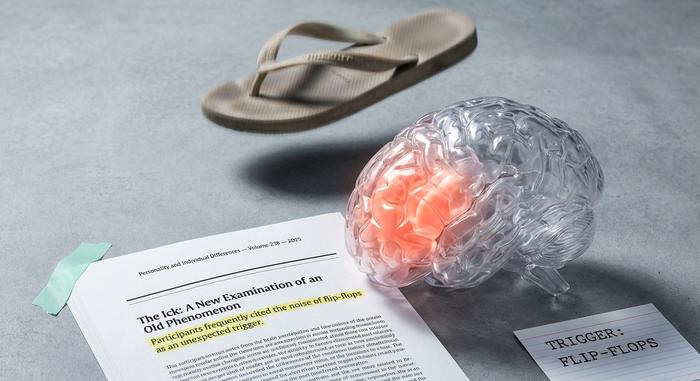
A 2025 study in the journal Personality and Individual Differences, conducted by Brian Collisson, Eliana Saunders, and Hanyu Yin at Azusa Pacific University, surveyed 125 single adults. They found that 64% of participants had experienced the ick at least once. Among women, the figure was 75%; among men, 57%. The study also identified three traits that predicted both the likelihood and frequency of the ick: high disgust sensitivity, grandiose narcissism, and other-oriented perfectionism. None of those is a quirk of Gen Z. They are stable personality dimensions. The ick, the researchers argue, is a behavioral output of personality structures that have always existed. The slang just made the experience nameable.
Tom Sherman, a neuroendocrinologist at Georgetown University, has framed the ick as a probable malfunction of the anterior insular cortex, the part of the brain that monitors bodily state and runs interference on inputs that feel "off". When that region overinterprets a small visual or auditory cue, the body reacts as if to an actual threat or contaminant. The result is a sharp, hard-to-control feeling of repulsion that the conscious mind then has to make sense of.
Therapists frame it differently. Dr. Chivonna Childs, a Cleveland Clinic psychologist, calls the ick "not a new concept" but one that "social media has brought to life". Couples therapist Emily J. Burke, LMFT, has argued that the ick is sometimes a projection: the person feeling it dislikes a trait in themselves and reacts strongly to seeing it in someone else. Bumble's Sex and Relationship Expert Shan Boodram describes it as "your brain searching for reasons to halt the intimacy".
These framings overlap more than they conflict. The ick can be neuroscience, attachment-pattern, projection, or all three at once.
How Ick Relates to Red Flags and Real Dealbreakers
The single most common writing mistake on this topic is treating the ick and a red flag as the same thing. They are not.
A red flag points to a real problem. Dishonesty. Contempt. Controlling behavior. Cruelty. Abuse. Those deserve serious weight, every time. Cleveland Clinic's Dr. Childs draws the line cleanly: "Real concerns involve degradation, name-calling, or emotional and mental abuse, behaviors affecting core values. Icks are teachable surface issues."
The ick is almost always surface. A chewing sound. The way someone hunches walking. A pet name landed two dates too early. None of that points to a deep issue. In a different mood or context, the same person would not even register the moment.
The clean test is to ask one question. Would I still be reacting this way if I was already in love with this person? If yes, it might be a real signal. If no, it is most likely the ick.
That said, the ick is not always meaningless. Therapists generally agree that a sudden, persistent ick can mark the moment a half-formed doubt finds something concrete to attach to. The brain may be spotlighting a small thing because the bigger thing is harder to name. In that sense, the ick can be data, but data about the person feeling it, not necessarily the person it is aimed at.
Gendered Patterns: A Description of Who Gets It
The peer-reviewed work to date suggests the ick is not gender-neutral. The 2025 Collisson study found a measurable gap.
| Reported experience | Women | Men |
|---|---|---|
| Familiar with the term "the ick" | 63% | 39% |
| Have personally experienced the ick | 75% | 57% |
| Ended a relationship immediately after an ick | — (not split by gender) | — |
A description of the gap from the same authors: women in the sample were both more aware of the slang and more likely to label their own reactions as "icks". The researchers offered no single causal explanation. Possible factors include heavier exposure to the dating-discourse corner of TikTok, longer-running cultural conditioning around the protective use of disgust in dating, and the simple fact that women face more first-date safety calculations and may have more practice cataloguing physical reactions to a partner.
A separate Hinge data point reinforces the same direction without using the word "ick" directly. Hinge's 2024 Gen Z D.A.T.E. Report, drawing on more than 15,000 users surveyed in August 2023, found that 49% of users said bad spelling and grammar in messages turned them off. Hinge's Director of Relationship Science, Logan Ury, has framed this kind of small textual signal as "digital body language". A spelling slip is a textbook ick: trivial, irrational, common, and sometimes decisive.
Long-Term Relationships and the Sudden Ick
The ick is not just a first-date problem. Couples who have been together for years sometimes find one arriving without warning, and that version is harder to handle.
Dr. Chivonna Childs has noted that when icks come up in long-term relationships, they are usually surfacing something else. "It's not about the thing that happened," she has said. "It's typically about a deeper issue." A small repeated behavior that did not bother a partner for two years suddenly becomes intolerable. Most of the time, the issue is not the behavior itself; it is something in the connection that has shifted, and the brain has latched onto a convenient symbol.
Tom Sherman, the Georgetown neuroscientist, frames the long-term version more gently. The ick, he has argued, "can become endearing" inside committed relationships, with oxytocin and dopamine smoothing over what would otherwise read as repulsion. Many couples can describe the moment a former ick became a private joke. The behavior did not change. The frame did.
For new icks in established relationships, therapists advise against rushing to a conclusion. The ick is a signal, but in a long-term context it is rarely a signal about the surface behavior. It is closer to a smoke alarm pointing at the wrong room of the house.
How to Get Past the Ick (or Decide Not To)
The advice column literature on the ick is now substantial. The general structure of recommendations is consistent across Cleveland Clinic, Wondermind, Time, and Refinery29 coverage. It looks roughly like this:
- Pause before acting. The ick is a snap reaction. Treat it as data, not a verdict.
- Trace the trigger. Was the moment a real character signal or a stylistic preference?
- Check the projection. Is the trait one you dislike in yourself?
- Communicate, gently. Most icks are about small things that can be discussed without confrontation.
- Decide on context. New relationship in week two and the ick is everywhere? It might be self-protective. Year four and the ick arrived suddenly? It is probably about something else.
Counter-discourse is now part of the conversation too. CNBC and NBC New York have run pieces calling ick-listing "the No. 1 dating mistake Gen Z is making", arguing that hyper-criticism in app culture has fed superficial rejection. NPR ran a December 2024 segment titled "Your date gave you 'The Ick?' That might be a YOU problem". Cosmopolitan India in April 2026 used the phrase "ick epidemic". The basic critique is that a generation primed to swipe past minor friction has built a vocabulary that legitimises the swipe.
Whether that critique is fair is a matter of taste. What is not in doubt is that "the ick" has settled into the language. The slang has outlived the trend cycle that birthed it, and it now sits in three major dictionaries. Eight years after Olivia Attwood made it famous, it is not slang anymore. It is just a word.