Brazil Crypto Tax in 2026 : Rates, Exemptions, DeCripto Guide

If you only read English-language crypto tax sites, you will probably arrive in 2026 thinking Brazil moved to a flat 17.5% rate on every cryptocurrency disposal. That is wrong. The Provisional Measure that proposed the change, MP 1303/2025, lost validity on 8 October 2025 after the Câmara dos Deputados removed it from the agenda by a 251-193 vote. The progressive 15-22.5% brackets and the famous R$35,000 monthly exemption stayed in force for tax year 2026, and Brazilian crypto investors are still working under the same regime they had a year ago.
This Brazil crypto tax guide walks through how crypto taxes in Brazil actually work in 2026: the tax rates, the R$35,000 exemption, the new DeCripto reporting framework that replaces IN 1888 from July 2026, the flat 15% offshore rule under Lei 14.754, and what crypto mining, staking, DeFi and NFT activity looks like to Receita Federal. Every figure is sourced to a Brazilian primary or top-tier advisory document. If your crypto position is large or structurally complex, this article is a starting point — a Brazilian tax professional should still review your specific filing. The tax laws here apply to any Brazilian resident with a tax liability triggered by crypto activity, whether held domestically or abroad.
Is crypto taxed in Brazil? The 2026 rules
Brazil taxes crypto under three different regimes that live side by side in 2026, and each catches a different slice of activity. Domestic disposals by individual residents fall under the progressive ganho de capital table from Lei 8.981/1995. Holdings on a foreign cryptocurrency exchange follow the flat 15% offshore rule from Lei 14.754/2023. Brazilian companies use corporate income tax on their crypto profits. The same person, with the same wallet, can hit two of the three regimes in a single year.
Receita Federal do Brasil (RFB) treats crypto as a movable financial asset, not as currency. Bitcoin is not legal tender in Brazil, even though it is freely tradable and held by millions of Brazilian crypto investors. Every disposal is potentially a taxable event subject to taxation: crypto sales for fiat, crypto-to-crypto swaps, using crypto to pay for goods or services, and the receipt of mining or staking rewards. The Brazilian tax authorities confirmed this position in Solução de Consulta Cosit 214/2021 and the 2024 IRPF Perguntas e Respostas (questão 607). Tax obligations begin at receipt for income-style cryptocurrency transactions and at disposal for capital gain or loss events, with the calendar month as the reporting unit for monthly DARF payments. RFB taxes crypto whether the user trades on a regulated venue or in self-custody.

How crypto capital gains tax works in Brazil
For Brazilian residents disposing of crypto on domestic venues, the personal income tax brackets apply progressively to the monthly gain after the R$35,000 exemption is checked. The table sits in Lei 8.981/95 art. 21 (as amended by Lei 13.259/2016), and Receita applies it to crypto disposals via IN RFB 1500/2014.
| Monthly gain (R$) | Rate |
|---|---|
| Up to 5,000,000 | 15.0% |
| 5,000,001 - 10,000,000 | 17.5% |
| 10,000,001 - 30,000,000 | 20.0% |
| Above 30,000,000 | 22.5% |
Most retail traders never leave the 15% band on their crypto gains, since gains up to R$5 million per month sit in the lowest tier. The higher brackets matter mainly for active high-volume traders and family offices that owe capital gains tax above the lowest tier. To calculate the tax, you take the disposal proceeds in BRL and subtract the cost basis, then apply the rate band the monthly net gain falls into. The 2026 Brazil crypto tax code calls for monthly settlement: tax is paid via DARF code 4600 by the last business day of the following month, with no annual netting against losses from earlier months. Late payment carries a 0.33% per-day penalty capped at 20%, plus SELIC interest currently around 14.75% per year as of May 2026, so a missed deadline rapidly compounds even on small balances. The market value of your cryptocurrency at the moment of sale, less the original cost basis, drives the calculation.
The R$35,000 monthly crypto tax exemption
The single most important number for Brazilian crypto holders is R$35,000. If your gross crypto disposals across all venues stay at or under R$35,000 in a calendar month, the entire month's gain is exempt from IRPF. The rule lives in IN RFB 1500/2014 art. 130 and Receita's IRPF Q&A questão 607.
Three details that catch people out:
- The threshold is on gross disposals, not realized gain. Sell R$33,000 of BTC bought for R$10,000 and the entire month is exempt. Push gross sales to R$36,000 in the same month and the whole R$36,000 of gain becomes taxable, not just the R$1,000 over the line.
- Disposals are summed across all assets and all Brazilian venues. Mercado Bitcoin, NovaDAX, self-custody P2P trades all count toward one shared monthly bucket.
- The exemption applies only to domestic disposals. Trades on Binance.com, Coinbase, or any foreign exchange follow Lei 14.754 instead, with no R$35K shelter.
MP 1303 and why the flat 17.5% tax did not pass
The Brazilian executive issued Provisional Measure 1303/2025 on 11 June 2025, which would have eliminated the R$35,000 exemption, replaced the progressive table with a flat 17.5%, and added 17.5% withholding at source on staking rewards. MPs in Brazil have 120 days to be converted into ordinary law or they lose validity.
On 8 October 2025, the Câmara dos Deputados shelved MP 1303 by a 251-193 vote. Without floor consideration the MP expired the next day. The pre-existing rules snapped back. Between 12 June and 8 October 2025, the country effectively had a parallel regime for four months. Receita is expected to issue guidance during 2026 on how to treat disposals made in that window.
A successor crypto tax bill is expected during the 2026 legislative session, with reform "pushed to 2027" per Brazilian press coverage. For now, the legacy progressive table and the R$35,000 exemption are the live rules.
Lei 14.754 and offshore crypto tax in Brazil
Brazilian residents who hold crypto on foreign exchanges or self-custody wallets owned outside Brazil fall under Lei 14.754/2023, the offshore taxation law that took effect on 1 January 2024. The mechanics differ sharply from the domestic regime.
Income and gains from "ativos virtuais" abroad are taxed at a flat 15%, regardless of monthly volume. There is no R$35,000 shelter. Reporting and payment happen annually through the DIRPF Ajuste Anual rather than monthly DARF. Currency conversion uses the PTAX rate from Banco Central on the acquisition and disposal dates. Offshore losses can offset only other offshore gains, not domestic ones.
Lei 14.754 also offered a transitional regime: stockpiled offshore earnings as of 31 December 2023 could be repatriated and taxed at 8% if the resident elected the rule during the 2024 filing window. Most retail holders missed it; corporate and family-office structures used it heavily.
Crypto-to-crypto swaps under Brazilian tax law
Receita Federal treats every change of token identity as a realization event. Crypto transactions are taxable in Brazil whenever ownership of one crypto asset is exchanged for another: ETH-to-USDT, USDC-to-USDT, BTC-to-WBTC bridges, DEX swaps on Uniswap or PancakeSwap — each is a disposal of the outgoing asset and an acquisition of the incoming asset at fair market value in BRL. RFB confirmed this in the 2024 IRPF Q&A questão 607. To calculate your capital gain on each leg, the user records the BRL value at the time of the swap and compares against the cost basis carried over from the previous acquisition.
The swap value uses the BRL price at the timestamp of the transaction, sourced from the user's primary venue or a representative price feed. This makes record-keeping non-trivial: a single trader rotating through five tokens can rack up hundreds of taxable events even without ever cashing out to BRL. Receita's pre-filled DIRPF will pull this data from Brazilian CASPs starting tax year 2026; foreign-venue and self-custody activity remains the user's responsibility.
Mining, staking, NFTs and DeFi crypto tax rules
Mining rewards are ordinary income. RFB treats newly minted coins as taxable on the date you receive crypto from the network, valued in BRL at the spot price on the user's primary venue. Hobby miners report under regular IRPF brackets (0% to 27.5%) on their cryptocurrency income, while operators with continuous, profit-seeking crypto activities are characterized as a de facto business and required to register a CNPJ. The line is fact-dependent and the burden of proof sits with the taxpayer to justify hobby treatment when activity scales up. Crypto trading conducted at scale, typically with multiple ASICs, rented facilities, or hired help, almost always crosses into business territory under the Brazilian tax administration's reading of the rules.
Staking rewards follow the same logic. Income is recognized at the moment of receipt at the BRL fair value, with the cost basis of the principal staked tokens unchanged. When the staked coins are later sold, capital gains tax rules apply on the spread between disposal value and the receipt-date basis. The MP 1303 proposal would have introduced 17.5% withholding at source on staking rewards paid by Brazilian CASPs, but with the MP gone, no source withholding currently applies in 2026.
NFTs are explicitly covered under the new DeCripto framework as Group 08 code 10. Disposals are taxed under the same progressive ganho de capital table as fungible crypto. DeFi activity (including LP token deposits, lending positions, governance token claims) is treated conservatively by Brazilian tax advisers as a chain of disposals where every state change of underlying tokens is a realization. RFB has not issued a binding ruling on bridges, leaving room for interpretation, but DeCripto extends reportable events to lending, liquidity provision, and inter-wallet transfers regardless. Airdrops are recognized as income on receipt at fair market value, identical to mining and staking treatment.
DeCripto, IN 1888 and crypto reporting in Brazil
Brazil has run two parallel reporting frameworks during 2025 and 2026, and the new one is replacing the old in stages.
IN RFB 1888/2019 has required Brazilian residents to file a monthly statement of cryptocurrency operations (the Coleta Nacional via the e-CAC portal) when monthly aggregate crypto transactions exceed R$30,000 and were not intermediated by a Brazilian exchange. The deadline runs to the last business day of the month following the operation. Penalties for missed tax reporting under IN 1888 art. 10 start at R$500/month for individuals exempt from IRPF and climb to R$1,500 plus a 3% surcharge on transaction value for non-compliant filers.
Brazil just dropped RFB 2.291/2025 on 14 November 2025, bringing in DeCripto, a new domestic reporting regime that locks the country into the OECD's Crypto-Asset Reporting Framework (CAR)
Filing your DIRPF crypto tax return step by step
Crypto holdings and disposals enter the standard annual income tax return (Declaração de Imposto de Renda da Pessoa Física, or DIRPF) in the Bens e Direitos section. To report your crypto correctly, every position above the itemization threshold must be listed individually with its acquisition cost. The filing window for tax year 2025 ran 17 March to 30 May 2026, and the 2026 window will follow the same rhythm in 2027. Crypto income subject to income tax (mining, staking, airdrops) is reported separately from capital gains.
Receita assigns specific group and asset codes for crypto: Group 08 ("Criptoativos") with subcodes 01 for Bitcoin, 02 for other cryptocurrencies, 03 for stablecoins, 10 for NFTs, and 99 for other crypto-assets. Holdings with acquisition cost of R$5,000 or more must be itemized individually. Below that threshold the holding still exists but is not itemized in the return.
The actual tax on disposals is computed using GCAP (Ganhos de Capital), a desktop tool downloaded from Receita's site that walks taxpayers through gain calculation per asset and per month. GCAP outputs export directly into the DIRPF return. Five-year retention of supporting CSVs, transaction hashes, and wallet histories is mandatory; without records, Receita defaults the cost basis to zero and taxes the full disposal as gain.
Failure to declare crypto holdings or disposals carries serious penalties. Under-reporting attracts a 75% surcharge on unpaid tax under CTN art. 44, doubling to 150% in cases of fraud, plus SELIC interest on the late payment. Outright tax evasion can also trigger criminal penalties under Lei 8.137/1990. Receita's enforcement modernization includes AI cross-matching of PIX outflows against declared assets and blockchain analytics that tie wallet activity back to a specific CPF, so the historical assumption that crypto activity stays invisible to the Brazilian tax authorities no longer holds. To report your crypto taxes correctly and avoid surprises, Brazilian crypto investors with non-trivial portfolios should keep a clean monthly trail and consult a tax professional before complex events such as cross-border transfers, hard forks, or DeFi yield strategies.
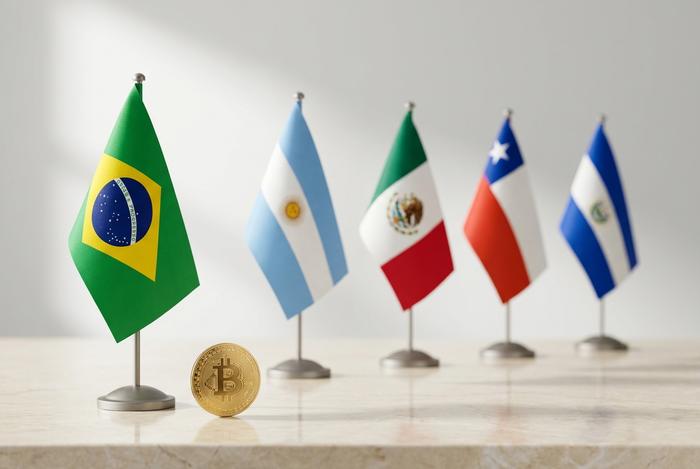
Brazil crypto tax vs Argentina, Mexico and El Salvador
Brazil is neither the friendliest nor the harshest crypto-tax jurisdiction in Latin America. Coincub's Global Crypto Tax Report 2025 ranks Brazil 58 out of 86 globally, with the score dragged down by stacked reporting overhead more than by the headline rate.
| Country | Personal crypto rate | Notes |
|---|---|---|
| Brazil | 15-22.5% progressive (>R$35k/month) | Lei 8.981/95 + R$35K exemption |
| Brazil offshore | 15% flat | Lei 14.754/2023 |
| Argentina | 5-35% income tax + Bienes Personales | Wealth tax adds 0.25-1.25% |
| Mexico | 1.92-35% progressive ISR | ~MXN 90,000 movable property allowance |
| Chile | 0% or 35% Global Complementario | UTA 13.5 (~CLP 1.05M) threshold |
| Colombia | 10-39% progressive | ~COP 1.4B wealth threshold |
| El Salvador | 0% on Bitcoin | Ley Bitcoin 2021 |
El Salvador is the only outright zero-rate destination for Bitcoin. Brazil's 15% floor on the progressive table is competitive against Mexico, Argentina, and Colombia, although the additional reporting burden under DeCripto and IN 1888 puts compliance cost above peers. For a Brazilian resident with mostly domestic activity under R$35,000 monthly, the effective rate is often zero.