
What is a DAO (decentralized autonomous organization) and how do DAOs actually work
In 2016, a group of strangers pooled $150 million into a smart contract on Ethereum. No CEO, no board, no legal entity. No CEO, no board of directors, just code and a group chat. They called it "The DAO," and for about six weeks it was the largest crowdfund anyone had ever seen. Then a hacker found a bug in the smart contract and pulled $60 million out through a recursive call exploit. The Ethereum community was so rattled that they forked the entire blockchain to reverse it, splitting the network into Ethereum and Ethereum Classic.
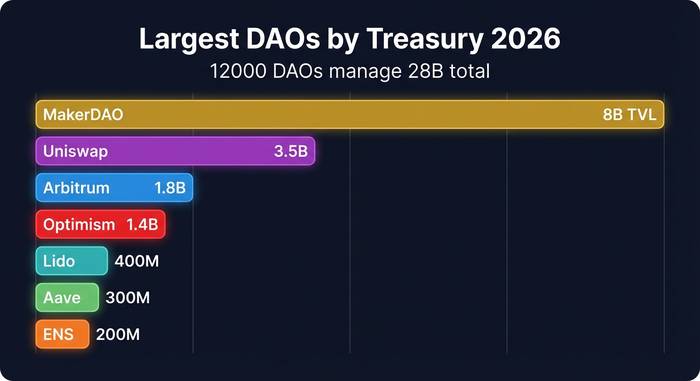
That disaster could have killed the concept forever. Instead, it sharpened it. In 2026, over 12,000 active DAOs manage roughly $28 billion in treasury assets. Uniswap's DAO controls $3.5 billion. Arbitrum's controls $1.8 billion. MakerDAO governs the protocol behind a stablecoin with over $8 billion in locked collateral. The idea didn't die in 2016. It grew up.
So what is a decentralized autonomous organization, and why are billions of dollars being managed by groups of token holders voting on proposals through the internet?
How a DAO works: governance, smart contracts, and voting
A DAO is a type of organization that runs on rules encoded in smart contracts on a blockchain platform. No central authority making decisions. No HR department. No intermediary between you and the organizational treasury. The rules are code, and the code runs itself. Members propose changes, vote on them, and if a proposal passes, the smart contract executes it automatically.
Here's the practical flow:
First, somebody writes a proposal. Could be "let's spend $2 million on public goods grants" or "let's change the fee split on the protocol." It gets posted to a governance forum where people debate it, sometimes for days.
Then DAO members vote. If you hold the governance token (the DAO's cryptocurrency), you get a say. Your voting weight depends on how many tokens you have. Some people delegate their votes to community members who follow governance more closely, kind of like handing your shareholder proxy to someone who actually reads the earnings reports.
If enough people vote yes and the quorum threshold is met, the smart contract carries out the decision on its own. Funds move, parameters change, whatever the proposal specified. No wire transfer to approve, no signature page to sign. The code just does it.
That's the pitch, anyway. Replace the boss with rules written in code on a blockchain network, where every vote and every dollar spent is logged publicly and nobody can fudge the numbers. You don't need to trust the people making decisions because the decisions are visible and the execution is automatic.
In practice, the DAO treasury sits in a smart contract stuffed with governance tokens and stablecoins, and the only way to move money out of it is through a successful community vote. There's no CFO with a company card. No one person holds a key to the wallet. Getting funds released requires collective approval, which is both the beauty and the frustration of the model.
DAO vs traditional organization: the key differences
I find the easiest way to get what a DAO actually is comes from putting it next to what it replaces:
| Aspect | Traditional organization | DAO |
|---|---|---|
| Structure | Hierarchical (CEO, board, employees) | Flat, token-holder governance |
| Decision-making | Top-down, executive authority | Proposal + community vote |
| Transparency | Internal records, limited disclosure | All activity on public blockchain |
| Treasury access | CFO/finance team controls funds | Smart contract, requires vote |
| Participation | Employees and shareholders | Anyone holding the governance token |
| Geographic limits | Office-based, jurisdiction-specific | Global, internet-only |
| Legal status | Clearly defined (LLC, Corp, etc.) | Unclear in most countries |
| Speed | Fast (one person decides) | Slow (consensus required) |
| Accountability | Board oversight, regulators | Code and community pressure |
Look at that table for a second. Traditional companies are fast and legally clean. DAOs are slow and legally messy. But DAOs are transparent in a way that no Fortune 500 company has ever been. Pick your trade-off based on what matters more for the specific problem you're solving.
Where DAOs shine: managing crypto protocols and decentralized applications where the community should decide how the protocol evolves. Decentralization is the point. Where they struggle: anything requiring fast decisions, legal contracts with the real world, or managing operations that don't fit neatly into on-chain proposals.
Benefits of DAOs for crypto governance
You can actually check the books. MakerDAO's treasury? On-chain, right now, for anyone to look at. Every vote, every grant, every dollar spent. I challenge you to get the same visibility into Apple's operating expenses or JPMorgan's internal allocation decisions. DAOs make corporate transparency reports look like redacted CIA documents.
No single person can kill it. When Sam Bankman-Fried got arrested, FTX collapsed within days because one man controlled everything. A well-built DAO doesn't have that vulnerability. The rules live in code distributed across thousands of computers. Remove any one person and the system keeps running. That's not a theoretical benefit; it's been tested repeatedly in the crypto space.
Anyone on earth can participate. Got a wallet and an internet connection? Buy some governance tokens on a decentralized exchange and you're a voting member. No invitation needed, no citizenship requirement, no minimum account balance at a brokerage. A student in Nairobi using blockchain technology has the same governance rights as a hedge fund in Manhattan, weighted only by how many tokens they hold.
Skin in the game is built in. MakerDAO voters decide what types of collateral back the DAI stablecoin. If they approve risky collateral and DAI loses its peg, the MKR token price crashes, and those voters lose money. Their own wealth is tied to their governance decisions. Compare that to corporate boards where executives get golden parachutes regardless of how badly they mess up.
The rules don't bend for anyone. A smart contract doesn't know who you are and doesn't care. 51% means pass, 49% means fail. There's no calling in a favor, no emergency executive session, no "let's just make an exception this time." That rigidity frustrates people who want flexibility, but it's precisely the point for people who've been burned by discretionary power.
Risks and limitations of decentralized autonomous organizations
DAOs are not a perfect form of governance. In practice, they have serious problems that the crypto community is still figuring out.
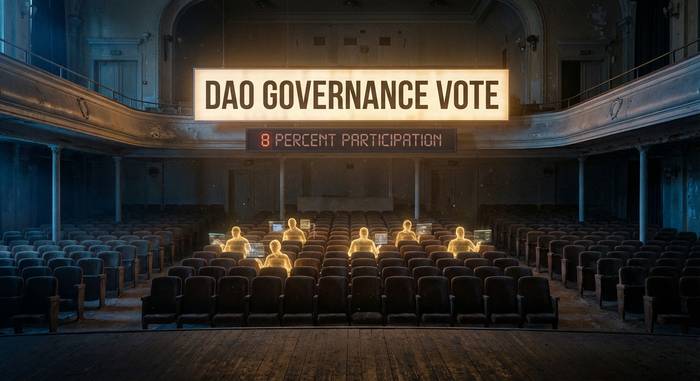
Almost nobody votes. This is the dirty secret of DAO governance. The median voting rate across major DAOs sits between 5% and 12% of all eligible tokens. That means 88-95% of people who could vote simply don't. They bought the token, maybe for price reasons, and never touch the governance side. The result: a small group of whales and active delegates end up controlling outcomes. It's "decentralized" in name but often centralized in practice.
Whale dominance. Governance tokens are assets. You can buy as many as you can afford. This means wealthy individuals or funds can accumulate enough tokens to dominate votes. Andreessen Horowitz (a16z) has been criticized for holding decisive voting power in several DeFi DAOs. When one entity controls the outcome, calling it "decentralized" becomes questionable.
Everything takes forever. I've watched DAO proposals sit in discussion for two weeks, go through a temperature check, enter a five-day formal vote, pass with 67% approval, and then sit for another week waiting for on-chain execution. Meanwhile, a startup competitor shipped three product updates. Speed is DAOs' Achilles' heel, and no one has really solved it. Some DAOs use fast-track processes for urgent matters, but "urgent" in DAO terms still means days, not hours.
One bug can drain everything. We already covered the 2016 hack, but it wasn't the last. Beanstalk, a DeFi protocol with DAO governance, lost $182 million in April 2022 when an attacker used a flash loan to temporarily gain majority voting power and passed a malicious proposal in a single transaction. The "governance" worked exactly as designed. The attacker just played the system better than the defenders. Smart contract audits help but don't guarantee safety.
Legal gray area. Most countries have no legal framework for DAOs. If a DAO gets sued, who shows up in court? If a DAO hires contractors, who signs the employment agreement? Wyoming passed DAO-specific legislation in 2021, and a handful of other jurisdictions have followed, but most DAOs operate in legal limbo. That's fine when everything works. It's a nightmare when disputes arise.
Treasury illusion. DAO treasuries look huge on paper but are mostly made up of the DAO's own token. Uniswap says it has "$3.5 billion" in its treasury. Sounds great. But nearly all of it is UNI tokens. If Uniswap tried to sell even 10% of that UNI, the market would dump and the price would crash. The real liquid value, the money a DAO could actually spend, is a fraction of the headline number. It's like saying you're rich because you own a million shares of your own startup. Until you sell them, it's paper wealth. And selling them tanks the price.
The largest DAOs in 2026 and what they manage
Over 12,000 DAOs exist as of 2026, with more than 6.5 million DAO token holders globally. The decentralized finance (DeFi) sector drives most of the activity, but DAOs now manage everything from digital currencies to art collections to real estate. But a handful dominate:
| DAO | Treasury value | Primary function | Governance token |
|---|---|---|---|
| Uniswap | ~$3.5 billion | DEX protocol governance | UNI |
| Optimism | ~$1.4 billion | L2 network + public goods funding | OP |
| Arbitrum | ~$1.8 billion | L2 network governance | ARB |
| MakerDAO | $8B+ TVL | Stablecoin (DAI/USDS) governance | MKR |
| Aave | ~$300 million | Lending protocol governance | AAVE |
| ENS | ~$200 million | Domain name system governance | ENS |
| Lido | ~$400 million | Liquid staking governance | LDO |
Uniswap DAO is a fascinating case study in governance paralysis. It controls the largest DEX and sits on $3.5 billion, but actually spending that money has been nearly impossible. The "fee switch" debate, whether to redirect a portion of trading fees to UNI holders, has dragged on for years without resolution. Multiple proposals have failed or stalled. Having a massive treasury means nothing if the governance process can't agree on what to do with it.
Optimism Collective uses an innovative two-chamber model: the Token House (OP holders voting on protocol changes) and the Citizens' House (reputation-based members distributing retroactive public goods funding). It's one of the most structurally interesting governance experiments in crypto.
MakerDAO (now rebranded to Sky) is the oldest and most battle-tested DeFi DAO. It governs the protocol behind the DAI stablecoin, managing collateral types, stability fees, and risk parameters. Bad governance decisions here directly affect a multi-billion dollar stablecoin.
Arbitrum DAO controls a massive ARB token treasury. In 2023, its first governance proposal caused controversy when the Arbitrum Foundation was found to have already spent $1 million before the vote concluded. The incident highlighted the tension between DAOs and the teams that build the underlying technology.
How to join a DAO: membership, wallets, and voting
Getting involved in a DAO is straightforward if you already use crypto.
Token-based DAOs (most common): Buy the governance token on a decentralized exchange like Uniswap or a centralized exchange like Coinbase. Hold it in your wallet. That's it. You now have voting rights proportional to your holdings. To actually vote, go to the DAO's governance platform (Snapshot, Tally, or the DAO's own portal) and cast your vote on active proposals.
Share-based DAOs: These are more selective. You submit an application (usually through a governance forum or Discord), and existing members vote on whether to admit you. MolochDAO pioneered this model. You typically commit tokens or work as tribute.
Reputation-based DAOs: You earn voting power through contributions, not purchases. DXdao has used this model since 2019. You can't buy reputation; you earn it by coding, providing liquidity, or completing bounties. This addresses the whale problem but limits who can participate.
Practical steps for a first-time DAO participant:
1. Get a crypto wallet (MetaMask, Coinbase Wallet)
2. Buy the DAO's governance token
3. Connect your wallet to Snapshot.org or Tally.xyz
4. Browse active proposals and read the forum discussions
5. Vote or delegate your tokens to someone you trust
Delegation is the move most people miss. If you hold tokens but don't have time to read every 40-page proposal, hand your vote to someone who does. On Optimism alone, over 90,000 addresses have handed their OP tokens to active governance participants. You still own the tokens. You just let someone else press the vote button. You can take it back any time.
One practical tip: don't just buy a token and forget about it. Join the DAO's Discord or governance forum. Lurk for a week. Read a few proposals and the discussions around them. You'll learn more about how crypto projects actually run than you would from a hundred Medium articles. The education alone is worth the time, even if you never cast a single vote.\
DAO legal status: Wyoming and the growing framework
The legal question is real. If a DAO controls billions in assets but doesn't exist as a legal entity, what happens when things go wrong?
Wyoming pioneered DAO legislation in July 2021, allowing DAOs to register as LLCs. This gives them legal standing to enter contracts, open bank accounts, and limit member liability. CityDAO used Wyoming's law to purchase 40 acres of land near Yellowstone, an early example of a DAO owning real-world property.
Other jurisdictions moving forward: Vermont has a blockchain-based LLC framework. The US Virgin Islands have DAO-friendly legislation. The Marshall Islands recognized DAOs as legal entities in 2022. Switzerland's Association structure has been used by several crypto projects for DAO-like governance.
The EU hasn't created DAO-specific laws, but the MiCA regulation framework requires crypto projects to have identifiable legal entities, which creates tension with fully decentralized DAOs.
The challenge: Most DAOs don't want to file paperwork. Doing so means naming people in charge, which clashes with the whole point of being anonymous and decentralized. The ones that do incorporate get legal cover but give up some of what makes a DAO a DAO. Nobody has solved this tension yet.
What I find telling is how few DAOs bother with legal status at all. Of the 12,000+ active DAOs, only a tiny fraction have any formal legal wrapper. Most operate as if they're above the law, which works until it doesn't. The first major lawsuit against an unincorporated DAO will set a precedent that reshapes the entire space. It hasn't happened yet, but it will.



