VeChain (VET) in 2026: The Enterprise Blockchain

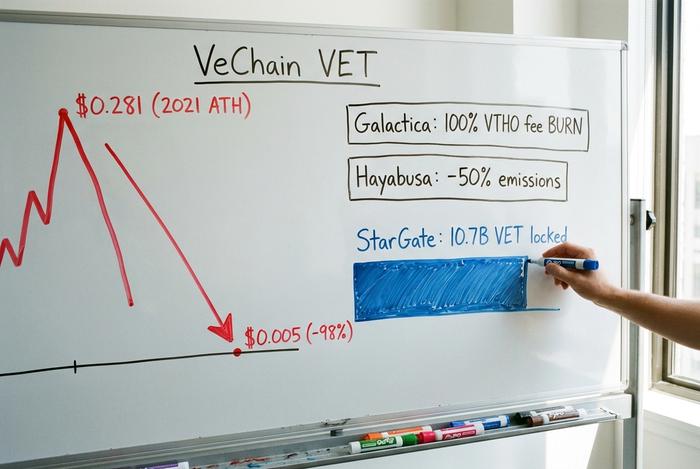
VeChain looks dead if you only check the price. VET trades for about half a cent, roughly 98% below its 2021 high, and most traders filed it under "old supply-chain coin that missed the boat." Then you look at what the network actually did in 2025 and 2026. It rebuilt its entire token economy in two hardforks. It launched a staking program that locked up more than 10 billion VET. And it quietly runs a sustainability app ecosystem with over 5 million users, which is more real people than most louder chains can claim. This is the enterprise blockchain a former Louis Vuitton executive founded to track physical goods. So the honest question for 2026 is not whether VeChain is alive. It is whether any of that life ever reaches the token.
What Is VeChain and the VET Token
VeChain never tried to win over DeFi traders. It went after Walmart and BMW instead. From the start it was an enterprise blockchain, an unusual cryptocurrency built for supply chain management rather than yield farms, a layer-1 designed to track real products through real supply chains.
The project goes back to 2015. Its founder, Sunny Lu, was the chief information officer of Louis Vuitton China before crypto, which tells you a lot about the audience he had in mind. The company started life as "Bitse," rebranded to VeChain in 2017, and launched its own public blockchain, VeChainThor, when the mainnet went live in June 2018. That is also when the original VEN token swapped to VET. The VeChain Foundation, now based in San Marino, has run the network ever since. Lu did not build it alone, either; co-founder Jay Zhang, a former PwC and Deloitte auditor, designed the early governance, which is a clue to the compliance-minded customers VeChain wanted from day one. VET itself is the core digital asset: you hold it as a store of value and for value transfer, and just by holding it, it generates the second token that actually pays for using the chain.
How VeChain Works: Dual Token and PoA
Two design choices define VeChain, and both were made for businesses rather than crypto purists.
The dual-token model: VET and VTHO
Most blockchains make you pay fees in the same volatile coin you are trying to hold. VeChain splits the job in two. VET is the asset you own. VTHO is the "gas" that pays for transactions, and here is the clever part: simply holding VET generates VTHO automatically, historically around 0.000432 VTHO per VET each day. A company building on VeChain can budget its costs in VTHO without worrying whether VET doubled or halved overnight. For an enterprise finance team, that predictability matters more than any moonshot chart. Historically, 70% of every VTHO fee paid was burned and the other 30% went to the validators, though the 2025 upgrades changed that math, as we will see.
Proof-of-Authority consensus
VeChain does not use anonymous miners or open staking to secure the chain. It uses Proof-of-Authority, where 101 known validators, called Authority Masternodes, verify every block, and they have to disclose who they are. The upgraded version, PoA 2.0, shipped in late 2022 and gives the network roughly 100 transactions per second with near-instant finality and almost no energy use. That low energy footprint is not a side detail; it is central to the sustainability pitch, because you cannot credibly sell carbon tracking on a chain that burns power like a small country. There is a real tradeoff here, though. Identity-checked validators make VeChain more centralized than Bitcoin or Ethereum. To a purist that is a red flag. To a corporation that needs to know who is running the infrastructure, it is the whole point. A bank or a shipping firm does not want a pseudonymous validator in Siberia signing off on its data; it wants a named, accountable operator, and that is exactly what Proof-of-Authority delivers.
ToolChain, VeWorld, and enterprise tools
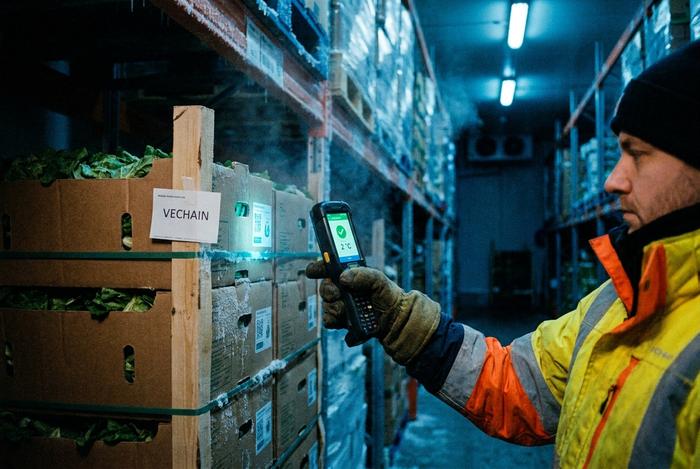
The rest is built to hide the crypto. ToolChain is a no-code service that lets a business deploy traceability without writing a single smart contract in Solidity. VeWorld is the super-app wallet for the ecosystem, the front door to its decentralized applications. And "fee delegation" lets a company pay the gas on a customer's behalf, so an end user scanning a QR code never needs to own a token at all. Tie that to NFC chips, QR codes, and RFID tags across Internet of Things sensors, and a physical product becomes something you can verify on-chain.
The VeChain Renaissance: Galactica and Hayabusa
Here is the part almost everyone missed, because it happened while the price did nothing. For years, VeChain promised to fix its tokenomics. In 2025, it finally did, in two hardforks it grouped under the name Renaissance.
Galactica, July 2025
Galactica came first, in July 2025, and it rewired the fees. Two big changes: a full 100% burn of the VTHO base fee, and an EIP-1559-style dynamic gas market lifted from Ethereum. Translation? The busier the VeChain network gets, the more VTHO it burns. For the first time ever, using VeChainThor actually shrinks the token supply instead of inflating it.
Hayabusa, December 2025
The second fork, Hayabusa, reached mainnet on 2 December 2025 and hit the supply side. It cut VTHO emissions by about 50%, dropping the issuance trajectory from roughly 13.67 billion VTHO a year toward 7.3 billion, and reworked how validators and stakers are rewarded under PoA 2.0. Half the new supply, gone. Put Galactica and Hayabusa together and you get a genuine deflationary push on VTHO, which is exactly the kind of structural change holders had begged for since 2021. VTHO itself still trades for a tiny fraction of a cent, around $0.0004, but for the first time the supply trend points the right way.
StarGate Staking and VET/VTHO Tokenomics
Galactica and Hayabusa fixed the supply. StarGate is the piece that actually moved the numbers.
StarGate staking
Launched on 1 July 2025, StarGate replaced VeChain's old and confusing system of X-Nodes and Economic-Node NFTs with a single staking platform anyone could join. It opened with a $15 million bonus pool (5.48 billion VTHO), rewards of up to 9% during the bonus period, a minimum stake of 10,000 VET, and tiered positions represented as NFTs. The uptake was not theoretical. Within 13 weeks, active stakers had jumped nearly 94%, and more than 10.7 billion VET sat locked in the program. Most of that, around 5.9 billion VET, came from ordinary delegators, with validators who run the heavier infrastructure locking up another 3.2 billion, a sign the program reached well past the usual whales. Worth noting: that 9% was the bonus rate, and ongoing yields are dynamic, so do not treat it as a fixed return.
VET and VTHO supply reality
Now the sober numbers. VET has about 85.99 billion tokens circulating against a maximum of 86.71 billion, so nearly all of it is already out. VTHO runs to roughly 100 billion. VET trades near $0.005 for a market cap around $429 million, which lands it outside the top 100 coins, about 98% below the $0.281 all-time high from April 2021.
| VET tokenomics (June 2026) | Figure |
|---|---|
| VET price | ~$0.005 |
| Market cap | ~$429 million |
| All-time high (Apr 2021) | $0.281 (down ~98%) |
| Circulating supply | ~85.99 billion VET |
| Max supply | 86.71 billion VET |
| VET locked in StarGate | 10.7 billion |
| VTHO emissions (Hayabusa) | cut ~50% |
VeChain's Real-World Adoption in 2026
Here is the case that VeChain still matters, and it has nothing to do with DeFi. On-chain, the total value locked is a joke, around $1.35 million, the kind of figure that would embarrass a mid-cap token. So skip DeFi entirely. The relevance lives in two places: physical supply chains, and a sustainability app network that turned out far bigger than anyone expected.
Start with the enterprise roster, because it is deep. Walmart China traced food with it. BMW, BYD, DNV (on board since 2018), AWS, the luxury house LVMH, the UFC, all of them ran projects on VeChain, and the foundation counts 30-plus Fortune 500 companies with live solutions. The original pitch, the one Sunny Lu opened with, still drives it: kill counterfeits in a market worth roughly $600 billion a year, then add food safety, carbon tracking, and provenance you can check from your phone. None of it is slideware. Think cold-chain sensors watching vaccines and groceries, carbon-footprint reporting through a VeCarbon platform built with AWS, and luxury authentication that proves a handbag or a wine is the real thing. VeChain even ran a digital vaccination-record app during the pandemic. The catch? It is not alone out there. IBM, SAP, and even a few of its own partners run competing traceability systems, so this lead is anything but locked in.
The bigger surprise is newer. VeBetterDAO is a Web3 corner of the VeChain ecosystem, a cluster of "X-to-Earn" apps that pay people in the B3TR token for everyday green habits, from recycling to shopping cleaner. It has pulled in north of 5 million users across more than 50 apps and clocked roughly 50 million transactions. That is real, repeat usage almost no layer-1 outside the giants can claim. The honest caveat: no new marquee partner signed in 2026, so the enterprise side reads more "still running" than "still growing."
| VeChain adoption (2026) | Figure |
|---|---|
| Fortune 500 live solutions | 30+ |
| Named enterprise partners | Walmart China, BMW, DNV, LVMH, BYD |
| VeBetterDAO users | 5 million+ |
| VeBetterDAO apps / transactions | 50+ / ~50 million |
| DeFi TVL | ~$1.35 million |
Is VeChain (VET) Still Relevant in 2026?
Here is the honest verdict. VeChain is one of the few projects where the network is unmistakably alive and the token looks unmistakably dead, and you have to hold both ideas at once.
The bull case is real follow-through. Plenty of chains promise tokenomics reform; VeChain actually shipped it, twice, and the StarGate numbers show people responded. It has 5 million app users, a long enterprise client list, and low-energy blockchain technology that suits the compliance-minded companies it courts. The bear case is just as real. VET is down 98% and shows no sign of turning. DeFi activity is negligible. Proof-of-Authority means real centralization. And the project's Chinese roots still scare off some Western investors and keep it off certain exchanges. What gives me pause is simpler than any of that: none of the genuine usage has ever translated into demand for VET. Until it does, the chart may keep ignoring the progress.
| The two sides of VeChain | Detail |
|---|---|
| Network health | Renaissance shipped, 10.7B VET staked, 5M+ app users |
| Token health | VET ~98% below ATH, DeFi TVL ~$1.35M |
| Biggest risk | Usage has not converted into VET demand |
How to Buy and Stake VeChain (VET)
Buying VeChain is the easy part. VET sits on most big exchanges, Binance and Coinbase included, so you can grab it for price exposure in a minute. Want to hold it yourself? Drop it into the official VeWorld wallet, or a Ledger if you prefer cold storage. Want it to earn? Stake through StarGate. You will need at least 10,000 VET, and the rewards land in VTHO, not more VET. Two things to keep in mind before you commit. The yield is dynamic now, not the 9% the launch promo dangled. And VET is a cheap, twitchy token, so size your position like one.
The Verdict: Does VeChain Have a Future?
VeChain spent the last two years doing the unglamorous work most projects skip: a real tokenomics reset, a working staking system, and an app ecosystem with millions of actual users. That is more than most surviving altcoins from 2021 can say. But none of it guarantees a higher VET price, because upgrades and partnerships are not the same as demand for the token. The future of VeChain rests on one question: can enterprise traceability and millions of sustainability users finally turn into a reason to own VET? Watch VeBetterDAO's growth and the enterprise pipeline, not the price chart. That is where the answer is hiding.