Polkadot (DOT): The Blockchain of Blockchains in 2026

Polkadot is one of the easiest projects in crypto to write off and one of the hardest to actually dismiss. Its token, DOT, trades around 98% below its 2021 peak, and plenty of investors have already filed it under "failed Ethereum rival." Yet in March 2026 the Polkadot network did something almost no major blockchain has managed: it rewrote its own monetary policy by community vote, capping a supply that used to grow forever. At the same time it is shipping the most ambitious architecture overhaul in the industry, a project called JAM. So which is it: a fallen star, or a slow-burn infrastructure bet that the market hasn't repriced yet? This guide walks through what Polkadot is, how it works, where it stands in 2026, and whether DOT deserves a place in your portfolio.
What Is Polkadot, and the Problem DOT Solves
Picture every blockchain as its own island. Bitcoin over here, Ethereum over there, and no easy ferry between them. Moving an asset from one to another usually means trusting a bridge, and bridges are where the biggest hacks of the last few years happened. Polkadot's pitch is to get rid of the ferries. It doesn't want to be the fastest single chain. It's a layer-0 metaprotocol, which is a fancy way of saying it sits underneath other blockchains and lets them share one security layer while passing messages back and forth. People call it the "blockchain of blockchains." Ugly phrase. Right idea.
Who built it matters here. Gavin Wood did, and Wood is no outsider: he co-founded Ethereum and wrote the Yellow Paper that pinned down how the Ethereum Virtual Machine works. His Polkadot whitepaper landed in October 2016. Mainnet followed on 26 May 2020. The money story is older still. A 2017 token sale raised more than $144 million, and two groups have run the project since: Parity Technologies writes the code, the Swiss Web3 Foundation pays for it. The promise has barely changed in eight years, interoperability, scale, and shared security in a single protocol. And this is the part investors keep getting wrong. They grade Polkadot like one app-chain and tally the DeFi money sitting on it. It was never trying to be that.
How Polkadot Works: Relay Chain and Parachains
Polkadot's design splits the work between a central coordinator and a fleet of specialized chains. If you understand that split, the rest of the system falls into place.
The relay chain: the security spine
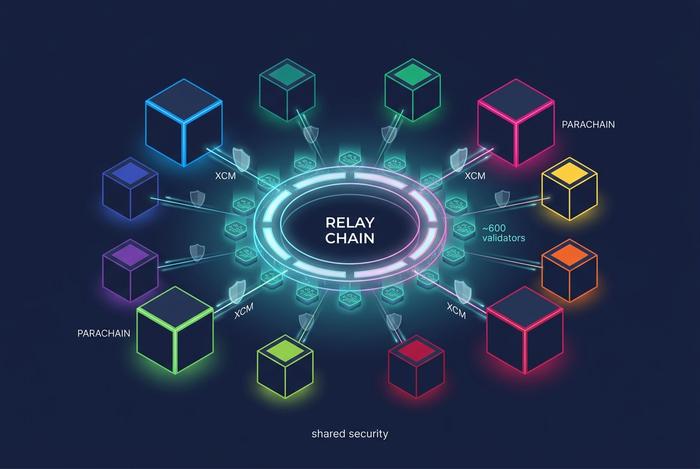
At the center sits the relay chain. It runs no apps of its own, and that's on purpose. Its one job is to hand out consensus, finality, and security to everything plugged into it. Two mechanisms split the labor: one churns out blocks quickly, the other finalizes them so they can't be reversed. Roughly 600 validators stake DOT to keep this spine honest. And here's the payoff, the reason the whole design exists: a new chain doesn't have to recruit its own validators or bootstrap its own security. It borrows the relay chain's. That borrowing has a name, shared security, and everything else in Polkadot hangs off it.
Parachains and the end of auctions
The specialized chains that connect to the relay chain are called parachains. Each one is sovereign: it sets its own rules, runs its own logic, and can have its own token, while still inheriting the relay chain's security. For years, getting a parachain slot meant winning a competitive auction and locking up huge amounts of DOT, often raised from the community through "crowdloans." The first auctions began in October 2021, with Acala winning the opening slot that November, and leases ran up to 96 weeks.
That model is gone. On 19 September 2024, Polkadot replaced slot auctions with Agile Coretime. Instead of bidding for a two-year lease, a team now buys blockspace ("coretime") flexibly, the way you'd rent cloud compute. Crowdloans have been deprecated. If you read about Polkadot a few years ago and remember the auction frenzy, this is the single biggest thing that has changed.
Validators, nominators, collators, and XCM
Three roles keep the thing running. Validators secure the relay chain. Nominators don't run nodes themselves; they back validators they trust with staked DOT and take a cut of the rewards. Collators sit on each parachain, bundling its transactions and passing them up to the validators to verify. The glue is XCM, Polkadot's own cross-chain message format. It lets parachains send assets and instructions to each other inside the shared-security umbrella, not through some external bridge that could get drained overnight. Does any of this actually scale? In a December 2024 stress test on Kusama, Polkadot's live "canary" network, the system pushed about 143,000 transactions per second. That was at 23% of capacity.
The DOT Token: Staking, Governance, and Fees
DOT has three honest jobs today, and one that recently became obsolete. It's worth being clear about each rather than overselling the token.
First, staking. Polkadot uses nominated proof-of-stake (NPoS), where holders nominate validators and earn rewards for helping secure the network. About 51.9% of the supply, roughly 875 million DOT, is staked. The reward rate now sits near 3% a year, and one quietly important change is that the unbonding period, the time your DOT is locked after you stop staking, was cut from 28 days to around two days.
Second, governance. Polkadot runs OpenGov, a fully on-chain governance system that replaced the older council model. Any token holder can vote on proposals directly or delegate their vote to someone they trust, pushing decentralization further than the older council model did. This isn't decoration: OpenGov is the actual mechanism the Polkadot community used to approve the 2026 supply cap. Third, DOT pays transaction fees. The obsolete fourth job was bonding DOT to win a parachain slot, which Agile Coretime made unnecessary.
Polkadot 2.0: Coretime, JAM, and Developer Tools
The last two years split neatly into two efforts. Polkadot 2.0 was the "make it usable" release. JAM is the "rebuild the engine" bet. Keeping them separate in your head helps.
Polkadot 2.0: lowering the barrier for developers
Polkadot 2.0 is the boring-but-important release. The whole point was developer experience. Agile Coretime is the headline: rent blockspace by the block, no multi-year lease required. Need to absorb a sudden traffic spike? Elastic scaling lets a chain grab extra coretime on demand. Underneath, asynchronous backing reworked how parachain blocks get produced and roughly doubled throughput. The toolkit tying it together is the Polkadot SDK, formerly Substrate, an open-source framework that hands developers most of the hard plumbing so they can ship a custom blockchain without reinventing consensus from scratch.
JAM: the Join-Accumulate Machine
JAM is the big swing. Outlined by Gavin Wood in a technical "Gray Paper," it would replace the relay chain with a general-purpose decentralized computer, less a coordinator of parachains and more a single distributed machine anyone can deploy to. In practice that could let developers ship services straight to Polkadot itself, the way they deploy smart contracts to Ethereum today, instead of launching a whole parachain. The Web3 Foundation has put up a prize pool of 10 million DOT plus 100,000 KSM to seed independent implementations, and 43 teams are building competing versions, tested on a rig nicknamed the "JAM Toaster" running more than 1,000 nodes. One honest caveat: JAM is not live on mainnet, and there is no confirmed launch date. Treat it as a multi-year project, not a next-quarter catalyst.
DOT Tokenomics: The 2026 Hard Cap on Supply
For investors, this is the headline. For most of its life, DOT had no supply ceiling at all.
The old uncapped model
From launch, Polkadot issued new DOT at a fixed rate of about 10% per year, with no maximum supply. Circulating supply drifted upward past 1.6 billion tokens. Critics had a fair point: constant new issuance is constant structural sell pressure, a slow leak working against every holder.
The 2.1 billion hard cap
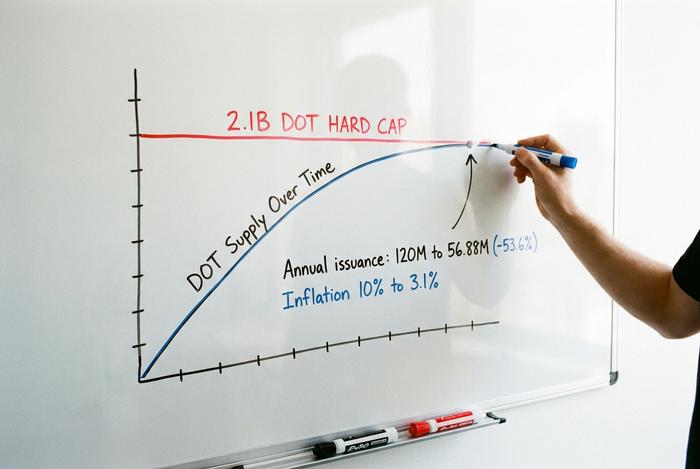
On 14 March 2026, that ended. Through two OpenGov referenda passed with roughly 81% support, the community set a hard cap of 2.1 billion DOT and cut annual issuance from about 120 million to 56.88 million tokens, a 53.6% reduction. Inflation dropped from around 10% toward 3.1% and keeps declining as the supply approaches the ceiling. It's the largest structural change to DOT since launch.
| Tokenomics | Before March 2026 | After March 2026 |
|---|---|---|
| Maximum supply | Uncapped | 2.1 billion DOT |
| New issuance / year | ~120 million DOT | ~56.88 million DOT |
| Annual inflation | ~10% | ~3.1% and falling |
| Unbonding period | 28 days | ~2 days |
Whether this re-rates the price depends on real demand for coretime and block space. But the direction finally favors holders instead of working against them, and that matters for the long-term thesis.
Is DOT a Good Investment in 2026?
Let me be blunt. The price chart is ugly. The fundamentals are mixed, though they're finally trending the right way. DOT is an infrastructure bet, not a momentum trade, and if you came here for a quick double, you picked the wrong asset. My own bias: I don't think DeFi TVL is a fair way to judge a layer-0. I also won't pretend the ecosystem is buzzing, because it isn't.
Now the numbers. DOT trades near $0.95. Market cap, about $1.61 billion. That's roughly 98% under its November 2021 high of $55 (CoinGecko, as of June 2026). Five years, almost the whole way down. The swings were always violent, mind you: up 188% in 2021, down 84% in 2022, up 90% again in 2023. Some of the news is genuinely good. A U.S. spot DOT ETF, the 21Shares TDOT, listed on Nasdaq on 6 March 2026, with a 0.30% fee and Coinbase holding the coins, so a regular brokerage account can now buy in. The treasury even ran a surplus for the first time under OpenGov in Q4 2025. And builder counts hold up better than the price; Polkadot is still a top-tier blockchain by developer numbers, even as Ethereum and Solana sprint ahead.
Then the bad. Real DeFi on Polkadot parachains adds up to only about $54 million, and most of that sits in one app, the parachain exchange Hydration. There was a scare, too. In April 2026 a Hyperbridge exploit minted a billion fake bridged DOT on Ethereum and walked off with around $250,000. The saving grace: native DOT and the relay chain were never touched. The hole was in a bridge, not in Polkadot itself.
| DOT snapshot (June 2026) | Figure |
|---|---|
| Price | ~$0.95 |
| Market cap | ~$1.61 billion |
| All-time high (Nov 2021) | ~$55 (down ~98%) |
| Circulating supply | ~1.689 billion DOT |
| Staked | ~51.9% (~875M DOT) |
| Staking reward | ~3% / year |
| Parachain DeFi TVL | ~$54 million |
Polkadot vs Other Cryptocurrencies
Polkadot doesn't really compete with one chain. It competes on a philosophy. Its genuine edges: shared security out of the box, native cross-chain messaging through XCM, and on-chain governance that actually functions. The weak spots are just as clear, thin liquidity, low mindshare, and developer traction that trails Ethereum and Solana. Here's how the main interoperability networks line up.
| Network | Shared security | Native app-chains | Interop method |
|---|---|---|---|
| Polkadot | Yes (relay chain) | Yes (parachains) | XCM |
| Cosmos | Optional | Yes | IBC |
| Avalanche | No default | Yes (L1s) | Warp messaging |
| Ethereum | L1 only | Rollups | Bridges |
Short version. Want shared security and built-in cross-chain messaging without trusting a third-party bridge? Polkadot's design is genuinely strong. Want the deepest liquidity and the biggest developer crowd right now? It's not your pick.
How to Buy, Store, and Stake DOT in a Wallet
Buying DOT is straightforward. You can pick it up on most major exchanges, or, for hands-off exposure, hold the TDOT ETF through a brokerage. For self-custody, store DOT in a user-friendly wallet such as Polkadot.js, Nova, or Talisman, or on a hardware wallet for larger amounts. To earn the staking reward, you don't need to run a validator; you can join a nomination pool with a low minimum and let it back validators for you. Just remember the unbonding lock before you commit funds you might need quickly.
The Bottom Line: Is Polkadot Still Relevant?
Polkadot just fixed its single biggest investor objection, an uncapped, ever-inflating supply, and it's betting the next era on rented coretime and a from-scratch computer called JAM. That's a serious technical hand. But the market won't re-rate DOT on architecture alone; it wants to see real coretime demand, deeper liquidity, and developers choosing Polkadot over an EVM chain. The cleanest tokenomics in layer-0 only pays off if the usage shows up. The open question for 2026 and beyond is simple: will builders come for the design, or keep going where the users already are? Watch coretime sales, not the price chart.