Lido (stETH): Liquid Staking and How to Stake ETH
Want staking rewards on your ETH? The official route is brutal. You need exactly 32 ETH, the technical skill to run a validator that never sleeps, and the patience to lock those coins away with no quick exit. Most people have none of the three.
Lido takes all three problems off the table. Deposit any amount of ETH, let the protocol run the validators, and you walk away with a token called stETH. It earns rewards like staked ETH, but you can still trade it, lend it, or post it as collateral. That single trade-off, give up direct control and keep your liquidity, is why Lido (stETH) grew into the largest liquid staking protocol on the Ethereum blockchain, with roughly $15.6 billion in deposits as of June 2026.
None of that convenience is free, though. The fees, the risks, the centralization questions are all real, and this guide does not skip them.
What is Lido and what is stETH?
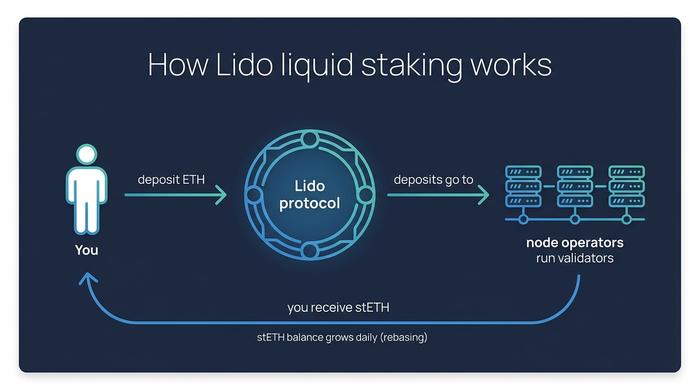
Lido is a liquid staking protocol built around Ethereum staking. You hand it ETH, it stakes that ETH on Ethereum's proof-of-stake network through professional operators, and it gives you stETH in return, one stETH for each ETH you deposit. Think of stETH as a receipt that earns interest. It represents your staked ETH plus the rewards piling up on top, and unlike the underlying stake, you can trade it, lend it, or use it as collateral the same day.
That is the part that makes liquid staking different from plain staking. Normally, staked ETH sits frozen and does nothing else. With Lido, the value is in two places at once: working as a validator deposit and sitting in your wallet as a usable asset.
One thing to keep straight: stETH is not the same as LDO. The stETH token is your stake. LDO is Lido's separate governance token, used to vote on how the protocol is run. Owning stETH does not require touching LDO at all.
That scale is not an accident. Being early and deeply liquid created a flywheel — more users meant deeper markets for stETH, deeper markets made stETH more useful as collateral, and that usefulness pulled in more users still. It is the main reason a single protocol came to dominate the category.
How Lido staking and stETH work
The mechanics look complicated, but they come down to three ideas people often blur together: pooling, rebasing, and wrapping.
Pooling and node operators
Running your own validator needs exactly 32 ETH. Lido gets around that by pooling deposits from thousands of users and splitting them into validator-sized chunks. Those validators are run by a curated set of professional node operators, more than 400 of them across Lido's operator modules, not by Lido itself. You never see any of this. You deposit two ETH, or 0.1 ETH, and the protocol does the assembling.
Those operators are not all cut from the same cloth. Most run under a curated set vetted by the Lido DAO, while a newer community staking module lets independent stakers join by posting a bond. That second track is a deliberate push to widen the operator base over time, which matters for the centralization debate later in this guide.
How stETH rebases
Your stETH balance is not static. Lido pays staking rewards by increasing the number of stETH in your wallet, a process called rebasing that runs roughly once a day. Hold 10 stETH today and you might hold 10.0006 tomorrow, with no transaction on your part. The price of each stETH stays close to one ETH; the rewards show up as more tokens, not a higher price.
stETH vs wstETH
That daily rebasing is tidy for holders but awkward for many DeFi protocols, which expect a token whose balance does not shift. So Lido offers wstETH, the wrapped version. Its balance stays fixed while each wstETH slowly becomes worth more stETH. Same underlying stake, two formats: stETH for simple holding, wstETH for plugging into the wider DeFi system and for cleaner accounting.
| stETH | wstETH | |
|---|---|---|
| Balance | Grows daily (rebases) | Stays fixed |
| Value per token | Steady, around 1 ETH | Rises over time |
| Best for | Holding, simple tracking | DeFi, accounting |
How to stake ETH with Lido step by step
The flow takes about two minutes. Open the official stake.lido.fi site, connect a wallet like MetaMask, type in how much ETH you want to stake, and confirm. The matching stETH lands in your wallet right away. No lock-up date, no minimum to clear.
Prefer a hardware wallet? You can stake Lido through Ledger Live, which keeps your keys offline the whole time. One warning, whichever route you pick: phishing is rampant here. Fake Lido sites and bogus "withdrawal NFT" claim pages exist for one reason, to drain wallets that approve a bad transaction. Bookmark the real domain, check it every single time, and never sign an approval you did not start yourself.
stETH rewards, APR and the 10% fee
The yield on stETH comes from Ethereum itself: the consensus rewards validators earn for securing the network, plus a share of transaction tips and MEV. Lido bundles all of that and passes it to stETH holders through the daily rebase. As of June 2026 the rate sat around 2.36% APR on a seven-day average, though that figure moves with network activity.
Lido is not a charity. It takes a 10% cut of the staking rewards, and only the rewards, never your deposited principal. That fee is split evenly, 5% to the node operators who run the validators and 5% to the Lido DAO treasury. So the headline rate is what actually reaches you, after the protocol takes its share of the gross. Worth knowing: because those rewards arrive as more stETH, your position compounds on its own. You never claim or re-stake anything; each daily rebase simply leaves you holding a little more.
| Lido at a glance | Figure (as of June 2026) |
|---|---|
| Total value staked | ~$15.6 billion |
| stETH in circulation | ~9.0 million stETH |
| Share of all staked ETH | ~21.8% |
| Protocol fee | 10% of rewards (5% operators / 5% DAO) |
| stETH APR | ~2.36% (7-day average) |
Using stETH and wstETH across DeFi
The reason to choose liquid staking over plain staking is right here: your staked ETH can keep working. Because stETH and wstETH are ordinary ERC-20 tokens, they slot into the rest of DeFi. You can post wstETH as collateral on Aave and borrow against it, supply it to Curve or Balancer liquidity pools, or loop it to amplify your staking yield.
This is where the "liquid" in liquid staking earns its name. It is also where the risk compounds. Every extra layer, a lending market, a pool, a leveraged loop, stacks its own smart-contract and liquidation risk on top of the staking risk you already hold. Earning a second yield on your stETH is attractive, but you are now exposed to two or three protocols, not one.
A real example makes both the appeal and the danger concrete. For years the deepest market for stETH was the stETH/ETH pool on Curve Finance, where holders collected trading fees and token incentives on top of their staking rewards. That same pool, and the leverage built around it, is exactly what turned an ordinary market scare into the 2022 depeg covered below.
stETH vs rETH, cbETH and other tokens
Lido is the giant of this market, holding somewhere around 60% of all liquid staking by value, but it is not the only option, and the alternatives make different trade-offs. Rocket Pool's rETH leans harder into decentralization, letting almost anyone run a node with far less than 32 ETH. Coinbase's cbETH is the custodial route: simple if you already trust an exchange, centralized by design.
| Token | Issuer | Decentralization | Reward model |
|---|---|---|---|
| stETH | Lido (DAO + curated operators) | Medium, many operators | Rebases daily |
| rETH | Rocket Pool | High, permissionless node operators | Value accrues in price |
| cbETH | Coinbase | Low, single custodian | Value accrues in price |
There is no universally correct pick. Compared to traditional staking, all three remove the 32 ETH minimum — but stETH wins on liquidity and DeFi support, rETH on decentralization, cbETH on familiarity for exchange users.
Risks of staking ETH through Lido
Now the part the tutorials gloss over, and the part I would read twice. Lido is battle-tested, but staking through it carries real risks that every crypto investor should understand before committing funds.
The 2022 stETH depeg
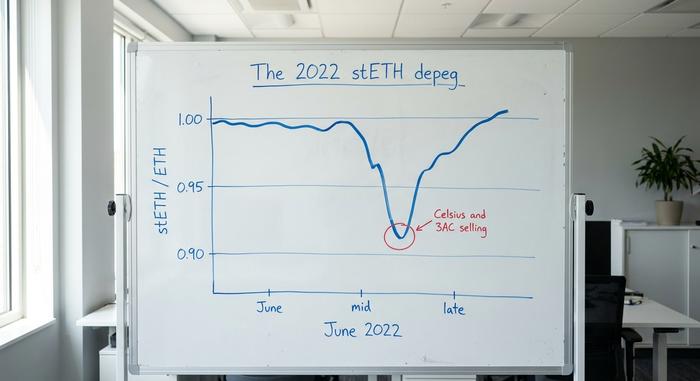
In June 2022, stETH slipped to about 0.92 ETH, an 8% discount to the asset it represents. People panicked that stETH was "breaking." It was not. Each stETH was still backed one-for-one by staked ETH. The catch was that withdrawals did not exist yet, so the only way out was selling on the open market. When Celsius and Three Arrows Capital dumped large amounts into thin liquidity, the secondary-market price fell below peg even though the backing never changed. Once withdrawals went live, that gap closed.
Validator-set dominance
The deeper concern is structural. At its peak Lido controlled roughly a third of all staked ETH, which set off a real debate: if one protocol approaches the ~33% threshold that matters for Ethereum's finality, it becomes a single point of systemic risk for the whole network. Lido's share has since fallen to about 21.8% of staked ETH as of June 2026, easing the pressure, and the protocol added Dual Governance, a mechanism that lets stETH holders veto DAO decisions they object to. The criticism has not vanished, but it has softened.
Why does a third matter so specifically? On a proof-of-stake chain, an entity controlling more than 33% of the stake can, in theory, stop the network from finalizing blocks, and past half it could censor transactions outright. Opponents argued that no protocol, however well run, should sit near those lines. Lido's reply is that its stake is spread across hundreds of independent operators rather than one company, so the real concentration is looser than the single headline number implies.
Smart contract and slashing risk
Finally, the plumbing. Your ETH is governed by Lido's smart contracts, and any bug in that code is a risk no audit fully erases. If a node operator gets slashed for misbehaving or going offline, those penalties are socialized across stETH holders, nudging the value down slightly. And none of this is insured. There is no FDIC backstop and no promise that stETH always trades at one ETH.
How to unstake stETH back to ETH
For Lido's first couple of years you could not actually redeem stETH at all. You could only sell it. That changed with Ethereum's Shapella upgrade in April 2023, which switched on staking withdrawals, and Lido V2 added in-protocol unstaking a month later.
Now there are two ways out. Request a withdrawal through Lido, join the exit queue, and claim your ETH once it processes, with an NFT holding your place in line until then. Or skip the wait entirely: swap stETH for ETH on a decentralized exchange in one transaction and take the going market price. One costs time. The other costs a little slippage.
Queue length depends on traffic. In quiet weeks a withdrawal clears in days; in a rush it drags, the same way Ethereum's deposit queue clogs when everyone piles in at once. For small amounts, the instant swap usually beats waiting around.
Is Lido staking with stETH worth it?
So is it worth it? For most people who just want ETH staking rewards without buying hardware or freezing their funds, Lido (stETH) is the easiest door in, and the deep liquidity means you can leave whenever you want. You pay for that ease with a 10% fee and a slice of shared, protocol-level risk a solo staker avoids. Convenience and DeFi access, or maximum decentralization. That is the real choice here, and only you know which side you land on.