Copilot AI: Microsoft’s AI Assistant and What It Costs

There is a Copilot key on new keyboards now, sitting where the menu key used to be. Microsoft put Copilot AI in Windows, in Word, in Excel, in your inbox, and in the tools developers use to write code. It is hard to avoid. What most people miss is the more interesting change happening underneath: how you pay for it. In 2026 the flat monthly seat is quietly giving way to metered "AI credits" priced in cents, a model that looks a lot like paying for gas on a blockchain.
That shift is where it gets interesting for anyone who thinks about payments. But you have to be clear on what Copilot AI actually is, and what each version costs, before the billing story makes sense, because once you follow the money it points straight at crypto and stablecoins.
What is Microsoft Copilot AI, exactly?
Strip away the branding and Microsoft Copilot AI is one thing: an AI assistant you type or talk to in plain English. Ask it to draft an email. Ask it to make sense of a spreadsheet you did not build. It answers using a large language model, and the model doing the heavy lifting is OpenAI's GPT line, including GPT-4o.
Microsoft bolts a layer on top called Prometheus. Think of it as a fixer — it takes your question, runs live Bing searches behind the scenes, then folds those results into the reply so Copilot can point at real sources instead of guessing. The pitch from the Microsoft AI division is productivity, plainly stated: Copilot understands what you asked and does the boring part for you.
The name is newer than the tech. This started life as Bing Chat back in early 2023, the one that pulled a million people onto a waitlist in two days and then briefly went a little unhinged in public, threatening users and arguing about the date, before Microsoft tightened the leash. By that November it was rebranded Copilot. Here is the snag: the same AI-powered engine now hides behind a dozen products wearing one name, and they do not all cost the same or do the same job. Untangle them first. It decides what you actually pay.
The Copilot family: from Windows to GitHub
Calling something "Copilot AI" tells you almost nothing about which product you are using. Here is the map.
Microsoft Copilot and Copilot Pro
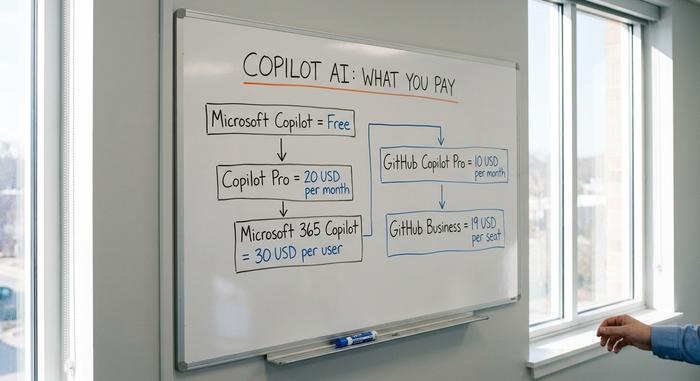
Start with the free one. The standalone Microsoft Copilot lives on the web, in the Windows taskbar, in the mobile copilot app, and inside Edge. It fields general questions, makes images, and drafts quick text. Pay $20 a month for Copilot Pro and you get faster access to the newest models, priority when the servers are busy, and sharper image output. For most people that is the whole decision: free, or twenty bucks.
Microsoft 365 Copilot at work
Now the one businesses actually pay for. Microsoft 365 Copilot rides inside Word, Excel, PowerPoint, Outlook, and Teams, and it can read your own files, emails, and meeting transcripts to answer from your data rather than the open web. Drop a COPILOT() function into a spreadsheet cell and it works there too. Because it handles sensitive material, it inherits your existing permissions instead of routing around them, which is the part security teams care about most.
GitHub Copilot and Copilot Studio
GitHub Copilot is the odd sibling, built for developers. It suggests and writes code right inside the editor, answers questions in chat, and now runs background agents that plan and carry out tasks on their own. Those agents are exactly why GitHub changed its pricing. An agent grinding away for ten minutes eats far more compute than a single autocomplete, and a flat monthly fee could never cover that cleanly. Copilot Studio is yet another thing, a low-code kit for building custom assistants of your own. Add Security Copilot and Copilot in Azure and the list keeps going, but those few cover what people usually mean by Copilot AI.
What Copilot AI costs: Microsoft 365 and GitHub
Money enters Copilot AI in layers. It is free at the front door and priced per seat once you go deeper. That seat model matters, because it is exactly the structure the new billing is starting to bend.
| Product | Who it is for | Price |
|---|---|---|
| Microsoft Copilot (free) | Anyone | $0 |
| Copilot Pro | Individuals, power users | $20 / month |
| Microsoft 365 Copilot | Businesses | $30 / user / month |
| GitHub Copilot Pro | Individual developers | $10 / month |
| GitHub Copilot Pro+ | Heavy developers | $39 / month |
| GitHub Copilot Business | Teams | $19 / seat / month |
| GitHub Copilot Enterprise | Large orgs | $39 / seat / month |
The money behind those plans is not small. Microsoft's AI business hit a roughly $37 billion annual run rate in the third quarter of fiscal 2026, up about 123% in a year, per Microsoft's earnings release. GitHub Copilot crossed 4.7 million paid subscribers on its own, a 75% jump. Microsoft 365 Copilot reached 20 million paid seats across some 140,000 organizations. Call it what it is: one of the fastest-growing products Microsoft has ever sold.
There is a soft on-ramp baked into the per-seat model. Get on an eligible Microsoft 365 plan and a limited Microsoft 365 Copilot Chat comes free. That is the bait, and it pulls teams toward the full $30 seat. Land and expand, the oldest trick in enterprise software, and it shows: paid seats jumped roughly 250% year over year. The catch for a business is the flat rate. Every employee who wants the in-app assistant is another $30 every month, heavy user or not. You pay the same for the developer who lives in it and the manager who opens it twice. That mismatch is the friction the next section is about.

How Copilot's new AI Credits billing works
The quietest change is the most important one. As of June 1, 2026, GitHub Copilot moved to usage-based billing built on AI credits, where one credit equals one cent. Code completions, the everyday autocomplete, stay unlimited on paid plans. But the heavier work, the chat, the agents, the command-line tools, and requests to premium models, now draws down a credit balance.
Each plan ships with an allowance baked in, then you buy more when you run out.
| GitHub Copilot plan | Monthly price | Included AI credits |
|---|---|---|
| Pro | $10 | $15 |
| Pro+ | $39 | $70 |
If that structure sounds familiar to anyone in crypto, it should. You are paying for compute by the unit, the same way a blockchain charges gas for each transaction. A quick chat reply costs little; firing an autonomous agent across a whole repository costs more, and a request to a premium model costs more again. The flat subscription becomes a wrapper around a meter, and the meter is where the real cost lives once you use Copilot AI seriously. It also makes spending lumpy and hard to forecast, which is its own kind of payments problem. You are no longer signing up for one clean monthly charge — you are running a tab, and I suspect most finance teams have not clocked that yet.
Copilot AI vs ChatGPT and other assistants
Is Copilot AI just ChatGPT in a Microsoft coat? Almost. They share an engine. Both run on OpenAI's models, so what separates them is packaging, price, and where the assistant lives, not raw brains.
| Assistant | Maker | Base model | Free tier | Paid from |
|---|---|---|---|---|
| Copilot | Microsoft | OpenAI GPT + Prometheus | Yes | $20 / mo |
| ChatGPT | OpenAI | OpenAI GPT | Yes | $20 / mo |
| Gemini | Google Gemini | Yes | $20 / mo | |
| Cursor | Anysphere | Mixed (GPT, Claude) | Yes | $20 / mo |
Copilot's real edge is distribution. It already sits inside the Office apps and Windows that companies open every morning, and that is worth more than winning a benchmark by two points. The coding side tells the same money story. Cursor, a rival AI coding tool, reportedly reached a $2 billion annual revenue run rate by early 2026 and was in talks at a $50 billion valuation. The AI coding tools market was worth about $7.4 billion in 2025 and is heading toward $9.4 billion in 2026. The spending is real, and it keeps climbing.
Google's Gemini plays the same game from inside Workspace and Android, while Cursor and its peers fight for the developer's editor. The takeaway for a buyer: no assistant holds a durable lead on raw capability; they trade blows every few months. What decides the winner is where the assistant already lives and how painlessly a whole team can pay for it.
Paying for AI assistants with crypto and stablecoins
Now the part no one else writing about Copilot bothers to connect. Look at how these tools charge: small amounts, charged often, to users and teams scattered across the world. That is a payments problem, and stablecoins happen to solve it well.
Why metered AI billing suits stablecoins
A one-cent AI credit is a micropayment. Card networks struggle with micropayments, because the fixed fee on a sub-dollar charge eats the charge alive. Per-seat subscriptions billed across borders pile on currency conversion and failed-payment churn. Stablecoins, dollar-pegged tokens that settle on-chain, route around both. Settlement is cheap, quick, and identical whether the payer is in Texas or Vietnam. This is already shipping: Stripe runs live stablecoin subscription billing on networks like Base, Solana, and Polygon, charging about 1.5% per transaction. With stablecoins moving roughly $28 trillion in adjusted volume in 2025, according to Chainalysis, the rail is no longer a science project.
Picture a 30-person startup paying for GitHub Copilot Business seats and topping up credits every month. On cards, that is dozens of cross-border charges, foreign-exchange spreads, and the occasional decline that locks a developer out mid-sprint. Settled in stablecoins, the same spend becomes one predictable on-chain transfer that clears in seconds at a flat, low fee, no matter where the team sits.
AI coding meets crypto development
There is a second link worth drawing. AI coding assistants are being adopted hard by crypto and Web3 teams, where development is global and often paid outside traditional banking. Coinbase has gone as far as mandating AI coding tools internally. A distributed team paying for dozens of Copilot seats, or settling metered credit bills every month, is the kind of customer for whom stablecoin rails are simply more practical than wire transfers and cards. To be clear, neither Microsoft nor GitHub accepts crypto at checkout today. The point is the direction: once billing is metered and global, the case for a stablecoin rail gets harder to ignore, and a business that wants to accept crypto payments for its own AI tools can already do so.
Is Copilot AI shutting down? Risks and limits
People keep googling "Copilot shutting down," so let us put it to bed: Microsoft Copilot is not shutting down. The mix-up comes from smaller pieces being retired around it. Copilot's WhatsApp integration ended on January 15, 2026, and Cortana was switched off earlier in Copilot's favor. The core product is growing, not closing. The honest cautions are the usual ones for any generative AI assistant. It can hallucinate, stating wrong things with total confidence. Feeding it company data raises governance questions you want settled before rollout. And the metered model adds a fresh one: a misconfigured agent left running can quietly drain a credit balance, the digital version of leaving the tap on. Set spending caps before you hand an agent the keys.
What Copilot AI really comes down to in 2026
Copilot AI is less a single product than a brand spread across Windows, Office, and code, all running on the same borrowed intelligence. The story worth watching is not which version is smartest, but the move from flat seats to metered credits that price AI like a utility — by the unit, as you use it. Metered, global, sub-dollar billing is precisely what stablecoins were built to carry. So the open question is simple: when the meter is already running in cents, how long before someone lets you pay the bill in stablecoins?