Sora AI: OpenAI’s Text-to-Video Model, Explained
For about a month, Sora AI was the most downloaded app in the United States. Then OpenAI turned it off. The app that let anyone type a sentence and get back a minute of synced, cinematic video hit number one, drew a flood of celebrity deepfakes and Studio Ghibli knockoffs, and then quietly shut down in April 2026. People kept asking the obvious question: how does something that popular just disappear?
The short answer is money. The longer answer is more useful, especially if you pay for AI tools or sell them. The value of Sora AI never really sat in the free social feed. It sat in the compute you rent by the second to generate videos. That distinction is the whole story, and it leads somewhere most write-ups skip: how people actually pay for this stuff, and why the payment rail is starting to matter as much as the model.
What Sora AI is and how the video model works
Sora AI is a text-to-video model built by OpenAI. You give it a text prompt, and the video generation model returns a short clip. That is the whole idea behind AI video generation. Under the hood it is a diffusion transformer, the same broad family that powers modern AI image tools, trained instead on video and time.
OpenAI previewed Sora in February 2024 with a handful of demo clips, then released a first version inside ChatGPT in December 2024. Early Sora generated clips up to roughly a minute long and, oddly, picked up a rough sense of 3D space and camera movement without being explicitly taught either. Nobody programmed parallax into it. It learned that moving the camera changes what you see — the way a child learns it — by watching enough examples.
That is also why the output was uneven. The model could render a believable street scene and then have a person walk through a wall, because it never learned physics as rules, only as patterns. Useful to remember when a clip looks flawless: the thing has no idea what gravity is.
How to create AI videos with Sora 2
The version that went viral was Sora 2, released on September 30, 2025, alongside the iOS app. This was the real jump, and it is worth seeing what creating with it actually looked like.
Synced audio, physics, and cinematic shots
Sora 2 added sound. Dialogue, footsteps, and background noise now arrived in sync with the picture instead of as a silent clip you had to score yourself. Realistic motion was the visible upgrade, so objects collided and fell in ways that mostly held up. The model could also string together multiple camera angles in one generation, giving short clips a cinematic feel that the first version lacked. It was the difference between a moving postcard and something that read like a film cut.
Cameos, remix, and editing
The headline social feature was cameo: record yourself once, then drop your likeness into any generated scene. That, more than the raw quality, is what made the app spread. On top of that sat a small editing kit. Remix let you adjust an existing clip with a new prompt. Re-cut regenerated a single segment. Loop turned a clip into a clean repeat, and blend merged two videos. None of it required editing skills, which was the point.
Writing a prompt: text and image-to-video
Getting a good result came down to the text prompt. The model rewards specifics. "A dog" gives you noise. "A wet golden retriever shaking off water in slow motion, backlit by late afternoon sun, shot on a 50mm lens" gives you something usable. Describe the subject, the action, the light, and the camera. You could also upload an image and have Sora animate it, an image to video mode that turned a still into a few seconds of motion, which made it double as a kind of moving image generator. Most of the craft was learning to write prompts the way a director writes shot notes.
By default every clip carried a visible watermark and C2PA metadata marking it as AI-generated. Both mattered later.
Why was the Sora AI app shut down?
OpenAI announced the wind-down on March 24, 2026, and switched the app off on April 26. The technology worked. The business did not.
Running Sora at consumer scale reportedly cost around a million dollars a day in compute. Against that, the app earned roughly $1.4 million in its entire lifetime from in-app purchases, TechCrunch reported. The user base peaked near a million and then slid under half a million within weeks of launch, a classic novelty curve. A separate Disney licensing deal, worth about a billion dollars for the rights to use 200-plus characters, ended when the app did.
| Date | What happened |
|---|---|
| Feb 2024 | Sora previewed publicly |
| Dec 2024 | First version released inside ChatGPT |
| Sep 30, 2025 | Sora 2 and the iOS app launch |
| Mar 24, 2026 | Discontinuation announced |
| Apr 26, 2026 | App shut down |
OpenAI did not abandon the technology, though, and that part tends to get lost. The capability lives on inside ChatGPT and enterprise products, and the Sora model itself stayed reachable through the API for developers. What OpenAI killed was the free-to-browse social app built around Sora AI — the most expensive and least profitable way to deliver it. For anyone selling AI services, the lesson is blunt: value accrues where people pay for output, not where they scroll for free.
What Sora AI costs: subscriptions, credits, API
Money flowed into Sora three ways, and the differences explain a lot about how paid AI works in general.
| Access route | What you get | Price |
|---|---|---|
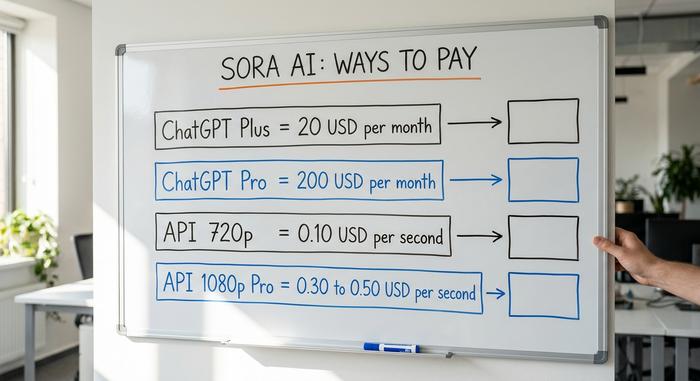
| ChatGPT Plus | Sora in chat, standard generations | $20 / month |
| ChatGPT Pro | Higher limits, longer and HD clips | $200 / month |
| Credit packs (free tier) | Pay per individual video | Varies by pack |
| API, sora-2 (720p) | Billed per second of video | ~$0.10 / sec |
| API, sora-2-pro (1080p) | Billed per second of video | ~$0.30 to $0.50 / sec |
Most casual users never paid directly. Sora came bundled with a ChatGPT subscription, so it rode on the same $20 or $200 a month people already spent on the chatbot. That bundling matters, because OpenAI's real engine is subscriptions: around 50 million paying subscribers, an estimated $25 billion in annual recurring revenue, and roughly 900 million weekly active users. Next to that, the Sora app's $1.4 million was a rounding error.
The interesting tier is the API. There, you did not buy a plan. You paid by the second of video generated, about ten cents a second at 720p and three to five times that for 1080p pro output, per OpenAI's API documentation (as of 2026). A ten-second clip cost a dollar at the low end. This is metered compute — the same way you pay for cloud servers or electricity. You buy usage, not a seat or a plan. For a developer or a creator running Sora at volume, the per-second meter is the actual product, and it never went away.
Think about what that meter implies. A studio rendering a hundred clips a day has a bill that scales with output, like a utility. A hobbyist who makes one video a month pays cents. The same model serves both because the price attaches to compute, not to a seat. That is the shape almost all serious AI billing is converging on, from language models to image generators: you are charged for what you consume, measured in tokens, seconds, or megapixels. Flat monthly plans are the friendly wrapper. Metered usage is the engine underneath, and I'd bet that is where the next decade of AI revenue actually lives.
Sora 2 vs other AI video generators
Sora AI got the headlines, but it was never alone, and the market around it is real money. The AI video generator space was worth about $716 million in 2025 and is tracking toward roughly $847 million in 2026, growing near 19% a year, according to Fortune Business Insights. Runway, one rival, raised a $315 million round in early 2026 at a $5.3 billion valuation. This is a serious industry, not a demo.
| Tool | Maker | Synced audio | Access | Pricing model |
|---|---|---|---|---|
| Sora 2 | OpenAI | Yes | ChatGPT, API | Subscription + per-second |
| Veo 3 | Yes | Gemini, Vertex AI | Subscription + per-second | |
| Runway | Runway | Limited | Web, app | Credits, subscription |
| Kling | Kuaishou | Yes | Web, app | Credits, subscription |
The competitive picture rhymes with Sora's own. Google's Veo bills through Gemini subscriptions and per-second Vertex AI pricing that lands in the same ballpark as Sora's. Kling and Runway lean on credit bundles, where you buy a block of generations up front and burn it down. Strip away the branding and you are mostly comparing two billing styles, prepaid credits or pay-as-you-go metering, wrapped around models that all do roughly the same thing. When you choose Sora over Veo or Kling, you are choosing an ecosystem and a payment model, not a wildly different capability. Quality leapfrogs every few months. The pricing structure does not.

Paying for AI video tools with stablecoins
Here is where the crypto angle stops being a stretch and starts being obvious. Look again at how these AI tools charge: small amounts, charged often, to users all over the world. That is a payments problem, and it happens to be the exact problem stablecoins solve well.
Why stablecoins fit metered AI billing
A ten-cent-per-second API call is a micropayment. Card networks hate micropayments, because fixed fees eat a sub-dollar charge alive. Recurring subscriptions across borders add currency conversion and failed-payment churn on top. Stablecoins, dollar-pegged tokens that settle on-chain, sidestep both. The settlement is cheap, near-instant, and the same whether the user is in Ohio or Lagos. This is not theoretical anymore. Stripe launched stablecoin payments for subscriptions in October 2025, letting businesses bill recurring USDC the way they bill cards. The plumbing is being laid right now.
Creator payouts and global access
The other half is getting money out, not just in. AI video is a creator economy, and creators sit everywhere, including places where card rails are weak or payouts take a week. Paying a creator in stablecoins lands in minutes, in dollars, regardless of local banking. For a platform paying thousands of small creators every month, the savings on processing fees and currency conversion alone can decide whether the whole model is viable. The scale behind this is no longer small: the stablecoin market cap topped $323 billion in 2026, and stablecoins moved on the order of $33 trillion in gross volume in 2025, by Visa's estimate. When metered AI billing and global creator payouts both point at the same rail, that rail starts to look less like a crypto experiment and more like infrastructure. A merchant who wants to accept crypto payments for an AI tool today can do it without touching a card processor.
Sora AI risks: deepfakes, copyright, watermarks
None of this is clean. Sora AI's watermark and C2PA tags were meant to flag AI-generated clips, but watermark-removal tools showed up within a week of launch. The copyright default was opt-out, not opt-in, so Sora reproduced protected characters and styles until rightsholders objected. Studio Ghibli and Square Enix both demanded removals. An AI image or video that looks real and strips its own watermark is a problem the industry has not solved, only labeled.
What the Sora story actually tells you
The Sora app died for a dull reason: it cost more to run than it earned. The technology was never the problem. Underneath the free feed sat a model that makes real money the moment you charge for it by the second. The durable value in AI video is metered compute, and metered compute is a billing question before it is a creative one. So if you are going to pay for AI by the second, or get paid for making it, ask which rail moves dollars that small, that fast, that globally. Right now the honest answer is not a card. How long before the default answer is a stablecoin?