Jupiter (JUP): Solana’s DeFi Aggregator Explained

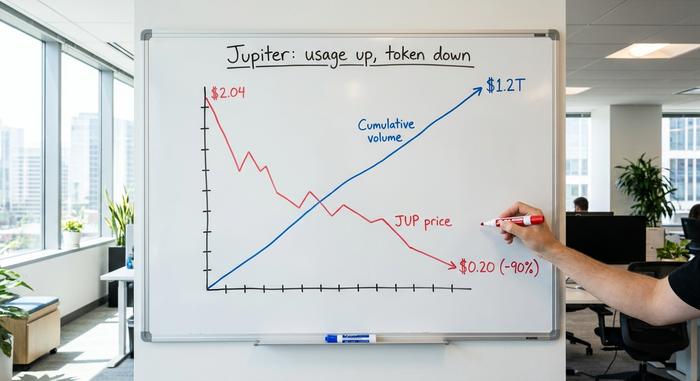
Here is a puzzle. Jupiter has routed more than a trillion dollars in trades and handles over nine out of every ten aggregator swaps on Solana. By almost any measure of usage, it is one of the most successful products in DeFi. And yet its token, JUP, has lost roughly 90 percent of its value since launch.
That gap between a thriving product and a sinking token is the real story of Jupiter (JUP), and most explainers skip right past it. So let's not. This guide covers what the platform actually does on Solana, how the aggregator finds you a better price, what the token is for, why the famous Jupuary airdrops keep shrinking, and why the coin keeps falling even as the platform wins. Crypto is full of projects that are all token and no product. It is the opposite, which makes it worth understanding properly.
How the Jupiter DEX aggregator works on Solana
The Solana blockchain has a liquidity problem hiding in plain sight. Trading is spread across dozens of separate decentralized exchanges, and no single one always has the best price. Jupiter solves that. It is an aggregator — a router that checks every venue at once and stitches together the cheapest path for your swap. You click once; it does the shopping.
Smart routing across Solana DEXs
When you swap on jup.ag, Jupiter scans liquidity across Raydium, Orca, Meteora, and many smaller pools. Its routing engine, called Metis, maps the possible paths between two tokens and picks the combination with the least slippage. Then it splits your order. A trade might run 60 percent through one pool and 40 percent through another, or hop across three tokens to land a better rate than any direct pair offers. The user never sees this. They see a quote and a confirm button. Underneath, the routing engine is doing real work, and it is the reason traders default to Jupiter instead of picking a DEX by hand.
From a swap tool to trillion-dollar volume
It launched quietly in 2021, built by a small team led by a pseudonymous founder who goes by Meow. No token, no hype, just a tool that worked. Volume followed. By mid-2026, cumulative trading volume through the aggregator had crossed $1.236 trillion, according to DeFiLlama, and Jupiter controlled about 93.6 percent of Solana's aggregator market as of late 2025. That is not a lead. That is a near-monopoly on how Solana trades. On its busiest days it has even out-traded Ethereum's Uniswap; during the WEN memecoin frenzy in early 2024, Jupiter's daily volume briefly topped the largest DEX in all of crypto. It did this for years without raising traditional venture money, growing on fees and word of mouth instead. Developers tap Jupiter's swap APIs to route trades inside their own apps, and an active Jupiter community helps steer the protocol, which is part of why its liquidity turns up far beyond jup.ag.
Limit orders, DCA, and the pro terminal
Routing was just the start. The platform added limit orders, so you can set a price and walk away. It added dollar cost averaging, letting you buy a fixed amount on a schedule instead of timing the market. For active traders there is a pro terminal with charts and analytics. These are the kinds of tools that used to require a centralized exchange account; it put them onchain, next to a non-custodial wallet, with no sign-up and no custody handover. Each feature kept users on the platform a little longer, and each one fed more volume back into the routing engine. The flywheel is simple, and it spun fast.

Inside the Jupiter ecosystem: perps and beyond
At some point the aggregator stopped being a swap tool. It became a Solana super-app, and it got there largely by buying the pieces it wanted rather than building them all from scratch.
Jupiter Perps, derivatives, and leverage
The biggest expansion was perpetual futures. Jupiter Perps lets traders take leveraged long or short positions on majors like SOL, ETH, and BTC, with leverage running as high as around 100x, and it quickly became one of the protocol's largest sources of fees. The trades draw on a shared liquidity pool, the JLP pool, whose depositors collect a slice of the fees in return for taking the other side of those bets. Derivatives are where the real money is in crypto trading, and the protocol wanted that revenue, not just the thin margins of spot swaps. For users it meant they could hedge or speculate without leaving the app they already used for everything else.
The acquisition spree and JupNet
Between 2024 and 2025, Jupiter went shopping. It acquired Moonshot, the mobile app that made memecoin buying simple, plus the analytics site SolanaFM, the data platform Coinhall, and the NFT distribution service DRiP, among others. At its Catstanbul event it announced JupNet, a cross-chain network ambition, and a $10 million fund aimed at onchain AI. Six acquisitions in two years turned a single product into a sprawling platform spanning trading, data, and distribution. Alongside the deals, it built its own launchpad for new Solana tokens and rolled out JupSOL, a liquid staking token that earns validator rewards while staying tradable.
JupUSD and the push into stablecoins
In early 2026 Jupiter went further into finance. It launched JupUSD, a stablecoin backed roughly 90 percent by BlackRock's BUIDL fund and paying a 4 to 4.5 percent yield to holders. Around the same time it brought Polymarket's prediction markets to Solana and closed a $35 million strategic investment led by ParaFi Capital. You do not raise institutional money or issue a yield-bearing stablecoin to run a humble swap router. Jupiter did both, because it has quietly turned into a financial platform. JupUSD also gave it something most DeFi apps lack: a native dollar that keeps user funds circulating inside its own ecosystem instead of leaking out to rival stablecoins.
JUP token: tokenomics, supply, and burns
Now the part where a lot of write-ups go stale. JUP did not launch with a small fixed supply. It launched with a maximum of 10 billion tokens, split 40 percent to community airdrops, 40 percent to the team and development, and 20 percent to liquidity and grants. That is a big number, and early holders felt every bit of the dilution that came with it.
Then the DAO changed course. In January 2025, at Catstanbul, Jupiter burned 3 billion JUP, worth around $3.6 billion at the time, permanently removing them from supply. Total supply has since settled near 6.862 billion. The team also pushed a "Net Zero Emissions" plan to stop the token count from creeping up. The message flipped from growth to scarcity, which tells you how worried the project had become about its own inflation.
Holding JUP is not entirely passive, either. Stakers earn Active Staking Rewards, a share of protocol fees and set-aside tokens paid out for locking them and taking part in votes. It is the closest thing the token has to a yield, and the DAO has leaned on it to give the token a purpose beyond pure speculation.
| JUP tokenomics | Detail |
|---|---|
| Original max supply | 10 billion JUP |
| Total supply (after burns) | ~6.862 billion JUP |
| Circulating supply | ~3.4 billion JUP |
| Tokens burned (Jan 2025) | 3 billion (~$3.6B) |
| Distribution | 40% airdrops / 40% team & dev / 20% liquidity & grants |
| Token type | Governance token |
Jupuary: the JUP airdrops that minted millions
If you have heard of Jupiter, you have probably heard of Jupuary. Every January, it handed JUP to users, and the numbers were enormous. The first drop, on January 31, 2024, sent 1 billion JUP to more than a million wallets that had used the platform before November 2023. A year later, the second Jupuary distributed 700 million JUP, worth about $616 million, to roughly 2 million wallets. Eligibility came down to real usage, how much you had actually swapped, not how many empty wallets you could spin up.
Then the program hit a wall. Constant new tokens meant constant selling, and the price kept sliding. So for the final Jupuary, on January 30, 2026, Jupiter cut the airdrop to 200 million JUP, a 71 percent reduction. The decision was unpopular with farmers expecting another windfall, but it followed the same logic as the burn: stop flooding the market and the token might stabilize. Generosity, it turned out, was part of the problem.
Jupiter price, market cap, and why JUP crashed
So why is Jupiter crashing, when the product is this strong? The numbers tell a brutal story. JUP traded near $0.202 in June 2026, with a market cap around $680 million and a rank near #69, according to CoinGecko. The token's history is short but punishing. Its all-time high was $2.04, set the day it launched in January 2024. From there to its February 2026 low of $0.136, the token fell almost 90 percent. If you want to follow the Jupiter price today, live price charts on most exchanges and trackers show its real-time moves, market sentiment, and the metrics behind each swing.
The cause is not weak fundamentals — Jupiter has earned over $1.066 billion in cumulative protocol fees, real money from real usage. In 2026 the project began spending part of that revenue buying JUP back from the open market, routing tens of millions of dollars into a community reserve nicknamed the Litterbox Trust. The problem is supply. Years of airdrops and team unlocks dumped fresh JUP onto the market faster than demand could absorb it, and a governance token with limited cash-flow rights gave buyers little reason to hold through the flood. The burn and the airdrop cut are attempts to fix exactly this. Whether they work depends on whether usage revenue eventually outweighs what is left to unlock.
| JUP market snapshot | Value (June 20, 2026) |
|---|---|
| Price (USD) | ~$0.202 |
| Market cap | ~$680 million |
| Market cap rank | ~#69 |
| All-time high | $2.04 (Jan 31, 2024) |
| All-time low | $0.136 (Feb 12, 2026) |
| Down from ATH | ~90% |
How to buy and use Jupiter (JUP)
Getting JUP is easy, and you have two routes. The exchange route: buy it on a centralized platform like Kraken, Coinbase, or Binance, where you can deposit dollars and withdraw the token to your own wallet. Simple, familiar, and fine if you just want exposure.
The native route is more fitting. Open jup.ag, connect a Solana wallet such as Phantom or Solflare, and swap any token you hold for JUP directly through the same aggregator the whole article is about. You get the best routed price, and you can set a limit order or a DCA schedule while you are there. You can also place stop-loss and take-profit orders, run technical analysis from the pro terminal, and manage your portfolio, or simply dollar-cost average into the dip, all without handing over custody. Once you hold it, you can stake to earn active staking rewards and signal support inside the community. Just remember the token is highly volatile; that volatility can erase a chunk of your position in days, so size it accordingly.
Is JUP a good investment? Risks to weigh
Here is the honest version. Jupiter the product is dominant and profitable. JUP the token is a separate question, and the two have drifted apart. The risks are real: more tokens are still scheduled to unlock, formal DAO governance votes were suspended in 2025 while staking rewards kept running, and a large share of its volume depends on Solana's memecoin churn, which can vanish in a downturn. The platform also inherits Solana's own weaknesses, including the network congestion and outages the chain has suffered before, and team and investor tokens still vest on a schedule, so the unlock pressure that crushed the price has not fully cleared. A bet on the coin is a bet that supply discipline plus fee revenue eventually reconnect the price to the business. That may happen. It has not yet.
What JUP's future on Solana depends on
Jupiter has already won the part that is hardest to win: it is the default way people trade on Solana, and that position is sticky. The open question is whether the token ever captures that success. The burns, the airdrop cut, the stablecoin, the institutional raise all point in one direction, toward a project trying to turn relentless usage into a reason to hold JUP rather than just farm it. If they pull it off, the gap between product and price closes. If they don't, Jupiter stays a great business with a disappointing coin. So before you buy, ask yourself which of those two stories you actually believe.