Best DeFi exchanges in 2026: a deep dive into the top decentralized exchanges and how they actually compare

The first time I tried to swap tokens on a decentralized exchange, I accidentally set my slippage to 0.1% on a low-liquidity pair and the transaction reverted three times before I figured out what was happening. That was 2021. I lost $47 in failed gas fees learning a lesson that no centralized exchange would have taught me: on a DEX, you are your own trading desk, and nobody is going to save you from yourself.
Five years later, the DEX landscape looks nothing like it did back then. Total daily volume across decentralized exchanges now runs about $6 billion, spread across over 1,140 platforms tracked by CoinGecko. Uniswap V4 has introduced hooks that let developers customize pool behavior. Aerodrome came out of nowhere to dominate Base. Jupiter turned Solana's fragmented liquidity into a single clean interface. And dYdX moved to its own chain to compete with centralized derivatives exchanges on speed.
This is a deep dive into the decentralized exchanges that actually matter in 2026, how their underlying mechanics differ, what the real fees and risks look like, and which one makes sense depending on what you are trying to do.
How decentralized exchanges work (and why the model matters)
I am going to simplify this because most guides make it sound more complicated than it is. There are four types of DEX, and knowing which type you are using changes what you should expect.
AMMs (Uniswap, PancakeSwap, Raydium) are pools of money. People deposit tokens. You trade against the pool. A math formula sets the price. Simple. The downside: if you are swapping a lot, you move the price against yourself. That is slippage, and it is the tax you pay for not having a traditional order book.
Concentrated liquidity (Uniswap V3/V4, Aerodrome) is the same idea but sharper. Instead of your money sitting across all possible prices, you pick a range. More efficient. More returns. But if the price moves outside your range, you earn nothing. I have set positions on Uniswap V3 that made great fees for a week and then went to zero returns when ETH moved 15% in a day. Active management required.
Aggregators (Jupiter, 1inch, CoW Swap) are the cheat code. They do not hold money. They scan every DEX, find the best price, sometimes split your trade across three or four pools, and execute it all in one transaction. If you are doing anything over a few hundred dollars, use an aggregator. You will get a better price than going to any single DEX directly.
Order book DEXs (dYdX) work like Binance but without the company in the middle. Real limit orders. Real matching engine. This is where the derivatives traders go because AMMs cannot handle leverage efficiently.
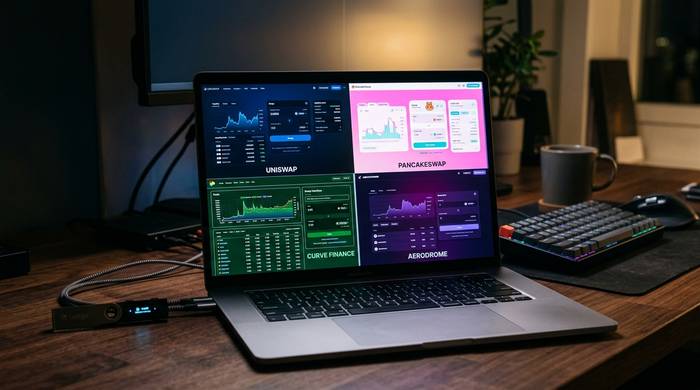
The top decentralized exchanges compared
Here is what the current landscape looks like across the platforms that matter:
| DEX | Type | Chains | TVL | 24h volume | Fees | Best for |
|---|---|---|---|---|---|---|
| Uniswap V4 | AMM (hooks) | 20+ EVM chains | $5.59B | ~$660M | 0.05-1% | ERC-20 swaps, any EVM chain |
| PancakeSwap V3 | AMM | BSC, ETH, others | ~$2B | ~$674M | 0.25% | BSC ecosystem |
| Aerodrome | AMM (concentrated) | Base | ~$1.5B | ~$500M | 0.02-0.2% | Base L2 trading |
| Curve Finance | StableSwap AMM | ETH, multi-chain | $2.17B | ~$260M | 0.04% stable | Stablecoin swaps |
| Jupiter | Aggregator | Solana | N/A (routes) | ~$400M+ | 0% (routing) | Solana trading |
| dYdX | Order book | dYdX Chain | ~$300M | ~$200M | 0.02-0.05% | Perpetual futures |
| 1inch | Aggregator | Multi-chain | N/A (routes) | ~$150M | 0% (routing) | Best-price routing |
| Raydium | AMM + CLOB | Solana | ~$500M | ~$200M | 0.25% | Solana AMM |
| THORSwap | Cross-chain | Multi-chain native | ~$400M | ~$50M | 0.1-0.5% | Native cross-chain |
Uniswap: still the king, but why V4 matters
I have been using Uniswap since 2020 and watching it evolve from a simple swap interface into a $5.59 billion TVL platform that processes more volume than any other DEX. V4, which shipped in 2025, is the update that made me rethink what a DEX can be.
Hooks are modular code snippets that developers can attach to liquidity pools. They run before or after swaps, deposits, or withdrawals. What does that mean in practice? A pool can now implement dynamic fees that change based on volatility. It can add time-weighted average pricing. It can create on-chain limit orders. It can build custom oracle integrations. Hooks turn Uniswap from a single DEX into a platform for building custom DEXs.
For regular users, V4 is mostly invisible. You swap tokens the same way you always did. But the liquidity is deeper and the fees can adapt to market conditions, which means better execution on your trades. The 0.3% flat fee that defined early Uniswap is gone. V4 pools can charge anywhere from 0.05% to 1%, set by the pool creator.
Uniswap also launched Unichain, its own L2 built on the OP Stack. The goal: faster transactions and lower fees for Uniswap-native activity. Whether the market needs another L2 is debatable, but the move signals that Uniswap sees itself as infrastructure, not just an app.
Aerodrome: the Base chain dark horse
Aerodrome was not on my radar six months ago. Now it is consistently in the top five DEXs globally by daily volume, processing around $500 million per day. It launched on Coinbase's Base L2 and grew faster than anything I have seen in DeFi since the 2021 summer.
Aerodrome combines three ideas that have worked elsewhere: Uniswap's concentrated liquidity for volatile pairs, Curve's StableSwap AMM for stablecoin pairs, and a vote-locking mechanism for its AERO governance token. The fee structure is aggressive: 0.02% for stablecoin swaps and 0.2% for volatile pairs. That undercuts Uniswap's typical fees by a wide margin.
Why does this matter? Because Base is growing fast as a cheap L2 for Ethereum users, and Aerodrome captured the liquidity before anyone else. If you are trading on Base, Aerodrome is the default, the way Uniswap is the default on Ethereum mainnet.
Jupiter and the Solana DEX ecosystem
Solana's DEX landscape is dominated by Jupiter, which works as an aggregator routing trades across Raydium, Orca, Lifinity, and other Solana AMMs. Jupiter does not hold liquidity itself. It finds the best price across all available sources and executes the trade in a single transaction.
What makes Jupiter interesting beyond aggregation: it added limit orders, dollar-cost averaging, and perpetual futures trading. The JUP token launched with a massive airdrop that made it one of the most widely distributed tokens on Solana. As of 2026, Jupiter handles the majority of Solana's DEX volume.
Raydium is the largest AMM on Solana by TVL, combining traditional AMM pools with a central limit order book (CLOB) for tighter spreads. Orca focuses on concentrated liquidity with a simpler interface. Together with Jupiter routing on top, Solana's DEX ecosystem is arguably more user-friendly than Ethereum's, largely because transaction fees are fractions of a cent.
Curve Finance: the stablecoin specialist
I swap stablecoins on Curve because the math is built for it. Try swapping $100,000 of USDC to USDT on Uniswap and watch the slippage eat your lunch. Do the same swap on Curve and you lose almost nothing. That is what the StableSwap algorithm does: it flattens the price curve for assets that are supposed to be worth the same thing.
Curve's TVL sits at $2.17 billion, and its 0.04% fee on stableswaps makes it the cheapest venue for large stablecoin trades. The CRV token powers a vote-locking mechanism (veCRV) that has become the template for DeFi governance. Protocols compete to accumulate CRV to direct liquidity incentives toward their own pools, creating what the community calls the "Curve Wars."
The platform took a hit in 2023 when an exploit drained several pools. Curve recovered, but the incident reminded everyone that even audited, battle-tested protocols carry smart contract risk.

dYdX: decentralized derivatives
If you want to trade perpetual futures without a centralized exchange, dYdX is the primary option. The platform moved from Ethereum to its own blockchain (dYdX Chain, built on Cosmos SDK) specifically to achieve the speed needed for an order book matching engine.
dYdX offers up to 20x leverage on major crypto pairs with fees of 0.02-0.05%, which is competitive with centralized exchanges like Binance. The order book model means no AMM slippage. You place a limit order, and it fills when someone takes the other side. For derivatives traders who want decentralization without the AMM trade-offs, dYdX is the answer.
DEX vs CEX: where the market stands in 2026
I get asked this a lot: why would anyone use a DEX when Binance exists? The answer depends on what you value.
Centralized exchanges are faster, cheaper on fees, and easier to use. Binance charges 0.1% per trade with no gas fee. A swap on Ethereum L1 through Uniswap costs 0.3% plus $5-50 in gas depending on the day. On pure cost, CEXs win.
But here is what centralized exchanges take from you: custody. When you deposit funds on Binance or Coinbase, those are their tokens until you withdraw. FTX proved that $8.7 billion in customer deposits can disappear when the people running the exchange turn out to be criminals. Celsius proved that lending platforms can freeze your money and file for bankruptcy. With a DEX, your tokens stay in your wallet until the exact moment the swap executes. Nobody can freeze your account because nobody has access to it.
The market share split is shifting. In 2021, DEXs handled about 4-5% of total crypto trading volume. By 2026, that number is closer to 15-20%, driven by growth on Solana (near-zero fees), Ethereum L2s (fast and cheap), and Base (Aerodrome's rise). The gap is closing, especially for spot trading. Derivatives remain dominated by CEXs, though dYdX and GMX are chipping away at that too.
For me, the practical rule is simple: small trades on L2s or Solana where gas is negligible, use a DEX. Large trades where slippage matters, use an aggregator. Anything involving futures or leverage at serious scale, a CEX is still the more practical choice. And never leave more on a CEX than you are actively trading.
The risks nobody should ignore
DEXs give you freedom. They also give you the freedom to lose everything if you are not careful.
Impermanent loss is the hidden cost of providing liquidity. If you deposit ETH/USDC into a pool and ETH doubles in price, you would have been better off just holding ETH. The pool rebalances your position, selling ETH as it rises. The "impermanent" label is misleading. If you withdraw while prices have diverged, the loss is very permanent.
Smart contract risk is real even on audited protocols. Curve was exploited. Euler Finance lost $197 million. BadgerDAO lost $120 million. Audits reduce risk; they do not eliminate it.
MEV and sandwich attacks extract value from your trades. A bot sees your pending swap, places a buy order before yours (front-running) and a sell order after (back-running), profiting from the price movement your trade creates. Aggregators like CoW Swap and MEV-protected RPCs help, but the problem has not been solved.
Rug pulls on low-liquidity tokens remain common. Anyone can create a token and add a pool. Just because a token is trading on Uniswap does not mean it is legitimate. I have personally seen tokens on Uniswap where the contract had a hidden function that prevented anyone except the creator from selling. The token price goes up as people buy. Nobody can sell. Creator pulls the liquidity. Everyone else holds worthless tokens. Always check the contract on Etherscan before trading anything new.
Token approvals are a subtler risk. When you trade on a DEX for the first time, you approve the smart contract to spend your tokens. That approval often defaults to unlimited. If the contract is later exploited, the attacker can drain every token you approved. Revoke unused approvals through Etherscan's token approval checker or Revoke.cash. This takes five minutes and is one of the simplest things you can do to protect yourself in DeFi.