Crypto 30x Explained: Crypto30x.com, 30x Leverage and Blockchain Risks

Search "crypto30x" and you get two very different things in the same results page. One is a trading platform called crypto30x.com that markets up to 30x leverage and an AI signal tool. The other is a phrase traders throw around when they talk about turning a small position into thirty times its size, either through a single fast-moving altcoin or through a leveraged bet on bitcoin.
Both meanings carry the same temptation. Both have specific math and specific risks that almost no promotional page bothers to spell out. This guide does. It looks at what crypto30x.com actually offers, how 30x leverage works on a real cryptocurrency exchange, what regulators have decided about products like this, and what the recent liquidation data says about how it ends for most retail traders.
What Crypto30x Means: The Brand and the 30x Strategy
You will see the term used in two ways, and they are not the same thing. As a brand, "crypto30x" usually points to crypto30x.com. That is a Malta-licensed cryptocurrency exchange. It launched in 2022, supports more than 120 digital assets, and offers leverage up to 30x. As a strategy, "crypto 30x" is just shorthand. People use it for any approach aimed at a thirty-fold return, whether that comes from catching a small-cap altcoin early, running a perpetual futures position, or piggybacking on someone else's trades through copy trading.
The two ideas play off each other, of course. The platform's name implies the strategy works on its rails. The strategy's appeal funnels traffic to the platform. Reality is messier than either pitch. Hitting 30x on a single token is rare. Usually it means being early on something thinly traded that nobody else has noticed yet. Hitting 30x through leverage means putting your full margin in front of a single price move that, on bitcoin, can play out in a few minutes. Conflating the two is how people get burned.
Crypto30x.com Platform: Key Features and Digital Assets Support
So what is crypto30x.com, in concrete terms? A cryptocurrency trading platform built around leverage, AI signals, and a native token. Public material and third-party reviews put monthly trading volume around $2 billion. The asset list runs past 120 cryptocurrencies. Bitcoin and ethereum sit at the top, plus a long tail of altcoins. You can take spot positions or trade leveraged perpetual contracts on the same account.
The headline feature is an AI signal tool the company calls Zeus. Zeus pulls in technical indicators, on-chain data, and market sentiment, then spits out trade ideas. Whether those ideas beat a coin flip is another question, and one the platform does not answer with audited backtests. Copy trading is also there. You can mirror top performers, though their drawdowns mirror right back to you. The platform's native utility token, GIGA, runs on Solana. GIGA is meant to give holders fee discounts, staking rewards, and governance rights.
Other trading features include real-time charts, customizable alerts, mobile apps, a demo account, and educational resources aimed at beginners learning blockchain technology and cryptocurrency trading from scratch. The trading interface is browser-based, so there is nothing to install. New accounts usually start at 5x to 10x leverage. Higher tiers open only after extra verification and meaningful trading volume.
That is a lot of surface area for a company that has been around less than four years. Most of these features are standard on any modern cryptocurrency exchange in 2026. What separates a real exchange from a slick interface is what sits underneath. Who runs the place. How customer funds are held. Which regulator picks up the phone if your withdrawal goes silent for a week.
How High-Leverage 30x Trading Works on a Crypto Exchange
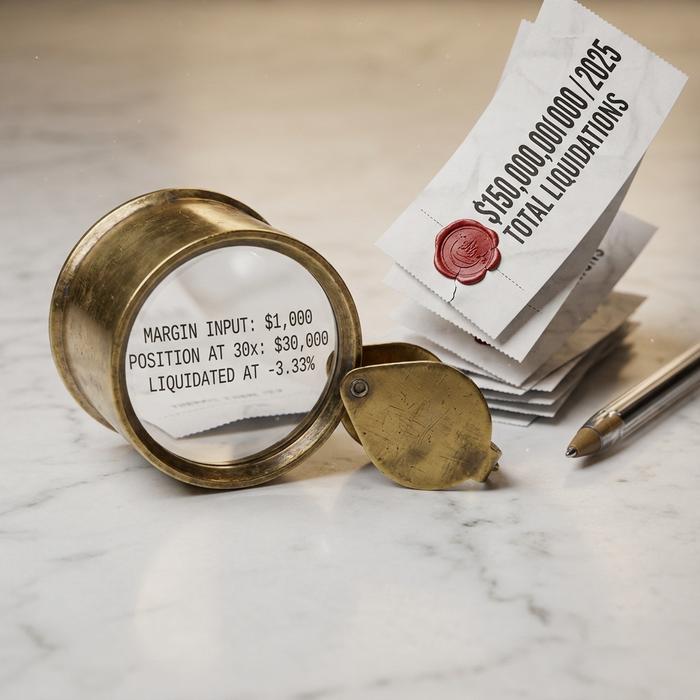
Leverage on a crypto exchange is borrowed exposure. If you put up $1,000 of margin at 30x, you control a $30,000 position in bitcoin or another asset. Every 1% move in the market price is a 30% move on your equity. A 3.33% adverse move wipes out your margin entirely, which is what traders mean when they say "you get liquidated."
Most leveraged crypto trading happens on perpetual futures, contracts that mimic spot prices but never expire. They use a funding rate paid between longs and shorts every eight hours to keep the contract close to spot. BitMEX's Q3 2025 report found that bitcoin perp funding pinned at the +0.01% per eight-hour minimum about 78% of the time, which works out to roughly 10.95% on an annualized basis. That is the cost of carrying a long position even when nothing else is happening.
Total derivatives turnover hit $85.7 trillion in 2025, with an average of $264 billion changing hands every day, according to CoinGlass. Perps now drive most price discovery in crypto markets. They are also where leverage damages people fastest. A 30x position on bitcoin moves three times more violently per dollar of equity than a 10x one. The math does not care how confident you are.
Security Measures and Digital Asset Service Provider License
Crypto30x.com lists the standard set of security measures: multi-factor authentication, AES-grade encryption for user data, cold storage for the majority of customer funds, real-time fraud monitoring, and AI-based detection of unusual account activity. KYC verification is required, and the platform applies AML checks on deposits and withdrawals.
Its primary regulatory document is a Malta Digital Asset Service Provider license. Under Malta's framework, this gives oversight inside the European Union for the activities the license actually covers, which is mainly the cryptocurrency support and exchange function. It is a real license, but its scope is narrow. It does not cover users in the United States, the United Kingdom, or jurisdictions where local regulators have their own rules for retail crypto derivatives.
There is also a structural issue that no encryption can fix. Multiple independent reviews note that crypto30x.com publishes no verifiable information about its founders, leadership team, or corporate ownership. For a platform handling leveraged positions and custody of user funds, anonymous management is the single biggest red flag a careful trader can encounter. It does not mean the operators are dishonest, but it does mean there is nobody to hold accountable if a withdrawal is delayed or an account is frozen.
Regulatory Oversight and Blockchain Compliance for Crypto30x.com
The rules around 30x leverage on crypto have tightened fast. The UK shut the door first. On 6 January 2021, the Financial Conduct Authority banned crypto derivatives for retail consumers outright, and that ban is still in force. The EU's market regulator, ESMA, went further in 2025: its guidance treats crypto perpetuals as contracts for difference under MiFID II. If that sticks, retail leverage caps in Europe drop as low as 2:1.
Enforcement keeps piling up. Binance paid $4.3 billion to settle with the US Department of Justice, the CFTC, and Treasury in November 2023. That is the largest crypto enforcement action ever recorded. The Dutch central bank then fined Bybit €2.25 million in October 2024 for serving Dutch users without registration. Bybit walked away from France in August 2024, and shut its French operation entirely on 8 January 2025.
| Jurisdiction | Status of high-leverage retail crypto trading |
|---|---|
| United Kingdom | Retail crypto derivatives banned since Jan 2021 (FCA) |
| European Union | ESMA 2025: perps treated as CFDs; potential 2:1 retail cap |
| United States | No federal retail framework; CFTC has fined major exchanges |
| Malta | Digital Asset Service Provider regime (covers crypto30x.com) |
| Offshore | Largely unregulated; up to 500x leverage offered |
Crypto30x.com's Malta DASP license means EU users have a real point of contact for complaints inside Malta. Users elsewhere are operating outside the regulatory perimeter, which translates into limited legal recourse if something goes wrong.
Risk Management Tools for Experienced Traders
The platform offers the standard toolkit for experienced traders managing high-leverage positions. Stop-loss and take-profit orders can be attached to a trade at the moment of entry. Position-sizing calculators help size margin against account balance. The demo account lets new users test order types without real money. Customizable price alerts can flag intraday volatility before it reaches a stop.
These tools are necessary, not sufficient. Stop-loss orders only execute at the next available price, which during the kind of cascade that hit the market on 10 October 2025 can be far below the trigger. The Bank for International Settlements found that between 2015 and 2022, 73 to 81 percent of retail crypto investors lost money on their initial investment, based on a 95-country panel. That number predates the perp boom. Layering 30x leverage on top of an asset class where most participants already lose money does not improve the odds.
A workable approach for anyone determined to use high leverage is simple and unforgiving. Risk no more than 1 to 2 percent of account equity per trade. Place stops before entering, not after. Never adjust a stop wider while in a position. Size based on the stop distance, not the leverage offered.
The Real Math of 30x: Liquidation Risk and High-Return Reality
The case for 30x leverage rests on a single number: 30x. A 1% move in your favor on bitcoin produces a 30% gain on your margin. The case against rests on a different single number: 3.33%. That is the adverse move that wipes you out. On 10 October 2025, bitcoin fell from roughly $122,000 to $104,000 in a single session, a drop of about 15 to 17 percent triggered by a White House announcement of 100 percent tariffs on Chinese imports. Around $560 billion in total crypto market capitalization evaporated.
The forced selling that followed was the largest single-day deleveraging in crypto history. CoinGlass and CoinShares put the 24-hour liquidation total at $19.13 billion, and roughly 1.6 million traders had positions closed against them. Amberdata's tick-level analysis showed that about $16.7 billion of those liquidations came from longs and only $2.6 billion from shorts, a roughly 6.7-to-1 ratio that traders use as a textbook signature of an over-leveraged, one-sided retail crowd.
| Leverage | Adverse move that liquidates | What this looks like on BTC at $100,000 |
|---|---|---|
| 5x | 20.0% | A $20,000 drop |
| 10x | 10.0% | A $10,000 drop |
| 20x | 5.0% | A $5,000 drop |
| 30x | 3.33% | A $3,333 drop |
| 50x | 2.0% | A $2,000 drop |
| 100x | 1.0% | A $1,000 drop |
Liquidations are not rare events. Across all of 2025, total crypto liquidations exceeded $150 billion, an average of roughly $400 to $500 million flushed every single day, according to CoinGlass data cited by Bitcoinist. The 30x trader is not betting against ordinary volatility. They are betting that ordinary volatility will not happen during the window their position is open.
The aspirational path, where 30x on a single trade compounds into life-changing money, exists. It is rare. The realistic path involves a series of small drawdowns, occasional liquidations, and funding costs that bleed equity even on positions that are technically correct. Going in with realistic expectations is the difference between a tool and a trap.
Crypto30x.com vs Other Cryptocurrencies Exchanges and Tokens
Crypto30x.com is not playing in the same league as the venues most traders compare it to. Binance handled 29.3 percent of all derivatives volume in 2025. That worked out to $25.09 trillion across the year, or roughly $77.45 billion changing hands every single day. The top four centralized exchanges, Binance, OKX, Bybit, and Bitget, take about 62 percent of global derivatives flow between them. On the decentralized side, perp DEXs like Hyperliquid, dYdX, and GMX have already crossed $1.3 trillion in monthly volume. Hyperliquid alone runs 70 to 80 percent of that.
Thirty times leverage, by the way, is not even high anymore. It sits in the middle of the table. MEXC advertises up to 500x on bitcoin and ethereum USDT-margined perps. Bitget offers 125x. BitMEX offers 100x. Binance has held its 20x retail cap since July 2021. Hyperliquid trimmed its own limits in March 2025, after a $4 million oracle-linked loss, cutting BTC from 50x to 40x and ETH from 50x to 25x.
| Exchange | Max leverage | KYC | Regulation | 2025 status |
|---|---|---|---|---|
| Binance | 20x retail | Yes | Multiple licenses; $4.3B US settlement (2023) | $25T derivatives volume |
| Bybit | 100x | Yes | Bybit France exit Jan 2025; €2.25M Dutch fine | Top 4 by volume |
| MEXC | Up to 500x | Optional (no-KYC ≤ 10 BTC/day) | Offshore | Aggressive leverage offering |
| Hyperliquid | 40x BTC, 25x ETH | None (DEX) | Decentralized | $2.8B–$4.5B TVL late 2025 |
| Crypto30x.com | 30x | Yes | Malta DASP | ~$2B monthly volume |
GIGA, the platform's native token, has its own story. It trades on Solana and has a market cap near $43.5 million as of early 2026, down 95 to 97 percent from its all-time high. Conservative 2026 forecasts compiled by third-party reviewers see GIGA between $0.001 and $0.002. Optimistic projections require a sustained altcoin rally that nobody is currently calling.

Educational Resources, User Experience and Investment Opportunities
Crypto30x.com leans hard on its educational resources to pull in beginners. There are tutorials. There are webinars. There are community forums. The platform also runs a mentorship program that pairs new users with more experienced traders. Customer support sits behind live chat and email, with a stated response window of a few hours to 24 hours.
User experience is the part that gets the most positive reviews, and not by accident. The interface is user-friendly without being dumbed down. Charts load fast. The dashboard is clean. New users see their balances, open positions, and live cryptocurrency market data on a single screen. There is a demo account for testing the trade interface without real funds. None of that is exotic in 2026, but the execution is competent.
The investment opportunities go beyond plain leveraged trading. You can stake GIGA. Copy other traders. Take spot positions in a portfolio of more than 120 cryptocurrencies. Run real-time market analysis tools to spot setups. The pitch is convenience. The trap is that convenience at 30x is also concentration. Bundling spot trades, leverage, and a thinly traded native token onto the same screen makes it too easy to slide from a careful spot allocation into a 30x perp on the same afternoon.
An Honest Approach to Cryptocurrency Trading at 30x
A defensible approach to cryptocurrency trading at 30x starts with a question most marketing pages avoid: would a professional desk run this trade at this size? Institutional traders use leverage, but they almost never use the maximum on offer. They size positions against value-at-risk targets, not the leverage their platform allows. Retail traders flipping the same lever as a hedge fund are operating without the risk controls that make the math work.
The honest version of the strategy looks unglamorous. Allocate a small portion of total crypto exposure to leveraged trading, perhaps 5 to 10 percent. Trade the highest-liquidity pairs, mainly bitcoin and ethereum. Keep leverage well below the maximum, often in the 3x to 5x range, where a normal day's volatility does not threaten the position. Use stops, accept that some will be hit, and stop trading on days when emotion is in charge.
Crypto30x.com can be used inside this framework. So can Binance, Bybit, or a regulated derivatives venue if your jurisdiction allows it. The platform is the smaller decision. The bigger one is whether 30x belongs anywhere near your account in the first place.