Crypto Tax in India: Complete 2026 Guide
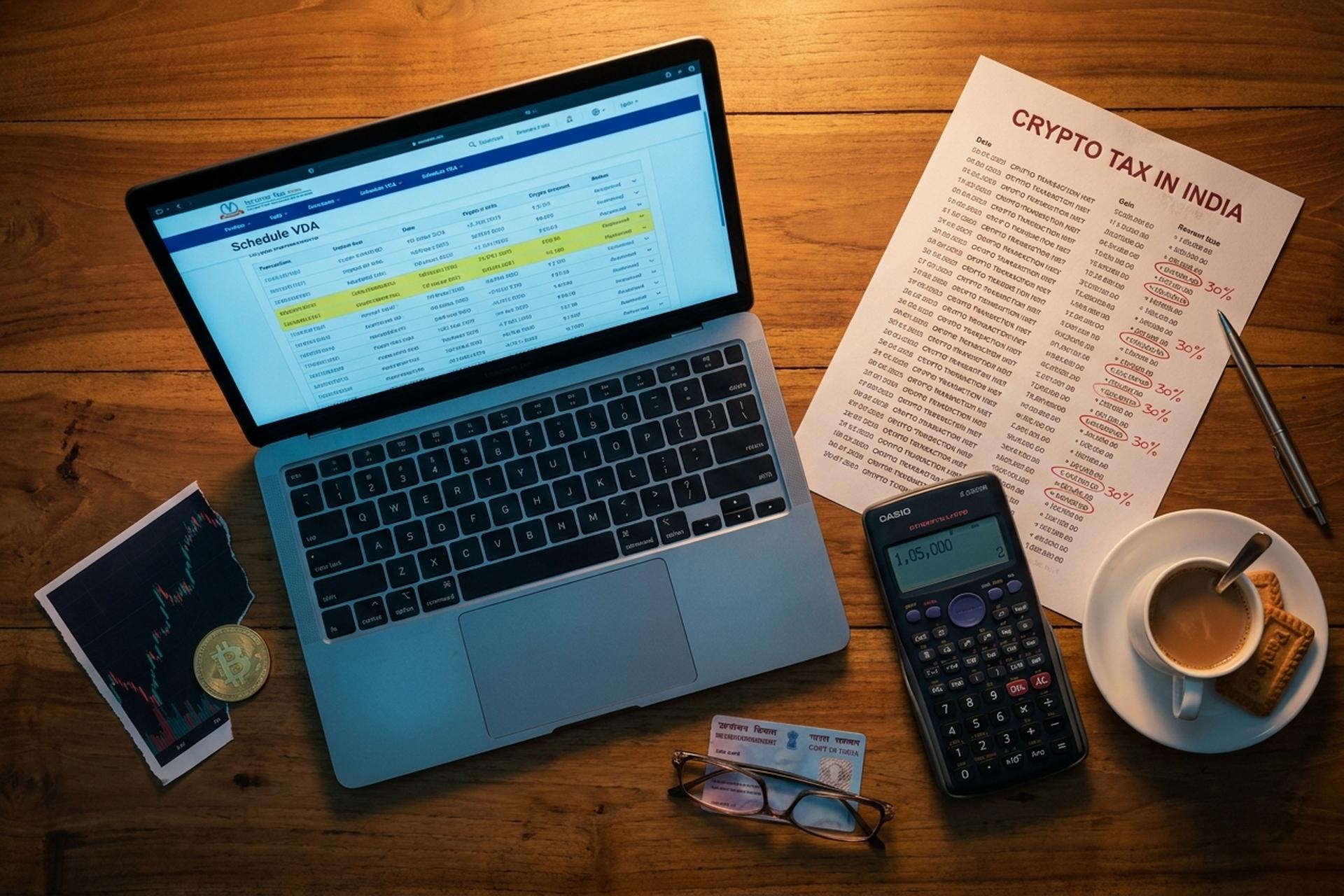
India taxes crypto harder than almost anywhere else. Thirty percent flat on every gain. One percent TDS on every trade. No loss set-off. No indexation. And a Schedule VDA line in your ITR that asks for every transaction by date. By end of 2025, 73 percent of Indian crypto volume (around $6.1 billion) had fled to offshore platforms. Most resident investors still don't know what they actually owe.
Here's the guide. Individual investors, AY 2026-27. We'll cover the law, the two tax layers (Section 115BBH and Section 194S), airdrops, NFTs, DeFi, staking, mining, how to run the math, and how to file. With real numbers and a couple of worked examples. None of this is financial advice, and the rules can shift with Budget 2026 in February.
What Is Crypto Tax in India and Why It Exists
Crypto tax in India means the income tax rules that fire whenever you buy or sell, swap, mine, earn, or gift any virtual digital asset (VDA). Virtual digital assets sit in their own category, separate from capital gains on shares or property. The regime came in with Budget 2022 on 1 February 2022. Finance Minister Nirmala Sitharaman's Union Budget added Section 115BBH to the Income Tax Act, 1961. The section kicked in on 1 April 2022. A separate 1 percent tax deducted at source (TDS) under Section 194S followed on 1 July 2022.
Why so tough? Three reasons. The government wanted eyes on a sector it couldn't fully monitor. It wanted revenue. It wanted to cool speculative trading in crypto without banning the category outright. The RBI pushed for a full ban. The Ministry of Finance went with punitive tax instead. What we ended up with is a functional compromise: crypto is legal to hold and trade in India, but taxed like nothing else in the tax code. The tax implications matter whether you trade once a month or every day.
Crypto Tax in India Under the Income Tax Act (2022)
The Finance Act, 2022 added two new sections. Both sit on top of the regular income tax law. Both apply to you whether you consider yourself a trader or a buy-and-hold investor.
Section 115BBH sets the flat 30 percent tax on income from the transfer of any VDA. Under Indian tax law, only the cost of acquisition can be deducted. Nothing else. Losses from one VDA cannot be offset against gains from another VDA, and cannot be offset against any other income source. Losses also cannot be carried forward. Add 4 percent health and education cess on top of that tax. Then a surcharge that scales with your total income. For high earners, the effective rate climbs past 35 percent. Cross INR 5 crore in total income under the old regime and you're at 42.74 percent on crypto gains.
Section 194S requires 1 percent TDS on every VDA transfer above the threshold. Indian exchanges do this for you automatically. For P2P or off-exchange trades, including anything done on an offshore platform, it's on the buyer to deposit the TDS via Form 26QE within 30 days of the end of the month.
The list of assets caught by this is broad. A VDA, under the Act, is any information, code, number or token generated through cryptographic means that represents value digitally and can be transferred or stored. In practice that sweeps in most things you'd expect: cryptocurrencies (Bitcoin, Ethereum, Solana), stablecoins (USDT, USDC), NFTs, wrapped tokens, LP tokens, and governance or reward tokens from DeFi protocols. The digital rupee, India's CBDC, is explicitly excluded. So are gift cards, loyalty points, and reward points you can't transfer.

30% Flat Tax on Crypto Earnings and Gains
This is the core rule, and it's what makes crypto tax in India uniquely harsh. Every rupee of gain on the transfer of a VDA is subject to a 30 percent flat tax plus 4 percent cess plus any surcharge. Holding period doesn't matter. Your other income and normal slab rates don't matter. There's no short-term or long-term capital gains distinction, no indexation benefit, no basic exemption on the VDA piece. Gains from cryptocurrency are treated differently from gains on shares, mutual funds, or real estate.
A simple example. You buy 0.01 BTC on an Indian exchange for INR 60,000. Six months later you sell for INR 80,000. Taxable gain is INR 20,000. Base tax at 30 percent is INR 6,000. Add the 4 percent cess (INR 240) and you pay INR 6,240. Trading fee, gas fee, your tax software subscription, none of that is deductible.
Now a more realistic trading year. Twelve trades. Seven profits totaling INR 3,50,000. Five with losses incurred totaling INR 1,20,000. Almost any other tax system lets you net these to INR 2,30,000 and tax that. Not 115BBH. You pay 30 percent on the full INR 3,50,000, which is INR 1,05,000 plus cess, as your overall tax liability on that crypto activity. The INR 1,20,000 of losses is gone. You can't use it this year, next year, or ever.
The table below shows how the effective rate scales once cess and surcharge are added in for higher incomes.
| Total income slab | Surcharge on tax | Effective rate on crypto gains |
|---|---|---|
| Up to INR 50 lakh | Nil | 31.20% |
| INR 50 lakh to 1 crore | 10% | 34.32% |
| INR 1 crore to 2 crore | 15% | 35.88% |
| INR 2 crore to 5 crore | 25% | 39.00% |
| Above INR 5 crore | 37% (old regime) or 25% (new regime cap) | 42.74% or 39.00% |
That's also the answer to the common search about who pays 42 percent tax in India. A high net-worth individual with crypto gains in the top surcharge band lands at roughly 42.74 percent on those gains under the old regime. The new tax regime caps surcharge at 25 percent, pulling the top down to about 39 percent.
1% TDS on Crypto Transactions Explained
The 1 percent TDS under Section 194S is a compliance mechanism, not a second layer of tax. Every time you sell or swap a VDA, 1 percent of the sale consideration gets withheld and sent to the government. It shows up in your Form 26AS as a tax credit at year-end. You claim it against your final liability in your ITR, and any excess comes back as a refund.
TDS doesn't kick in below certain limits: INR 50,000 a year for specified persons (individuals and HUFs with no business income, or business turnover under INR 1 crore in the previous year), or INR 10,000 a year for everyone else.
Above those limits, TDS hits every transfer. The mechanics differ by venue. On Indian exchanges like WazirX, CoinDCX, Zebpay, CoinSwitch, and Mudrex, TDS is deducted automatically on every sell or crypto-to-crypto swap. You get the net, the exchange reports the TDS against your PAN. On peer-to-peer (P2P) transfers, the buyer deducts the 1 percent and deposits it through Form 26QE within 30 days of month-end. On offshore exchanges like Binance, Bybit, OKX, and Kraken, the Indian resident initiating the trade has to self-deposit the TDS. This is widely under-complied with, and it's one of the main gaps the Income Tax Department has started going after.
On a crypto-to-crypto swap, TDS applies on both sides if both legs are VDAs. You can lose 2 percent per trade just in TDS on chained swaps. That's one of the main reasons active traders went offshore.
Industry has been lobbying hard for relief. CoinSwitch, CoinDCX, and the Bharat Web3 Association formally asked Union Budget 2026 (presented 2 February 2026) to cut TDS to 0.01 percent, lift the threshold to around INR 4.5 lakh, and allow loss set-off. As of April 2026, none of that has moved. The 1 percent rate remains.
Tax Treatment of Airdrops, NFTs, and DeFi
The tax treatment of specific crypto activities has been clarified through CBDT guidance, but gaps remain. Here is how each major category is handled.
Airdrops. Tokens received via airdrop are taxable as "income from other sources" at your applicable income tax slab rate on the fair market value at the time of receipt, determined under Rule 11UA of the Income Tax Rules. That market value then becomes your cost of acquisition for any future sale. When you eventually sell the airdropped tokens, the gain (sale price minus that initial market value) is taxed at the flat 30 percent under Section 115BBH. The airdrop itself can therefore be double-taxed in effect: slab rate on receipt, plus 30 percent on any appreciation at disposal.
NFTs. Non-fungible tokens are explicitly included in the VDA definition. Buying an NFT, selling it, or minting and selling one all trigger the 30 percent rate on any gain. NFT creators who sell original work may argue the income is business income, particularly if NFT creation is their primary activity, but the safer default is 115BBH treatment. Royalties from secondary-sale smart contracts are treated as income from other sources.
DeFi. DeFi is the grey area in Indian crypto tax. The law does not directly address liquidity provision, yield farming, or lending protocols. Most tax experts take the position that:
- Supplying liquidity to a pool is a swap of your tokens for LP tokens, taxable at 30 percent on any deemed gain at the moment of deposit.
- Rewards from staking, liquidity mining, or yield farming are income at slab rates on receipt (fair market value), and the tokens then carry that FMV as cost basis.
- Removing liquidity is another taxable event at disposal, gain calculated against the LP token cost basis.
This is conservative, and aggressive filers sometimes treat LP deposits as non-taxable transfers between own wallets. The CBDT has not issued a definitive clarification, so conservative treatment is strongly advised, especially given the 50 to 200 percent penalty range under Section 270A for under-reported income.
Staking rewards. Taxable at slab rates on accrual, at FMV on the day the reward becomes transferable or claimable. Any subsequent sale of the staked token triggers 115BBH.
Mining. Income at slab rates on the FMV of the mined coin at the time of receipt, with cost of acquisition set to zero. Electricity costs, hardware depreciation, and pool fees are not deductible when the later sale is computed under 115BBH. Sale of the mined coins then faces the flat 30 percent on the full sale price.
Crypto Gifts, Mining, and Staking Tax Rules
Crypto gifts sit under Section 56(2)(x) of the Income Tax Act. Get more than INR 50,000 worth of crypto in a financial year from one or more non-relatives, and the whole lot is taxable at your slab rate. Close-relative gifts (spouse, parents, children, siblings, a few others the Act names) are exempt. So are gifts on the occasion of marriage, or under a will. The INR 50,000 limit is annual and cumulative across all non-relative senders. Not per gift.
Quick example. INR 30,000 of ETH from one friend. INR 25,000 of USDT from another. Same year. Total: INR 55,000. You cross the threshold, so the entire INR 55,000 is added to your income at slab rates. If one friend sent INR 48,000 alone, nothing is taxable. You stayed under.
Once you've received a taxable gift, the gifted value becomes your cost basis. Later sale hits the 30 percent under Section 115BBH. Same as crypto you bought yourself.
Crypto mining works on the same two-layer pattern as airdrops. FMV of the mined coin on the date of receipt is taxable as income from other sources at slab rates. That value becomes your cost basis. Sale is taxed at 30 percent under 115BBH. You can't deduct electricity, rent, cooling, or hardware depreciation against either layer. That is a big part of why Indian miners are at an economic disadvantage compared to most other jurisdictions.
Staking rewards follow the same path. FMV when rewards become claimable is slab-rate income. Disposal is under 115BBH. For liquid-staking derivatives (stETH, rsETH), it gets messier because the wrapped token technically represents a claim rather than an outright holding. Conservative practice still treats each reward accrual as income.
How to Calculate Your Crypto Taxes in India
The core formula to calculate tax on crypto is simple: taxable profit on each VDA sale equals sale price minus cost of acquisition. No other deduction is allowed. Multiply each gain by 30 percent, add 4 percent cess, add surcharge if applicable, and that is your crypto tax. Losses do not reduce the number. The value of the crypto at the moment of the transaction, converted to INR, is the figure that matters.
The complication is record-keeping. To run the math accurately across a full financial year, you need five things.
One. Every transaction record. Buy, sell, swap, transfer, airdrop receipt, staking reward, mining reward, NFT mint, NFT sale. For each, capture date, asset, quantity, INR value at the moment, counterparty, and fees.
Two. An INR conversion for every non-INR trade. If you traded BTC for USDT, both legs need an INR value on the trade date using a fair reference rate.
Three. A cost basis method. The CBDT hasn't mandated one, but FIFO (first-in, first-out) is what almost every Indian crypto-tax tool uses by default. Pick it once and stick with it.
Four. Separate pools per asset. Gains are computed per VDA, not portfolio-wide. BTC gains cannot be netted against ETH losses.
Five. Records of TDS already deducted, taken from your Form 26AS. You need these to claim the credit and avoid paying twice.
Once you have the raw data, the math is mechanical. Sum all positive gains per asset, multiply by 30 percent, add cess and surcharge, subtract TDS credit already on Form 26AS, and pay the balance. Excess TDS is refunded after ITR processing.
Practical tip: do this quarterly, not annually. If your total tax liability for the year crosses INR 10,000, advance tax kicks in. The installments fall on 15 June, 15 September, 15 December, and 15 March. Miss them and interest under Sections 234B and 234C starts compounding.
Tax Calculator Tools and Filing ITR Schedule VDA
A handful of Indian services now offer crypto tax calculator tools that pull your transaction data from exchanges (via API or CSV upload), apply the 30 percent and 1 percent TDS logic, and spit out a ready-to-file Schedule VDA report. The main options in 2026:
| Tool | Supported exchanges | Price (INR) | Notable features |
|---|---|---|---|
| KoinX | 180+ exchanges, 50+ wallets | Free tier to INR 9,999 | CA review add-on, ITR filing |
| Binocs | 100+ exchanges | Free tier to INR 4,999 | Direct ITR filing integration |
| ClearTax Crypto | Major Indian exchanges | INR 2,999+ | Full ITR-2 / ITR-3 filing bundle |
| CoinSwitch calculator | CoinSwitch only | Free | Basic 30% / TDS calculation |
| CoinLedger | Global exchanges | $49 to $299 | Stronger for offshore platforms |
Expect each tool to charge more if your transaction count exceeds 500 or 1,000 for the year, or if you use many offshore platforms.
The filing workflow for assessment year 2026-27:
1. Pick the right ITR form for tax filing. ITR-2 if your crypto activity is pure investment. ITR-3 if you classify as a trader and want to treat VDA gains as business income. The 30 percent rate under Section 115BBH overrides either treatment for the gain itself, but other heads of income (salary, interest, rent) still follow normal classification.
2. Complete Schedule VDA in your income tax return. It was added to ITR forms from AY 2023-24 onwards and asks for per-transaction detail: date of acquisition, date of transfer, cost of acquisition, consideration received, and computed gain.
3. Report the TDS credit from Form 26AS under TDS schedule against Section 194S deductions.
4. File by 31 July 2026 if no audit is required, 31 October 2026 for audit cases, 31 December 2026 for belated returns with a late fee under Section 234F. This covers the financial year 2025-26 (AY 2026-27).
Schedule FA (Foreign Assets) is the trap most Indian crypto investors miss. Held crypto on any foreign exchange, custodial wallet abroad, or in a foreign decentralized protocol during the year? You have to disclose it in Schedule FA. Non-disclosure of foreign assets can pull in the Black Money Act, 2015: a flat 30 percent tax, penalties up to three times the tax, and prosecution as an option.
Cryptocurrency Tax for Indian Crypto Investors
Cryptocurrency tax in India now touches somewhere between 100 and 120 million Indian crypto users, per industry surveys and the Bharat Web3 Association. Blockchain-based assets have moved from fringe holdings to a mass-retail asset class. For most of these users, the rules come down to four things nobody teaches you until your first filing goes sideways.
You can't hide from it. Since 2023, every registered Indian exchange reports user transactions to the tax department through the Statement of Financial Transactions (SFT) framework and PAN-linked TDS filings. The Income Tax Department cross-checks Form 26AS and exchange data with your ITR each year. Mismatches trigger notices. In 2024 and 2025, thousands of Indian investors got Section 148 reassessment notices for unreported VDA income from earlier years. Budget 2025 tightened this further. Undisclosed VDA income now falls within the block-assessment scope of Section 158B, letting the department reopen cases retroactively for up to 48 months with penalties up to 70 percent.
You pay on paper gains inside the year. Crypto-to-crypto swaps are taxable events. Convert BTC to ETH and that's a disposal of BTC at fair value, a taxable gain if the BTC has appreciated. You don't need to off-ramp to INR to trigger tax.
TDS isn't optional on P2P or offshore trades. Plenty of Indian investors think TDS only applies on Indian exchanges. It doesn't. Any VDA transfer above the threshold by an Indian resident is subject to 194S regardless of venue. Non-deposit is technically tax evasion, not a compliance slip.
Keep three to seven years of records. Normal reassessment rules let the department look back three years, and up to ten in serious cases. Under the expanded Section 158B framework, 48-month retrospective audits are possible. Hold on to transaction exports, wallet logs, bank statements, and bridge records for at least seven years.
Income from Crypto on Offshore Exchanges
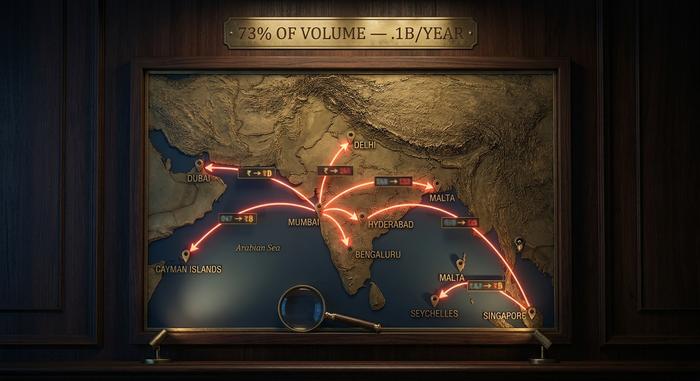
Roughly 73 percent of Indian crypto volume now runs on offshore platforms, about $6.1 billion in annual flows from various income sources that mostly bypass Indian exchange reporting. The tax obligation doesn't vanish with the volume. It just moves onto the user.
Income from crypto on Binance, Bybit, OKX, KuCoin, Coinbase, Kraken, any non-Indian exchange used by an Indian resident, is fully subject to Section 115BBH. The 1 percent TDS under Section 194S applies too, and it's on you, not the exchange. Self-deposit via Form 26QE within 30 days of month-end.
The regulatory picture moved in 2024. FIU-IND (Financial Intelligence Unit India) blocked access to nine foreign exchanges, Binance, Kraken, KuCoin, Huobi, MEXC, Bitstamp among them, for not complying with Indian anti-money-laundering rules. Binance paid an INR 18.82 crore fine in June 2024 and re-registered as an FIU-reporting entity. KuCoin paid INR 34.5 lakh and came back the same year. Several others are still inaccessible without a VPN as of April 2026.
A VPN doesn't change the tax obligation. If you're an Indian resident, your worldwide income is taxable in India. Crypto held or traded anywhere counts. Schedule FA disclosure in the ITR is mandatory. Black Money Act risk applies to undisclosed offshore holdings, with penalties that can exceed the value of the asset itself.
Industry groups formally asked Union Budget 2026 to align crypto taxation with equities (LTCG 12.5 percent, STCG 20 percent after the 2024 equity tax revision), to allow loss set-off, and to cut TDS to 0.01 percent to bring capital back onshore. As of early April 2026, none of those proposals have been enacted. The 30 percent plus 1 percent TDS regime continues in full for AY 2026-27.