What Is a Crypto Liquidity Pool? A DeFi Beginner’s Guide
If you have ever swapped one token for another on Uniswap, you used a crypto liquidity pool. You probably did not see it. The whole thing is invisible from the user's side: pick a token, click swap, the trade fills. Behind that one click, a smart contract is doing the work that hundreds of human market makers used to do on a traditional exchange.
A crypto liquidity pool is a pile of cryptocurrency tokens locked inside a smart contract. The contract uses a math formula to set prices automatically. Anyone can put tokens into the pool and earn a slice of the trading fees. Anyone can pull their share back out. There is no order book. There are no professional market makers brokering each trade. There is just code, the pool, and the people who deposit into it. The whole arrangement is the engine that powers most of decentralized finance.
This guide walks through what a liquidity pool actually is, how it works, why DeFi cannot exist without them, and what can go wrong. We will look at how liquidity providers earn yield, the math behind automated market makers, the danger of impermanent loss, and the real exploits that have drained billions of dollars from pools over the past few years.
Crypto Liquidity Pool: What It Is and Why It Exists
So what is a liquidity pool, really? It is a smart contract that holds a pair of cryptocurrencies (sometimes a whole basket) and lets traders swap between them at a price set by a formula. No counterparty needed. Anyone can deposit. Anyone can trade. Anyone can pull out. The pool is non-custodial; the contract holds the tokens, not a company.
Why bother? Because early DeFi had one truly ugly problem. Back in 2017, decentralized exchanges tried to copy traditional exchanges with on-chain order books. Buyers and sellers posted bids and asks. It was awful. Gas fees ate every order. The user base was tiny. Spreads were huge. A $200 ETH swap could wait an hour and still fill five percent off the real market.
Bancor floated the alternative in 2017. Uniswap shipped it in 2018. Replace the order book with a single pool of tokens. Replace the matched buyers and sellers with an algorithm. Now anyone with capital can become a market maker by dropping tokens into the contract and grabbing a slice of trading fees on the way out. The mechanism turned out to be almost weirdly suited to blockchain economics, and DeFi exploded around it.
Today, crypto liquidity pools sit underneath nearly every major decentralized exchange. The big DEXs (Uniswap, Curve, Balancer, PancakeSwap, Raydium, Orca) share the same basic idea but run different formulas across different chains. DeFi TVL is sitting around $95-140 billion in early 2026 per DeFiLlama, with Ethereum alone holding roughly $57 billion. The depth of this market liquidity is now the single biggest reason on-chain trading is competitive with centralized venues for most tokens. A trader can swap a major pair on a DEX without ever needing matched buyers and sellers. The pool plays both roles.
How Crypto Liquidity Pools Work Behind the Scenes
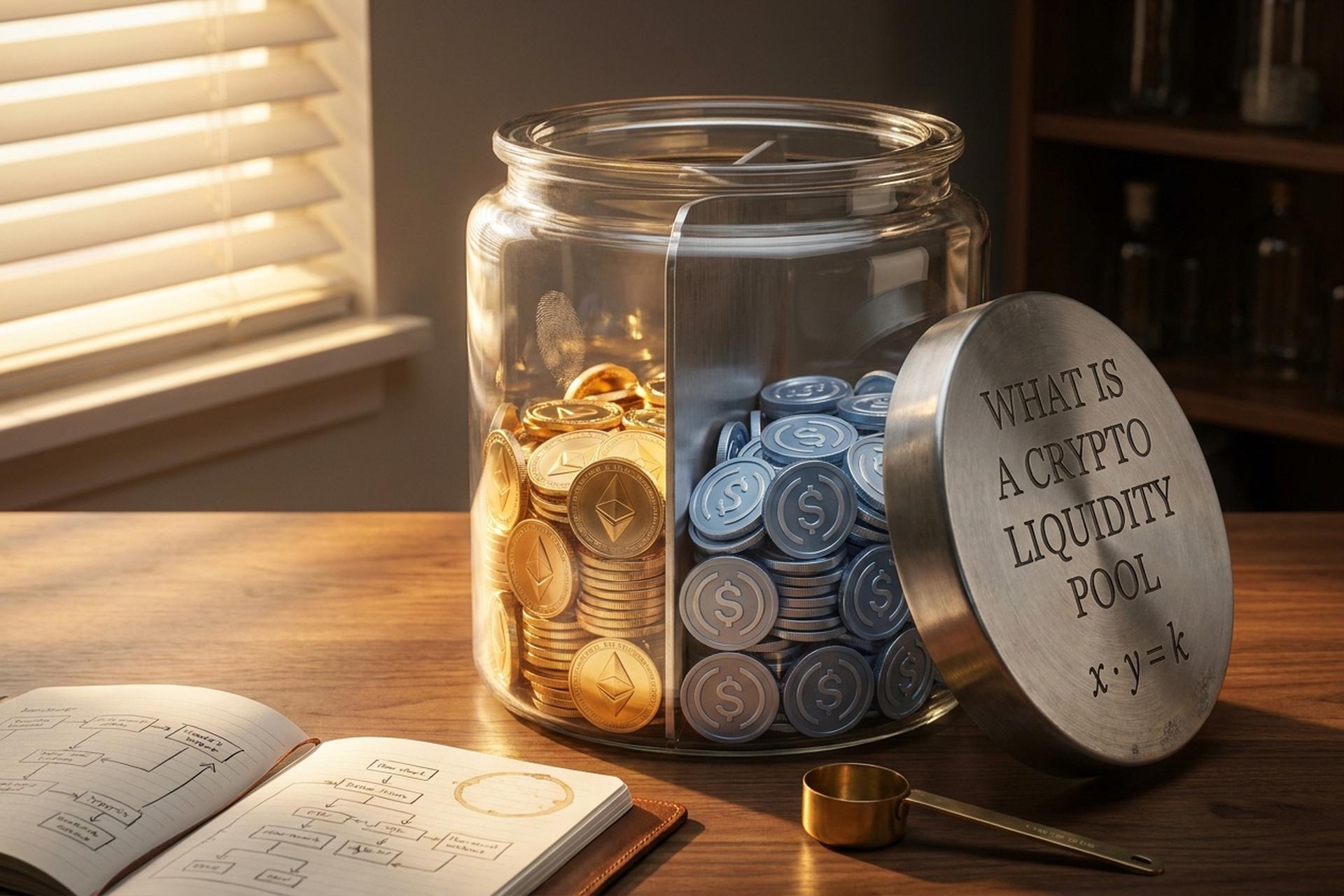
Picture the liquidity pool as a small jar with two compartments. One side, 100 ETH. The other side, 200,000 USDC. Now suppose a trader wants to buy ETH with their USDC. They drop USDC into the jar. The smart contract pushes ETH out the other side. How much ETH? That depends on a formula keeping a specific relationship between the two compartments constant.
On Uniswap V2 and most of its clones, the formula is the constant product rule: x times y equals k. Multiply the amount of token A by the amount of token B, and the answer has to stay the same after every trade. Buy ETH from the pool, and the ETH side shrinks while the USDC side bulges. The next ETH buyer pays a slightly higher price (there is less ETH and more USDC in the jar now). Each trade nudges the price further along the curve.
Each swap also charges a fee. Typically 0.30% on Uniswap V2. Or 0.05% to 1% on Uniswap V3, Curve, and others. That fee gets dumped back into the liquidity pool, so the share belonging to the people who supplied the tokens quietly grows with every swap. Liquidity providers do not collect fees in real time. They collect them when they exit, and they walk away with more tokens than they put in if the pool stayed busy.
All of this happens inside a single on-chain transaction. Trader puts in the input token, the smart contract runs the math, the output token comes back, and the pool balances are updated. No intermediary. No counterparty. Just one swap against the entire liquidity pool.
Automated Market Makers vs the Old Order Book
The name for the algorithm that replaces the order book inside a liquidity pool is the automated market maker, or AMM. Different pools use different AMM formulas, but the goal is always the same: produce a price for any trade size, instantly, without needing a matching counterparty.
Compare it to a traditional exchange. There, an order book lists every buyer's bid and every seller's ask. A trade only happens when one of each shows up at the same price. If nobody is offering to sell ETH at the price you want, you wait. The market maker's job in a traditional venue is to constantly post bids and asks so trades can happen. Professionals do this for a living, and they need fast hardware, sharp risk models, and big balance sheets.
The automated market maker turns that job into a public utility. The "market maker" is the formula, and anyone with tokens can supply the inventory. The trade-off is that AMM prices are mechanical. They do not anticipate news. They do not adjust for sentiment. They follow the math, which means they sometimes lag behind the centralized markets and create arbitrage opportunities, especially around volatile events.
Different pool types use different math:
| Pool type | Formula type | Best for | Example |
|---|---|---|---|
| Constant product | x*y=k | Volatile pairs (ETH/USDC) | Uniswap V2 |
| Stable swap | Mostly flat curve | Stablecoins (USDC/USDT) | Curve 3pool |
| Weighted | Multi-asset, custom ratios | Index-style baskets | Balancer |
| Concentrated liquidity | x*y=k within a band | Capital-efficient majors | Uniswap V3 |
| Hybrid / dynamic | Mixed, parameterized | Specialized assets | Trader Joe v2.1 |
Concentrated liquidity, introduced by Uniswap V3 in 2021, lets liquidity providers concentrate their capital into a narrow price range instead of spreading it across the full curve. The efficiency gain is real: up to 4,000x the capital efficiency of V2 within a tight band, according to Uniswap's own analysis, and as much as 30x the fee revenue per dollar deposited. That setup is more efficient for stable pairs but exposes providers to sharper impermanent loss when price exits the chosen range. V3 currently captures around 60% of Uniswap volume, with the newer V4 hooks model already taking another 30% less than a year after launch.
Liquidity Provider Mechanics: LP Tokens and Fees
Drop a pair of tokens into a liquidity pool, and the smart contract mints LP tokens straight to your wallet. Those LP tokens are your receipt. They represent your proportional share of the pool. Supply 1% of the total liquidity, you get 1% of the LP tokens. In many liquidity pools the LP tokens are themselves transferable ERC-20 assets, which means you can trade them, lend them, or post them as collateral elsewhere in DeFi.
Earning happens in two places. First, every swap that hits the pool pays a fee, and your slice accrues to your LP position over time. Second, plenty of protocols layer rewards on top: governance tokens, partner-token incentives, boosted yields for staking your LP tokens in a separate farming contract. Those layered rewards are how a 0.30% per-swap fee can stack up into a 5%, 20%, or 100%+ APR for a liquidity provider, depending on volume and incentives.
Want out? Send the LP tokens back to the contract. The contract burns them and returns your proportional share of whatever is currently sitting in the liquidity pool. That last word matters. You do not get back the same tokens you put in, and not in the same ratio. You get whatever the pool holds right now, scaled to your share. If traders have been swapping one token for the other and the pool's composition shifted, your withdrawal will reflect every bit of that drift.
Yield Farming and Liquidity Mining Strategies
Yield farming is the practice of moving liquidity around DeFi to chase the highest combined return from fees, incentives, and extra token rewards. A farmer might put USDC and ETH into a Uniswap liquidity pool, take the LP tokens, stake them in a separate contract that rewards them with a project's governance token, then swap that governance token for more USDC and ETH and start the loop again.
Liquidity mining is the related practice on the protocol side. A new DeFi project bootstraps its pool by handing out its own native tokens to early liquidity providers, often in addition to the regular trading fees. Protocols offer liquidity rewards because they need depth fast, and the cheapest way to get depth is to pay for it. The 2020 "DeFi summer" was driven by exactly this mechanic. Compound launched COMP rewards. Other projects copied. APRs hit four digits in some pools, briefly. Then most of the rewards collapsed, and providers learned the hard way that an APR of 800% means very little when the reward token loses 95% of its value.
The serious liquidity providers today think in terms of risk-adjusted yield. A 30% APR on a USDC/USDT stable pool with negligible impermanent loss is often a better trade than 200% APR on a volatile alt-pair where the underlying tokens can dump 50% before you wake up. The math matters more than the headline number.
Impermanent Loss: The Risk Most Beginners Miss
Impermanent loss is the gap between what you would have if you had just held your tokens versus what you actually have after providing liquidity in a pool that experienced price changes. The word "impermanent" is misleading. The loss is real, and it locks in the moment you withdraw your liquidity pool position.
Here is a concrete example. You deposit 1 ETH and 2,000 USDC into an ETH/USDC liquidity pool when ETH is at $2,000. Total value: $4,000. Now ETH doubles to $4,000. The pool's automatic rebalancing means traders have been buying ETH from your pool, so when you withdraw, you get back roughly 0.707 ETH and 2,828 USDC, total value $5,656. If you had simply held the original 1 ETH and 2,000 USDC, you would have $6,000. The $344 gap is the impermanent loss.
The loss grows fast as the price gap widens. A 2x move costs about 5.7%. A 4x move costs roughly 20%. A 5x move runs around 25.5%, and a 10x move balloons to about 42%. Most pool providers learn the painful version of this lesson during a sudden alt-coin pump or dump.
The fix is to choose pairs that move together, like USDC and USDT (close to zero IL), wstETH and ETH (close to zero IL), or major majors that historically track each other. Volatile pairs can still be profitable if trading volume is high enough that fee revenue outpaces IL, but most retail liquidity providers underestimate how much volume that requires.
DeFi Exploits, Rug Pulls, and the Real LP Risks
Pools are smart contracts. Smart contracts get exploited. The history is long enough now to draw real lessons from, and a few cases tell the story clearly.
October 2020. Harvest Finance lost roughly $33.8 million to a flash-loan exploit that manipulated the price oracle inside a stablecoin liquidity pool. The attacker pulled a flash loan, swapped to skew the pool's pricing, deposited into Harvest's vault at the bent price, swapped back, walked away with the difference. Several similar attacks followed across 2021 and 2022.
October 2021. AnubisDAO drained roughly $60 million from its own liquidity pool inside the first day after launch. The team controlled the LP tokens. They yanked everything. They vanished. Classic rug pull. Rug pulls are still one of the dominant attack types on smaller chains and during memecoin manias, where anonymous teams spin up unaudited liquidity pools and wait for retail to wander in.
July 2023. Curve Finance lost about $73 million across several stablecoin pools to a Vyper compiler bug that broke reentrancy protection. Even battle-tested protocols can be undone by infrastructure-layer flaws. Whitehats clawed back some of the funds, but plenty of the losses stuck.
March 2023. Euler Finance hack: roughly $200 million drained through a donate-and-liquidate logic bug. The funds came back eventually after on-chain negotiation with the attacker, but the incident showed how messy the attack surface gets on lending protocols tied to LP-token collateral.
The freshest reminder came on November 3, 2025. Balancer V2 was drained for $128.6 million across six chains. The cause? A rounding-direction error in its pool invariant math. About $19.3 million came back through a white-hat counter-exploit, but the rest was gone. The protocol had been audited multiple times by reputable firms. So the lesson is sharp: audits dramatically cut risk, but they do not eliminate it.
Rug pulls keep appearing too. The LIBRA memecoin tied to Argentina's President Milei evaporated roughly $100 million in February 2025 after the team yanked liquidity. The HAWK token, launched in December 2024, dropped from a $500 million market cap to $60 million in 20 minutes. Lower-tier scam tokens added another $85 million in losses across 2024 per Coincub. The vehicle is almost always the same. Insiders spin up a pool, retail piles in, the LP tokens get yanked. Curtain.
Three categories of risk worth keeping straight: smart contract bugs (often patched and audited away), economic exploits (oracle manipulations, flash-loan attacks, math precision errors), and team-level fraud (rug pulls, malicious upgrades, admin-key abuse). Chainalysis logged $3.4 billion in total crypto theft across 2025, with roughly $2 billion tied to North Korea's Lazarus Group. DeFi-specific losses ran lower as a share of TVL than in 2021, but the absolute dollar figures stayed enormous.
Popular Liquidity Pool Platforms in 2026
The big names dominate the on-chain volume:
| Platform | Chain | TVL band (2026) | Specialty |
|---|---|---|---|
| Uniswap | Ethereum, L2s | $5-7B | Constant product + concentrated (V3, V4); 35.9% DEX market share |
| Curve | Ethereum, L2s | ~$2.5B | Stablecoin pools, low slippage |
| Balancer | Ethereum, L2s | $0.6-1B | Multi-asset weighted pools |
| Aerodrome | Base | $1-2B | ve(3,3) incentive model on Base |
| PancakeSwap | BNB, others | $1-2B | Largest on BNB Chain |
| Raydium | Solana | $1-1.5B | Order-book hybrid AMM on Solana |
| Orca | Solana | $0.5-1B | Concentrated liquidity on Solana |
Where you go depends on what you want to do. Stablecoin yields without serious IL? Curve and Aerodrome's stable pools. ETH/USDC majors on concentrated liquidity? Uniswap V3, whose liquidity pool fee revenue hit roughly $985 million through October 2025 and another $132 million in October alone. Niche or memecoin exposure? PancakeSwap on BNB, or Raydium on Solana, where DEX volume cleared $1 trillion in 2025, with rug-pull risk priced into the yield.
DeFiLlama is the public dashboard most pros use to compare TVL, volume, fees, and APRs across these venues. Anyone serious about supplying liquidity should bookmark it and check before they deposit.
Advantages of Liquidity Pools and Their Trade-offs
A liquidity pool buys you three things you cannot easily get on a centralized crypto market venue. First, permissionless access. Anyone with a wallet can deposit or trade, anywhere in the world, with no account or KYC at the protocol level. Second, non-custodial control. The pool's smart contract holds every token in the pool, but you keep the LP tokens and the keys, so a single company cannot freeze you out. Third, transparency. Every deposit, every swap, every fee is on-chain and verifiable.
The trade-offs are real. Smart contract risk is permanent, not eliminated. Impermanent loss can quietly eat your fee income on volatile pairs. Gas fees on Ethereum mainnet can make small deposits unprofitable. Tax treatment of LP tokens is unsettled in many jurisdictions, and providers should assume they have a transaction fee event every time they enter or exit a pool.
Compared to centralized market makers, AMM pools are slower to react to news and tend to bleed value to arbitrage during sharp moves. The arbitrage is a feature, not a bug; it is what keeps pool prices honest. But that bleed is real, and it shows up in your IL the next time you check.
How to Provide Liquidity in a DeFi Pool
Becoming a liquidity provider in a DeFi liquidity pool is mechanical once you have a wallet, some funds, and a clear-eyed view of the risks.
1. Pick a chain and a wallet. Ethereum mainnet, an L2 like Base or Arbitrum, or Solana. Connect a self-custody wallet (MetaMask, Rabby, Phantom).
2. Choose a liquidity pool. Use DeFiLlama or the protocol's own dashboard. Compare TVL, 24h volume, fee tier, and the historical correlation of the two tokens. Avoid pools where one token has a near-zero market cap or no listing on a major exchange.
3. Acquire both tokens. Most liquidity pools require you to deposit a balanced ratio of the two. Some, like Uniswap V4 and Bunni, support single-sided deposits with auto-swap.
4. Deposit and confirm. The protocol returns LP tokens to your wallet. Save the position URL or the LP-token contract address.
5. Monitor and reinvest. Check the liquidity pool weekly for divergence between your two tokens, accrued fees, and any incentive program changes. Compounding rewards manually or via a yield aggregator usually beats letting them sit.
6. Plan the exit. Know in advance the conditions under which you will withdraw: a price move you cannot stomach, a yield drop below your threshold, or a security disclosure. Pre-committing to an exit removes the emotional pull at the moment it counts.
Start small on your first liquidity pool. Two-token deposits, mainstream pairs, audited protocol. Build muscle memory before scaling capital. Most of the lasting losses in DeFi do not come from being wrong; they come from sizing in too fast on a setup the provider did not yet understand.