Treasure NFT Scam: Verify Legit Returns, Token & Ecosystem

In early 2025, an app called Treasure NFT pulled in more than 100,000 deposits. Most of them came from Pakistan, India, the UAE, and parts of Africa. The pitch was simple. Deposit USDT. Earn 4 to 7 percent every day from "AI-powered NFT trading." A few weeks later, the website was gone. The withdrawal queue was frozen. Pakistan's Federal Investigation Agency was looking at what local press called the country's largest digital fraud in history. By mid-2025, the same operators had relaunched under new names. The "world's first comprehensive NFT trading platform" was, on inspection, a textbook Ponzi scheme dressed in Web3 clothing.
This guide explains what Treasure NFT actually was. It walks through the mechanics, the official record, and how to tell whether any "AI NFT trading" platform is legit before you deposit a dollar. It also separates Treasure NFT, the fraudulent app, from Treasure DAO, the legit Arbitrum gaming ecosystem behind the MAGIC token. The two share a word. They share nothing else.
What Treasure NFT Is and Why It Looked So Risky
Treasure NFT (treasurenft.xyz) was a mobile app and web platform that surfaced in 2024 and went viral in early 2025. Marketing materials described it as a Web3 profit platform that used algorithmic trading to "flip" undervalued NFTs for guaranteed daily returns. Users deposited USDT, usually a $100 minimum, into in-app wallets and watched a counter tick up by single-digit percentages every twenty-four hours. Referral bonuses paid 11 percent on direct sign-ups plus a multi-level downline.
Three things made the proposition risky from the start. First, the daily returns. A 4 to 7 percent daily yield compounds to roughly 30 percent a month and several thousand percent a year, a number no real trading operation has ever sustained. Second, the corporate paper trail. The platform's claimed Tempe, Arizona headquarters address resolves, on independent inspection by Gate News and others, to a Russian music academy. Third, the absence of any verifiable on-chain activity. Independent analysts could not find evidence that the platform actually executed NFT trades that matched the returns it paid out.
If you deposited money on the basis of the returns alone and skipped these three checks, you were the target audience.
The Treasure NFT Platform and Its AI Trading Promise
The marketing pitch was simple. The platform claimed to run an algorithmic trading model that scanned NFT marketplaces, identified mispriced collections, and bought and sold them automatically through smart contracts. Users did not need to understand NFTs. They picked a "treasure bag" tier matching their deposit, then waited for the AI to do the work.
In practice, none of the public-facing parts matched a real trading platform. No smart-contract code on Etherscan or Arbiscan. No third-party audits. No on-chain trail showing the platform buying or selling any non-fungible NFT assets to back up the earnings credited to users. The lack of transparency was total. No transparent reserve. No creator royalties on any collection. No liquidity for users who tried to exit. The "AI" was a counter inside a closed-loop app, not an algorithm reacting to volatile NFT market prices.
Closed-loop is the operative phrase. Money came in through crypto deposits, balances grew on an internal ledger, and withdrawals had to be requested back into crypto. As long as deposits exceeded withdrawal demand, the system worked from the user's perspective. As soon as it didn't, the entire structure had nothing real to fall back on.
Ponzi Scheme Mechanics: Daily Returns and Referrals
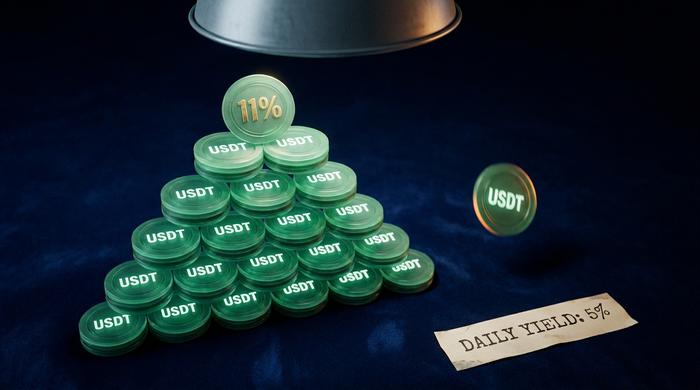
Strip the Web3 vocabulary and the business model is one of the oldest in finance. New deposits funded the daily payouts to existing users. New deposits came from a multi-level referral system that paid 11 percent on direct invites and a smaller cut on every layer below. Early users earned real withdrawals during the growth phase. They posted screenshots. They were encouraged to pull in their networks for bigger rewards. Community sentiment turned euphoric. The pyramid grew. Real profitability was nowhere in the picture.
The daily-return promise also forced the structure into a corner. With yields at roughly 5 percent a day, the platform had to find new money equal to about 150 percent of total balances every month just to stay solvent. No trading market on earth can sustain that. This is why Ponzi schemes that promise daily yields all fail in roughly the same way.
Recognizing the pattern matters because the same structure shows up under dozens of different brand names every year. The product changes. The math does not. No automated trading system has ever produced a viable, sustainable yield at the rates these schemes promise.
The Collapse: Withdrawal Issues and Vanishing NFTs
The unraveling happened fast. According to Gate News and follow-up reporting by Mudrex and Bitrue, the platform took in roughly $143.8 million in deposits over a six-hour window on March 24, 2025, while quietly extending the standard 96-hour withdrawal window to 168 hours, and later to more than 480. By the end of March, withdrawal requests were being rejected outright or left in indefinite "pending" status. By early April, treasurenft.xyz was offline.
In Pakistan, the impact was severe. An analysis by Salman Mehdi cites context from the Federal Investigation Agency, the State Bank of Pakistan, and the Securities and Exchange Commission of Pakistan. Significant financial losses ran to roughly PKR 45 billion, or about $160 million USD, across more than 100,000 investors. Damage was concentrated in Balochistan, Sindh, and the tribal areas of Khyber Pakhtunkhwa. The Express Tribune called it one of the country's largest digital frauds. Pakistan's authorities have signalled they will prioritize enforcement. No public arrests had been announced as of April 2026.
The "NFTs" themselves never had visible secondary-market value. There was no marketplace to sell them on, no on-chain provenance to verify them, and no buyer once the app stopped paying. Holders of "treasure bags" were left with nothing more than entries in a ledger that no longer existed.
Is Treasure NFT Real or Fake? Spotting the Scam Pattern
The honest answer in 2026 is that the original app is functionally dead, the brand has been rebooted twice, and the underlying operation displays every hallmark of a sophisticated scam rather than a legitimate financial product. The verification fingerprint is consistent across analyses by Mudrex, Bitrue, ChainUp, the Express Tribune, and West Bengal Police communications.
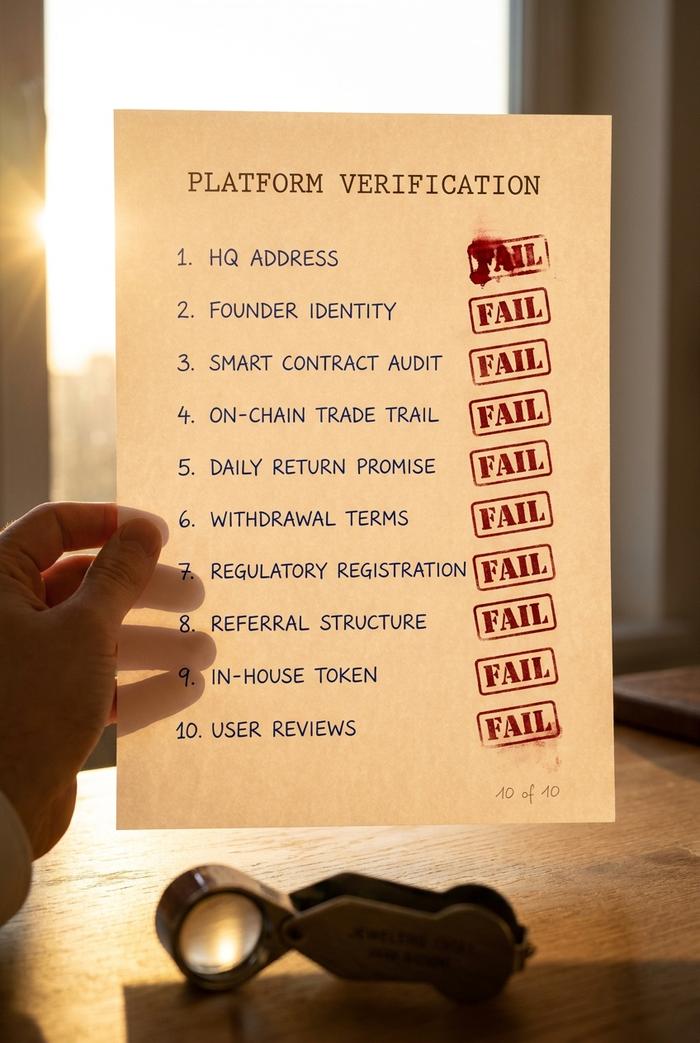
Here is what a five-minute legitimacy check would have shown before depositing:
| Check | What you'd find | Verdict |
|---|---|---|
| HQ address verification | "Tempe, Arizona" address resolves to a Russian music academy | Fake |
| Founder identity | "Steven Alexander" with no verified corporate filings; LinkedIn flagged as fabricated | Fake |
| Smart contract audit | None published; no audit firm associated | Missing |
| On-chain trade trail | No NFT purchase/sale activity matching paid returns | Missing |
| Daily return promise | 4–7% per day (~30%/month) | Mathematically impossible |
| Withdrawal terms | Multi-tier delays, "verification fees" required to release funds | Classic late-stage Ponzi |
| Regulatory registration | Not registered with FIU-IND, SEC, FCA, MAS, or equivalent | Unregulated |
Any one of these would be a red flag. Together they describe an unambiguous fraud pattern, not an ambiguous edge case.
Crypto Investment Rebrands: Treasure Fun and NovaNFT
The most predictable thing a collapsed Ponzi does is rebrand and try again. Treasure NFT followed the script.
In the spring of 2025, a new domain at treasurefun.xyz appeared, accepting the same login credentials from the original app and adding a new in-house token called TUFT. West Bengal Police issued a public warning on May 6, 2025 explicitly calling Treasure Fun a continuation of the same Ponzi scheme. The TUFT token launched at around $0.006 and briefly traded near $0.02 by late May 2025 on small unregulated venues, but it never made it onto any reputable exchange and effectively had no liquid market.
By November 2025, exposé blog TrickPK reported a third iteration under the name NovaNFT, again sharing the operational fingerprint of the previous two. Each rebrand recycles the same playbook: high daily returns, multi-level referrals, in-house token, opaque corporate identity, opaque on-chain trail. If the name is different but the mechanics are identical, it is the same scam.
For anyone holding TUFT or original Treasure NFT balances, the practical reality is that funds inside the closed system are unrecoverable through the platform itself. Recovery routes are limited to filing complaints with local cybercrime units and, in jurisdictions with active investigations, cooperating with law enforcement.
Regulatory Response and Police Action on the Platform
Public regulatory action has been concentrated in South Asia. West Bengal Police in India issued a public advisory through their official X account on April 4, 2025 and an expanded notice on May 6, 2025, naming both Treasure NFT and Treasure Fun as fraudulent and warning citizens not to deposit. APAC News Network covered the expanded warning the same day.
In Pakistan, the Federal Investigation Agency, the State Bank of Pakistan, and the Securities and Exchange Commission of Pakistan have all been linked to the case in local press given its scale. No public arrest or court filing has been confirmed in the sources reviewed here. Local outlets including the Express Tribune covered the collapse in detail.
In the United States, no FBI, IC3, FTC, SEC or CFTC alert specifically naming Treasure NFT could be found as of April 2026. The FBI's 2025 IC3 report came out on April 7, 2026. It logged $11.366 billion in crypto-related fraud losses, a 22 percent jump year over year. It does not single out this platform by name. That gap is itself a warning. Scams concentrated in emerging markets often escape the headlines that drive Western enforcement.
App store action is documented mostly through community channels. Multiple secondary sources reported the iOS app's removal from the Apple App Store in 2025; no official Apple statement is public. On Google Play, removal-request threads in the Developer Community ran for months, with the app intermittently still listed.
Treasure DAO vs Treasure NFT: Different Blockchain NFTs
If you have searched "Treasure NFT" and ended up on a project called Treasure or TreasureDAO with a token ticker MAGIC, you have found a completely different entity. The two share a word and nothing else.
Treasure (MAGIC) is an Arbitrum-based gaming ecosystem. It includes Bridgeworld, Smolverse, an NFT marketplace, and AI-agent tools. It launched in 2021. It has a public team led by founder John Patten. The contracts are on-chain and audited. The treasury publishes its balance. As of late April 2026, MAGIC trades around $0.068 with a market cap of roughly $22 million per CoinGecko, ranking #826. That is sharply down from its 2021–2022 peak.
The project is in financial trouble, not in fraud. On April 2, 2025, TreasureDAO announced a major restructuring. Founder John Patten returned to leadership. The Treasure Chain L2 was wound down (the network shut on May 30, 2025). Third-party game publishing ended. Roughly 15 contributors were laid off. According to The Defiant, the treasury at restructuring held $2.4 million in stablecoins plus 22.3 million MAGIC tokens. The annual burn rate was $8.3 million. Q4 2024 expenses were $11.3 million against $40,000 in revenue.
That is a struggling early-stage project pivoting to extend its runway. It is not a scam. The brand collision with Treasure NFT has been a real headache for the legit team. But the gap is visible at every layer. Real public team versus fake one. Audited on-chain code versus closed-loop ledger. Published treasury versus hidden wallets.
Verification Red Flags on Any NFT Trading Platform
Pattern recognition is the cheapest insurance in crypto. The Treasure NFT episode is a near-perfect case study in what to look for. Before depositing on any platform that promises NFT trading returns, run through the following checklist. If you hit two or more red flags, walk away.
| Red flag | What it looks like in practice |
|---|---|
| Guaranteed daily returns | "Earn 1–8% per day", which sustainable trading cannot deliver |
| Anonymous or unverifiable founders | No real LinkedIn history, no past company record, no public talks |
| No published smart contracts | "AI trading" with no code on a block explorer means no AI you can verify |
| No third-party audit | Reputable projects publish audits from CertiK, Trail of Bits, OpenZeppelin or similar |
| Multi-level referral pay structure | Recruitment commissions deeper than two tiers signal a pyramid economy |
| Corporate address that fails inspection | Google Maps + Street View can disprove a "headquarters" in five minutes |
| Withdrawal delays or new "fees" | Adding fees or extending lock-up periods after deposit is a near-universal late-stage Ponzi tell |
| In-house token with no real exchange listing | Tokens that only trade on the platform's own venue have no real price discovery |
| Marketing pressure to recruit | Incentives weighted toward bringing in new deposits, not actual product use |
| Generic Trustpilot reviews | A flood of 5-star reviews with stock language and no platform-specific detail |
These red flags are not specific to NFTs. The same checklist applies to any "AI trading bot," "DeFi farm," or "crypto reserve" promising defined daily returns. Real platforms invite verification. Fraudulent platforms hide it under marketing.
Disclaimer: The Allure of Quick Crypto Transaction Profits
A note on the human side of this story, because the math alone does not explain it.
The allure of a Treasure NFT-style scheme is that it works for the early users. Real money does come out, real screenshots get posted, real friends and family get pulled in by people who genuinely believe they have found something. The pyramid funds the early withdrawals from later deposits, and during the growth phase that looks indistinguishable from a successful product. It is only when growth slows that the structure collapses, and by then most participants are sitting on losses they cannot reverse.
In Pakistan and parts of India, the damage was concentrated in communities where formal financial services are thin, returns on savings are low, and a 30-percent-a-month yield offered through a slick mobile app reads as a genuine opportunity rather than an obvious red flag. That is where the operators concentrated their referral marketing, and that is where the largest losses landed.
This article is not financial advice. The disclaimer matters for one reason: any platform that promises you fixed daily crypto transaction profits is asking you to ignore three centuries of accumulated evidence about how financial frauds end. They end the same way every time. The only question is whether you exit before the door closes or after.