Solana Saga Review: Saga Phone, Solana Mobile Seeker, Web3 in 2026
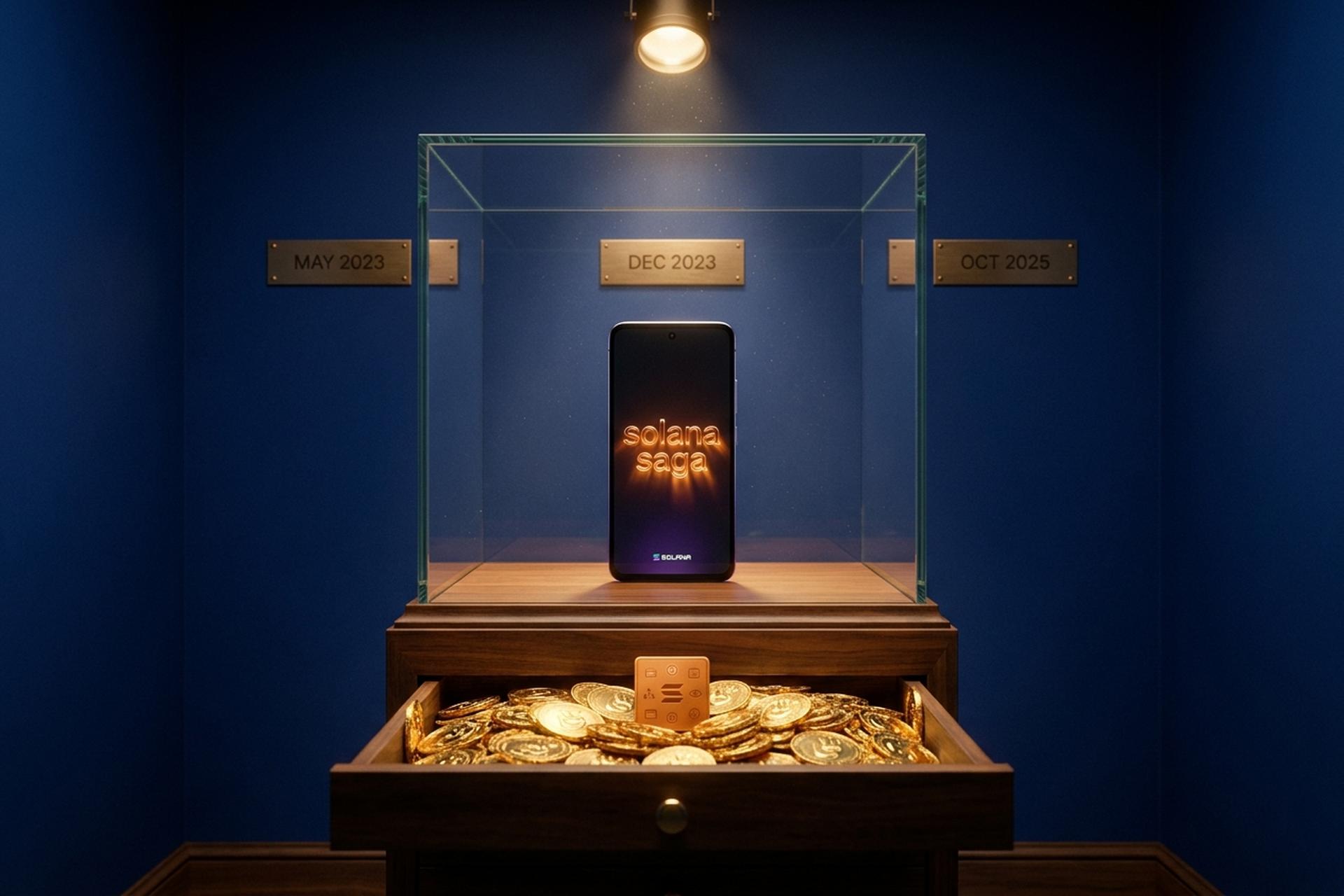
The Solana Saga has had three lives. The first one was short. It launched in 2023 as an ambitious crypto phone almost nobody bought. The second life started a few months later, when one airdrop turned the device into a sold-out cult object selling on eBay for five grand. Life three began in October 2025: Solana Mobile stopped pushing security patches and quietly walked away. Early adopters were left with a beautiful $1,000 phone that no longer talks back to the operating-system team.
This guide pulls all three lives into one place. What is the Solana Saga phone, exactly. Why did the BONK airdrop turn a flop into legend. What changed with the Solana Seeker that replaced it. And, the question most people are actually asking right now: is buying a Saga in 2026 still a smart move, or just nostalgia.
What Is the Solana Saga Phone? A Quick Solana Saga Review
Quick version. The Solana Saga is a Web3-focused Android phone. OSOM built it. Solana Mobile, a Solana Labs subsidiary, sold it. Launch day was 8 May 2023. Sticker price: $1,000.
The pitch was three layers. One: a flagship Android mobile phone. Two: an isolated hardware Seed Vault for crypto private keys. Three: a censorship-resistant dApp Store for decentralized apps, no 30 percent Apple-or-Google tax in sight. All of that sat on the Solana Mobile Stack, a toolkit for developers who actually wanted to build mobile-first dApps tied to the Solana blockchain.
If you want the short Solana Saga review, here it is. The hardware was good but unremarkable. The price was steep. Marques Brownlee called it the "worst phone of 2023" in his reference video and treated the whole thing as a marketing object for an audience that did not exist yet. He had a point. For most of 2023 the Saga sold badly. Only 2,400 to 2,500 phones in the first six months, against an internal target ten times that. Anatoly Yakovenko later said the program needed roughly 25,000 to 50,000 units a year to make any business sense.
So that is the rough start. What happened next is the entire reason anyone still talks about this device.
Solana Saga Hardware: Specs of a Web3 Android Phone
On paper, the Saga lined up against mid-2022 flagships, not the 2023 generation. Internals: strong enough. Camera: fine. Battery: survived a normal workday. None of that is where you win when you sell a Web3 Android phone, though. You win on the security stack. And that is where the Saga's design budget actually went.
| Component | Solana Saga spec |
|---|---|
| Processor | Qualcomm Snapdragon 8+ Gen 1 |
| RAM / Storage | 12 GB / 512 GB (microSD support) |
| Display | 6.67" 1080p AMOLED, 120 Hz |
| Cameras | 50 MP main, 12 MP ultrawide |
| Battery | 4,110 mAh, USB-C, wireless charging |
| OS | Android 13 (later updated to Android 14) |
| Connectivity | 5G, WiFi 6, Bluetooth 5.2, dual SIM |
| Build | Aluminum frame, Gorilla Glass |
| Biometric | In-display fingerprint |
It was also heavier than its competitors. Reviewers kept calling it awkward in one hand. The Snapdragon 8+ Gen 1 was already a generation behind the Galaxy S23's 8 Gen 2 by the time the Saga shipped. Camera output: respectable, not flagship-tier. None of this was going to pull an iPhone or Pixel user across the aisle. That was never really the goal in the first place.
Seed Vault and Web3 Features That Made the Solana Phone Unique
The Seed Vault is the part of the Solana phone people remember. It is a dedicated secure hardware enclave that generates and stores the 24-word seed phrase entirely separately from the Android operating system. Wallet apps can request a transaction signature, and the Seed Vault returns a signed payload after a single biometric tap, but the apps themselves never see the seed or the private key. That model is much closer to a Ledger or Trezor hardware wallet than to typical mobile crypto wallets, where the seed lives in app storage.
On top of the Seed Vault, the Solana Mobile Stack provided three things developers asked for. A standard wallet adapter so any Solana dApp could connect without each wallet rolling its own protocol. A mobile device-friendly dApp publishing flow that supports both DeFi apps and consumer dApps. And the Solana dApp Store itself, which launched with 16 apps including Phantom, Solflare, Jupiter, Magic Eden, Marinade, Mango, and Audius. The dApp Store charges 0 percent platform tax, against the 15 to 30 percent Apple and Google take on in-app purchases, which on paper is a meaningful pitch to developers tired of being taxed.
The result was the cleanest mobile crypto experience available in 2023. NFT minting, swap signing, and dApp logins all happened with one tap and no keyboard. For a narrow audience, that mattered.
The BONK Airdrop That Saved the First-Generation Saga Phone
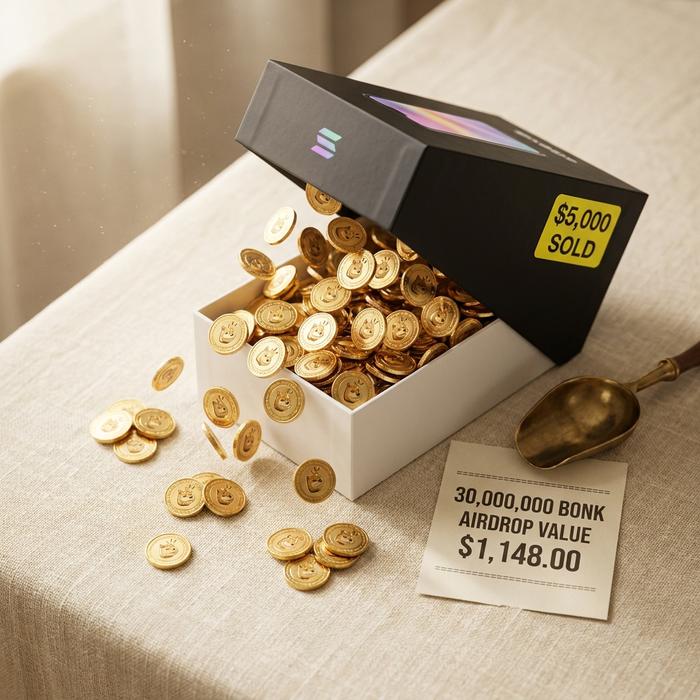
By late 2023, the Saga story looked like a write-off. The price had already been cut to $599 on 9 August 2023 (a 40 percent discount), and sales were still flat. Then early December happened. The BONK community announced an airdrop of 30 million BONK tokens to every Saga owner. The token was rallying hard right then. At peak, that single allocation was worth somewhere between $700 and $1,150 per phone, more than the discounted Saga itself. Sales jumped roughly 10x in 48 hours. Solana Mobile sold out of remaining stock inside that same 48-hour window. On eBay, unopened units climbed past $5,000 at the peak, with a sustained $2,000 floor through early 2024.
And that was only the headline airdrop. Saga holders also picked up smaller drops from Helium Mobile (HNT credits), Jito (JTO), NEON, mfer, Genopets, plus a long tail of meme-token projects trying to land in front of pre-vetted crypto users. Owners who claimed everything say total airdrop value crossed $3,000 per device in the first year. None of this was promised by Solana Mobile. It happened because handing free tokens to 20,000 hardware-wallet-ready phones turned out to be the cheapest viral marketing the Solana ecosystem had ever seen.
In retail terms, the device sold out. In cultural terms, the Saga went from a punchline to a cult object. The story is the single best advertising any first-generation Web3 product has ever produced, and Solana Mobile did not plan it.
Why Solana Mobile Stopped Software Updates and Security Patches
The BONK win did not fix the harder problem. The Saga was still an expensive niche device with a small fleet to maintain. On 21 October 2025, Solana Mobile told its Discord community that software updates and security patches were over. The exact wording: "The Solana Mobile Saga has reached the end of its support lifecycle. Compatibility with new software or services cannot be guaranteed." From that point, Saga-specific customer support would be limited to general inquiries only.
The last security patch had shipped back in November 2024. The last big OS bump pushed the phone to Android 14. Everything after that, Android 15 and Android 16, never arrives on a Saga. Two years of full support, and that is it.
Compare that to the rest of the industry. Apple commits to at least five years of security updates on iPhones. Google Pixel 8 and the Samsung Galaxy S24 both promise seven years of software support. Saga: two. There is also a clean structural reason for the cutoff: OSOM Corp, the manufacturing partner Solana Mobile worked with on the Saga, filed for bankruptcy in September 2024. With the hardware partner gone, maintaining a kernel, an Android security stream, and a 20,000-unit fleet at flagship cadence simply stopped being viable. Solana Mobile is not Samsung. The math did not work.
The phones still function, to be clear. The Seed Vault still holds keys. The dApp Store still loads. Seed phrases can be exported and restored on any other wallet. What ends is the security guarantee on the OS itself. Every new Android exploit shipped unpatched on a Saga is a real, growing risk for anyone storing meaningful crypto on the device.
Saga Lifecycle: From Launch to End of Software Support
Compressing the full lifecycle into a timeline shows what a strange product cycle this turned out to be.
| Date | Event |
|---|---|
| June 2022 | Solana Mobile project announced |
| 8 May 2023 | Solana Saga ships at $1,000 |
| 9 Aug 2023 | Sales weak (~2,500 units); price cut 40% to $599 |
| Dec 2023 | BONK airdrop (30M tokens); 10x sales in 48h; eBay peak $5,000 |
| 2024 | Saga holders claim ~$3,000+ in airdrops (HNT, JTO, NEON, mfer, etc.) |
| Aug 2024 | Solana Seeker preorders open at $450 (Founder Window) |
| Sep 2024 | OSOM Corp files for bankruptcy |
| 21 Sep 2024 | Founder Window closes |
| Nov 2024 | Final security patch pushed to Saga |
| 4 Aug 2025 | Solana Seeker begins shipping in 57 countries |
| 21 Oct 2025 | Solana Mobile ends software updates and security patches for Saga |
| 21 Jan 2026 | SKR token airdrop opens (Seeker holders only, 90-day window) |
Two years and five months of full support is short by any consumer-electronics yardstick. It is not unusual for first-generation niche hardware. It is unusual for a $1,000 device that was marketed as a flagship.
Solana Seeker: The Saga 2 Replacement Crypto Phone
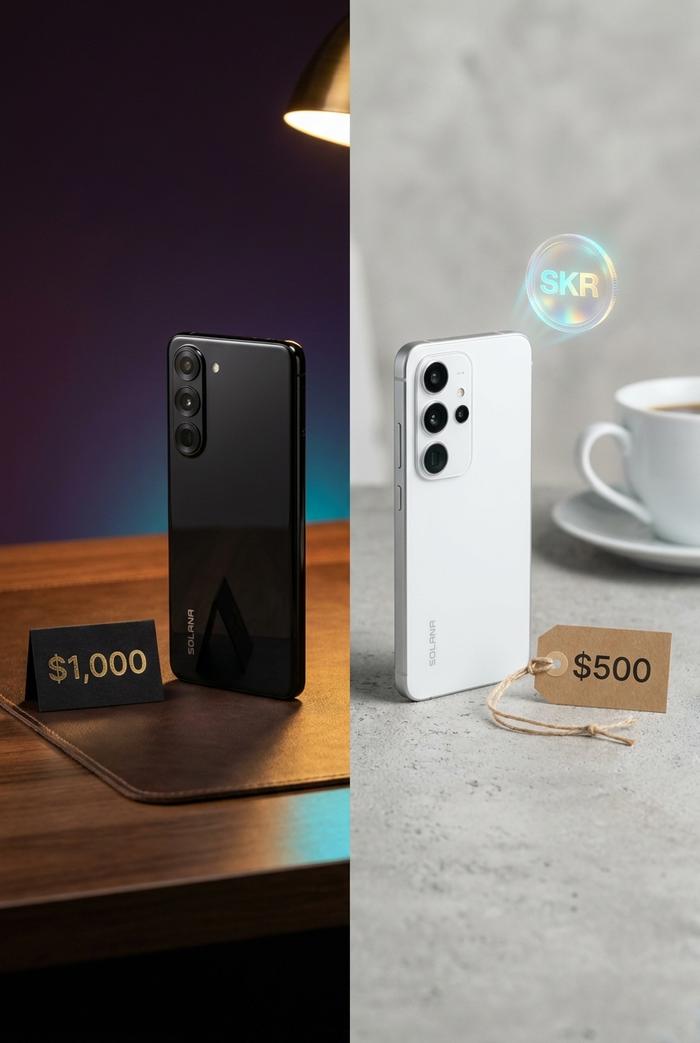
Solana Seeker is the second-generation crypto phone. It went through two name changes first (Saga 2, then Chapter 2) before settling on Seeker. Pre-order signups opened in August 2024. The Founder Window deposit was $450 and ran until 21 September 2024. The next preorder phase moved to $500. By the time the device started shipping on 4 August 2025, Solana Mobile had collected more than 150,000 preorders across 57 countries. Retail came in flat at $500. Half what the Saga cost on launch day.
Here is where it gets odd. The Seeker is, on paper, a hardware downgrade. The Saga ran a Snapdragon 8+ Gen 1, 12 GB of RAM, 512 GB of storage. The Seeker ships with a MediaTek Dimensity 7300, 8 GB of RAM, 128 GB of storage. The camera went the other way: a 108 MP main, a 50 MP telephoto, a 13 MP ultrawide. Why? Because crypto users do not care about flagship specs the way phone reviewers do. They care about the Seed Vault. The dApp Store. The SKR airdrop. Cut the price in half, accept the chipset hit, and the deal works for the actual buyer.
Two crypto-specific features are genuinely new. The first is SeekerID, a portable on-chain identity primitive any dApp can use for login and reputation. The second is the SKR token. SKR opened its airdrop on 21 January 2026 with a 90-day claim window. Roughly 2 billion SKR (about 20 percent of supply) was set aside for the community: 1.82 billion split across a verified list of 100,908 Seeker users, plus 141 million reserved for 188 builders actively shipping in the dApp Store. Preorder buyers also collected a 37,600 MEW token allocation worth around $250 at distribution, which by itself paid back more than half their deposit. Lesson learned from BONK. For Solana Mobile, airdrops are no longer a side benefit. They are the marketing.
Solana Saga vs Seeker: Specs, Price and Migration Path
For Saga 1 holders, the question is whether the Seeker is enough of an upgrade to justify the move, especially given the loss of Saga security updates.
| Spec | Solana Saga (2023) | Solana Seeker (2025) |
|---|---|---|
| Launch price | $1,000 (later $599) | $500 |
| Display | 6.67" 1080p AMOLED 120 Hz | AMOLED, similar size |
| RAM / Storage | 12 GB / 512 GB | 8 GB / 128 GB |
| Chipset | Snapdragon 8+ Gen 1 | MediaTek Dimensity 7300 |
| Cameras | 50 MP + 12 MP UW | 108 MP + 50 MP tele + 13 MP UW |
| Seed Vault | Yes (first generation) | Yes (refined) |
| dApp Store | Yes (16 apps at launch, more later) | Yes, expanded |
| Native token | None | SKR Genesis Token (airdrop opened 21 Jan 2026) |
| Identity | Wallet-based only | SeekerID |
| Security updates | Ended 21 Oct 2025 | Active |
| Builder | OSOM (bankrupt Sept 2024) | New manufacturing partner |
| Lifetime sales | ~20,000 | 150,000+ preorders |
The migration math has one important catch. The SKR airdrop is gated by a Genesis Token that only Seeker preorder holders received. Saga 1 owners are explicitly excluded. There is no formal Saga-to-Seeker migration discount or grandfathering program. To get into SKR, you have to buy a Seeker outright, on top of whatever you already paid for the Saga.
That changes the calculus. At $500, refreshed Seed Vault and active security updates plus the SKR allocation can easily be worth the upgrade. Most engaged users seem to be holding both devices, using the unsupported Saga as a hardware-wallet-grade phone for cold-ish storage on a strict app whitelist, and using the Seeker as the daily driver. Exporting the seed and restoring it on the Seeker is a five-minute operation. Nothing forces Saga 1 owners to retire the older device, but nothing rewards them for keeping it either.
Should You Still Buy a Solana Saga Phone in 2026?
Buying a Solana Saga phone in 2026 is a different decision than buying one in 2023. The original three pitches have all changed. The hardware-secure wallet is still there but no longer receiving security patches against new Android exploits. The dApp Store works, but the larger Seeker fleet is where developer attention sits now. The airdrop bonanza is over; future Solana-ecosystem airdrops are aimed at Seeker holders.
There are still two reasonable cases for buying a Saga today. First, as a collector item: a sealed, unopened first-generation Saga has historical interest, and prices on the secondary market have stabilized at multiples of the original retail. Second, as a dedicated hardware-wallet device that never connects to consumer apps or banks. Used purely as a sign-and-send tool with a fresh seed and a strict app whitelist, the security model still holds.
For everyone else, the honest answer is: pick up a Seeker for $500, get supported software, the SKR allocation, SeekerID, and a much better path forward. The BONK story is a closed chapter.
Saga Phone Airdrops Beyond BONK and the SKR Token
Airdrops shaped the Saga's identity, and that pattern carries forward into the Seeker era. The full Saga airdrop list ran past BONK and included Jito (JTO) governance allocations for active stakers, Helium Mobile credits and HNT, NEON, the Tensorians and Mad Lads NFT communities running token claims, Genopets in-game allocations, mfer NFT-related drops, and a long tail of ecosystem rewards from smaller projects looking to attach themselves to Saga holders' wallets.
For the Seeker, the SKR token is the headline reward. The 90-day SKR claim window opened on 21 January 2026, with about 2 billion tokens (20 percent of supply) earmarked for the community: 1.82 billion split across 100,908 Seeker users and 141 million for 188 active dApp Store builders. The MEW preorder airdrop already paid back over half of the deposit. Other Solana-ecosystem projects are expected to airdrop on top of that, since the Seeker fleet of 150,000+ devices is now the most concentrated and identifiable group of high-intent crypto users on any single mobile platform.
This is the part of the Solana Mobile thesis that has actually proven out. Owning the device wins you tokens. The phone is a wallet that walks around with you, and projects pay to land in front of that wallet.