What Is Wrapped Bitcoin (WBTC)? BTC in DeFi Explained
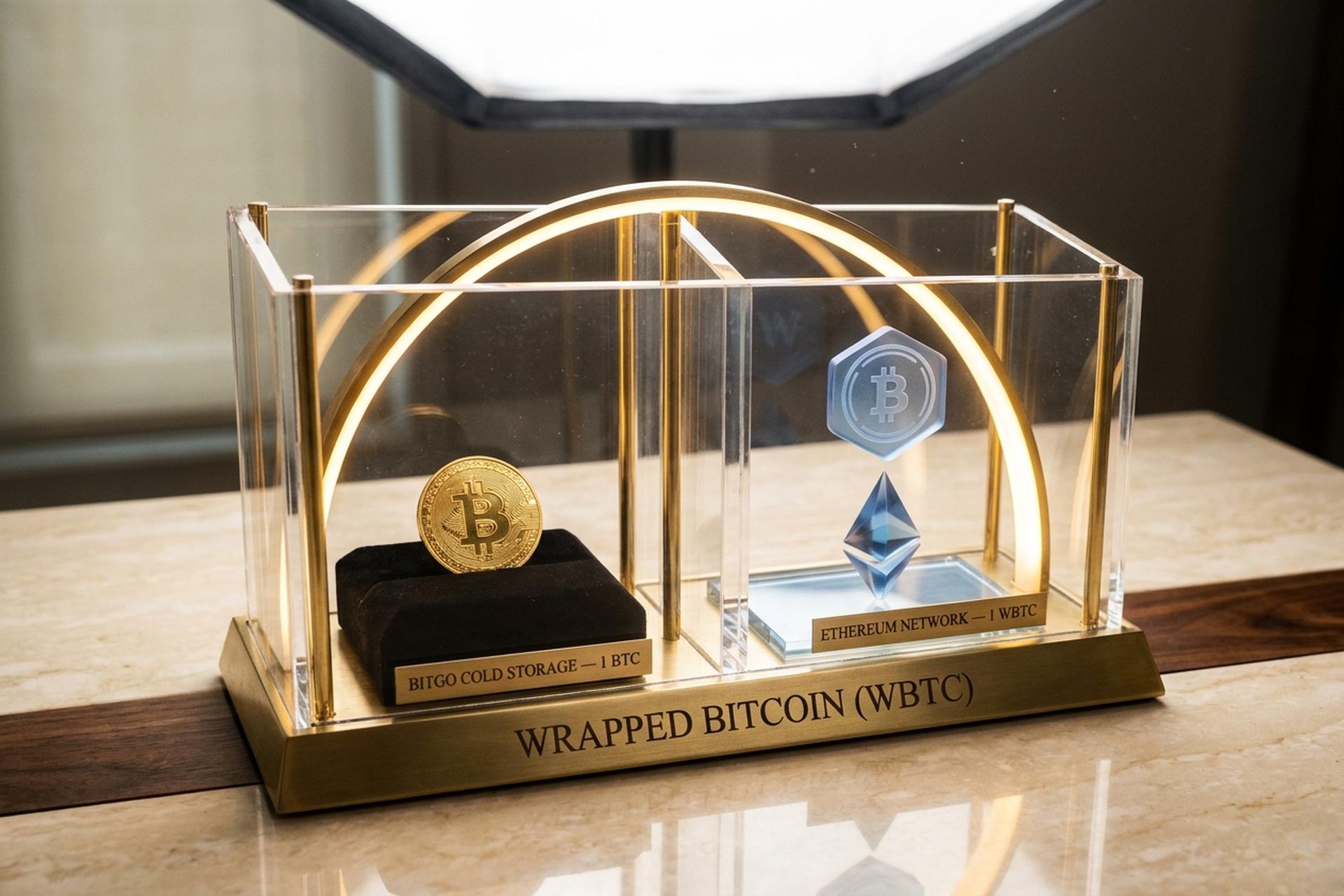
Here's the puzzle WBTC was built to solve. Bitcoin is the biggest cryptocurrency and digital asset in crypto. Ethereum is where DeFi lives. And for years, a trillion-dollar pile of BTC sat on its own network and could do nothing with the financial machinery running next door on Ethereum. No yield. No collateral. No AMM pool trade. Wrapped Bitcoin fixed that. In practice, WBTC is a tokenized version of bitcoin. It lives on the Ethereum blockchain. And it's fully backed by bitcoin held in custody.
WBTC launched in January 2019. Since then it's become the dominant way to bring bitcoin liquidity into Ethereum. Peak was late 2021. Over 285,000 BTC were parked in WBTC, worth more than $10 billion at the time. WBTC is still the largest wrapped version of bitcoin. But the landscape now has competition. And one real controversy. This guide covers how the token works. What DeFi uses it for. What happened with BitGo and Justin Sun in 2024. And how WBTC compares to cbBTC, tBTC, and newer alternatives.
What Is Wrapped Bitcoin and Why WBTC Exists
Wrapped Bitcoin is an ERC-20 token on the Ethereum blockchain that represents bitcoin one-to-one. Send 1 BTC into the WBTC system, you get 1 WBTC. Send the WBTC back, you get your BTC. One concept, one paragraph.
The reason it exists comes from a basic structural split. Bitcoin and Ethereum run on separate blockchains with completely different rules. Bitcoin has no smart contracts. Ethereum has smart contracts, but no native BTC. Want to deposit bitcoin into Aave? Trade it on Uniswap? Use it as collateral in a lending protocol? Raw BTC on the bitcoin network can't do any of that. You need a token that represents bitcoin inside Ethereum's world. That's WBTC.
It was launched by a consortium of Kyber Network, Ren, and BitGo on 31 October 2018. The consortium released the WBTC whitepaper on January 24, 2019, and the first tokens minted shortly after. Over the years the consortium added more members. BitGo, though, remained the sole custodian all the way to 2024.
Why did a wrapped version of bitcoin matter in the first place? DeFi protocols grew fast between 2019 and 2021. And the biggest asset in crypto (BTC) was locked out of every one of them. Wrapping solved that. It let BTC holders put their bitcoin to work in financial services built on Ethereum without selling BTC or moving into ETH.
How Wrapped BTC (WBTC) Works on Ethereum
Three roles drive the whole WBTC system: a user, a merchant, a custodian. That's it.
A user who wants WBTC doesn't ship BTC directly to any contract. They go through a merchant. These are authorized intermediaries like Kyber Network, Airswap, or a whitelisted trading desk. User sends BTC to the merchant. Merchant runs KYC and AML checks. Merchant forwards BTC to BitGo, the custodian. BitGo confirms receipt on the bitcoin network. Then it mints the equivalent WBTC on the Ethereum blockchain. The new WBTC flows back to the user through the merchant. That's the mint flow.
Redemption runs the same path in reverse. The user sends WBTC back to the merchant. The merchant and the WBTC system coordinate the burn. The custodian burns the WBTC on Ethereum, then releases the underlying BTC from reserves back to the merchant. The merchant hands it to the user. This cycle is sometimes described as "WBTC is traded back" to bitcoin: the ERC-20 token is burned, and the bitcoin held in custody is released.
Here's the property that matters. Every WBTC in circulation is backed by an equal amount of bitcoin sitting in cold storage at BitGo. The supply of WBTC on Ethereum should always match the amount of bitcoin held in BitGo's wallets. You can check this. BitGo publishes the bitcoin reserve addresses. A proof of reserve dashboard runs live on the WBTC network, letting anyone audit the bitcoin reserves held one-to-one against WBTC in circulation. That's what it means for WBTC to represent bitcoin on the ethereum network: a tokenized IOU backed by bitcoin sitting somewhere else in cold storage.
All of which makes WBTC a custodial product, not a trustless one. You're trusting BitGo to actually hold the BTC. Trusting the audit. Trusting the custodian to honor redemptions. Big difference from native bitcoin, which is trustless by design. Because WBTC is an ethereum-based token, it inherits Ethereum's smart-contract risks. But it also gets the full upside of Ethereum and Bitcoin blockchains working together as one financial layer.
WBTC Token Supply, Minting, and Burning
The supply of WBTC is not fixed. It expands when users mint new WBTC against fresh BTC deposits and contracts when users burn WBTC to redeem BTC. This minting and burning of WBTC is continuous. New BTC coming in means new WBTC token units on the Ethereum blockchain. Redemptions mean tokens are burned and removed from circulating supply.
As of April 2026, the circulating supply of WBTC sits near 128,000 tokens. A lot lower than the late-2021 peak of about 285,000. The WBTC market cap rides the BTC price closely. At BTC prices around $69,000, total WBTC value is roughly $8.8 billion.
Two main trends drove the drop in supply. First, Ethereum gas fees made small WBTC transactions uneconomic. Smaller holders moved to alternatives. Second, the 2024 BitGo custody controversy (more below) set off a wave of redemptions. DeFi platforms and DAOs shifted BTC exposure to competitors.
Minting is gated by merchants. Burning, on the Ethereum side, is permissionless. Anyone holding WBTC can fire the tokens at a burn address to kick off redemption. A certain number of WBTC can be minted or burned daily without extra audits. Larger batches get reviewed. The whole process feels closer to how a regulated stablecoin issues and redeems than to a decentralized bridge. Users who want to buy wrapped bitcoin without going through a merchant can just swap into WBTC on any exchange that lists the token. That's the practical path for most retail holders.
Wrapped Bitcoin Price Today: WBTC Price Chart, Price History
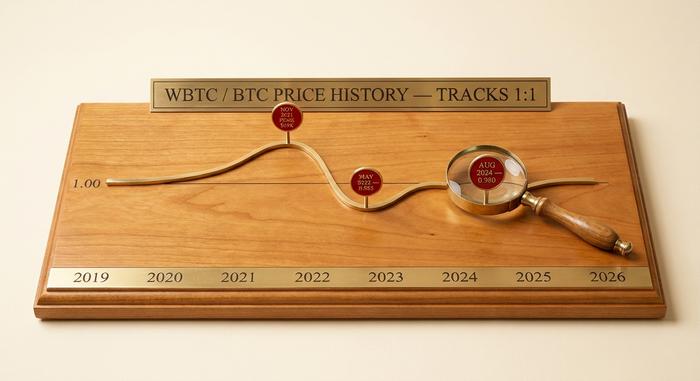
The wrapped bitcoin price today tracks the bitcoin price one-to-one. That's the design goal. As of 2026-04-24, the price of wrapped bitcoin sits around $69,012, within a few dollars of spot BTC. Check the live price on CoinGecko, CoinMarketCap, Kraken, Coinbase, or any DEX that lists the token. They all match up within a fraction of a percent.
In theory WBTC should match BTC exactly. In practice small premiums and discounts show up depending on supply and demand for wrapping and redemption.
| Condition | WBTC / BTC ratio | Typical market price effect |
|---|---|---|
| Normal market | 0.998 to 1.002 | Spread from minting fees and DEX liquidity |
| High DeFi demand | 1.01 premium | Users bidding up WBTC to get into Aave, Compound fast |
| Credibility shock | 0.90 to 0.98 discount | BitGo 2024 news, Justin Sun disclosure, early wobble |
| Gas spike | Small premium | Redemption is gas-heavy, so holders prefer to hold |
Three episodes in the wrapped bitcoin price chart history stand out. One, the 2021 peak: WBTC hit its all-time high near $69,000 on 10 November 2021, tracking BTC exactly. Two, the May 2022 stablecoin crash. WBTC briefly discounted 1.5 percent against BTC as DeFi users panic-sold wrapped assets. Three, August 2024's BitGo controversy. WBTC fell to a 0.98 discount against spot bitcoin before recovering inside a week.
For a full WBTC price chart with years of history, CoinGecko and CoinMarketCap are the standard sources. Both publish a wrapped bitcoin price chart that updates tick by tick during active trading hours. Want a long-term wrapped bitcoin statistics view (max 1Y, 5Y, since launch)? Kraken's research page and Kaiko's institutional dashboards cover it well.
How to Use WBTC in DeFi and Token Exchange
This is where WBTC earns its keep. It's an ERC-20 token, so any DeFi protocol on Ethereum can accept it. That unlocks options most bitcoin holders didn't have before. The short answer on why to use WBTC? It's the kind of bitcoin that can be used in the financial services built on Ethereum.
Main use cases in 2026:
- Lending and borrowing. Drop WBTC on Aave or Spark. Earn a small variable yield (usually 0.1% to 2% APR). Borrow stablecoins against it at 50% to 75% loan-to-value.
- Trading on DEXs. Uniswap, Curve, Balancer, SushiSwap all run deep WBTC pools. Swap WBTC for any other ERC-20 token. Or pair it against ETH for liquidity provision.
- Yield farming. Provide WBTC/ETH or WBTC/USDC liquidity on a DEX. Earn trading fees plus, sometimes, extra token rewards. Common on Uniswap V3 and Balancer.
- Collateral for stablecoins. MakerDAO and similar CDP protocols accept WBTC as collateral for minting DAI and other stablecoins.
- Cross-chain bridges. WBTC moves to Polygon, Arbitrum, Optimism, and Base via official bridges. That gives BTC holders access to cheaper DeFi platforms on Layer 2. Effectively, WBTC puts bitcoin on other blockchains without needing a separate wrapped version for each chain.
- Trading on a centralized exchange. Kraken, Coinbase, Binance, all list WBTC. Treat it like any other token for buying or selling.
WBTC is the dominant wrapped-BTC option on every major DeFi protocol by TVL. On Aave alone, it accounts for over 80% of all tokenized bitcoin deposits. Run a serious DeFi strategy with bitcoin exposure and you will touch WBTC at some point. The token exchange flow is as easy as swapping any ERC-20.
Wrapped Bitcoin Markets: Wrapped Bitcoin Statistics
Wrapped bitcoin statistics that actually matter, snapshot April 2026. Wrapped bitcoin markets break into two halves. Centralized exchange trading (Kraken, Coinbase, Binance, OKX). And decentralized exchange liquidity (Uniswap, Curve, SushiSwap).
| Metric | Value | Source |
|---|---|---|
| Circulating supply | ~128,000 WBTC | BitGo proof of reserve |
| Market cap | ~$8.8B | CoinGecko |
| 24h volume | $120M to $250M | aggregated CEX + DEX |
| CEX share of volume | ~58% | Kaiko estimate |
| DEX share of volume | ~42% | DefiLlama aggregate |
| Largest DEX pool | Uniswap V3 WBTC/ETH | ~$220M TVL |
| Top CEX by WBTC volume | Kraken | ~30% share |
WBTC trades on over 40 centralized exchanges and more than 60 DeFi protocols. Kraken leads CEX volume. Coinbase is close behind. On the DEX side, Uniswap's WBTC/ETH pool has been the deepest source of WBTC liquidity for years. It consistently holds more than $200 million in total value locked. That one pool alone now carries significant bitcoin liquidity for every major DeFi protocol that integrates Uniswap.
User base numbers tell the story of how WBTC is actually used. Most CEX holders use WBTC as a bitcoin proxy that is easier to move across Ethereum-native services. DeFi users hold WBTC primarily for lending collateral and liquidity provision. Retail holders rarely keep WBTC long-term; native BTC on the bitcoin blockchain is simpler and cheaper to store. Most bitcoin holders who also hold WBTC do so for a specific DeFi strategy, then unwind.
The BitGo Custody Controversy and WBTC DAO
August 2024 was the biggest WBTC test since launch. BitGo announced a restructuring that would move custody of WBTC from a single US entity to a joint venture between BitGo and BiT Global, a Hong Kong and Singapore firm. The rumor that broke the story faster than the official announcement: Justin Sun (Tron founder, man behind a string of polarizing projects) would be involved as a partner in the new joint venture.
DeFi protocols reacted immediately. MakerDAO held a governance vote that offboarded WBTC as a collateral type. Sky (formerly MakerDAO) reduced WBTC exposure across its vaults. Aave considered cutting WBTC loan-to-value ratios. The WBTC back to bitcoin redemption queue spiked as holders rushed to exit.
BitGo and Sun pushed back. Published extra audit materials. Reiterated that the BTC reserves stayed one-to-one against circulating WBTC. Throughout the episode, the proof-of-reserve dashboard kept showing reserves backed by actual btc held on the bitcoin network. No fraud materialized. But the whole mess flagged the structural risk of WBTC as a custodial product. It depends on trust in one party. And that one party can change in ways that matter.
The result was a permanent shift. WBTC's share of the wrapped-bitcoin category fell from roughly 90% in mid-2024 to around 60% by late 2025. Coinbase's cbBTC ate the gap. A WBTC DAO was discussed in industry forums as the long-term response, intended to decentralize governance of the merchant list and audit cadence. As of April 2026, the current WBTC issuance model still runs as a custodial joint venture, not a DAO-governed protocol. The WBTC DAO proposal is on the roadmap.

WBTC vs cbBTC, tBTC, LBTC: Crypto Token Safety
Bitcoin on other blockchains now has several flavors. Each has a different trust model and different strengths as a crypto token. For a BTC holders trying to decide which wrapper to use, the right choice depends on how much you value decentralization vs liquidity.
| Token | Custodian / mechanism | Chains | Pros | Cons |
|---|---|---|---|---|
| WBTC | BitGo + BiT Global joint custody | Ethereum + 10 L2s | Deepest liquidity, longest history | Custodial, 2024 controversy |
| cbBTC | Coinbase (single custodian) | Ethereum, Base, Solana | Simpler trust, regulated US entity | Centralized to one company |
| tBTC | Threshold Network (decentralized signers) | Ethereum, Arbitrum, Polygon | No single custodian, decentralized finance native | Smaller liquidity, more complex |
| LBTC | Lombard Labs (Babylon-staked) | Ethereum, Solana, TON | Yield-bearing via restaking | New, higher smart-contract risk |
| sBTC | Stacks (Bitcoin L2) | Stacks, not Ethereum | Bitcoin-native, no external custody | Limited DeFi ecosystem |
Coinbase launched cbBTC in September 2024, capitalizing on the WBTC custody wobble. cbBTC hit over 40,000 BTC of backing within 12 months. tBTC, the decentralized option from Threshold Network, stayed smaller. But it saw renewed attention from users who wanted to avoid custodial risk. LBTC, launched in 2024 by Lombard, added a yield-bearing twist by restaking the underlying BTC through Babylon.
Crypto token safety is a trade-off with four different answers. WBTC: size and liquidity. cbBTC: simpler single-company custody. tBTC: decentralization. LBTC: yield. The original Bitcoin design valued decentralization and self-custody. That's why tBTC and native bitcoin-layer solutions (sBTC on Stacks, BTC restaking through Babylon) appeal to purists. WBTC sits in the pragmatic middle. Trusted enough for institutional DeFi. Not trustless enough for maximalists.
Is WBTC Safe? A Quick BTC Holder's Checklist
Safety for WBTC breaks into three categories: custodial, smart contract, and market.
Custodial safety. The BTC is held in BitGo/BiT Global cold storage, and every unit of WBTC is backed one-to-one. The proof-of-reserve system is real and continuously audited. The historical record is strong: no WBTC redemption has ever failed. The 2024 BitGo/Sun restructuring introduced new jurisdictional risk but did not change the reserve backing. If you trust BitGo, you trust WBTC.
Smart-contract safety. The WBTC ERC-20 contract on Ethereum is a simple, mintable token. Audited by ChainSecurity and others. No exploits in the contract itself over six-plus years. DeFi protocols that integrate WBTC (Aave, Uniswap, Maker) have their own security histories, generally strong.
Market safety. WBTC trades with high liquidity on both CEXs and DEXs. Premium/discount spread against spot BTC usually stays under 0.5%. In stress events WBTC has occasionally discounted 1% to 2%, but never de-pegged hard. Recovery has been quick each time.
For most BTC holders who want to use DeFi, WBTC is safe enough. For maximalists who refuse any custodial layer, tBTC or native bitcoin-layer solutions are the better fit. For active DeFi users, WBTC remains the default because that's where the liquidity sits.
One practical note on sizing. The minimum sensible WBTC position is probably $1,000 or higher. Ethereum gas fees make smaller amounts uneconomic. With less than $500 of BTC and still want DeFi exposure? Use a Layer 2 like Base (which supports cbBTC natively). Or skip wrapping entirely.