What Is Spot Trading in Crypto? A Beginner’s Spot Crypto Guide
If you ever bought one Bitcoin on an exchange, hit "buy," watched the trade fill, and saw the BTC land in your account, you already did spot trading. The whole industry, from the tiny altcoin purchase on a phone to the institutional desk routing $50 million in ETH at 3 AM, runs on the same simple mechanic. Two parties agree on a price right now, money goes one way, the asset goes the other, and the trade settles immediately.
Spot trading is the most direct, most boring, and most important way to buy and sell digital assets in the crypto market. No leverage. No expiry. No counterparty contract dressed up as the asset. You pay, you own. Spot trading involves a real exchange of value rather than speculation on future price. If Bitcoin drops 30% the next day, that's on you. If it doubles, that's on you too. The simplicity is the entire feature.
This guide explains what spot trading in crypto really is, how it works behind the order book, what separates it from margin or futures, and how to do it without making the rookie mistakes that drain new traders. We will also look at the 2025 data (record volumes, the ETF effect, the October cascade) that put spot trading back at the center of the market.
Crypto Spot Trading: What It Is and Why It Matters
Spot trading in crypto is the immediate purchase or sale of cryptocurrencies at their current market price, with direct ownership transferring to the buyer at the moment of settlement. You hand over fiat (USD, EUR) or a stablecoin (USDT, USDC) and you receive Bitcoin or Ethereum or whatever else you bought. Settlement is instant. The coins land in your exchange account or, if you withdraw, your self-custody wallet. You own them. You can hold them for ten minutes or ten years.
The word "spot" comes from traditional finance, where it has meant "settled on the spot" since long before crypto existed. Forex desks have done spot trading for decades. Commodity traders settle gold on the spot. Crypto inherited the term and the mechanic, then added one twist: 24/7/365 markets, no closing bell, no public holidays, and a global pool of buyers and sellers that never stops bidding.
That second part matters more than newcomers realize. The combined spot trading volume across centralized crypto exchanges hit $2.07 trillion in May 2025 alone, according to Kaiko, with full-year 2025 spot volume topping $18.6 trillion across all venues. Bitcoin spot ETFs pulled in roughly $53 billion in net inflows during 2025, and BlackRock's IBIT alone reached $62.5 billion in cumulative assets. Spot is no longer a backwater. It is the largest, deepest, most liquid layer of the crypto market.
How Does a Spot Trade Actually Work?
Strip spot trading to its bones, and four things happen.
You deposit funds into a crypto exchange or DEX wallet. You pick a trading pair: BTC/USDT, ETH/USDC, SOL/USD, whichever applies. You submit an order. Either a market order ("buy now at the best available price") or a limit order ("buy only if the price hits $X"). The exchange matches your order against the opposite side of the order book. The trade fills, fees come off, and the resulting balance shows up in your account.
The math behind the match is straightforward. Every exchange maintains an order book listing all active bids (buyers willing to pay) and asks (sellers willing to take). When you submit a market buy, the engine pairs you against the lowest ask and walks up the book until your order is filled. The "spot price" you see quoted is just the midpoint between the highest bid and the lowest ask, updated thousands of times per second as new orders come in.
Settlement is what makes a spot trade a spot trade. The asset and the cash change hands the moment the orders match. Compare that to a futures contract, which locks in a future price for delivery in three months without any cryptocurrency actually moving until expiry. Spot is now-now-now. That immediacy and the direct ownership it gives you are the entire appeal, and also the limitation, because there is no built-in way to hedge against falling price movements.
Spot Market Mechanics: Order Books and Pricing
The spot market is the venue where these immediate exchanges happen. Spot trading lives on three architectures: centralized exchanges (CEXs), decentralized exchanges (DEXs), and over-the-counter (OTC) desks.
Centralized exchanges (Binance, Coinbase, OKX, Bybit) run an order book the same way a stock exchange does. Buyers and sellers post orders. The matching engine pairs them up. The exchange takes a small fee on each match. Binance owned roughly 40% of CEX spot share and about 64% of global volume per Kaiko's mid-2025 data. Coinbase, the largest US-regulated venue, runs a smaller share but dominates institutional flow on dollar pairs.
Decentralized exchanges replace the order book with a smart contract. Uniswap, Curve, and Raydium use automated market makers, where prices come from a math formula based on the pool's reserves. DEX share of total spot volume hit an all-time high of 37.4% in June 2025 before settling around 20%, per DeFiLlama. The advantage is non-custodial trading. The cost is sometimes higher slippage on thin pairs.
OTC desks handle large block trades that would move the public market. A buyer wanting $20 million in BTC can avoid leaving footprints on the order book by negotiating a single price with an OTC desk privately. The trade still settles on the spot. It just doesn't show up on a TradingView chart in real time.
The current market price you see on any of these venues is just the latest matched trade. Bid-ask spread, depth, and liquidity vary wildly between BTC/USDT on Binance (paper-thin spread, billions in depth) and a low-cap altcoin on a tier-three exchange (massive spread, fragile depth). For a spot trader, knowing the difference is the difference between a clean fill and a 5% slippage hit.
Trading Methods: Market Orders vs Limit Orders
Two trading methods do most of the work in spot trading.
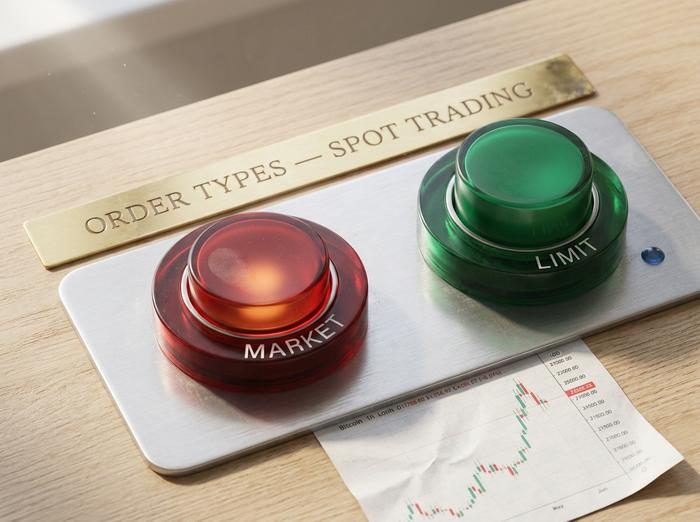
A market order tells the exchange to buy or sell immediately, at whatever the best available price happens to be. Speed first, price second. If you market-buy 1 BTC during a calm session, your fill price will sit within a few dollars of the screen quote. Try the same trade during a flash move, and you can pay 1-3% above the headline price as the engine eats up multiple ask levels to fill the order. That gap is slippage, and it is the unglamorous tax that market orders pay.
A limit order tells the exchange to execute only at your chosen price or better. You set the bid. You wait. If the market touches your level, the trade fills. If it doesn't, the order sits. Limit orders give you control. They also give you the chance to miss the move entirely while you wait.
Most experienced spot traders use a mix. Limit orders for planned entries when price is a few percent away. Market orders when speed matters more than the last few basis points. Stop-loss orders (a special form of conditional market order) for downside protection. Take-profit orders (a conditional limit) to lock in gains while you sleep. Whatever you choose, read the order on the wallet or exchange screen before you confirm. The cleanest accidents in crypto come from a fat-fingered "buy" that should have been a "sell."
Spot Trading vs Margin Trading and Futures
The single biggest decision a new crypto trader makes is whether to stick with spot or jump into margin and futures. The trade-offs are worth understanding before the first leveraged position blows up.
| Feature | Spot Trading | Margin Trading | Futures Trading |
|---|---|---|---|
| Asset ownership | Yes, real coins | Borrowed coins, real for now | Synthetic contract, no coins |
| Leverage | None | Typically 2x-10x | Up to 100x+ on perpetuals |
| Liquidation risk | None | Yes, lose collateral | Yes, lose collateral |
| Maximum loss | Initial capital only | Initial capital, can hit zero fast | Initial capital, can hit zero fast |
| Funding fees | None | Borrow interest | Funding rate every 8h on perps |
| Best for | Long-term holding, beginners | Short-term swing trades | Hedging, professional speculation |
| Tax treatment (US) | Capital gains | Capital gains + interest | Often Section 1256 contracts |
Spot is the conservative choice. Your worst-case outcome is the asset going to zero, in which case you lose only what you put in. Margin trading borrows funds against your collateral to amplify the position. Futures and perpetuals do the same with synthetic contracts. The October 10-11, 2025 cascade was a case study in what happens when leverage breaks. CoinGlass logged $19.13 billion in liquidations across 1.6 million traders in 24 hours, including $10.3 billion on Hyperliquid alone, $4.65 billion on Bybit, and $2.41 billion on Binance. Bitcoin dropped roughly 18% from a $126,000 all-time high inside that window. Pure spot holders saw a painful unrealized drawdown but lost nothing involuntarily. Leveraged traders got force-closed.
Derivatives now dominate raw volume. About 73.2% of total Q1 2026 crypto trading volume sits in derivatives per CCData. But spot is where ownership lives, and ownership is what most retail traders actually want.
Pros and Cons of Spot Trading in Crypto
Spot trading carries a clear set of advantages and a smaller but real list of drawbacks.
Pros first. You own the underlying asset, so you can withdraw to a personal wallet, stake it, use it as collateral elsewhere, or simply hold for years. There is no liquidation. The most you can lose on a single position is the capital you put in, which means a 50% drawdown is painful but survivable. Tax accounting is simpler than derivatives in most jurisdictions; the IRS treats spot crypto sales as capital gains under standard short-term/long-term rules. Beginners can start with $50 and a basic exchange account, no margin agreement, no separate derivatives onboarding.
Cons next. There is no built-in way to profit from a falling market. If you think Bitcoin is going to crash, spot offers only "do not buy" as a strategy. Returns are capped by the capital you actually deploy; no leverage means no 10x amplification. Holding spot means dealing with custody risk: either the exchange's solvency (FTX, 2022) or your own wallet's security (phishing, lost keys). Liquidity for small altcoins can dry up fast; a token that traded $10 million daily during the bull can become unsaleable below the bid in a bear market.
The honest framing: spot trading is the simplest, lowest-stress entry point to crypto, and most retail traders should never leave it. The numbers back this up. Of the spectacular wipeouts that fill crypto Twitter timelines, virtually all involve leverage. Spot losses are slow and visible. Leveraged losses are sudden and terminal.
Advantages of Spot Trading for Beginners
For someone learning the market, spot trading wins on six counts that derivatives cannot match.
First, the mental model is simple. Buy at one price, sell at another, keep the difference (or eat it). No funding rates. No mark price calculations. No liquidation thresholds to monitor.
Second, your downside is bounded. The position can lose value. The position cannot trigger a margin call at 3 AM and force you out at the worst possible price. You see your unrealized loss on the screen and decide what to do.
Third, the asset is yours. Withdraw it to a hardware wallet and the exchange has no further claim on it. Stake it on Lido or Coinbase Earn. Send it to a friend. Real coins can do real things. Synthetic contract positions cannot.
Fourth, fees are cheap and predictable. Most major exchanges charge 0.10% to 0.40% in spot trading fees, with reductions for market makers, high-volume tier traders, or holders of the exchange's native token. Coinbase and Binance both run zero-fee BTC/USD or BTC/USDT promotions for advanced retail accounts. There is no funding rate cost for holding overnight.
Fifth, learning is cumulative. Order types, slippage, position sizing, and risk management all carry over directly to derivatives if you decide to graduate later. Going the other direction (futures first, spot later) leaves a lot of expensive lessons embedded in liquidation history.
Sixth, the regulatory and tax picture is cleaner. Spot trading in the US is well-established under existing securities and commodity rules. The IRS released Form 1099-DA for tax year 2025, which exchanges now use to report digital asset transactions; the format mirrors existing 1099-B securities reporting. Derivatives, especially perpetual swaps, sit in murkier territory.
Bitcoin Spot ETFs and What They Changed
January 2024 changed crypto spot markets in a permanent way. The SEC approved 11 spot Bitcoin ETFs after a decade of rejected applications. Spot ETH ETFs followed in July 2024. The effect on the underlying market has been steady, large, and easy to measure.
Through 2025, BTC spot ETFs absorbed roughly $53 billion in net inflows, with BlackRock's IBIT alone reaching $62.5 billion in cumulative assets according to ETF.com. Spot ETH ETFs pulled in $9.9 billion across 2025, with BlackRock's ETHA capturing about $9.1 billion of that. The flows do not just sit in the funds. The issuers buy actual Bitcoin and Ethereum on the spot market, often on Coinbase Custody, which means ETF demand translates into real on-chain accumulation.
For retail spot traders, the ETF era has three concrete consequences. First, deeper spot liquidity on the major dollar pairs, especially during US trading hours when ETF authorized participants are active. Second, a more visible institutional footprint, which can dampen the wildest 30% intraday swings that defined earlier cycles. Third, a clearer mainstream on-ramp for capital that does not want self-custody risk, which has shifted some retail flow from direct spot trading on exchanges into ETF buying through brokerage accounts.
Spot trading on a crypto exchange and ETF buying are not the same thing. The ETF is a wrapper. You own shares of a fund that owns the Bitcoin. Direct spot ownership keeps the full bundle of rights: self-custody, on-chain transfer, staking on PoS chains, the works. For most US retail traders the choice depends on whether they want the convenience of a brokerage account or the full sovereignty of holding the asset themselves.

Trading Strategies for Crypto Spot Markets
A few trading strategies dominate retail spot trading activity. None of them require leverage. Most reward patience over reflex.
Dollar-cost averaging (DCA) is the simplest. Buy a fixed dollar amount on a fixed schedule. $200 of BTC every Friday, for example. Regardless of price. Over time you accumulate at an average cost that is mathematically lower than the average price across the same period. DCA does not maximize returns, but it removes timing pressure and works particularly well in volatile assets like Bitcoin where retail traders consistently underperform their own buy-and-hold instincts.
Swing trading aims at multi-day or multi-week price moves. A swing trader buys when technicals (a confirmed support bounce, a bullish chart pattern, RSI rising from oversold) line up, and sells into resistance or a target level. Spot makes this clean: no funding rate eating returns, no liquidation pressure if a position runs against you for a day before recovering.
Trend following is closer to passive investing. Hold while the trend is up. Trim or exit when key moving averages flip. Wait for the next setup. This works well for spot because there is no time decay on the position.
Range trading suits sideways markets. Buy near the bottom of a defined range. Sell near the top. Repeat. Spot trading lets you run this loop without the funding-rate cost that bleeds out range traders on perpetuals.
Pair selection matters at every step. Stick to the major pairs (BTC/USD, ETH/USD, BTC/USDT, ETH/USDT) for the cleanest fills, the tightest spreads, and the most reliable charts. Drift down into low-cap altcoins for higher upside but accept thin liquidity, larger slippage, and the real possibility that the project rugs or vanishes.
Choosing a Crypto Exchange for Spot Trading
The exchange you pick shapes everything: the pairs available, the fees, the security, the regulatory clarity. A short rubric covers the decision.
Look at fees first. The gap between casual and pro tiers can dwarf any single-trade slippage for active traders. A simplified 2026 comparison:
| Exchange | Maker (entry) | Taker (entry) | Pro tier maker / taker |
|---|---|---|---|
| Coinbase Advanced | 0.60% | 0.40% | 0.00% / 0.05% |
| Binance Spot | 0.10% | 0.10% | <0.04% / <0.04% with BNB |
| Kraken Pro | 0.25% | 0.40% | 0.00% / 0.10% |
| Bybit Spot | 0.10% | 0.10% | 0.025% / 0.060% |
| OKX | 0.080% | 0.10% | 0.020% / 0.050% |
Most retail accounts sit in the entry-tier row. Active traders or those holding the exchange's native token drop fees substantially.
Liquidity matters next. The top three pairs on Binance and Coinbase will fill a $100,000 order with negligible slippage. The same trade on a tier-three exchange or a thinly traded altcoin can move the price 2% before you finish. Always size to the depth you can see on the order book.
Regulatory standing matters for US users especially. Coinbase, Kraken, and Robinhood Crypto operate under state-level money transmission and SEC oversight. Binance.US is more limited than the global Binance exchange. Bybit and OKX are not generally available to US retail. Pick a venue you can actually use legally and that publishes proof-of-reserves data.
Security is non-negotiable. Two-factor authentication, withdrawal whitelist, hardware-wallet integration, and proof of cold-storage holdings should be table stakes. The Bybit hack on February 21, 2025, drained $1.5 billion from a corrupted cold-to-warm wallet transfer, attributed by the FBI to North Korea's TraderTraitor group. Even the largest, most-audited venues are not immune; running balances at the bare minimum needed for active trading and self-custodying the rest is the standard play.