What Is a Pip in Forex Trading? Value and Examples
A pip in forex is the smallest number on a trading screen, and also the one that decides whether you made money. Every spread you pay, every profit you book, every stop-loss you set is counted in pips. It is a tiny unit, four decimal places deep, and traders who never bother to understand it tend to misjudge exactly how much they are risking on each trade.
The pip is a forex convention, with precise and universal rules. That is worth saying up front, because the moment you carry the word into crypto, those rules fall apart. This guide explains what a pip in forex really is, how to work out what one is worth in your own account currency, and then what happens to the idea when you move from currency pairs to Bitcoin, where no shared standard exists at all.
What a pip in forex actually is
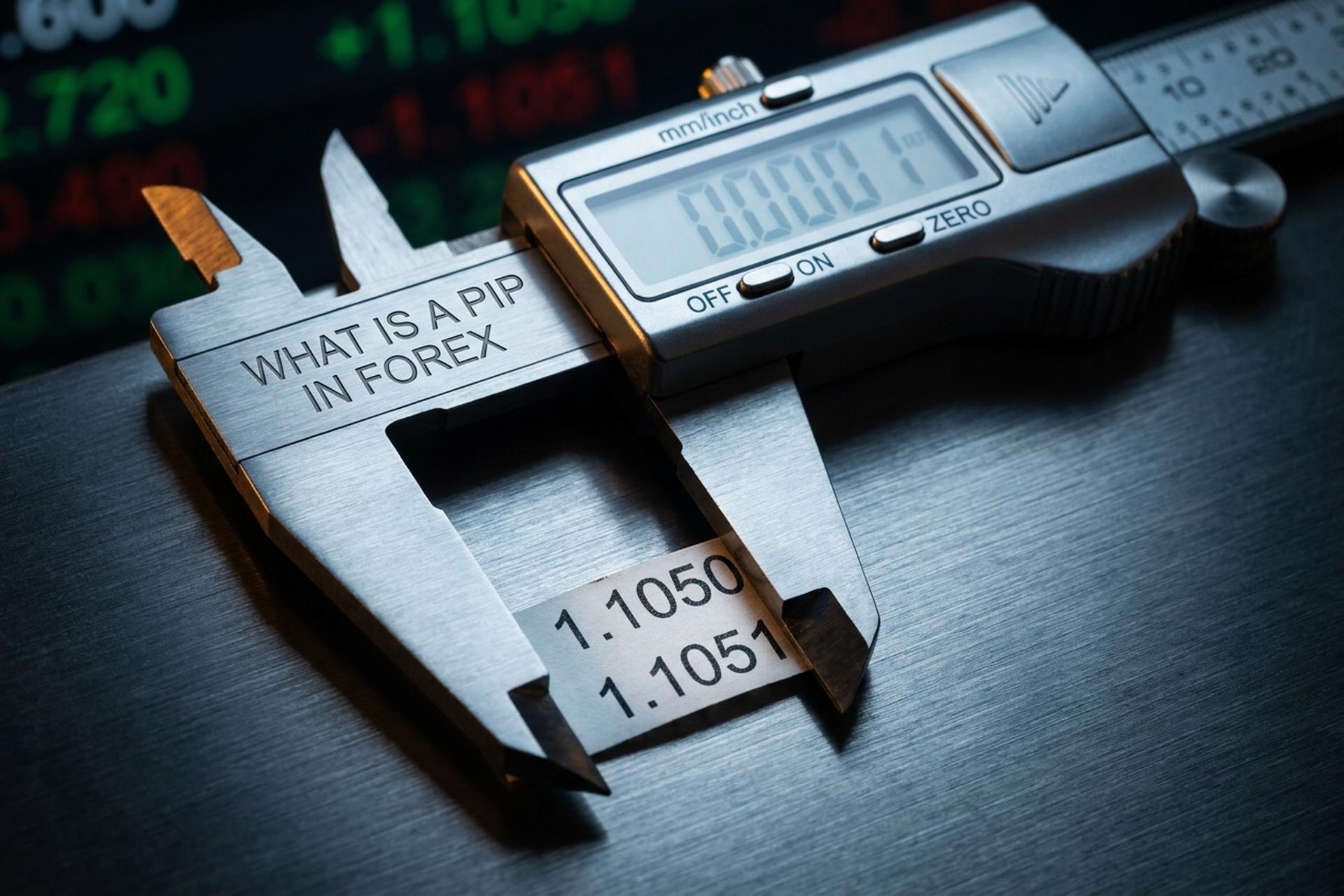
A pip, short for "percentage in point" (some brokers say "price interest point"), is the smallest standardized price movement a currency pair normally makes. For most pairs, one pip sits at the fourth decimal place: 0.0001. If EUR/USD moves from 1.1050 to 1.1051, that is a one-pip move. Nothing more complicated than that.
The reason the unit exists is scale. Currency prices run out to four or five decimals, and the foreign exchange market is enormous. The Bank for International Settlements put global daily FX turnover at $9.6 trillion in April 2025, up 28% from $7.5 trillion three years earlier. A market that large, quoting prices that granular, needs one shared, tiny unit so that a trader in Tokyo and a broker in London are talking about the same increment when they say a pair "moved 20." The pip is that unit, and because it is fixed everywhere, it turns an abstract decimal into something you can count, price, and risk against.
The decimal rule and the Japanese yen exception
For the great majority of currency pairs, the rule is simple — one pip is the fourth decimal place, 0.0001. EUR/USD, GBP/USD, AUD/USD all follow it. Then there is the exception everyone trips over at least once. Any pair that involves the Japanese yen quotes the pip at the second decimal place instead, so one pip equals 0.01.
This is not an arbitrary quirk. The yen simply trades at a very different price scale. One dollar buys well over a hundred yen, so USD/JPY is quoted as something like 148.20 rather than 1.4820. Pushing the pip out to the fourth decimal there would make it absurdly small, so the convention shifts it two places left to keep a pip meaningful. Once you know which camp a pair belongs to, the rest of the math follows.
| Pair type | Example | One pip | Decimal place |
|---|---|---|---|
| Most major pairs | EUR/USD, GBP/USD | 0.0001 | Fourth |
| Yen pairs | USD/JPY, EUR/JPY | 0.01 | Second |
| With a pipette | EUR/USD 1.10501 | 0.00001 | Fifth (fractional) |
| With a pipette (JPY) | USD/JPY 148.205 | 0.001 | Third (fractional) |
Pipettes: the fractional pip explained
Look at most broker platforms and you will see a fifth decimal on EUR/USD, or a third on USD/JPY. That extra digit is not a typo. It is a pipette, also called a fractional pip, and it equals one tenth of a pip.
Brokers added it to quote tighter, more competitive prices. Instead of pricing only to the full pip, they price to a tenth of one, which lets spreads come in below a single pip during calm markets. Traders sometimes call this "4-and-2 versus 5-and-3" pricing: four decimals plus a pipette for most pairs, two plus a pipette for yen pairs. It matters mostly when you read a quote, so you do not mistake a pipette for a whole pip and overestimate a move by a factor of ten.
How to calculate pip value step by step
Knowing what a pip is matters far less than knowing what one is worth to you. That gap is where most beginners lose money. Pip value is the money that one pip of movement adds to or subtracts from your position, in your account currency. It depends on two things — the size of your position, and which side of the pair your account currency sits on, because where the dollar sits in the quote changes the arithmetic. The base formula itself is straightforward: pip value equals the pip size multiplied by the number of units traded, adjusted by the exchange rate when your currency is not the quote currency.
When the dollar is the quote currency (easy case)
When the US dollar is the second, quoted currency in the pair, the math is clean. On EUR/USD, 1 pip (0.0001) on a standard lot of 100,000 units is worth exactly $10. Scale that down with the lot and the value scales with it, in a perfectly linear way. This predictability is the whole point of the convention.
When the dollar is the base currency (USD/JPY, USD/CAD)
When the dollar is the first, base currency, you have to divide by the exchange rate. Take USD/CAD at 1.2829 — 0.0001 divided by 1.2829, times 100,000 units, gives about $7.79 per pip on a standard lot. USD/JPY works the same way, landing near $9.13 per pip at recent rates. The number drifts as the rate moves, which is why a calculator beats memory here.
Lot sizes: standard, mini, micro
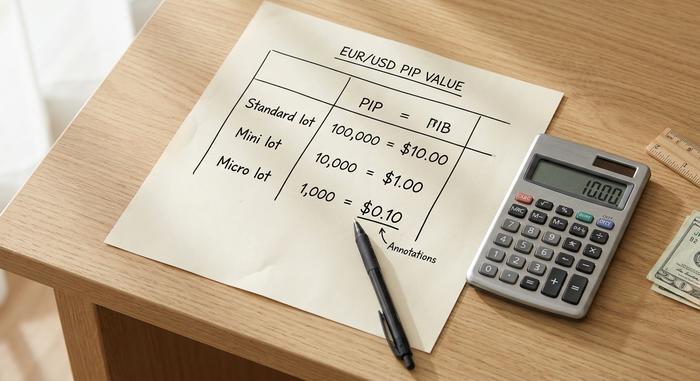
Position size is just lot size in disguise. A standard lot is 100,000 units of the base currency, a mini lot is 10,000, and a micro lot is 1,000. Because pip value scales linearly, the EUR/USD figures fall out neatly, and they are worth committing to memory as your anchor.
| Lot type | Units | EUR/USD pip value | 50 pips |
|---|---|---|---|
| Standard | 100,000 | $10.00 | $500 |
| Mini | 10,000 | $1.00 | $50 |
| Micro | 1,000 | $0.10 | $5 |
Spread, profit and the value of a pip
Pips are not an academic detail. They are where your costs and your profit or loss actually live. The spread, the gap between the bid and ask prices, is quoted in pips and is the first thing you pay on every trade. On EUR/USD that spread can sit near a tenth of a pip on a good ECN account in deep liquidity, then widen to several pips in the seconds around a central bank decision or a jobs report (a non-farm payrolls release is the classic example). That widening is a real cost, and because it is paid on entry, it is measured in the same unit as your gains.
The profit side is just as direct. A 30-pip move in your favor on a standard EUR/USD lot is $300; on a mini lot it is $30. Now add leverage. In the EU, regulators cap retail leverage at 30:1 on major pairs, which means a small deposit controls a much larger position, and every pip swings your balance far more than the cash you put down. This is the part beginners underestimate. The pip looks trivial until leverage multiplies it, and a 50-pip stop that felt small on paper turns out to be a meaningful share of the account.
Crypto pips and the units smaller than pips
Here is where the tidy forex picture breaks. Crypto has no standardized pip. There is no fourth-decimal rule, no shared convention, nothing that a trader on one exchange and a trader on another can both assume. Each venue prices coins to whatever decimal precision suits the asset, and each CFD broker invents its own "pip" on top of that.
Why crypto has no standard pip
A few examples show the mess. On IG's Bitcoin CFD, one pip is simply defined as $1 of price movement, a broker convention rather than a market-wide standard, while the same broker treats a $0.01 move as the unit for cheaper altcoins like Cardano or Dogecoin. eToro does not quote crypto in pips at all; it bakes a flat percentage fee into the spread instead. Spot exchanges, meanwhile, just price to a coin's natural precision, two decimals for Bitcoin, more for low-priced tokens. The word "pip" still gets used, but it means whatever the platform says it means. That is the opposite of forex, where the pip is fixed precisely so nobody has to ask.
The satoshi: crypto's true smallest unit
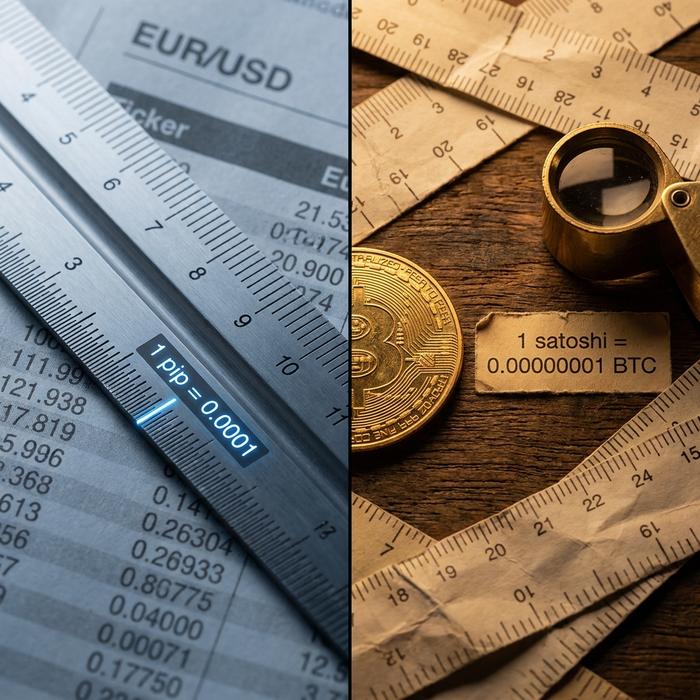
Crypto does have a genuine smallest unit, but it is not a pip. A bitcoin divides down to the satoshi, one hundred-millionth of a coin, or 0.00000001 BTC, with 100,000,000 satoshis in every bitcoin. The satoshi is an on-chain accounting unit, the smallest amount the network can record, not a quoting convention for measuring price moves the way a pip is. In regulated futures the role of the pip is filled by the tick: CME sets Bitcoin futures' minimum move at $5 per coin. So crypto has units smaller than any forex pip, and units larger, but nothing that does the pip's exact job.
| Feature | Forex pip | Crypto |
|---|---|---|
| Standard unit | 0.0001 (0.01 for JPY) | None; broker- or venue-defined |
| Smallest real unit | Pipette (1/10 pip) | Satoshi (0.00000001 BTC) |
| Futures increment | Pip / point | Tick ($5/BTC on CME) |
| EU retail leverage cap | 30:1 majors | 2:1 |
That last row is the practical warning. EU regulators cap retail crypto leverage at just 2:1, against 30:1 for major forex pairs, a gap that reflects how much more violently crypto moves. A "one-pip" idea borrowed from forex badly understates the risk when the underlying asset can swing several percent in an hour.
Pip vs point vs tick: clearing up the terms
Three words get blurred together, and keeping them apart saves confusion. A pip is the forex-specific unit at the fourth decimal. A point usually refers to a whole-number move, the digits to the left of the decimal, or in some platforms the very last digit of a price. A tick is the minimum price increment an exchange allows, the term used mainly in futures and on crypto venues.
The distinction tracks the market. Forex grew up around the pip because spot currency prices needed a shared sub-decimal unit. Futures and exchange-traded products use ticks, because each contract has its own minimum increment set by the exchange, such as $5 per bitcoin on CME or $10 on a crude oil contract. Crypto inherited "tick" from that exchange world rather than "pip" from forex. When someone quotes a crypto move in pips, they are really borrowing a forex word for a market that never adopted the convention.
A quick forex pip calculator walkthrough
In practice you will rarely compute pip value by hand. Every broker and most trading sites offer a pip calculator: enter the pair, the lot size, and your account currency, and it returns the value of one pip and your profit or loss for a given move. It does the exchange-rate adjustment for you, which is the part most people get wrong.
Still, run the numbers by hand at least once, so the figure stops being abstract. It pays off. Three mistakes catch beginners over and over, and I have watched traders make all three: confusing a pip with a pipette and overstating a move tenfold, ignoring the spread when sizing a trade, and forgetting that leverage scales pip risk just as much as pip reward. Get those three right and the calculator becomes a check, not a crutch.
What a pip means, in forex and beyond
In forex, the pip is a precise, shared, almost regulated-feeling unit. It exists so a $9.6-trillion-a-day market can agree on the smallest move that matters, and its rules, the fourth decimal, the yen exception, the linear pip value by lot size, are worth knowing cold. In crypto, the pip is a convenience layer a broker bolts onto an asset that never asked for one, while the real smallest unit, the satoshi, does a different job entirely.
The takeaway is the same in both markets. Before you size a position, know which decimal you are trading and what one pip is worth in your own currency. Run your pair through a calculator once, by hand, and the number stops being abstract and starts being risk you can actually see.