Forex Signal in 2026 : How Trade Signals Help Traders
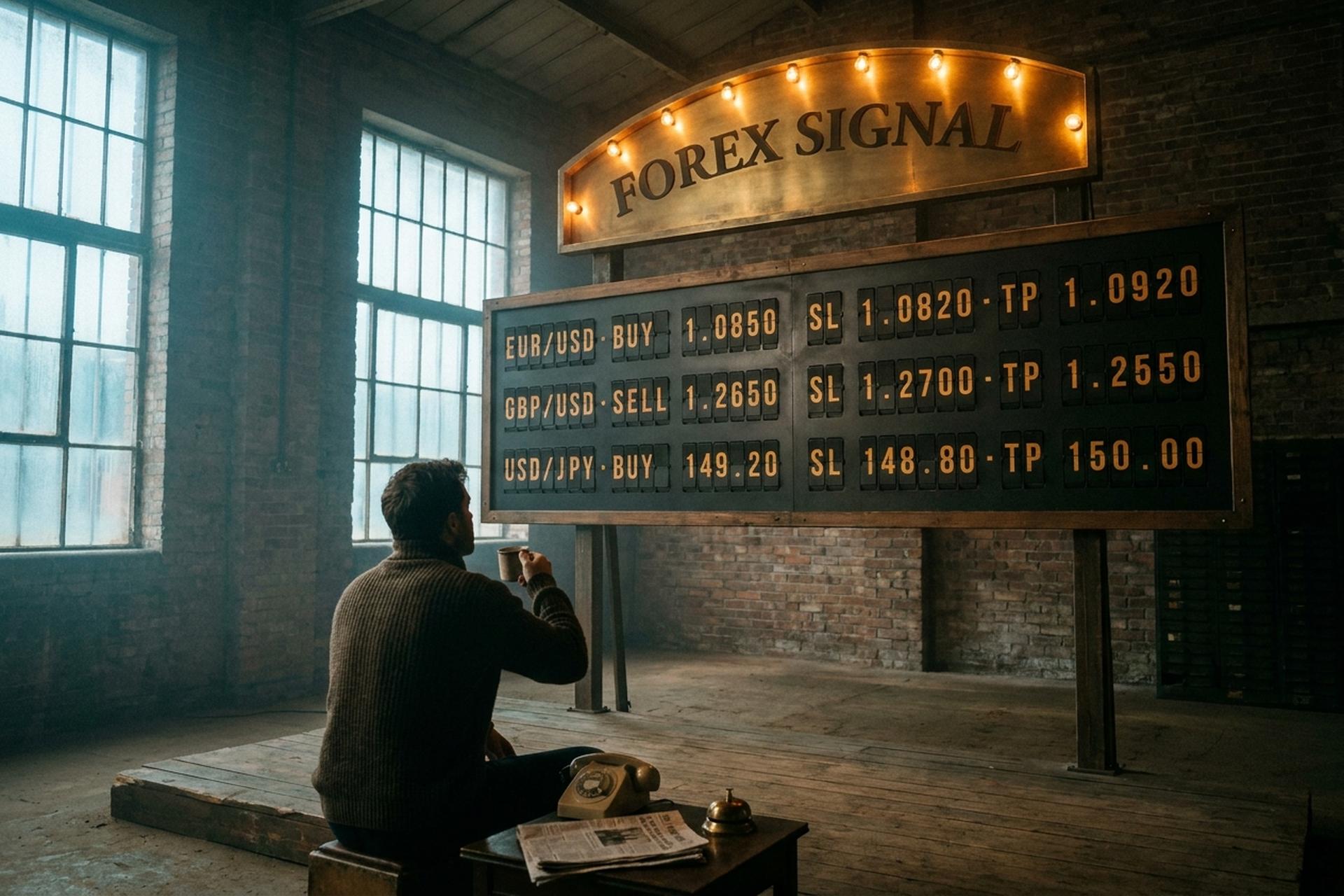
Every weekday, at about 8:00 AM New York time, roughly $9.6 trillion in foreign exchange activity rolls through the global market. That number comes from the BIS Triennial Survey published on September 30, 2025. Buried inside it is a much smaller, noisier layer: retail traders at laptops in Manila, Nairobi, Lagos and Miami, each one watching their phone for the next notification.
The notification is the signal. Someone, somewhere, either a human analyst or an algorithm, just decided that EUR/USD is about to move. The signal lands in your Telegram or your email or your MT4 copier. It tells you the pair, the direction, the entry price, the stop loss, the take profit. You decide whether to take it.
This is a beginner's guide to what a forex signal actually is in 2026. How the signal is generated. Where you get it. What a realistic win rate looks like once you peel off the marketing. And why 74% to 89% of retail accounts still lose money despite all of it.
What is a forex signal and how does it work?
A forex signal is a trade recommendation on a currency pair. Nothing more exotic than that. Someone says "buy GBP/USD at 1.2650, stop loss at 1.2600, take profit at 1.2750", and you decide whether to follow it. That is the whole product.
The signal can come from a human analyst staring at charts since 6 AM, or from a piece of software scanning for a technical pattern, or from a hybrid of both. It can arrive as a Telegram message, an SMS, an email, a push alert inside an app, or as an automatic trade placed into your MetaTrader account by a copier. All of those are forex signals. The delivery channel does not change the nature of the thing.
What a good signal does is very specific. It tells you the exact entry price (or a tight entry range), it tells you the stop loss, and it tells you the take profit. It tells you what pair and what direction. A "buy EUR/USD around here" message with no stop is not a signal. It is an opinion.
Forex signals exist because retail traders outside of institutional desks rarely have the time or the screen real estate to sit across four price charts at 7 AM New York, read central bank commentary, model where an economic release might push a pair, and then act within seconds. Someone else does that work. You pay either money or attention to receive the output.
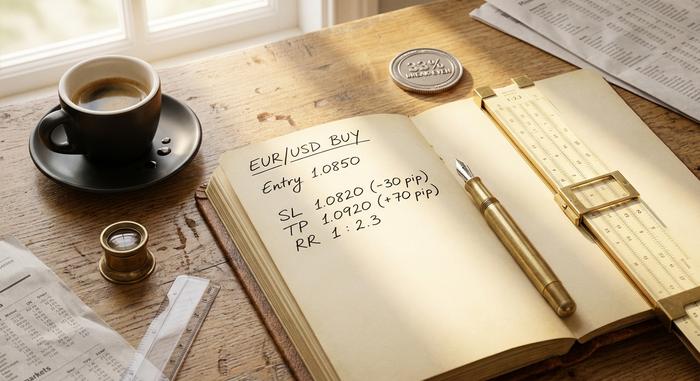
Forex signal anatomy: entry, stop loss, take profit, pip
A clean forex signal has six numbers and one direction. Here is what each slot means.
| Component | Example | What it means |
|---|---|---|
| Pair | EUR/USD | The currency pair to trade |
| Direction | Buy (long) | Whether to buy or sell the base currency |
| Entry | 1.0850 | The price at which to open the position |
| Stop loss | 1.0820 | The price at which to close if the trade goes against you |
| Take profit | 1.0920 | The price at which to close for a win |
| Risk:reward | 1:2.3 | Ratio of potential loss to potential gain |
| Timeframe | H1 / 4H | The chart period the setup is based on |
A pip is the smallest standard price movement in a currency pair. For most majors (EUR/USD, GBP/USD), one pip is 0.0001. A 30-pip stop and a 70-pip target means you are risking 30 pips to make 70, a 1:2.3 risk-to-reward ratio.
The risk:reward ratio quietly determines whether the signal service makes you money. Educational material from Alchemy Markets and Forex.com lays out the math clearly: a signal service with a 1:2 RR only needs you to win 33% of the time to break even. A 1:3 RR needs just 25% wins. That is why realistic professional signal services that publish 60% to 75% win rates at a 1:1.5-to-1:2 risk:reward can be profitable, while services that hit 90% wins but use a 3:1 RR (risk three to make one) can quietly drain accounts.
A rule of thumb: if a signal does not include a stop loss, it is not a signal. It is a gamble dressed up in a Telegram post.
Types of forex trading signals: manual vs algorithmic
There are four common species of forex trading signals. They are not mutually exclusive, and most paid services mix them.
Manual signals from a human analyst. A person, often with years of screen time, identifies a setup and posts it. Think 1000pip Builder, which has a Myfxbook-verified multi-year track record, or the chat rooms inside ForexSignals.com where mentors call trades live. Slower, but the reasoning is usually explained, which matters for learning.
Algorithmic signals from a trading bot. Software scans thousands of charts, spots a pattern, and fires. FX Leaders, for example, sweeps over 3,000 assets using six indicators (Fibonacci, EMA, Stochastic, RSI, Pivots, and support/resistance). Faster, more signals per day, no emotion. Also no judgment about whether today's price action is the kind of environment the algorithm was trained for.
Hybrid AI + analyst. The current dominant pattern in 2026. AltSignals and several Learn2Trade products mix an AI engine with a human overlay. A cited 2023 BIS study suggested AI outperformed human forecasters by about 15% in volatile conditions; that edge has narrowed in calm markets but has not disappeared.
Copy-trade and auto-execution signals. Platforms like ZuluTrade, eToro CopyTrader, Myfxbook AutoTrade and the MQL5 signal marketplace turn a signal into an immediate trade on your account. You do not even see the individual message. You just subscribe to a leader and their positions clone into yours. ZuluTrade alone reports 2.4 million users and over 90,000 signal providers across 150+ countries.
These four types trade off speed, transparency and control in different ratios. The right one for a beginner is almost always the manual or hybrid option, with copy trading only used once you already understand what the leader is doing.
Technical vs fundamental analysis in forex signals
Every forex signal, underneath the Telegram wrapping, comes from one of three places. The chart. The news. Or a blend of both.
Technical signals live on the chart. No macro. No ECB. Just price. The technical indicators you will see cited most often are moving averages (EMA, SMA), the RSI, MACD, Fibonacci retracements, pivot points, and good old support and resistance. A clean technical signal reads something like: "EUR/USD bounced off 1.0850 for the third time, RSI oversold on H4, entry 1.0855, stop 1.0820, target 1.0920." That's it. No story about Europe. The picture is the story.
Fundamental signals come from data and events. Here the analyst watches central bank calendars (Fed, ECB, BoE, BoJ), inflation prints, jobs reports, and whichever geopolitical fire is burning that morning. Non-farm payrolls and FOMC meetings used to be the two biggest signal-generation windows of the month, year after year. 2025 broke that. StoneX and Forex.com commentary flagged that NFP and FOMC releases triggered muted reactions through most of 2025, partly because BLS data went sideways after the October 2025 US government shutdown, and partly because of heavy backward revisions to earlier prints. Traders stopped trusting the number.
Price action signals are technical but stripped to the bone. No indicators at all. Just candlesticks and structure. Pin bars. Engulfing candles. A trendline that finally broke. Beginners like price action because there is no hidden parameter on a moving average. The rule is what the chart shows.
Most solid signal services blend at least two of these approaches. A pure technical signal into an ECB rate decision is asking to get stopped out. A pure fundamental call with no chart level is not really a signal, it is just a view.
How traders use signals with a forex broker
A signal is useless without an account behind it. Traders take signals through three pieces of infrastructure: a forex broker account (regulated or offshore), a trading platform (usually MetaTrader 4 or 5, cTrader, or the broker's own web app), and a risk-management plan that fixes position size in advance.
The workflow looks like this. The alert comes in. You compare the live price on your platform against the signal's entry. You size the trade based on how much of your account balance you are willing to risk on one position — industry norm is 1% to 2% per trade, and that is a hard ceiling, not a starting point. You enter with the stop loss and take profit already set. Then you step away and let it run. No hovering.
The broker sits between you and the market. A regulated retail account under ESMA or FCA rules caps leverage on majors at 30:1. Offshore venues, including some crypto-native names like XBTFX that accept USDT deposits, run 500:1 or higher. More leverage lets a small account act on signals, but every loss scales with it. FCA numbers say roughly 80% of UK-based CFD traders finish the year in the red. ESMA broker disclosures across 2024-2025 put average losses per client in a wide band from EUR 1,600 up to EUR 29,000, depending on the broker.
Professional traders do use signals. But almost never as the whole strategy. More often a signal is a sanity check. You've been watching EUR/USD for two hours. A signal drops that says the same thing you were already thinking. That confirmation is what you actually paid for, not the idea itself.
Get free forex signals vs paid forex signal service options
Free forex signals exist in abundance. Public Telegram channels, Twitter (X) posts, forex Discord servers, broker blogs, and demo-account features from MT4 all push signals at zero cost. The business model behind free signals is almost always one of three things.
1. Broker affiliation. The free signal provider earns a rebate every time you open or fund a broker account through their referral link.
2. Upsell funnel. Free signals lead to a paid VIP tier that costs money. FXPremiere, for example, has grown a free community past 75,000 members since 2010 and monetises a paid tier at $57+ per month.
3. Promotion of other products. Courses, mentorship programmes, prop-firm challenges, or brokerage services.
A paid forex signal service is usually cheaper than people expect. The typical VIP subscription in 2026 costs $79 to $250 per month. The MQL5 signal marketplace spans $30 to $999 per month per signal, with the expensive tiers almost always tied to a verified historical track record. Learn2Trade, 1000pip Builder, ForexSignals.com, AltSignals and UnitedSignals all sit in roughly the same $79-$149 range for their headline plan. Some services, such as UnitedSignals, offer a lifetime plan around $299.
Free is fine when you are learning the language of signals. Paid is where you get verified performance history, tighter entries, and a real track record you can audit on Myfxbook or MQL5 before you spend a cent.
Best forex signals on Telegram and other channels
Telegram dominates forex signal distribution in 2026, and has for years. The format is cheap to run, push notifications are instant, and the chat thread keeps a public record of every call. Discord is stronger in crypto; forex has not made the jump.
Here is a snapshot of the biggest names at the time of writing.
| Provider | Telegram footprint | VIP subscribers | Typical price | Claimed approach |
|---|---|---|---|---|
| United Kings | 500,000+ free members | 13,000+ VIP, 50+ countries | Tiered VIP | Human + algo hybrid |
| Learn2Trade | ~39,000 free followers | Not disclosed | ~GBP 40/month | Analyst + algo |
| AltSignals | 50,000 free | 1,500 VIP | $50-$125/month | AI + human |
| SureShotFX | 50,000 free | Tiered VIP | Tiered | Human analysts |
| FXPremiere | 75,000 registered (since 2010) | Cumulative | $57+/month | Human analysts |
| 1000pip Builder | Not disclosed | Myfxbook-verified | ~$97/month | Single human analyst |
| ForexSignals.com | Private live room | Subscription-based | ~$97/month | Human mentor room |
Two warnings. First, the member counts are self-reported; Telegram does not audit them. Second, claimed win rates of 80% to 95% on any channel should be treated with skepticism. Independent reviewers including Investor Tipster put realistic professional accuracy at 60% to 75%.

Copy trading, signals trading, and live streams
Copy trading is where signals turn into trades without you touching anything. You click subscribe. The leader's positions replicate into your account proportionally. If they risk 1% of their account, you risk 1% of yours. When they close, you close.
The headline numbers in 2026 are serious. eToro reported 3.73 million funded accounts in Q3 2025, up 16% year over year, with 35 million-plus registered users. ZuluTrade claims 2.4 million users, 90,000-plus signal leaders and over $800 billion in cumulative executed volume across 150+ countries. The broader copy trading industry is estimated at roughly $15 billion in revenue and 30 million-plus users. Copy trading is structurally bigger than the pure signal-service market.
Signals trading is a related but narrower concept. It describes the practice of trading exclusively off of third-party signals, usually with no independent analysis. It is the default beginner setup and the reason signal providers exist. When done with discipline (proper position sizing, verified track record, diversified signals), it can work. When done without, it is gambling.
Live streams are a third piece. ForexSignals.com, DailyFX, FX Leaders and most broker-owned education desks run live YouTube or in-platform streams during the London-New York overlap (8:00 AM to 12:00 PM ET), which remains the highest-liquidity, highest-volatility window of the day. A live stream is weaker than a signal, because by the time you have processed the analysis and clicked, price has already moved. But it teaches.
Risk management when using forex trade signals
Risk management is more important than the signal. Always. A mediocre signal service with tight 1% position sizing will outperform a great signal service used at 10% per trade.
Four non-negotiable rules for a beginner using forex trade signals:
- Never risk more than 1-2% of account equity on a single trade. This is the industry standard, documented in nearly every FCA-regulated broker education page. A 50-trade losing streak at 2% per trade still leaves you with roughly 36% of your starting balance. At 10% per trade, the same streak leaves you with less than one cent.
- Always use the stop loss the signal tells you to use. If the signal says 1.0820 and you think 1.0780 is "safer", you are not trading the signal anymore. You are trading your own opinion of the signal.
- Scale position size by stop distance, not dollar amount. A signal with a 20-pip stop and another with a 100-pip stop should never use the same lot size. Your account risk is the constant; the lot size is what flexes.
- Track everything. Keep a spreadsheet with pair, signal source, entry, exit, pip result, and a one-line note. Three months of honest data will tell you more about a service than any sales page.
Forex trading carries a high level of risk and may not be suitable for all investors. Before using any signal service, carefully consider your investment objectives, your experience level, and your risk appetite. Do not trade with money you cannot afford to lose.
How to choose a real-time forex signal provider
Most beginners pick a signal provider the wrong way. They scroll Telegram. They find a glossy channel with a "92% win rate" banner. They scan three testimonials. They subscribe. Here's a checklist that actually works.
Verified track record. Ask to see real performance history on Myfxbook, the MQL5 signals marketplace, or Forex Peace Army. Screenshots in the sales deck are not verification. If the provider won't link an outside audit, you already have your answer. Walk.
Consistent signal format. Every signal should carry the same fields: pair, direction, entry, SL, TP. Nothing more creative than that. If you see "buy EUR/USD, we'll update the target later", move on. Ambiguity in the signal is almost always cover for after-the-fact adjustments to the track record.
Reasonable win-rate claims. Anything advertising above 80% long-term should make you pause. Sustainable professional win rates, as Investor Tipster and other independent reviewers note, sit at 60% to 75%. Higher than that, either the sample size is tiny, the risk-to-reward is brutal (risking 3 to make 1), or the number is fabricated.
Refund terms with specifics. Performance-based refunds ("we refund if we don't hit X pips this month") beat time-based refunds ("7-day money back"). Time refunds are marketing. Performance refunds mean the provider is putting real skin in the game.
Regulatory red flags. Signal services are generally not licensed brokers, and that alone is fine. But providers that hide where they are based, or who runs them, or that appear on recent CySEC, FCA or CFTC warning lists should be avoided. A few recent data points: the FCA led an international crackdown on illegal finfluencers in June 2025 that produced 650+ social-media takedown requests across nine jurisdictions. The CFTC fined Lions of Forex $685,000 in a 2025 signal-service enforcement case. CySEC flagged 17 unauthorised investment websites in a single 2025 bulletin. These lists get updated constantly.
Check the warnings before you click subscribe. It costs nothing.
Forex signal start: trading strategies for week one
Here is a concrete seven-day path for your first week using forex signals. Don't skip any day. And don't touch real money before day seven.
Day 1. Open a free demo account at a regulated broker (IG, Oanda, Pepperstone or IC Markets all work). Install MT4 or MT5. Click buy. Click sell. Close a trade. Nothing more than that. Get comfortable with which button does what.
Day 2. Subscribe to two free signal channels on Telegram. One manual, one algorithmic. Do not trade them yet. Just read. Read every signal that comes in. Notice the format. Notice which pairs, which stop distances, how often the channel posts.
Day 3. Paper-trade the signals on your demo account. Enter every signal exactly as the provider writes it. Use a fixed 1% position size on every trade, no exceptions. Log each trade in a spreadsheet: entry, stop, target, outcome in pips.
Day 4-5. Park yourself in front of the screen during the London-New York overlap. That's 8:00 AM to 12:00 PM ET. This is when most signals hit, and when the major currency pairs (EUR/USD, USD/JPY, GBP/USD) are deepest in liquidity. EUR/USD alone accounts for 21.2% of daily FX turnover according to the BIS 2025 survey. USD/JPY sits next at 14.3%.
Day 6. Review your spreadsheet. Count wins and losses. Compute your actual win rate, your average win in pips, your average loss in pips, and the net total. Then compare that against what the channel advertised on its landing page. Are you within ten percentage points of their claim? Decent. Way off? Expected.
Day 7. If the math works on paper, switch one channel to live with 1% risk per trade on a tiny funded account. Not the whole amount. A tiny piece. If the math did not work, drop the weaker channel and pick a different free one. Repeat week one with the new pairing.
Your first week is not about making money. It is about learning to read a signal without second-guessing it mid-trade, and about building the spreadsheet habit. Everything downstream depends on that.