Justin Trudeau Net Worth in 2026: The $10 Million Truth
Spend ten minutes online and you will read that Justin Trudeau is secretly worth a hundred million dollars, maybe several times that. It is one of the stickiest rumors in Canadian politics. The paper trail tells a duller story: somewhere around $10 million.
Here is what makes a politician's wealth interesting. Unlike a pop star or a hedge fund manager, a former head of government leaves a partial trail you can actually check. Salary is public. Inheritance got disclosed. Speaking fees were filed. So the honest answer about Justin Trudeau net worth is not a guess pulled from thin air, and it is not the secret empire conspiracy theorists keep promising.
A quick note before the numbers. Trudeau is a former prime minister now. He resigned as Liberal leader in January 2025 and left office that March. What follows is where his money actually came from, and why the real figure is so much smaller than the legend.
Justin Trudeau's net worth in 2026: myth vs reality
Ask the internet and you get two completely different answers. One camp says $10 million. Another insists $90 million or more. Only one of those numbers has any documents behind it.
The credible estimate is about $10 million. Celebrity Net Worth, the most-cited source, lands there, and the serious range runs from roughly $5 million to $10 million. The $90 to $95 million figures? They trace back to nothing. No filing, no methodology, no source. They get copied from one tabloid to the next until repetition starts to feel like proof.
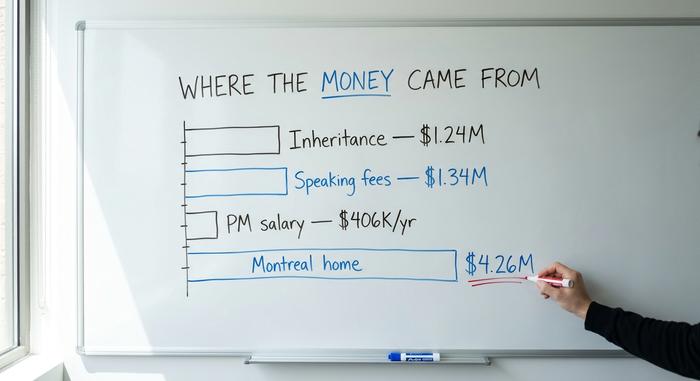
Here is the rough breakdown of where the money came from.
| Source | Reported figure | Notes |
|---|---|---|
| Family inheritance | CA$1.24 million | Disclosed 2011, from Pierre Trudeau's estate |
| Public speaking fees | CA$1.34 million | 2006-2012, before high office |
| PM salary | CA$406,200/year | Final full year, 2024 |
| Montreal home | ~CA$4.26 million | Purchased 2026, after leaving office |
One caveat that applies to every line of that table: these are estimates and disclosures, not an audited net worth statement. Nobody outside Trudeau's accountants has the full picture.
Where the $10 million estimate comes from
Stack up the verifiable pieces and $10 million is reasonable. A seven-figure inheritance that has grown for over a decade. Years of a high public salary. A pile of speaking income earned before politics. Add a Montreal house and ordinary savings, and you reach eight figures without inventing anything.
Why the "$90 million" claims fall apart
The inflated numbers usually appear in "who is richer" celebrity listicles, where a big figure makes for a better headline. None cite a source. Real estimates start from assets you can name. When a figure floats free of any asset, it is a vibe, not a valuation. So when a number cannot be traced to a single filing or disclosure, treat it as fiction, however many times you have seen it.
The Trudeau family inheritance and Pierre Trudeau
The base of the fortune is old money, not political money. Justin is the son of Pierre Elliott Trudeau, the former prime minister, and the grandson of Charles-Emile Trudeau, who built real wealth running a chain of Montreal gas stations in the early twentieth century.
That wealth eventually reached the next generation. In 2011, Trudeau disclosed an inheritance of CA$1,242,522, held in a numbered company, 90562 Canada Inc., and managed by the investment firm Jarislowsky Fraser. He made the disclosure himself, unusually, to counter exactly the kind of speculation this article is about. His mother, Margaret Trudeau, remains a public figure in her own right. The money was never flashy, either. A numbered company holding a managed investment portfolio is about as boring as wealth gets, which is rather the point. He started adult life already comfortable, which is true of more politicians than most voters care to admit.
How a teacher became prime minister of Canada
The middle of the story is surprisingly ordinary. Before the power and the motorcades, Trudeau was a salaried schoolteacher. He taught French and drama in Vancouver, about as far from Ottawa, and from a numbered investment company, as you can get.
Politics came later, and fast. He took the Montreal riding of Papineau in 2008. Five years after that he had the Liberal leadership. By 2015 he was prime minister. Three election wins followed, a majority and then two minorities, until the shine wore off and his own party decided it wanted someone new. Nearly a decade in the top job, from 2015 to 2025, makes him Canada's 23rd prime minister and one of the longest-serving in living memory. And through every bit of it, his paycheck was a public servant's. A generous one. Still just a paycheck.
Public speaking fees and the salary of a prime minister
Two sources of income did most of the legitimate work building Justin Trudeau's net worth: the speaking circuit before politics and the government paycheck during it. One of them turned into a genuine scandal.
The $1.3 million in speaking fees
Between 2006 and 2012, before he led the country, Trudeau earned roughly CA$1,341,500 on the public speaking circuit. His best year, 2007, brought in about CA$462,000. Good money for talks. The trouble came when it emerged that some of those fees, including a CA$20,000 payment, had come from charities and a school board. The optics were bad. He offered to repay the groups that asked. The episode stuck to him for years, a reminder that for a politician, where the money comes from matters as much as how much.
What a prime minister actually earns
The salary is no secret, because Parliament sets it. As of April 2024, the Canadian prime minister earned CA$406,200 a year, which combines the base salary of a member of parliament with the top-up for holding the top job. Over a decade in office, that adds up. It does not, however, add up to $90 million. This is the core problem with the conspiracy math: even a prime minister's salary, banked in full for ten years, gets nowhere near it.
Justin Trudeau's real estate and the blind trust
People assume the famous residences are his. They are not. Rideau Cottage and the Harrington Lake retreat are state property that comes with the job, like the White House. He lived there. He never owned a brick of it.
What he actually owns is modest. After leaving office, in 2026, he reportedly paid around CA$4.26 million for a home in Montreal's Outremont neighbourhood. While he was prime minister, his real estate holdings and other assets sat in a blind trust, the standard arrangement meant to stop a leader from steering policy toward his own portfolio. For someone of his means, honestly, it was more symbolic than anything. There was never a vast fortune to wall off. None of it spared him from ethics controversy, though. Canada's conflict of interest watchdog found he broke the Conflict of Interest Act twice. Once for a 2017 family vacation on the Aga Khan's private island. Again in the 2019 SNC-Lavalin affair. Neither was about hidden riches. Both were about judgment.
Justin Trudeau and the Freedom Convoy crypto freeze
Here is the part no other net worth article touches, and for a crypto audience it is the most important thing Trudeau ever did with money that was not his own.
The Emergencies Act and 34 frozen wallets
In February 2022, faced with the "Freedom Convoy" protests blocking Ottawa and border crossings, Trudeau's government invoked the Emergencies Act for the first time in Canadian history. The order did something new. Alongside freezing bank accounts, it named 34 cryptocurrency wallets tied to protest donations, with roughly CA$1.1 million in crypto in the crosshairs, according to CoinDesk. It was a G7 first: a government using emergency powers to reach directly into digital wallets.
The results were messy, though. Most of the targeted crypto slipped away. Only about 5.96 bitcoin was actually frozen; an estimated 70% of the donated funds evaded seizure because self-custody worked exactly as designed. The episode became a real-world stress test of an old crypto slogan, "not your keys, not your coins." Donors who held their own keys mostly kept their money. Those who left it on exchanges did not.
The freeze did not age well, either. In January 2024, a Federal Court judge ruled that invoking the Emergencies Act had been unreasonable and a breach of the Charter of Rights, a decision the government appealed. The crackdown worked in the moment and turned into a legal liability later, which is its own kind of lesson about emergency powers and money.
Trudeau versus Poilievre on Bitcoin
The freeze hardened a political divide that still defines Canadian crypto policy. Pierre Poilievre, who would later lead the Conservatives, had campaigned on making Canada the "blockchain capital of the world" and told Canadians they could "opt out of inflation" with Bitcoin. Trudeau mocked the idea openly, arguing that telling people to put retirement savings into crypto was reckless. Whatever you think of either man, the Freedom Convoy freeze gave that argument teeth no campaign speech could.
The episode became a global talking point, too. To crypto advocates, it was proof of exactly why permissionless money exists: a government had just shown it would reach into wallets during a political crisis. To crypto skeptics, the same event exposed the limits of the promise, since plenty of donors who trusted exchanges lost access anyway. Both camps walked away claiming the day as evidence for their side.
Katy Perry and the net worth comparison
The reason "Trudeau net worth" is trending again has little to do with politics. In 2025 he was linked to pop star Katy Perry, complete with the now-famous yacht photos, and suddenly every entertainment site wanted to know who was richer. It is not close.
| Person | Estimated net worth | Source year |
|---|---|---|
| Justin Trudeau | ~$10 million | 2026 |
| Katy Perry | ~$400 million | 2025 |
| Rishi Sunak (and family) | ~£640 million | 2025 |
| Mark Carney | ~$5 million | 2025 |
Perry is worth dozens of times what Trudeau is. Even among politicians the spread is wild: former UK leader Rishi Sunak and his wife sit on a family fortune in the hundreds of millions, while Trudeau's successor, Mark Carney, lands closer to Trudeau's own range despite a long banking career.
Justin Trudeau's net worth after leaving office
The number is probably going up. Former leaders almost always out-earn sitting ones, because the rules that bind a prime minister fall away the moment they become a private citizen.
Trudeau left office in March 2025. He draws a parliamentary pension. But the real money usually comes after: a memoir, board seats, the global speaking circuit. A former G7 leader can charge far more per appearance than the private speaker he once was. Look at Barack Obama, who reportedly pulled in around $400,000 for a single speech once he left the White House. Why would a former Canadian prime minister with Trudeau's profile be priced any lower? None of this has hit a public filing yet, so his post-office income is a question mark, not a number. But if his net worth ever does climb toward the rumored heights, it will be these years that do it, not his time in power.
The real story behind Justin Trudeau's net worth
Strip away the noise and Justin Trudeau's net worth is almost boring to explain. Around $10 million, built on an inheritance, a long public salary, and some pre-politics speaking income. There is no secret empire. The conspiracy version is just the dull truth wearing a costume.
His sharpest mark on the world of money may not be his own balance sheet at all, but the day his government tried to freeze a protest's Bitcoin and learned how much of it could simply walk away. So here is the question worth holding onto: now that the rules no longer bind him, will the post-office years finally make Justin Trudeau as rich as the rumors always insisted he already was?