Brad Pitt Net Worth in 2026: A $400 Million Star
William Bradley Pitt reportedly drove into Los Angeles in the early 1980s with about $325 to his name. He had left the University of Missouri two credits short of a degree. Today the Brad Pitt net worth sits at an estimated $400 million. That is a serious climb, but the interesting part is where the money actually comes from now, because it is no longer mostly the acting.
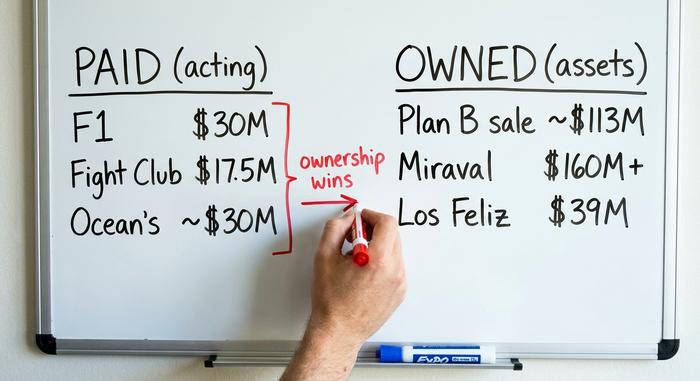
Here is the shape of it. Pitt spent the first half of his career being paid to appear in films, often very well. He spent the second half quietly buying things that pay him back — a production company, a French winery, points on his own movies. The face sold the tickets. The ownership built the fortune. Those two stories rarely sit in the same actor, and that is what makes his balance sheet worth a closer look.
One caveat before the numbers. No celebrity net worth is audited. The $400 million is an estimate from outlets like Celebrity Net Worth, cross-checked against reported deals and court filings. Treat every figure here as informed guesswork, not a bank statement.
How big is Brad Pitt's net worth?
The going estimate is about $400 million as of 2026, per Celebrity Net Worth. You will see the odd outlier closer to $240 million on older pages. Ignore those. They were written before the two events that now dominate the picture — the sale of most of his production company and the value locked inside his winery.
What is worth saying plainly is that the acting, the thing that made him famous, is probably the smaller half of his wealth now. A man can be the highest-paid actor on a film and still make more from a deal he signed in a lawyer's office. Pitt is that man.
It is also why his number is unusually hard to pin down. A salary is a known quantity once it leaks. A private company stake and a contested French estate are not, and both swing with markets, lawsuits, and the mood of whoever is doing the valuing. So hold the $400 million loosely. The honest version is a range, and the range is wide.
From Fight Club to F1 box office money
The acting money was always good. It was also, for years, structured the dumb way — a big fee, paid once, with no stake in whether the film printed money or sank.
The salary years
Through his peak as a leading man, Pitt commanded roughly $17.5 million a film. Fight Club paid it. So did Troy and Spy Game. Ocean's Eleven reportedly brought him somewhere around $20 to $30 million once backend was folded in, which was the early sign he understood the difference between a wage and a slice. The prestige films paid less up front. Moneyball and Inglourious Basterds came in nearer $10 million each, traded for the kind of roles that win awards rather than the kind that buy houses.
F1 and the backend habit
Then came F1 in 2025, and with it his biggest single payday — a reported $30 million. The Formula One racing drama earned around $634 million worldwide, the highest-grossing release of his career. Before it reset the record, his biggest earners had been World War Z at roughly $540 million in 2013 and the Ocean's and Mr. and Mrs. Smith hits before that, the latter around $478 million. Across thirty years his filmography has grossed billions.
Here is the thing to notice, though. A grossed dollar is not a Pitt dollar unless he owns a point of it. The whole arc of his money is him slowly insisting on owning that point.
| Film | Year | Reported pay | Box office |
|---|---|---|---|
| Fight Club | 1999 | $17.5M | cult hit on DVD |
| Ocean's Eleven | 2001 | ~$30M with backend | $450M |
| Troy | 2004 | $17.5M | blockbuster |
| World War Z | 2013 | ~$25M | $540M |
| Wolfs | 2024 | ~$35M | streaming release |
| F1 | 2025 | $30M | $634M |
Inglourious Basterds and the Oscars
Prestige did something more useful than fill a trophy case. It built the brand that lets a man charge backend and run a studio. Inglourious Basterds in 2009 and The Curious Case of Benjamin Button before it turned him from a handsome lead into a serious one. The acting Oscar finally arrived in 2020, Best Supporting Actor for Once Upon a Time in Hollywood, decades into the career. By then the trophy was almost a formality. The brand it certified had already been monetized, in glossy Chanel No. 5 campaigns and in the leverage to demand a piece of everything he touched. That is the quiet value of prestige. It does not pay much directly, but it raises the price of everything else with your name on it, from a backend clause to a bottle of rosé.
Plan B Entertainment: from actor to owner
This is the real wealth engine of the Brad Pitt net worth, and most people who can name ten of his movies cannot name it. In 2001 he co-founded Plan B Entertainment with Jennifer Aniston and the executive Brad Grey. When the marriage to Aniston ended, Pitt kept the company. It turned out to be the best thing he ever held onto.
A Best Picture machine
Plan B did not just produce films. It produced winners. The Departed took Best Picture in 2006. 12 Years a Slave won it in 2013, handing Pitt an Academy Award as a producer. Moonlight won again in 2016. Three Best Pictures from one shop, plus Moneyball and The Big Short along the way. As a producer he became more decorated, and more bankable, than he had ever been as a pretty face. Think about how unusual that is. Plenty of stars vanity-fund a production label that produces nothing anyone remembers. Plan B did the opposite, building a reputation for serious, awards-grade films that studios wanted in business with. That reputation was the real asset. By the time a buyer came calling, they were not paying for Brad Pitt's name on a poster. They were paying for a company with a genuine track record, which is worth far more.
The Mediawan payday
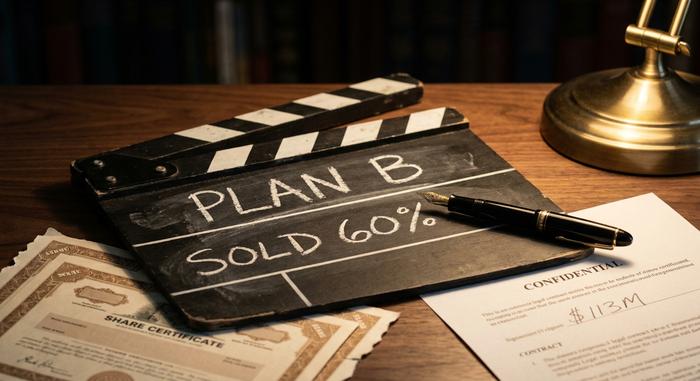
The payoff was structural. In December 2022 Pitt sold 60 percent of Plan B to the French media group Mediawan, in a deal that, according to CNBC, reportedly valued the company at around $300 million. Reports put roughly $113 million in his pocket from that single stake sale. Sit with that number. It is larger than any check he ever earned for stepping in front of a camera, and he got it for owning the company rather than starring in its films.
The structure mattered as much as the size. Mediawan reportedly paid partly in cash and partly in its own shares, which means Pitt did not simply cash out and walk away. He swapped a stake in one company for a stake in a larger one, keeping skin in the game while pulling nine figures off the table. That is what graduating from talent to mogul looks like on paper, and it is a move almost no working actor ever gets to make.
Château Miraval, the winery worth a fortune
The other asset is the one that became a war. Around 2008 Brad Pitt and Angelina Jolie took on a sprawling estate in the south of France called Château Miraval, reportedly for about $28.4 million. They married there. Then they turned it into a real business.
From wedding venue to wine empire
Miraval rosé became a genuine commercial hit, not a celebrity vanity label. Critics rated it, retailers stocked it, and it sold at scale, which is rare for a famous name's wine. From that base the estate grew into a small empire. A skincare line, Le Domaine, launched in 2022 with the winemaking Famille Perrin, the same family behind the wine. Miraval Studios, the legendary on-site recording studio where bands had cut records decades earlier, reopened the same year after twenty years dark. The property that merely hosted a celebrity wedding had quietly become a diversified brand. Court filings would later peg the estate's contested value north of $160 million, which tells you how far it had come from a vineyard bought on a whim.
The Jolie lawsuit
Owning things has a flip side: people can fight you over them. In October 2021 Jolie sold her stake in Miraval to a buyer linked to the Stoli vodka group, Tenute del Mondo, without Pitt's sign-off. He sued, in a claim reported around $35 million, arguing the sale violated an agreement between them. The case has dragged for years, with a trial reportedly set for February 2027. It is an ugly fight. It is also proof of the thesis: you do not get sued over a paycheck, only over an asset worth keeping.
| Where the fortune sits | Reported figure |
|---|---|
| Plan B 60% sale to Mediawan (2022) | ~$113M to Pitt; $300M valuation |
| Chateau Miraval estate (bought ~2008) | contested above $160M |
| Los Feliz compound (sold 2023) | $39M |
| F1 salary (2025) | $30M |
Angelina Jolie, divorces and Los Feliz
No honest tally skips the outflows, and Pitt has had expensive ones. He married Jennifer Aniston in 2000; they split in 2005. He married Angelina Jolie in 2014, after years together and six children between them, among them their eldest biological daughter Shiloh, with three of the six adopted; she filed to end it in 2016. Reported accounts of the eventual settlement put something like $80 million on each side, though the real terms were never made public, so treat that figure gently. The custody fight that followed was long and bitter, and it overlapped almost exactly with the winery dispute, which is part of why the post-2016 years were so expensive for him in both money and headlines.
The real estate told a happier story. Pitt bought a compound in the Los Feliz neighborhood of Los Angeles back in 1994 for about $1.7 million, lived in it for nearly thirty years, and sold it in March 2023 for $39 million. Run the math on that. A roughly twenty-three-fold return over three decades, on a house he actually lived in, beats the economics of most films he ever made. His wider real estate portfolio has included other property in California and at Miraval in France, but the Los Feliz sale is the cleanest example of an asset quietly compounding in the background while the cameras rolled elsewhere. He also poured money into causes, most visibly the Make It Right foundation, which built homes in New Orleans after Hurricane Katrina. He is now dating the jewelry executive Ines de Ramon, and lives, by his own telling, a quieter life than the tabloid decade suggested.
What the Brad Pitt net worth really shows
So the $325-to-$400-million arc is not really about a movie star, even a famous one. It is about an actor who learned, slowly, to own things instead of just being paid by them. The face sold the tickets. The brand let him demand a cut. The cut bought the studio and the winery, and those assets, not the roles, are what the $400 million mostly is.
The lesson inside the Brad Pitt net worth is the same one the smartest people in any industry eventually learn. Wages end when the work does. Ownership keeps paying, and occasionally it gets you sued. It took him most of a career to internalize it, and the timeline shows it: the salaries came first, the company and the vineyard came later, and the biggest single windfall, the Mediawan check, came near the end. The pattern is almost too tidy.
The next chapter is literally a courtroom, with the Miraval trial looming, and how that ends will move the Brad Pitt net worth more than any film he could make in the meantime. For a man who arrived with $325, that is a strange and telling place to be — rich enough that a lawsuit, not a role, is what decides his next move.