Cosmos (ATOM): The Interoperable Hub in 2026

Cosmos may be the most influential crypto project that never paid off for its own token. Its ideas are everywhere. The "app-chain" model, where every project runs its own sovereign blockchain instead of renting space on Ethereum, is largely Cosmos's invention, and its IBC protocol now links more than 115 chains. The tech won. The token did not. ATOM trades around $1.80, roughly 96% below its 2021 peak, and some of the biggest names it helped launch, dYdX and Celestia among them, left or now compete with it. So the real question in 2026 is not whether Cosmos works. It clearly does. The question is whether ATOM has any reason to be worth more than it is. This guide walks through what Cosmos is, how it works, why ATOM struggles, and whether it still matters.
What Is Cosmos and the Internet of Blockchains
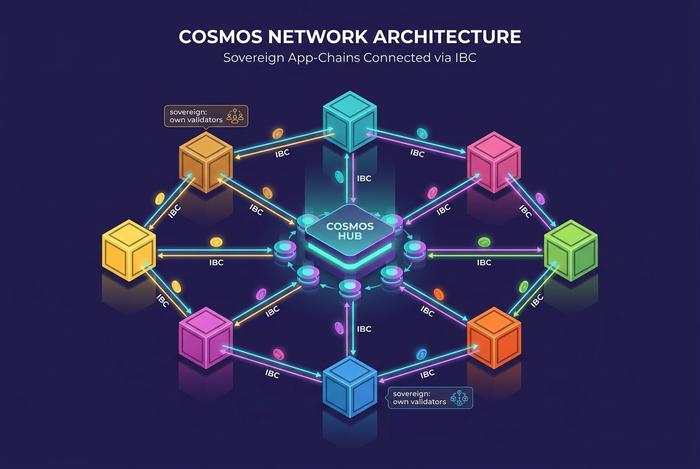
Cosmos made the opposite bet from Ethereum. Ethereum wanted one giant shared computer for everyone to build on. Cosmos wanted the reverse: thousands of separate blockchains, each tuned for a single job, all able to talk to each other. The nickname stuck, the "Internet of Blockchains." And the operative word is sovereign. Every chain runs its own validators, sets its own rules, mints its own token. Nobody rents space from anybody.
The roots run deeper than most people realize. Jae Kwon and Ethan Buchman started it back in 2014 under Tendermint Inc, with Switzerland's Interchain Foundation footing the development bill. The 2017 ICO was a frenzy: roughly $17.3 million raised in 28 minutes. Mainnet did not arrive until March 2019, with ATOM debuting at under a dime. Tendermint Inc later fractured, spinning Ignite out as a separate tooling company in 2022. Through all of it, one thing held steady. The pitch was never "come use our chain." It was "go build your own, and we'll wire it up." Half the industry took the advice, which is precisely why scoring Cosmos on ATOM's price alone misses what it actually built.
How the Cosmos Stack Works: SDK, CometBFT, IBC
Three pieces of open-source plumbing made the vision real. Two of them are good. One of them changed the industry.
CometBFT consensus, formerly Tendermint
Start at the bottom: CometBFT. You might know it by its old name, Tendermint. Its job is consensus, and it nails two hard things at once. Speed, first: blocks finalize in under three seconds. Then safety: the chain survives even if a third of its validators go rogue. That combination was unusual in 2019, back when most chains were still burning electricity on proof-of-work. Good enough, in fact, that other teams stopped rolling their own. Binance Chain, Terra, and plenty more just took CometBFT and ran with it.
The Cosmos SDK
Next, the Cosmos SDK, short for software development kit. Picture a box of Lego for blockchains. The boring, hard, easy-to-botch parts come pre-made and modular. Need staking? That's a module. Governance? Token issuance? Modules too. Work that once cost a team years, writing consensus and networking from nothing, now takes weeks, and the result is a custom, decentralized chain. That is why it spread. More than a hundred live chains are built on the SDK, and Ignite, the tooling layered on top, made getting started faster still.
IBC, the Hub, and the zones
Last, and most important, IBC: Inter-Blockchain Communication. This is the part that changed the game. IBC lets sovereign chains, the zones, ship tokens and messages straight to each other. No trusted middleman. No wrapped-asset bridge sitting there waiting to be drained. The Cosmos Hub routes the traffic in the middle; it was the network's first chain. And it works at real scale. By 2026, IBC links 115-plus chains, carries over 35 million transfers a year, and reaches around two million people a month. Then it jumped the fence entirely. In April 2025, IBC Eureka wired the protocol straight into Ethereum, moving assets for under a buck.
The ATOM Token and the Cosmos Hub
ATOM is the native token of the Cosmos Hub, and on paper it does the usual layer-1 jobs. It secures the Hub through staking. It pays the fees. It votes in governance. Holders hand their ATOM to one of about 180 validators and collect rewards for keeping the chain alive, and roughly 63% of all ATOM is staked, unusually high for a major network. Governance leans on that same token, and Cosmos uses it hard: inflation cuts, security overhauls, the big calls all live or die by on-chain ATOM votes.
Here is the catch, and it is the whole story of this article in one line. ATOM only secures the Cosmos Hub. It does not capture value from the rest of the ecosystem. When a chain built with the Cosmos SDK succeeds, it keeps its own fees and its own token. The Hub gets none of it, not the fees, not the liquidity. ATOM also has no maximum supply, so new tokens keep minting indefinitely. So you have a token that secures one chain in a galaxy of chains it cannot tax. Remember that as we get to the hard part.
ATOM 2.0 and the Value-Accrual Problem
This is the defining question for Cosmos in 2026, and it has an awkward answer. The sovereignty that makes Cosmos great for builders is exactly what starves ATOM.
The value-accrual problem
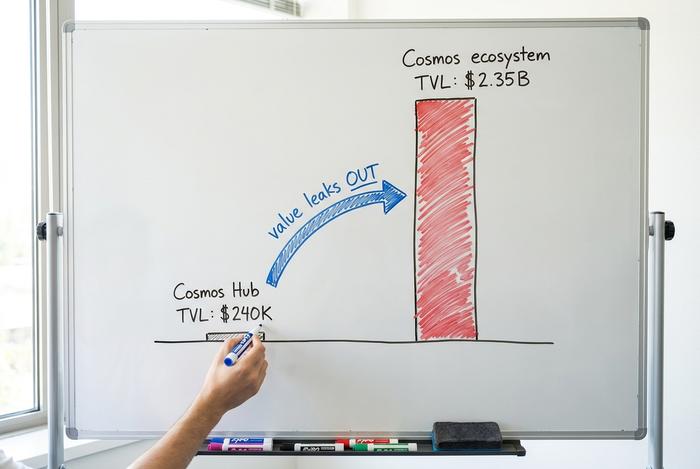
Think about what "sovereign" really means for the money. Celestia, dYdX, Injective, Sei: all grew up in or around the Cosmos toolset, and all keep their own value. None of their success flows back to ATOM. dYdX left Ethereum to launch its own Cosmos chain in late 2023, and Celestia went live as a standalone layer-1 around the same time. Both still run on Cosmos technology. Neither pays the Hub a cent. The numbers are brutal. As of April 2025, the Cosmos Hub itself held roughly $240,000 in DeFi value locked, while the broader Cosmos ecosystem held about $2.35 billion. Read that again. The Hub captures a rounding error of the wealth its own design created. ATOM is, in effect, the governance token for one chain in a network it built and cannot bill. The strain shows in the chain count, too: at least six Cosmos zones shut down during 2025 as teams consolidated, merged, or moved to rival ecosystems.
ATOM 2.0 and Interchain Security
Cosmos knew this. In September 2022 it published ATOM 2.0, an ambitious whitepaper meant to turn ATOM into a real utility and security asset, with a new issuance schedule and tools to route value to the Hub. The community rejected the full plan: Proposal 82 failed in November 2022 after enough validators voted "NoWithVeto" to kill it. What did ship was Interchain Security, also called Replicated Security, where Hub validators secure smaller "consumer chains" like Neutron and Stride in exchange for fees. The idea is sound. The uptake has been weak; Neutron, the very first consumer chain, later left the model. Cosmos has since reworked it into Partial Set Security, letting a chain buy only as much Hub protection as it actually wants, but the revenue that flows back to ATOM is still tiny. The fix exists. It is just far too small to matter yet.
ATOM Tokenomics: Inflation and the 2023 Cut
For years, ATOM "rewards" were mostly an illusion. The chain paid stakers in freshly printed tokens, and a lot of them.
The old high-inflation model
Cosmos used a dynamic inflation model that floated between 7% and 20% a year, rising when too few people staked and falling when more did, all aimed at keeping roughly two-thirds of ATOM bonded. With no supply cap, that headline "APR" of nearly 20% was largely dilution. If everyone earns 19% in new tokens, nobody is really 19% richer. It just punishes anyone who does not stake.
Proposal 848 and the price reality
In November 2023, governance finally acted. Proposal 848 capped maximum inflation at 10%, down from 20%, which dropped the nominal staking rate from around 19% toward 13%. It helped, but the gap between nominal and real is still wide: today's roughly 19.7% nominal staking yield nets out closer to 7% once you subtract real inflation. And the price tells the rest. ATOM sits near $1.80, a market cap under $1 billion, about 96% below its all-time high of $44.70 from September 2021. It has spent 2026 grinding in a narrow band between roughly $1.50 and $2.70.
| ATOM tokenomics (June 2026) | Figure |
|---|---|
| Price | ~$1.80 |
| Market cap | ~$927 million |
| All-time high (Sep 2021) | $44.70 (down ~96%) |
| Max supply | None (uncapped) |
| Staked | ~63% (~326M ATOM) |
| Validators | ~180 |
| Nominal vs real staking yield | ~19.7% vs ~7% |
Is Cosmos (ATOM) Still Relevant in 2026?
Here is the honest split verdict. As technology, Cosmos is thriving. As an investment, ATOM has been a disaster. Both are true at once.
The tech case is strong. More than 150 chains run on the stack, IBC moves tens of millions of cross-chain transactions a year, and the ecosystem's combined market cap runs into the tens of billions. The 2026 storyline is a pivot toward institutions. Cosmos launched a Tokenization Suite aimed at banks tokenizing deposits, IBC Eureka now plugs the network into Ethereum, and in June 2026 Cosmos Labs acquired the Mintscan explorer and consolidated core infrastructure under one roof. The Hub is also trying to be more than a router: a 2025 vote, Proposal 1007, opened it to permissionless smart contracts via CosmWasm, and the network now markets itself to institutions with claims of 10,000-plus transactions per second and tens of billions in assets secured.
The part I keep wrestling with is whether any of this finally reaches ATOM. The bull case says enterprise tokenization plus an Ethereum connection gives the Hub something real to charge for. The bear case is simpler: the value-accrual problem is still unsolved, there is no ATOM ETF, and chains kept leaving through 2025. Great architecture is necessary, not sufficient.
| Cosmos snapshot (2026) | Figure |
|---|---|
| Chains on the stack | 150+ |
| IBC-connected chains | 115+ |
| Annual cross-chain transactions | 35 million+ |
| Ecosystem market cap | ~$58 billion |
| Cosmos Hub DeFi TVL | ~$240K (vs ~$2.35B ecosystem) |
| ATOM vs ATH | ~96% below |
Cosmos vs Other Interoperable Blockchains
The whole interoperability race boils down to one trade: how much sovereignty will you give up for security? Cosmos gives up the least. Your chain, your validators, IBC to connect, full independence. Polkadot goes the other way and pools security, so its parachains share one validator set. Ethereum keeps everything under a single settlement layer and lets rollups inherit it. Same question, three very different answers.
| Network | Security model | App-chains | Interop method |
|---|---|---|---|
| Cosmos | Sovereign (own validators) | Yes (zones) | IBC |
| Polkadot | Shared (relay chain) | Yes (parachains) | XCM |
| Ethereum | Shared settlement (L1) | Rollups | Bridges |
| Avalanche | Subnet/own validators | Yes (L1s) | Warp messaging |
Put bluntly: no design hands builders more independence than Cosmos. And that same independence is the reason ATOM cannot capture the value those builders create. The strength and the weakness are the exact same feature.
How to Buy and Stake Cosmos (ATOM)
Getting ATOM is the easy part. Any big exchange, Coinbase, Kraken, Binance, will sell it to you, and you can simply hold it for price exposure. Want the staking rewards instead? Drop your ATOM into a Cosmos wallet like Keplr, pick a validator, and delegate. You will see roughly 13% a year. Just know two things going in. Pulling your stake back out takes about 21 days, and the price can move against you the whole time. And that 13%? Mostly printed tokens, not real growth. Discount it accordingly.
The Verdict: Has Cosmos Won or Lost in 2026?
Cosmos won the architecture war and lost the value war. App-chains and interoperability, the things people once doubted, are now mainstream, and a huge slice of that future runs on Cosmos plumbing. Yet ATOM is taxed into irrelevance by its own founding principle: sovereignty means the Hub cannot bill the chains it enabled. The 2026 pivot toward bank tokenization and an Ethereum connection is the most serious attempt yet to give ATOM a real job. Whether it works is genuinely open. If you are tracking Cosmos, the thing to watch is not the price chart. It is whether the Hub ever finds a way to get paid.