
What Is Staking in Crypto? How to Stake, Where to Earn, and What the Data Shows
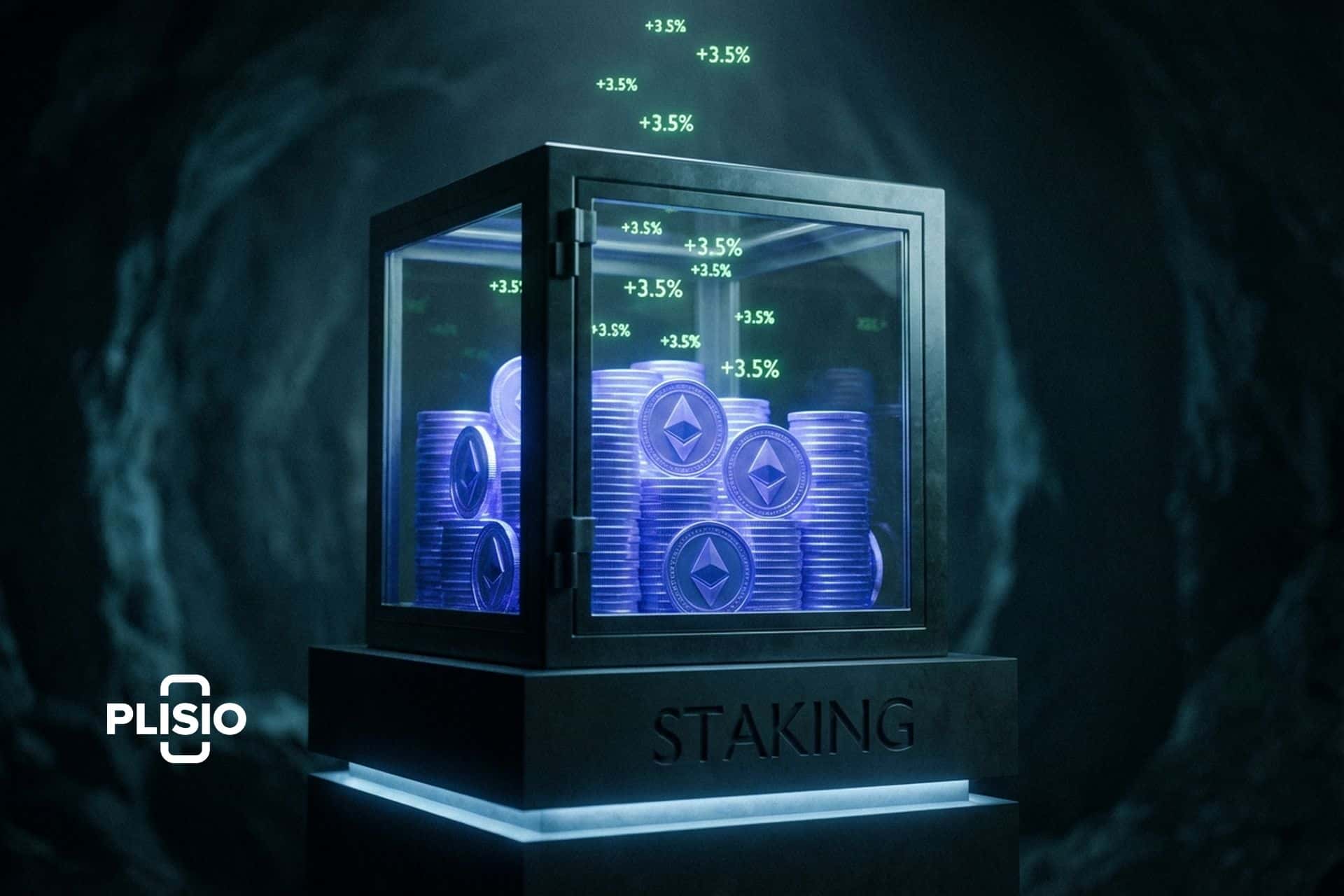
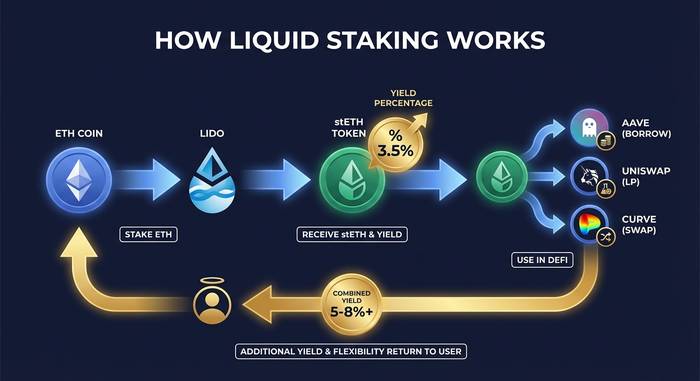
I staked ETH for the first time in early 2023 through Lido. Deposited 2 ETH, got back 2 stETH, and then immediately used that stETH as collateral on Aave to borrow USDC. Earning staking yield and borrowing against it at the same time. DeFi composability in action. It felt like free money, which in crypto usually means you're about to learn an expensive lesson. Two years later, the position is still running and the staking yield has been steady at 3-4%. Not exciting. But the reliability of it changed how I think about holding crypto.
Staking went from something only validators cared about to one of the biggest pools of capital in crypto. Over $100 billion in assets sit in staking contracts across proof-of-stake chains as of early 2026. Lido, just one protocol, holds around $27 billion. That makes it larger than most banks I've ever interacted with. Ethereum alone has 34+ million ETH staked, roughly 28% of total supply, locked into consensus layer contracts that secure the network.
If you hold any PoS token and you're not staking, you're losing purchasing power to inflation while everyone around you earns yield on the same asset. That's the practical reason to care. The analytical reason: staking data tells you where the money in crypto actually sits, who's earning what, and which protocols are accumulating the kind of TVL that matters.
Below: how to stake step by step, what the real yields look like after fees and inflation, and which protocols I'd actually put money into versus which ones look good on a marketing page.
How staking works: the short version for non-validators
Here's how crypto staking works at the blockchain network level. Proof of stake chains need someone to confirm transactions and produce blocks. On Bitcoin that's miners burning electricity. On Ethereum, Solana, Cardano, and most modern chains it's validators who lock up tokens as collateral instead. Behave honestly? Get paid. Cheat? Lose your deposit. That's the core deal.
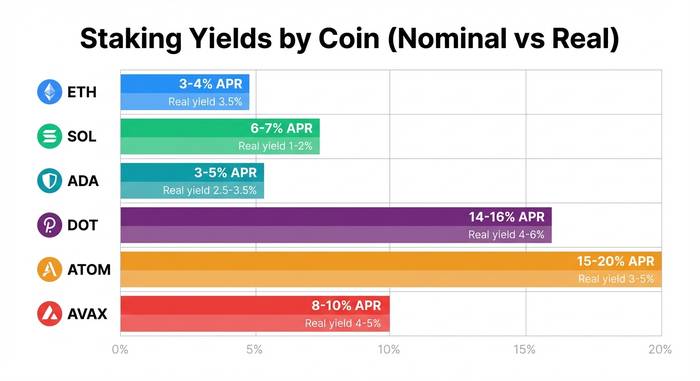
For you and me, staking cryptocurrency boils down to: stake your crypto somewhere and earn rewards as passive income. "Somewhere" could be a validator node you run yourself, a liquid staking protocol like Lido, or a button on Coinbase. The yield varies. ETH pays 3-4%. SOL pays 6-7%. Cosmos has gone as high as 20% during some periods.
Here's the thing that marketing pages never mention clearly enough: staking yield comes from inflation. New tokens get printed and handed to stakers. If ATOM pays 18% APR but inflates at 12%, your real return is roughly 6%. Every time I see someone bragging about 20% staking yields I check the inflation rate, and nine times out of ten the real return is much less exciting than the headline. ETH is the exception because its supply is sometimes net deflationary (fee burn exceeds new issuance), which means the 3-4% staking yield is almost entirely real.
Three ways to stake: solo, pool, or exchange
Not all ways to stake crypto are the same. The three main paths offer different levels of control, risk, and return. Understanding the cons of crypto staking at each level matters before you commit capital.
Solo validation means running your own node. On Ethereum, that requires 32 ETH (roughly $60,000-$100,000 depending on ETH price), a dedicated machine that stays online 24/7, and the technical knowledge to maintain it. You earn the full staking reward with no middleman fees. You also take the full risk: if your node goes offline during a critical moment or you double-sign a block, you get slashed. About 1 million validators run on Ethereum as of early 2026. Most are operated by institutions or technically sophisticated individuals. Solo staking is not a casual activity.
Staking pools let you deposit any amount and earn a share of the rewards. Lido is the largest: deposit ETH, receive stETH (a liquid receipt token), earn ~3.5% APR minus Lido's 10% fee. Rocket Pool works similarly with rETH. On Solana, Marinade Finance and Jito offer liquid staking with mSOL and jitoSOL. You don't need 32 ETH. You don't run a node. The pool handles validation and distributes rewards proportionally. The tradeoff: you trust the pool's smart contracts and the validators they delegate to.
Exchange staking is the simplest path. Coinbase, Kraken, Binance, and most major CEXs offer one-click staking. Buy ETH on Coinbase, tap "stake," earn yield. Coinbase takes a 25% commission on staking rewards. Kraken advertises up to 22% on some assets (though the fine print matters). The convenience is real but the fees are higher than DeFi pools and you don't hold your own keys. When Kraken settled with the SEC in 2023 for $30 million over its staking program, US customers lost access. Platform risk is real.
| Method | Minimum | ETH yield (net) | Fee | Control | Risk |
|---|---|---|---|---|---|
| Solo validator | 32 ETH | ~3.8-4.2% | 0% | Full | Slashing, downtime |
| Lido (stETH) | Any amount | ~3.2-3.5% | 10% | Medium | Smart contract |
| Rocket Pool (rETH) | Any amount | ~3.0-3.3% | ~15% | Medium | Smart contract |
| Coinbase (cbETH) | Any amount | ~2.8-3.0% | 25% | Low | Platform, regulatory |
| Kraken | Any amount | Varies | 15-25% | Low | Platform, regulatory |
The liquid staking revolution: stETH, rETH, and why it matters
Liquid staking changed everything about how staking works in practice. Before Lido launched, staking meant locking your ETH into the beacon chain with no way to use it until withdrawals were enabled (which didn't happen until April 2023). Your capital was frozen. You earned yield but you couldn't do anything else with it.
Lido fixed this by issuing stETH, a token that represents your staked ETH plus accumulated rewards. stETH is tradeable, usable as collateral, and accepted across most of DeFi. You can stake ETH on Lido, take the stETH to Aave and borrow against it, use the borrowed USDC in a liquidity pool, and earn three layers of yield simultaneously. This is what DeFi people mean by "composability" and it's the reason liquid staking protocols dominate the staking market.
The numbers are staggering. Lido's TVL sits at roughly $27 billion, making it the largest protocol in all of DeFi. Not the largest staking protocol. The largest DeFi protocol, period. Rocket Pool holds about $3-4 billion. Coinbase's cbETH and Binance's BETH add several billion more. Total liquid staking across all chains exceeds $40 billion.
Lido's dominance has raised centralization concerns and I think they're legitimate. At one point Lido controlled over 32% of all staked ETH. One protocol, one set of governance token holders, wielding that much influence over Ethereum's validator set. If Lido's validators coordinated (or were compromised), they could theoretically influence consensus on the chain that the entire DeFi ecosystem runs on. That's not a theoretical risk, it's a structural one.
Lido responded by diversifying across dozens of validator operators and implementing governance checks. The concentration has decreased from the 32% peak. But the debate isn't over. Some Ethereum researchers argue that no single liquid staking protocol should hold more than 22% of staked ETH (the one-third attack threshold minus safety margin). Others argue that the market naturally chose Lido because it offers the best product. Both sides have a point, and if you're staking through Lido, you should at least be aware of the conversation.
Restaking: EigenLayer and the yield multiplication game
Restaking is the evolution of staking that emerged in 2024 and grew fast enough to become its own category. The idea: take your already-staked ETH (or liquid staking tokens like stETH) and "restake" it to secure additional services beyond just the Ethereum consensus layer.
EigenLayer is the protocol that created this category. At its peak, EigenLayer held over $13 billion in TVL. Users deposit stETH or native ETH into EigenLayer, which then uses that capital to secure "Actively Validated Services" (AVS), things like oracle networks, bridges, data availability layers, and rollup sequencers. In exchange, restakers earn additional yield on top of their base staking rewards.
The promise sounds almost too good: stack your base ETH staking yield (3.5%) with EigenLayer restaking yield (1-5% extra depending on which AVS you're securing) for a combined 5-8%+ return on the exact same capital. Same ETH doing double duty. I tested it with a small position and the yield boost was real, though the dashboard complexity was overwhelming at first. The risk: you're now exposed to slashing conditions from both Ethereum and whatever AVS you're securing. If the AVS has a bug or its slashing conditions are poorly designed, you could lose restaked capital. The layers of risk compound with the layers of yield. More yield, more ways to lose. That tradeoff is worth thinking about carefully before going past basic staking.
Staking yields compared: which coins pay what
If you're evaluating where to stake, the yield comparison across top PoS chains matters. But remember: nominal yield minus inflation equals real yield. A 15% APR means nothing if the token inflates at 12%.
| Coin | Staking APR (approx.) | Inflation rate | Real yield (approx.) | Lock-up period |
|---|---|---|---|---|
| Ethereum (ETH) | 3-4% | ~0.5% (net deflationary at times) | ~3-3.5% | None (liquid staking) or variable |
| Solana (SOL) | 6-7% | ~5.4% | ~1-2% | ~2-3 days unbonding |
| Cardano (ADA) | 3-5% | ~3% | ~1-2% | None |
| Polkadot (DOT) | 14-16% | ~10% | ~4-6% | 28 days unbonding |
| Cosmos (ATOM) | 15-20% | ~10-15% | ~3-5% | 21 days unbonding |
| Avalanche (AVAX) | 8-10% | ~5% | ~3-5% | 14 days unbonding |
Ethereum stands out because its inflation rate is near zero and sometimes negative (when fee burn exceeds new issuance). That makes ETH staking yield almost entirely real yield. Most other chains have significant inflation that dilutes the headline APR. When someone tells you they're earning 18% staking ATOM, ask them what the inflation rate is before getting excited.
Risks you need to understand before staking
Cryptocurrency staking is not a savings account and it's not risk-free passive income. The risks are real and different from just holding crypto in a wallet on the blockchain.
Slashing happens when a validator misbehaves. Double-signing a block, prolonged downtime, or violating protocol rules can result in permanent loss of staked capital. On Ethereum, slashing penalties range from small (for minor downtime) to catastrophic (for coordinated attacks). Individual stakers using Lido or Coinbase are partially insulated because the pool absorbs the slashing loss across all participants, but the risk exists.
Lock-up periods freeze your capital. Polkadot's 28-day unbonding means if DOT crashes 40% and you need to sell, you wait four weeks. By then the damage is done. Liquid staking tokens solve this for ETH and SOL but introduce their own risk: if stETH loses its peg to ETH (as it briefly did in June 2022 during the 3AC collapse), your "liquid" position may not be worth what you think.
Smart contract risk is present in every DeFi staking option. Lido's contracts have been audited extensively and have held billions without incident, but "audited" doesn't mean "impossible to exploit." Smaller liquid staking protocols on newer chains carry higher smart contract risk simply because they've had less time and fewer eyeballs on their code.
Taxes are a mess and nobody talks about this enough. In the US, the IRS says staking rewards are taxable income the moment you receive them. Earn 1 ETH in rewards when ETH is at $3,000? You owe income tax on $3,000 even if you never sold anything. Then if ETH drops to $2,000 and you sell, you also get a capital loss to claim. The accounting is annoying enough that I use Koinly to track it, and I still end up spending an afternoon every April making sure the numbers match. Other countries handle it differently. Some don't tax staking at all. Some treat it as capital gains. Get professional advice if you're staking more than pocket change.



