Aptos (APT) in 2026: The Future of Web3?
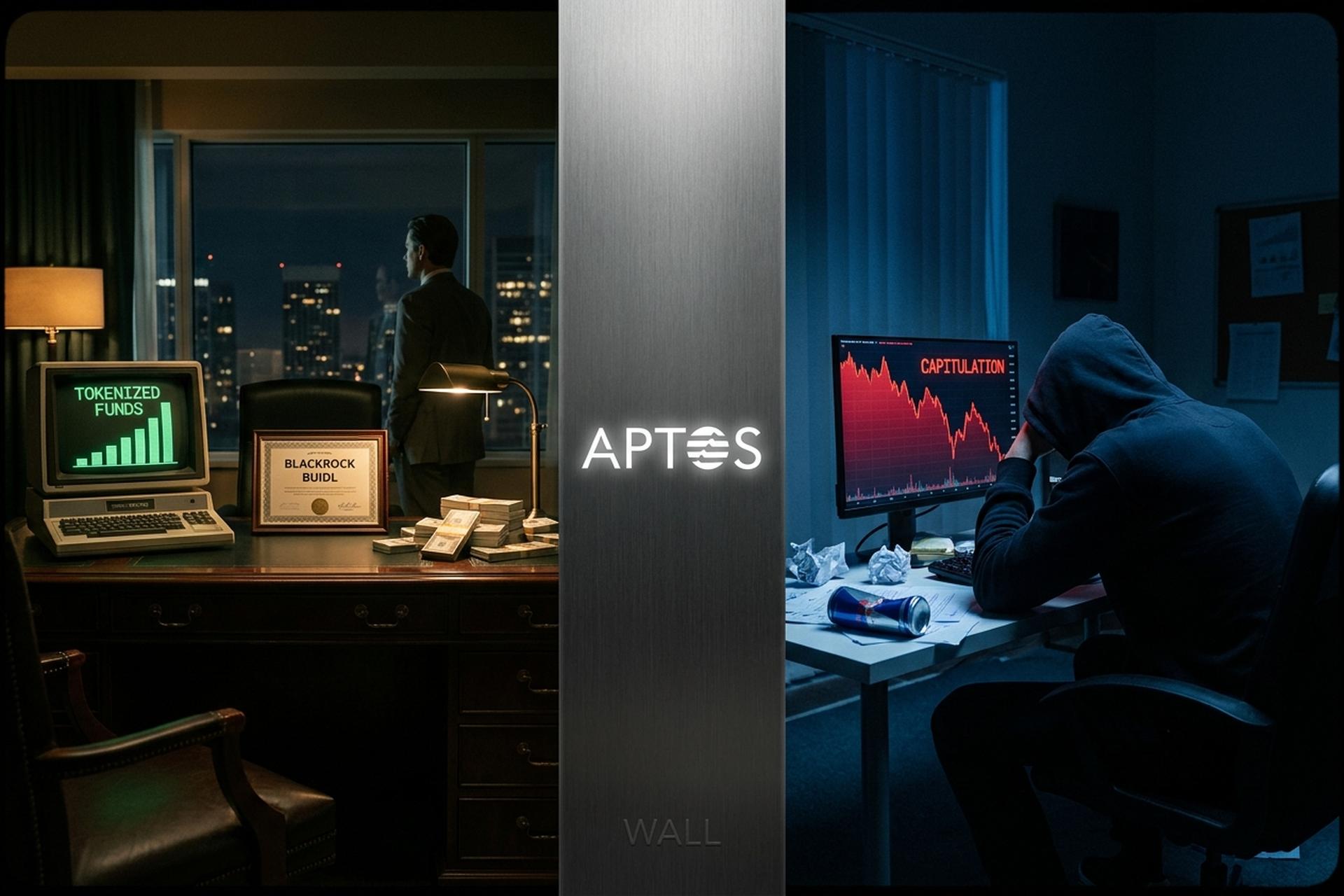
Aptos is a study in contradictions right now. Its token, APT, trades near $0.63, almost 97% below its old high, and it printed a fresh all-time low in June 2026. By that measure, it looks finished. But look at the network instead of the chart and you see the opposite story: in 2026 Aptos hard-capped its token supply, crossed $2 billion in stablecoins, hosts a tokenized BlackRock fund, and has a spot ETF sitting at the SEC. This is the chain a team of ex-Facebook engineers built after Meta killed their Diem project, the one that promised 160,000 transactions a second and a Web3 future. So which Aptos is real, the broken token or the serious institutional network? This guide walks through what Aptos is, how it works, the 2026 tokenomics reset, and whether it still matters.
What Is Aptos and the APT Token
A quick history, because it matters here. Aptos is what survived after Facebook's crypto dream collapsed. The company had spent years building Diem, a stablecoin meant for billions of users, until regulators shut it down cold. Too much power, they decided, for one private firm minting money. So in 2021, two of the engineers who built it, Mo Shaikh and Avery Ching, walked out with the technology and founded Aptos Labs. Investors did not hesitate. Around $350 million poured in fast, a $200 million seed and a $150 million Series A, from the likes of a16z and Jump Crypto. Mainnet launched in October 2022. Shaikh led as CEO until late 2024, when Ching, the more technical of the two, took over.
The token itself is almost boring, and that is deliberate. APT pays your fees. You stake it to help secure the network. You vote with it. Done. Here is the thing, though: Aptos was never really a story about the coin. It was a story about the technology, and, these past two years, about the surprising list of companies quietly building on it.
How Aptos Works: Move and Block-STM
Aptos rests on two genuinely good ideas and one number you should not take at face value.
The Move programming language
Start with Move, the language Aptos is written in. It came out of the same Diem effort, built in the style of Rust, and it treats digital assets as "resources" that the code physically cannot copy or delete by accident. That sounds academic until you remember how many crypto hacks come down to a token being minted or duplicated when it should not have been. Move also ships with the Move Prover, a tool that mathematically checks a smart contract behaves as intended before it goes live. Fewer foot-guns, fewer exploits. The practical effect is that a whole class of bugs, the ones where a token gets minted out of thin air or vanishes mid-transfer, becomes much harder to write by accident. Sui, Aptos's closest rival, uses a version of Move too.
Block-STM and parallel execution
Most blockchains process transactions one after another, like a single checkout line. Aptos does not. Its AptosBFT consensus protocol separates ordering from execution, and a system called Block-STM runs many transactions at the same time, then checks for conflicts and only re-runs the ones that actually clashed. In theory this scales to 160,000 transactions per second. In practice? Be skeptical of that number. Aptos averages around 130 transactions a second on a normal day, and its highest reading ever was about 12,933. Still, when the network got stress-tested in late 2025, it pushed past 19,000 transactions a second in bursts, well beyond what most chains sustain. The capacity is real. The demand to fill it is not there yet.
The developer experience and ecosystem
For builders, Aptos sells speed and low fees: sub-second finality, transactions that cost a fraction of a cent. More than 190 projects run on it, spanning use cases from DeFi names like PancakeSwap to consumer apps, and the Petra wallet is the usual front door. The catch is Move itself. It is safer than the EVM, but it is also unfamiliar, and most crypto developers already know Solidity. That learning curve is a quiet but real drag on how fast the ecosystem grows. Aptos Labs has tried to buy its way into new markets, too, acquiring Japan's HashPalette in 2024 to push into Asian gaming and consumer apps.
APT Tokenomics and the 2026 Hard Cap
For anyone holding APT, this is the section that matters, because tokenomics is most of why the price looks the way it does.
The old model and the unlocks
APT launched with about 1 billion tokens (now roughly 1.2 billion in existence) split four ways: community 51%, core contributors 19%, the foundation 16.5%, and investors 13.5%. The insiders' share vested over four years from mainnet, which meant a steady drip of new tokens hitting the market every month, on top of staking inflation that started near 7%. For three years, holders were effectively swimming against a current of fresh supply. No surprise the chart bled. The launch itself was rocky, too. When APT went live in October 2022, the team published its full tokenomics only after trading had already begun, and the airdrop to early testnet users drew criticism for how little was disclosed up front. Not the confidence-building debut they wanted.
AIP-140 and the hard cap
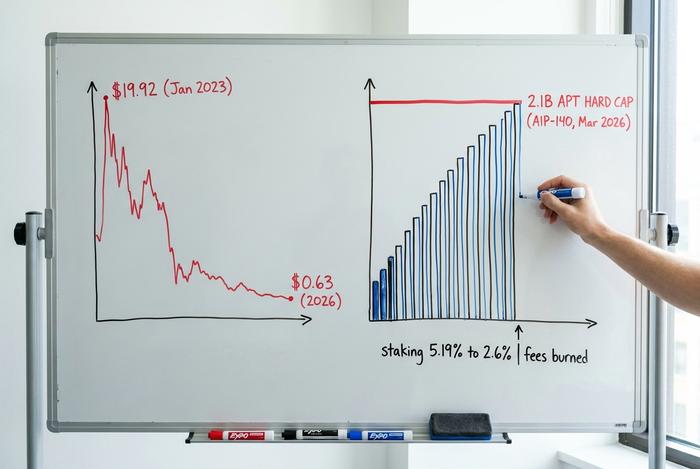
In March 2026, governance finally pulled the brakes. A proposal called AIP-140 passed overwhelmingly, 335.2 million APT voting yes against just 1,500 no, and it rewired the economics. There is now a hard cap of 2.1 billion APT, where before there was none. Staking rewards were cut from 5.19% to 2.6%. Gas fees rose tenfold but are now fully burned, and the Aptos Foundation permanently locked 210 million APT into staking. Together those changes point APT toward deflation instead of endless dilution. In a busy month, more APT could now be burned in fees than is minted in rewards, which would make the supply actually shrink. Whether the price reflects it yet is another matter.
| APT tokenomics (June 2026) | Figure |
|---|---|
| Price | ~$0.63 |
| Market cap | ~$528 million |
| All-time high (Jan 2023) | $19.92 (down ~97%) |
| All-time low | $0.61 (Jun 2026) |
| Circulating supply | ~832 million APT |
| Max supply (new cap) | 2.1 billion APT |
| Staking reward | ~2.6% / year |
Aptos in 2026: Stablecoins, RWA, and Web3
Here is the twist that the price chart hides completely. While retail traders walked away from APT, large institutions walked toward Aptos. Institutional adoption, in other words, ran in the opposite direction to the price.
Stablecoins and the money layer
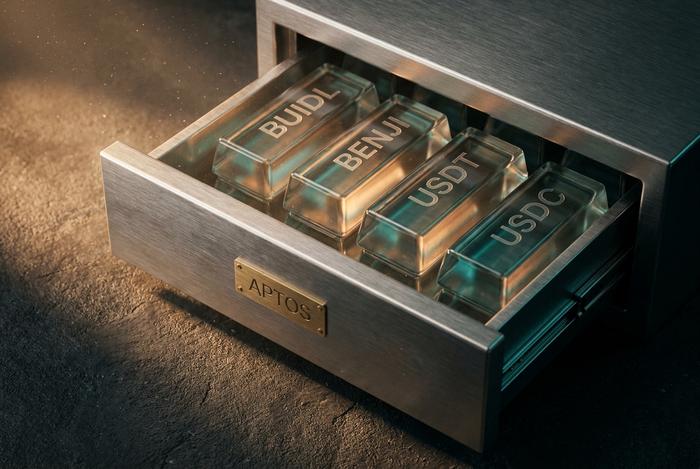
Aptos has quietly become a serious settlement layer for digital dollars. The stablecoin supply on the chain sits around $2 billion, up roughly 500% over the year, with both USDT and USDC live and active. Tether's USDT alone accounts for several hundred million dollars of that total. That is a real economy moving real money, and it is one area where Aptos clearly beats its rival Sui. Stablecoins are unglamorous, but they are exactly what payment and fintech firms look at first, which is part of why Aptos keeps showing up in institutional conversations its price would not predict.
Real-world assets and institutional rails
The bigger signal is who else showed up. BlackRock's tokenized money-market fund, BUIDL, holds roughly $585 million on Aptos. Franklin Templeton put its BENJI fund here too, and tokenized real-world assets on the chain have pushed past $540 million. On the regulatory side, Bitwise filed an S-1 for a spot APT ETF in March 2025, and US regulators classed APT as a digital commodity in March 2026, a meaningful clarity win. That label matters: it puts APT outside the securities crackdown that has left many rival tokens in legal limbo, and it is the kind of status an ETF needs to clear approval. Microsoft and Google Cloud have both partnered with Aptos, with Google Cloud even running a validator that helps secure the network, an operational commitment that goes well beyond a press release. Shelby, a decentralized storage network built with Jump Crypto, is also live on testnet, and beyond finance the chain has chased mainstream names too, counting NBC Universal among its earlier partners. None of this shows up in the token price. All of it shows up in the kind of partners a "dying" chain does not usually attract.
| Aptos institutional traction (2026) | Figure |
|---|---|
| Stablecoin supply | ~$2 billion (up ~500% YoY) |
| BlackRock BUIDL on Aptos | ~$585 million |
| Tokenized real-world assets | $540 million+ |
| Spot APT ETF | Bitwise S-1 filed (Mar 2025) |
| APT regulatory status | Digital commodity (Mar 2026) |
Is Aptos Still Relevant? Aptos vs Sui
Time for the honest verdict. Aptos is winning the institutional game and losing the token game, both at the same time, and that tension is the whole story.
The bull case is everything in the last section: $2 billion in stablecoins, a BlackRock fund, an ETF in the pipeline, and a supply that is finally capped. The bear case is just as real. APT is down 97% from its high. The 160,000 TPS headline collides with a real-world average near 130. And native DeFi value locked, which peaked around $1 billion in late 2025, has slid back toward the low hundreds of millions. What I can't reconcile is how a network this well-funded and this well-connected has a token the market treats as nearly worthless. Maybe the market is wrong. Maybe it is early.
The natural comparison is Sui, the other layer-1 spun out of Diem alumni using Move. The two are diverging rather than fighting. Sui leads on native DeFi, developer count, and on-chain trading volume, and it carries a larger market cap; its total value locked peaked around $2.6 billion in late 2025, well ahead of Aptos on that score. Aptos, in turn, leads decisively on stablecoins, roughly three to one, and on institutional real-world assets. The network draws fewer everyday developers, partly because Move is still a niche skill, but the partners it does land tend to be bigger names. The two even differ under the hood: Aptos uses an account-based data model while Sui organizes everything around objects, a choice that shapes how each one handles parallel transactions. Different bets, same family tree.
| Aptos vs Sui (2026) | Aptos | Sui |
|---|---|---|
| Market cap | ~$1.4B | ~$5.5B |
| Stablecoins | ~$2B | ~$715M |
| Native DeFi TVL | Lower | Higher |
| Main strength | Institutions, RWA | DeFi, developers |
How to Buy and Store Aptos (APT)
Getting APT is straightforward. It trades on major exchanges like Coinbase, OKX, and Bitget, and you can simply hold it for price exposure. For self-custody, the Petra wallet is the native Aptos wallet and the easiest place to store and stake. Delegate to a validator and you will earn around 2.6% a year after the 2026 rewards cut, which is modest by crypto standards. One honest caveat before you commit: insider unlocks still pressure the price through 2026, so the staking yield may not outrun the dilution. The heaviest unlocks taper after the October 2026 cycle, which is the moment many holders are quietly waiting for. Treat it as a long-term position, not a quick trade.
The Verdict: Is Aptos the Future of Web3?
Aptos quietly built the kind of institutional plumbing most layer-1s only put in their pitch decks: real stablecoin volume, a tokenized BlackRock fund, an ETF filing, and now a capped supply. The technology was never the weak point. The token was, and the 2026 reset is the first credible attempt to fix it. Whether it worked will take time to show, and patience is not a virtue crypto markets are known for. But APT will not re-rate on architecture or partnerships alone; it needs those institutional flows to turn into actual demand for the token. Most layer-1s chasing institutions are still writing blog posts about it; Aptos has a tokenized BlackRock fund and an ETF filing to point to instead. The chain may already be more relevant than its price suggests. If you are watching Aptos, watch the stablecoin and real-world-asset numbers climb, not the APT chart. That is where the answer will come from.