Stellar (XLM): The Lumens Payment Network Explained
Sending money abroad through a bank can still take days and skim off a painful cut in fees. Send the same value over Stellar? It clears in about five seconds for a fraction of a cent. That gap is the entire reason the network exists. Stellar is an open, low-cost rail for moving money across borders, and XLM, also called the Lumen, is the token that keeps it running. As of June 2026, Stellar (XLM) ranks among the larger crypto assets, with a market cap near $7.2 billion.
So what are you actually looking at? A working payments network, an unusual consensus design, and a token whose supply story most guides skip. Here is the whole picture, including how it stacks up against XRP and how to hold it.
What is Stellar and what is XLM?
Stellar is a payment network, and an open-source one, so its code is public for anyone to audit or build on. It is not a meme coin or a trading gimmick. It is infrastructure, closer to email for money than to a speculative chip. The network launched in July 2014. Its co-founder Jed McCaleb had already helped start Ripple before walking away to build this with Joyce Kim. A non-profit, the Stellar Development Foundation, steers it instead of a company chasing a share price. That non-profit root runs through everything, pushing the network toward open access and financial inclusion over shareholder returns, which is an unusual stance in the cryptocurrency space.
XLM, the Lumen, is the native token, and it has two plain jobs. It pays the micro-fees that keep spammers out, and it works as a bridge. Want to move Nigerian naira into Argentine pesos with no direct market between them? Stellar routes the value through XLM in the middle. So the Lumen is less something you hodl and more the grease in the machine. Holding it is a bet that the machine gets used. That distinction, I think, is what gets lost in most of the price talk.
How the Stellar network reaches consensus
Most blockchains agree on their ledger by burning electricity or locking up capital. Stellar does neither, and how it actually reaches agreement is the part nearly every explainer glosses over.
The Stellar Consensus Protocol (SCP)
Stellar runs on the Stellar Consensus Protocol, or SCP, designed by Stanford computer scientist David Mazières. Forget mining. Forget staking. There is no race to solve puzzles, and no pile of locked-up coins earning block rewards. SCP rests on a different idea entirely, Federated Byzantine Agreement, where nodes reach agreement through trust instead of raw resources.
Quorum slices and trust
In plain terms: each node picks a small group of other nodes it trusts, called a quorum slice. It accepts a transaction once the nodes in its slice agree. The slices overlap, like circles of people who each vouch for a few others, and that overlap lets the whole network land on one answer with nobody in charge. No miner decides. No whale decides. Agreement just ripples outward through the web of trust.
The trade-off is real. SCP drops the open, permissionless mining of Bitcoin and gets speed and near-zero energy in return. You are trusting that the important nodes are set up sensibly. Critics say that makes it less decentralized than proof of work. Supporters say it is decentralized enough to move money. Both have a point.
Speed and fees
The payoff is speed and cost. A new ledger closes about every five seconds, and when it closes, that is final, no sitting through a dozen confirmations. The base fee runs 0.00001 XLM per operation, per Stellar's docs, which is a sliver of a cent at any realistic price. Near-instant and low-cost. That is what makes Stellar work for small cross-border transfers that bigger, slower chains would price right out. Stack it against a traditional wire, one to five business days and $15 to $50 a go, and the difference stops being academic.
XLM tokenomics: supply, the burn, no staking
The XLM supply story is the one competitors leave out, and it shapes exactly what you can and cannot earn. So it is worth a minute.
XLM is capped at about 50 billion tokens, and that ceiling cannot rise. It was once much bigger. Back in November 2019 the Stellar Development Foundation burned roughly 55 billion XLM in one move, slashing the total from around 105 billion to about 50 billion overnight. A month earlier, the network had already voted to kill its old inflation mechanism for good.
That second decision carries a consequence people miss. There is no native staking on Stellar. None. No new XLM is ever minted, so there are no block rewards and no protocol yield for locking up coins. Any "XLM staking" an exchange dangles is its own product, not something the network pays out.
For a holder, the fixed supply cuts both ways. Your stake never gets diluted by fresh issuance, which is genuinely rare in crypto. But you also earn nothing just for holding; any gain has to come from the price, not from a yield.
| XLM at a glance | Figure (as of June 2026) |
|---|---|
| Price | ~$0.21 |
| Market cap | ~$7.2 billion |
| Circulating supply | ~33.8 billion XLM |
| Maximum supply | ~50 billion XLM (fixed) |
| Native staking yield | None (inflation disabled in 2019) |
| Base fee | 0.00001 XLM per operation |
What Stellar is used for: cross-border payments
Strip away the price charts and Stellar is, at heart, a rail for global payments. Its design choices all point at one job: cheap, fast cross-border transactions between currencies and countries.
The anchor model
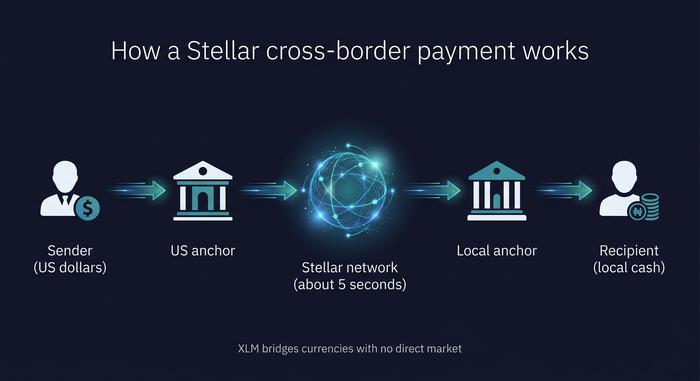
Stellar connects to the real world through anchors. An anchor is a regulated business, often a payment company or a financial services provider, that holds fiat currencies and issues matching tokens on Stellar that represent claims on that money. Deposit dollars with a US anchor, receive dollar tokens on Stellar, send them in seconds, and the recipient redeems them for local cash through an anchor on their end. Shared technical standards let different anchors plug into each other, and XLM bridges any gap where two currencies have no direct market. Picture a worker in the US sending wages home to Kenya: dollars go in through a US anchor, travel the network in seconds, and arrive as shillings that a relative collects as cash, with no chain of correspondent banks taking a cut at each hop.
USDC and MoneyGram
The model is not theoretical. Circle's USDC stablecoin went live on Stellar in February 2021, giving the network a dollar token backed one-for-one by reserves. And MoneyGram, the global money-transfer giant, launched a service in June 2022 that lets people turn cash into crypto and back out again at its physical locations using Stellar; the partnership was extended in 2026. That is real cash-in and cash-out, not a demo.
The built-in exchange
Stellar also has a decentralized exchange written directly into the protocol. Any asset issued on the network can be traded against any other through an on-chain order book, without a separate application. It is a quietly powerful feature for a payments network: the rails and the currency market live in the same place.
Soroban: smart contracts come to Stellar
For most of its life, Stellar could move and trade assets but could not run real programs the way Ethereum does. That ceiling lifted in March 2024, when Soroban, Stellar's smart-contract platform, went live on the main network. The Foundation backed it with a $100 million fund to pull in developers.
Soroban is built in Rust and compiles to WebAssembly, a deliberately modern stack. It cracks open lending, DeFi, and the tokenization of real-world assets, digital assets like tokenized bonds or commodities the network simply could not host before. Payments stay Stellar's core identity. But Soroban widens the Stellar ecosystem to a far broader class of financial activity, and it ends a limit that held for years: anyone who wanted programmable logic on Stellar used to have to build it elsewhere.
Stellar vs XRP: the key differences
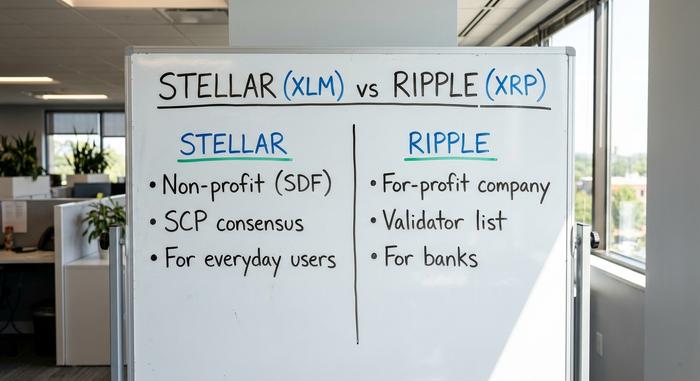
People mix up Stellar and XRP constantly, and you can see why: Jed McCaleb had a hand in both. He helped start Ripple, left, then co-founded Stellar, and the two networks chase the same prize of fast, cheap cross-border transfer. Their philosophies, though, run in opposite directions.
| Stellar (XLM) | Ripple (XRP) | |
|---|---|---|
| Run by | Non-profit (SDF) | For-profit company (Ripple) |
| Consensus | SCP (Federated Byzantine Agreement) | RPCA (validator list) |
| Main target | Individuals, financial inclusion | Banks and institutions |
| Token role | Fees + bridge asset | Bridge asset for institutions |
So neither is plainly better. Stellar tilts toward open access and ordinary users; Ripple sells into the banking system. If what you care about is who actually controls the network, that non-profit-versus-company split is the line that matters.
How to buy and store XLM (Stellar Lumens)
Buying XLM is easy. It trades on most big exchanges, Coinbase, Kraken, Binance, where a card or bank transfer gets you in. The real decision is where the coins live afterward.
For everyday use, a Stellar wallet like Lobstr or Trust Wallet does the job. For anything serious, a hardware wallet such as Ledger keeps your keys offline and far safer. One quirk catches newcomers: a Stellar account has to hold a small minimum balance, currently about one XLM, to stay active, so you can never quite empty it. And the usual rule applies, only louder. Guard your secret key, write the recovery phrase on paper, and treat anyone asking for that phrase as a thief. Self-custody makes you the bank. If that feels like a lot, parking a small amount on a trusted exchange is a fine way to start, just not the forever home for a stack you care about.
The risks and the real case for XLM
It is worth being even-handed here, because Stellar has both a genuine case and genuine problems.
The case for it is usage. Real companies move real money over Stellar, fees are negligible, finality is fast, and the supply is fixed with no inflation eating your holdings. Few crypto tokens can point to a working, named real-world job the way XLM can. The case against is competition and concentration. XRP targets the same payments market, banks are upgrading their own rails, and stablecoins are increasingly moving value directly without a bridge token at all. The Foundation also still holds a large share of XLM, which raises fair questions about sell pressure and decentralization. Regulators have circled payment-focused tokens before, too, and while Stellar has mostly stayed clear of the headlines, the whole category carries legal uncertainty that can swing prices quickly. And XLM trades far below its early-2018 peak near $0.93, a reminder that a useful network does not guarantee a rising token. None of this is financial advice; it is the ledger you should weigh yourself.
Is Stellar (XLM) worth your attention?
Stellar is one of the rare crypto projects with a clear, working purpose: moving money across borders for almost nothing, almost instantly. XLM is a bet on that rail winning real adoption, not on staking rewards, because there are none. If you find the payments thesis convincing and you understand you are buying into a crowded race, it earns a place on your radar. So here is the question to sit with before you buy: do you believe the world will settle more of its payments on rails like this one, or not?