Meta AI: Inside Meta’s Free Personal AI Assistant

You probably did not download Meta AI. It found you. One day there was a little blue circle in your WhatsApp search bar, then in Instagram, then in Messenger, and a personal AI assistant was just there, free, no signup, no fee. Meta says it reached a billion monthly users this way. Most of them never asked for it.
So here is the question worth asking, especially if you care about money: who pays for all this? A free assistant that runs on some of the most expensive computers ever built does not stay free by accident. The short answer is you do, with your data. The longer answer is stranger, and it loops back to something Meta tried once before and failed at spectacularly: building its own money. That second story is where Meta AI gets interesting.
What is Meta AI and how it works
Two different things share the name. Meta AI is the company's artificial intelligence research lab, born in 2013 as FAIR — the Facebook AI Research team that gave the world PyTorch, the framework half the industry now trains on. For years it was led by Yann LeCun, one of the handful of researchers who basically invented modern deep learning. Meta AI is also the chatbot you actually talk to. This article mostly means the second one, though the lab is the reason the chatbot exists at all.
The assistant runs on Llama, Meta's family of large language models, now on its fourth generation. Llama 4 uses a mixture-of-experts design, splitting work across smaller specialist models named Scout and Maverick instead of running one giant brain to generate every response. Meta also gives Llama away. The model weights are open enough that anyone can download and run them, and developers have done so more than 1.2 billion times as of 2025. That openness is unusual, and it matters later when we talk about how Meta makes money. Giving away the engine is only worth it if you sell something else.
Where to use Meta AI: apps and glasses
Ubiquity is the whole strategy. You do not go to Meta AI. It is already wherever you are.
Inside WhatsApp, Instagram, and Facebook
The assistant lives in the search bar and chat threads of WhatsApp, Instagram, Facebook, and Messenger. Ask it a question, draft a message, get a recommendation, settle an argument mid-thread. It even folds your feedback back into what it surfaces next. It is switched on by default once it reaches your account, which is exactly why that one billion monthly active users figure is so big. It is not a billion people who chose an app. It is a billion people who opened WhatsApp. That distinction matters whenever you read a headline about Meta AI's reach, because the number measures distribution, not demand.
The standalone Meta AI app and meta.ai
In April 2025 Meta launched a standalone Meta AI app built on Llama 4, plus a web version at meta.ai. The app has a Discover feed, a social wall where you can see and remix other people's prompts without posting anything yourself. It leans hard on voice, with a full-duplex mode that lets you talk over the assistant in real-time the way you would interrupt a friend. It also generates images and handles video-related tasks. The Discover feed is the telling part. Meta is trying to make AI prompting social, the way it once made photos and status updates social, because engagement is the thing it knows how to turn into money.
Ray-Ban glasses and Quest
Meta AI is the voice inside Ray-Ban Meta glasses and Quest headsets. These AI glasses put the assistant on your face instead of in your pocket. Look at a street sign in another country and ask for a translation. Ask what you are looking at. The glasses are Meta's bet that the assistant should ride along on your face, not just your phone, giving it a genuinely new perspective on your day. Whether that is convenient or unsettling depends on who you ask.
Is the Meta AI assistant really free?
Yes. There is no subscription, no per-message charge, nothing to enter a card for. Which should make you suspicious, because the compute behind this is not cheap.
Look at the numbers. Meta spent about $72 billion on capital expenditure in 2025, much of it on AI infrastructure, and guided to a staggering $125 to $145 billion for 2026. You do not lay out that kind of money to give away a chatbot out of kindness. The bill gets paid somewhere.
The first answer is advertising. Since December 16, 2025, Meta has used what you say to its AI to help target the ads you see across its apps, with users in the EU, UK, and South Korea exempted for now. Your chats are training data and ad signal at once. The second answer is business. Meta's business AI now handles around 10 million conversations a week between companies and customers, and that is the kind of thing companies will eventually pay for. A small paid consumer tier has been tested in a few markets too.
None of those lines is huge yet. Advertising is the one that scales, and it scales precisely because the assistant is everywhere and free. The more you chat, the sharper your ad profile, and the more an advertiser will pay to reach you. That is the flywheel — and a free Meta AI spins it faster than any paid product ever could.
Put plainly: the Meta AI assistant is free because you are not the customer. You are the inventory. That is a fine trade for a lot of people, and I make it myself most days without thinking twice. It is just worth naming, because it explains everything Meta does next, including its quiet return to crypto.
Before Meta AI: the Libra and Diem saga
To understand where Meta AI is going with payments, it helps to know where Meta already went — and got badly burned.
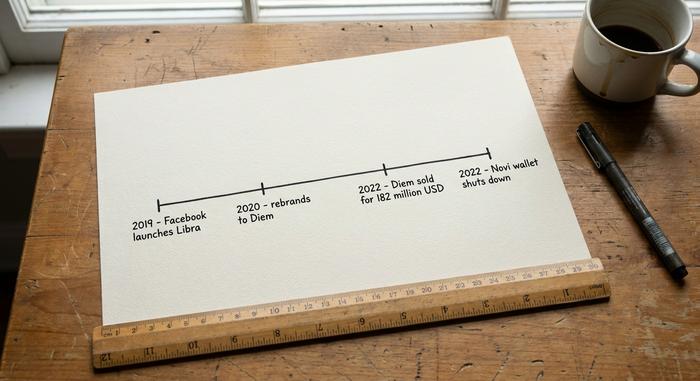
In 2019 the company, then Facebook, announced Libra, an ambitious global stablecoin meant to move value as easily as a text message. Governments panicked. The idea of a private company minting a currency for billions of users set off alarms in Washington, Brussels, and beyond. Regulators saw a threat to monetary sovereignty and refused to back down. The backlash was brutal. Within months the heavyweight backers Meta had lined up — Visa, Mastercard, PayPal, Stripe — quietly walked, unwilling to absorb the regulatory heat. A project pitched as banking the unbanked could not get past the central banks.
| Date | What happened |
|---|---|
| 2019 | Facebook unveils Libra, a global stablecoin |
| 2020 | Project rebrands to Diem, scales back ambitions |
| Jan 31, 2022 | Diem assets sold to Silvergate for about $182 million |
| Sept 1, 2022 | Novi, Meta's crypto wallet, shuts down |
Libra became Diem, shrank its scope, and still could not get clearance. In January 2022 the project sold its technology to Silvergate for roughly $182 million, a fire-sale ending. The Novi wallet that was meant to hold it closed months later. Meta walked away from crypto looking burned. Everyone assumed that was the end of it.
Meta AI vs ChatGPT, Gemini, and Copilot
Meta is playing a different game here. The goal is reach and price, not topping a benchmark chart.
| Assistant | Maker | Base model | Free tier | Where it lives |
|---|---|---|---|---|
| Meta AI | Meta | Llama 4 (open) | Yes, fully | WhatsApp, Instagram, glasses |
| ChatGPT | OpenAI | GPT | Limited | Own app, paid from $20/mo |
| Gemini | Gemini | Limited | Workspace, Android | |
| Copilot | Microsoft | OpenAI GPT | Limited | Windows, Office |
The others gate their best features behind a $20 monthly subscription. Meta AI does not gate anything, because charging you was never the plan. Its edge is that it is already inside the apps three and a half billion people open every day, and its model is open-weight, so developers build on Llama for free. The trade-off is honesty about data: a free assistant funded by ads sees more of you than one you pay for. For a casual user that is a fair deal. For anyone handling sensitive or commercial information, it is a reason to keep a paid, walled-off assistant in the toolkit too.

Stablecoins: inside the Meta AI money play
Here is the part almost no one is connecting to Meta AI. Meta is back in crypto, quietly, and this time it is shipping.
Meta's stablecoin comeback
In February 2026, CoinDesk reported that Meta was planning a stablecoin comeback, sounding out partners. Then it became real. On April 29, 2026, Meta began paying some creators in stablecoins, using USDC settled on Solana and Polygon, with Stripe handling the rails. The first creators were in Colombia and the Philippines. This is a pilot, not a global launch, and Meta has been careful not to oversell it. But the direction is unmistakable: the company that got crushed building its own coin is now using someone else's.
The change in strategy is the real headline. Libra tried to be the money itself. The 2026 version just moves money that already exists, over rails crypto built and regulators have slowly learned to tolerate. That is a far smaller target to shoot at. Meta gets a foothold in payments without asking anyone's permission to print a currency, which was always the part that doomed Libra in the first place.
Why stablecoins fit a 3.58 billion-user network
The logic is simple once you see the scale. Meta's apps reach about 3.58 billion people a day, and a huge share of its creators live in places where bank transfers are slow and cards barely work for payouts. Paying them in dollars normally means fees, delays, and currency headaches. A stablecoin lands in minutes, in dollars, anywhere. That is why Stripe's stablecoin rails, charging around 1.5%, suddenly make sense for Meta at a scale no one else can match.
There is a quiet irony here. Stripe was one of the partners that abandoned Libra back in 2019. Seven years later it is the company helping Meta move stablecoins after all, just without Meta having to mint the coin or carry the regulatory weight. Using USDC, an established dollar token, instead of a homegrown currency is the entire trick. Meta gets the rails it always wanted and lets someone else hold the legal risk. And none of this is exclusive to Meta. Any business can already accept crypto payments through a crypto payment gateway and pay or get paid the same way.
Is Meta AI good or bad? Privacy and ads
Both, honestly. It is genuinely useful and genuinely free, and that is not nothing. But the catch is real. Your conversations feed ad targeting, it is on by default, and you cannot fully strip it out of the apps you already use. Meta has also faced accusations that Llama was trained partly on pirated books. None of that makes Meta AI useless. It just means you should treat it like a colleague who reports back to the marketing department. Useful, but never quite private.
What Meta AI really costs all of us
Meta AI is free the way broadcast television was free. Someone is paying, and it is not you in cash. Today the price is your data, mined to sell ads. Tomorrow, if the stablecoin pilot grows up, Meta AI becomes the friendly front door to a payments network Meta has wanted for the better part of a decade. The assistant is the hook. The money rails are the business. So forget whether Meta AI is worth the price. The better question is whether you ever noticed you were paying it at all. Did you?